
National News
Ram Nath Kovind, Narendra Modi greet people on Janmashtami


President Ram Nath Kovind, Vice President M. Venkaiah Naidu and Prime Minister Narendra Modi on Monday greeted the people on the occasion of Janmashtami.
In a message, President Kovind said, “On the auspicious occasion of Janmashtami, I extend my warm greetings and best wishes to all the fellow citizens living in India and abroad.”
“The Janmashtami is a festival to dedicate ourselves to the life and teachings of Lord Shri Krishna. This festival is also an occasion to spread the message of Lord Shri Krishna that emphasised the virtue of righteousness, truthfulness and more on duty than reward. May this festival inspire us to assimilate all these eternal values,” Kovind said.
Prime Minister Narendra Modi greeted the people on the auspicious occasion of Janmashtami.
In a tweet, the Prime Minister said: “Greetings to you all on the auspicious occasion of Janmashtami.”
The Vice President Naidu also greeted the nation. “I convey my warm greetings and good wishes to the people of our country on the auspicious occasion of Janmashtami,” Naidu said.
He further stated: “Janmashtami celebrates the birth of Lord Krishna, who is worshipped as Lord Vishnu’s eighth incarnation. Lord Krishna’s eternal message, as expounded in the Bhagwad Gita, to discharge our duties with sincerity and without attachment to the outcomes, has been a source of inspiration for all of mankind.
“On this auspicious day, let us all resolve to perform our duties with utmost sincerity and to walk the path of righteousness,” Naidu said.
Naidu appealed to the citizens to celebrate the festival in a modest manner strictly adhering to Covid appropriate behaviour.
“While Janmashtami is usually celebrated across the country with great traditional fervour, we need to be cautious this year in light of the pandemic and celebrate the festival in a modest manner, strictly adhering to COVID-appropriate behaviour. May this Janmashtami bring peace, harmony and prosperity in our country,” Naidu added.
In view of the pandemic, the Delhi Police have asked the people to celebrate Janmashtami at homes and warned that those found violating Covid guidelines would face action.


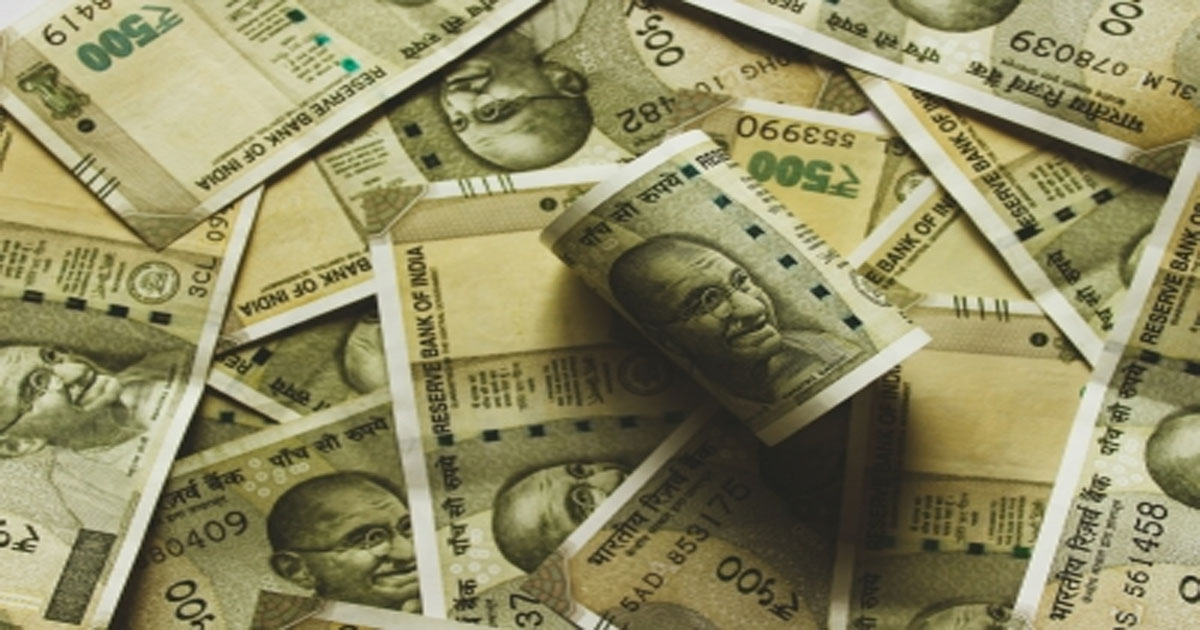
New Delhi, April 14: Indian agencies have reported a sharp rise in counterfeit currency seizures, pointing to a renewed push by organised networks to expand operations.
Investigators say the syndicate linked to Dawood Ibrahim, operating from Pakistan, is increasingly directing operatives in India to print fake notes locally instead of relying on cross-border smuggling routes through Pakistan and Bangladesh.
The trend points to a deliberate attempt to scale up production, with signs of a coordinated effort to undermine the Indian economy. Recent months have seen multiple seizures in border regions due to tighter security. At the same time, attempts to drop counterfeit currency using drones are being detected and intercepted with increasing frequency.
An Intelligence Bureau official said that the syndicate is now directing its operatives in India to print fake notes locally and circulate them within the market. They have been advised to keep operations small but frequent to maintain overall volume while avoiding attention.
“To reduce the risk of detection, members are also shifting bases regularly, making it difficult for agencies to track and pin down a single location,” the official added.
The route through the Bangladesh border has also become increasingly difficult for smugglers to use. Enhanced security measures have tightened surveillance, making it harder for operatives to push counterfeit currency into India.
Another official said the strategy now is to expand printing across multiple states, including Gujarat, Uttar Pradesh, Rajasthan, and Punjab. In the past, the syndicate had set up a localised unit in Malda, West Bengal, where high-quality counterfeit notes were produced and were difficult to detect.
“However, after the unit was uncovered, intensified action by agencies led to a sharp decline in operations,” the official said.
Another official said printing capacity in Malda has dropped by more than half after agencies, including the National Investigation Agency (NIA), intensified investigations and enforcement.
Officials added that efforts are underway to push in raw materials needed to set up fresh units to expand local production. If these consignments reach operatives in India, output could increase again. Even as the focus shifts to domestic printing, attempts to move counterfeit currency across the border using drones are expected to continue.
Last month, the Border Security Force (BSF) and Amritsar Police seized counterfeit currency worth Rs 2.5 lakh, which officials believe may have been a trial run. While drones have been intercepted carrying drugs, arms, and ammunition on several occasions, their use for moving fake currency has emerged as a growing concern.
Agencies said the syndicate is now relying on smaller consignments that are harder to detect on radar and surveillance systems. An official noted that operatives are adopting varied methods to increase the circulation of counterfeit notes.
Even as local production gathers pace, the use of drones is expected to continue. The broader objective, officials said, is to generate funds for terror activities and to inflict economic damage through the sustained circulation of fake currency.
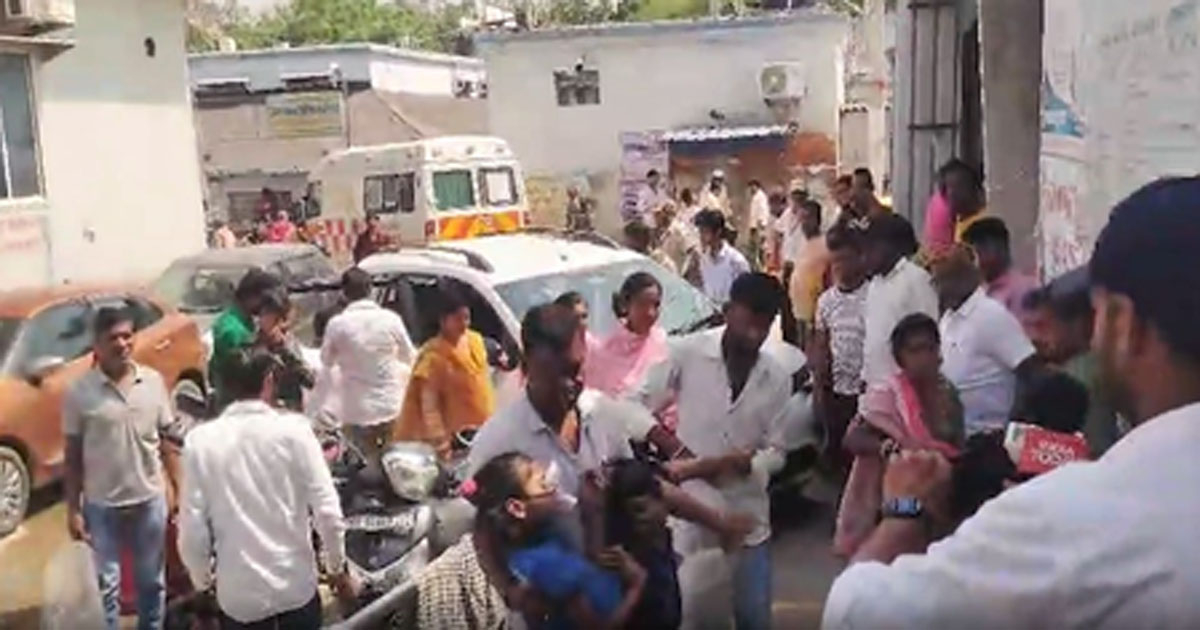
Patna, April 13: A nine-year-old girl was killed and over a dozen school children were injured after a school van overturned in Bihar Nawada district on Monday morning, police said.
The incident occurred on Kamlapur Road in the Govindpur block around 8.15 a.m. on Monday, where the vehicle reportedly lost control, plunged nearly 20 feet off the road, and overturned multiple times.
Eyewitnesses described a chaotic scene as the vehicle rolled repeatedly before coming to a halt. Local villagers — who were harvesting wheat in nearby fields — rushed to the spot upon hearing the crash. They played a crucial role in rescuing the children, pulling them out of the wreckage and transporting them to nearby hospitals.
According to the police, one student named Arohi Kumari (9) lost her life in this mishap, and two students have critical conditions at the moment. Other students are also under the close observation of doctors.
Preliminary findings suggest that the vehicle belonged to a private school. Local residents have alleged that the vehicle was overloaded beyond capacity. The vehicle has a capacity to transport 15 students, but it was carrying more than 25 at the time of the accident.
The eyewitnesses have also said that the driver of the vehicle was in an inebriated condition and travelling at high speed. These factors are believed to have contributed to the accident.
Police have reached the spot and initiated an investigation into the incident. Authorities are examining all aspects, including vehicle condition, driver’s conduct, and compliance with safety norms.
The Nawada police arrested the errant driver and lodged an FIR against him under the relevant sections of rash and negligent driving at the Govindpur police station. The district police will also conduct a medical check-up of the driver.
The incident has sparked widespread anger among villagers, who are demanding strict action against the school administration. Residents have emphasized the urgent need for enforcing safety regulations to prevent such tragedies in the future.
National News
‘Respected Modi ji, please save West Bengal’ poster at PM’s Asansol rally draws attention

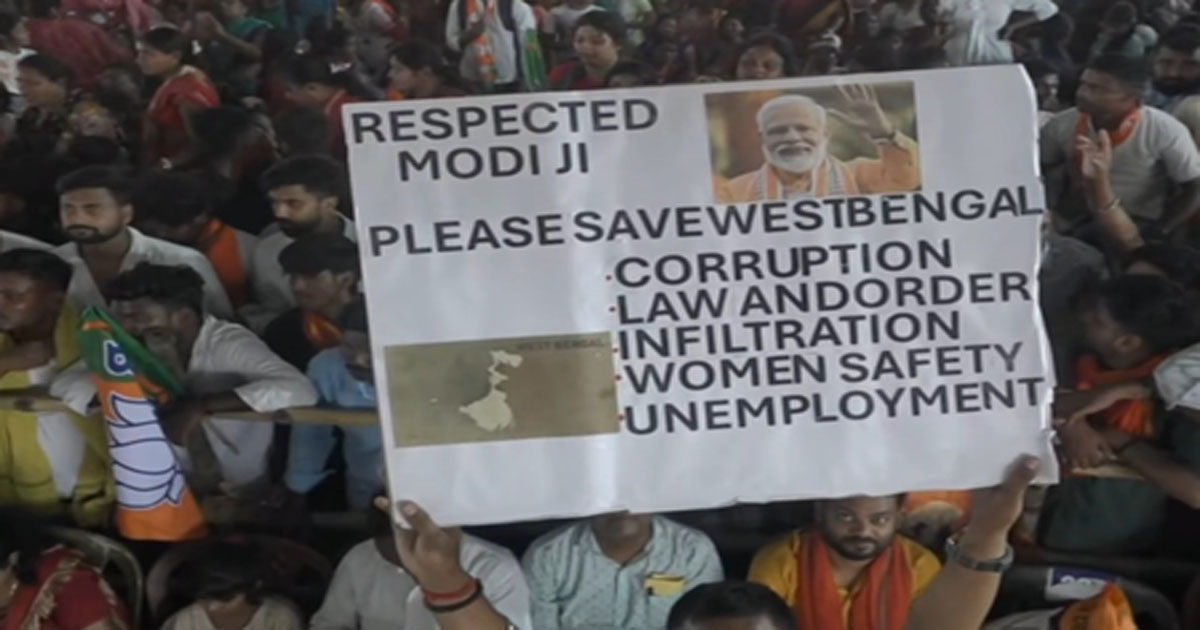
Kolkata, April 9: A striking visual emerged during Prime Minister Narendra Modi’s public rally in Asansol on Thursday, as a person in the crowd held up a poster appealing directly to the Prime Minister with the message, “Respected Modi ji, please save West Bengal.”
The moment came as the election campaign in West Bengal gathered momentum ahead of the upcoming Assembly polls.
The state is set to vote in two phases, scheduled for April 23 and April 29.
In the first phase, polling will take place across 152 Assembly constituencies, while the remaining 142 seats will go to the polls in the second phase.
The counting of votes is slated for May 4.
Amid loud cheers and slogans, the Prime Minister addressed a large and enthusiastic gathering in Asansol.
During his speech, attention briefly shifted to a person in the audience, who was seen holding up a poster featuring PM Modi’s portrait along with a map of West Bengal.
The poster prominently displayed the message, “Respected Modi ji, Please save West Bengal”, and also highlighted several issues faced by the public, including “Corruption, law and order, infiltration, women safety and unemployment”.
These concerns mirror the key themes on which the Bharatiya Janata Party (BJP) has been targeting the ruling Trinamool Congress government in the state.
The visual quickly stood out amid the rally, reflecting the charged political atmosphere as political parties intensify their campaigns in the run-up to the state elections.
Meanwhile, PM Modi launched a blistering attack on the Trinamool Congress government, claiming that the ruling-party-linked syndicate and mafia were looting the state’s resources and also warned that all those goons will be held accountable and answerable after the election results on May 4.
PM Modi, addressing his second election rally in Asansol, pinned the blame on previous dispensations from the Congress to Trinamool Congress for West Bengal’s “disgraceful decline from prosperity to deprivation” and said that the BJP’s good governance is the only solution for West Bengal’s burgeoning woes.
Accusing the Mamata Banerjee government of taking the state back to ‘dark ages’, the Prime Minister said that it is essential for West Bengal’s progress that the state is freed from Trinamool’s clutches.
“For Bengal’s progress, freedom from Trinamool is necessary, because while the entire country is moving ahead at a rapid pace, Trinamool is pushing Bengal backwards,” he added.
“Trinamool’s time is over. The next government will be a double-engine government of the BJP. After May 4, Bengal will enter a new era of development,” he said.
Making a fervent call to the electorate to choose their options wisely in the upcoming state polls, Prime Minister Modi said that the people of West Bengal won’t get fooled this time, as they want a “performing” government with a proven track record.

NESCO Drugs Party Crackdown: Kalyan-Based Builder Arrested After Hour-Long Police Standoff

Dawood-linked fake currency syndicate goes local as border routes tighten

Muslim Leaders Meet Mumbai Police Commissioner Deven Bharti, Seek Crackdown On Attackers Of Anti-Drug Campaigner; Demand Probe

Minor Scooter Collision Escalates Into Violent Mob Attack In Dongri; 3 Arrested, 1 Detained, Others Sought

Textile industry exports affected due to war in West Asia, Raees Sheikh demands package from the state

Dhurandhar 2 Box Office Collection Day 1: Ranveer Singh Starrer Takes An Exceptional Opening; Crosses ₹100 Crore Mark

Mumbai Police Busts Fake Apple Accessories Racket In Ghatkopar, ₹16.33 Lakh Goods Seized; Six Booked

Dhurandhar 2 Box Office Collection Day 9: Ranveer Singh Starrer Earns ₹41.55 Crore On Its Second Friday; Enters ₹700 Crore Club

Mumbai: 28-Year-Old Ghatkopar Woman Killed By Speeding Tanker While Crossing Road, Driver Arrested

Thane Horror: Man Slashed With Chopper In Naupada For Refusing ‘Vargani’, Caught On Camera
-

 Crime4 years ago
Class 10 student jumps to death in Jaipur
-

 Maharashtra2 years ago
Mumbai Local Train Update: Central Railway’s New Timetable Comes Into Effect; Check Full List Of Revised Timings & Stations
-

 Maharashtra1 year ago
Mumbai To Go Toll-Free Tonight! Maharashtra Govt Announces Complete Toll Waiver For Light Motor Vehicles At All 5 Entry Points Of City
-

 Maharashtra2 years ago
False photo of Imtiaz Jaleel’s rally, exposing the fooling conspiracy
-

 National News2 years ago
Ministry of Railways rolls out Special Drive 4.0 with focus on digitisation, cleanliness, inclusiveness and grievance redressal
-

 Maharashtra1 year ago
Maharashtra Elections 2024: Mumbai Metro & BEST Services Extended Till Midnight On Voting Day
-

 National News2 years ago
J&K: 4 Jawans Killed, 28 Injured After Bus Carrying BSF Personnel For Poll Duty Falls Into Gorge In Budgam; Terrifying Visuals Surface
-

 Crime1 year ago
Baba Siddique Murder: Mumbai Police Unable To Get Lawrence Bishnoi Custody Due To Home Ministry Order, Says Report