
National News
President lauds Govt’s welfare schemes, vaccination drive

President Ram Nath Kovind on Monday lauded the government’s performance in the last three years, specially during the corona pandemic.
Addressing the joint sitting of both Houses of Parliament at the start of the Budget session, the President said: “We are in the third year of the pandemic caused by coronavirus. In these years, the people have displayed profound faith in the democratic values, discipline and sense of responsibility.”
Hailing the government’s efforts during the pandemic, he said that the example of India’s capability in the fight against Covid-19 is evident in the ongoing Covid vaccination programme. India has surpassed the record of administering more than 150 crore vaccine doses in less than a year.
While more than 90 per cent adult citizens of the country have received the first dose of the vaccine, more than 70 per cent have been administered both the doses, President Kovind said. The government is also reaching out to the rest of the population through the “Har Ghar Dastak” campaign. Adolescents in the age group of 15 to 18 years have also been included in the vaccination programme from this month.
Highlighting the government’s efforts for the poor during the pandemic, President Kovind said that the government is providing free ration to every poor household every month under the “Pradhan Mantri Garib Kalyan Anna Yojana.” This is the world’s largest food distribution programme with an outlay of Rs two lakh sixty thousand crore reaching out to 80 crore beneficiaries for 19 months and now this scheme has been extended till March 2022.
More than two crore pucca houses have been provided to the poor under the “Pradhan Mantri Awas Yojana” as a result of the efforts made in the last few years. Under the “Pradhan Mantri Awas Yojana – Gramin,” 1 crore 17 lakh houses have been approved at a cost of about Rupees one and a half lakh crore in the last three years.
Launched with the aim of “Har Ghar Jal”, the Jal Jeevan Mission has brought about a huge difference in the lives of the people and nearly six crore rural households have been provided tap water connections despite the constraints imposed by the pandemic, he said on empowering the poor and enhancing their dignity.
To empower the farmers and the rural economy of the country, despite the pandemic, the government made record procurement to match the record production. The farmers produced more than 30 crore tonnes of foodgrains and 33 crore tonnes of horticulture produce in 2020-21.
It procured 433 lakh metric tonnes of wheat during the Rabi season benefitting about 50 lakh farmers. A record quantity of about 900 lakh metric tonnes of paddy was procured during the Kharif season, benefiting 1 crore 30 lakh farmers.
The government has endeavoured to open new avenues of prosperity for the farmers by launching “Kisan Rail Seva,” the President said. During the Corona period, Indian Railways operated over 1,900 Kisan Rails on more than 150 routes to transport perishable food items like vegetables, fruits and milk, thereby transporting about 6 lakh metric tonnes of agricultural produce. Under the “PM-Kisan Samman Nidhi,” Rupees 1 lakh 80 thousand crore have been provided to more than 11 crore farmer families.
Giving an impetus to the rural economy, the banks have extended financial help to the tune of Rs 65,000 crore to more than 28 lakh Self-Help Groups in 2021-22. This is four times the amount extended in 2014-15. The government has also provided training to thousands of members of the women self-help groups and made them partners as “Banking Sakhi”.
“A provision has also been made for the Gender Inclusion Fund in the National Education Policy to promote learning capability among our daughters. It is a matter of happiness that all the existing 33 Sainik Schools have started admitting girl students,” Kovind said, adding that the government has also approved the admission of women cadets in the National Defence Academy.
The first batch of women cadets will enter the NDA in June 2022. With the policy decisions and encouragement of my government, the number of women personnel in various police forces has more than doubled as compared to 2014.
On implementation of a new National Education Policy across the country, Kovind said it was part of the government’ endeavour to give shape to the resolve and potential of “Atmanirbhar Bharat.” Local languages are also being promoted through the National Education Policy.
Emphasis is being laid on conducting important entrance examinations for undergraduate courses in Indian languages as well. This year, 19 engineering colleges in 10 states will start teaching in six Indian languages, he added.
“We saw the capability of India’s youth power in the Tokyo Olympics. Giving its best-ever performance, India won seven medals. In Tokyo Paralympics too, India won 19 medals and set a record.”
With a firm belief in global brotherhood, India extended a helping hand when people in neighbouring Afghanistan were in distress due to political instability and launched ‘Operation Devi Shakti’ to airlift the Indian citizens in Afghanistan and minorities there in danger, including Afghan Hindus, Sikhs and others.
Even in such situations, “our government respected the religious emotions of our Sikh community” and successfully brought back the two copies of holy Guru Granth Sahib. Now India has been supplying corona vaccines, life saving drugs and grains to Afghanistan on a humanitarian basis, the President stated.
Noting that India has again emerged as one of the fastest growing economies in the world, he said that the GST collection has consistently remained above Rupees one lakh crore during the last several months. Inflow of 48 billion dollars in the first seven months of the current financial year is a testimony to the belief the global investor community has in India’s growth story. India’s foreign exchange reserves today exceed 630 billion dollars. During April to December 2021, goods exports stood at 300 billion dollars or more than Rupees 22 lakh crore, which is one-and-a-half times more than the corresponding period of 2020.
In order to protect MSMEs from crisis and ensure adequate availability of credit during the Corona period, the government started a scheme for guaranteed Collateral Free Loans of Rupees 3 lakh crore. It is evident from the recent studies that this scheme has given a fresh lease of life to 13 lakh 50 thousand MSME units and also secured 1 crore 50 lakh jobs.
In June 2021, the government enhanced credit guarantee from Rs 3 lakh crore to Rs 4.5 lakh crore, Kovind stated.
As against 90,000 kilometres of national highways in March 2014, today India have more than 1 lakh 40 thousand kilometres of national highways. Under the Bharatmala Project, construction of more than 20,000 kilometres of highways is in progress with an outlay of about Rs 6 lakh crore, including 23 green expressways and green-field corridors.
The government is committed to sustainable development of all the states of the North East – Arunachal Pradesh, Assam, Manipur, Meghalaya, Mizoram, Nagaland, Sikkim and Tripura. In these states, basic amenities and economic opportunities are being developed at every level. Rail and air connectivity are no longer a dream for the people of the North East, they are now able to experience them in reality.
A new airport is being set up at Hollongi, Itanagar. A modern new terminal has recently been opened at the Maharaja Bir Bikram Airport in Tripura. This development of North East will prove to be a golden chapter in India’s growth story. Efforts of the government to establish peace in the North East have attained historic success. Just a few months ago, a settlement was reached between the Central Government, the state government of Assam and the Karbi groups to end the decades-old conflict in Karbi Anglong.


National News
‘Took time to get used to Indian food but learnt slowly’: Sonia Gandhi shares her love for India’s cuisines

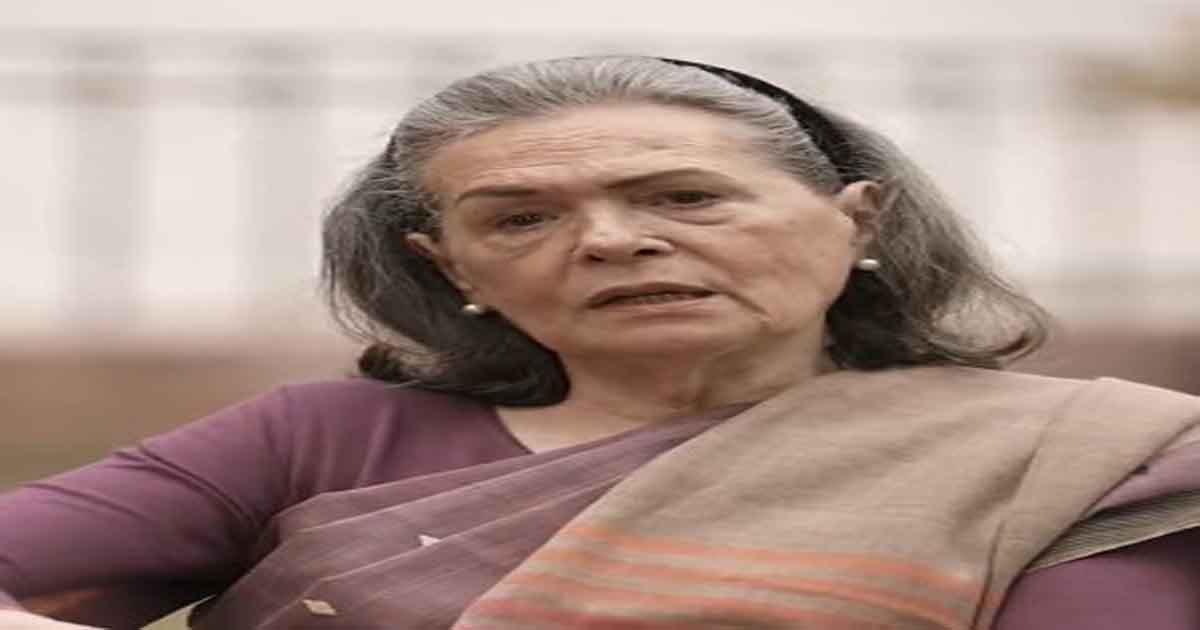
Congress Parliamentary Party (CPP) Chairperson Sonia Gandhi has shared her love for Indian food, saying that though she initially took time to adjust, she eventually “fell in love” with cuisines from different parts of the country.
This comes a day after her memoir “Belonging: A Journey of Love” hit bookstands worldwide.
A video posted on the official X account of the veteran Congress leader on Wednesday shows her, along with her daughter and party MP Priyanka Gandhi Vadra, interacting in the garden of 1, Safdarjung Road residence of the late former Prime Minister Indira Gandhi.
During the conversation, Priyanka Gandhi also made her mother fondly recall that the latter had even made the Gujarati dish ‘Khaandvi’ for her and her brother, Leader of the Opposition in the Lok Sabha, Rahul Gandhi, during their childhood.
Sharing her fondness for Indian dishes, Sonia Gandhi said: “I love Bengali food. Believe it or not, I love Gujarati food, from Surat.”
However, given her Italian roots, Gandhi said: “It took me time to get used to Indian food. It was difficult for me to enjoy Indian food right at the beginning. I didn’t know how to cook when I came. But later, slowly, I learned.”
The senior leader said that now she loves having kababs, chicken tikka, tandoori chicken, dal makhni, Kashmiri kofta and the ‘haakh’.
To this, Priyanka Gandhi added: “…and ‘Daal Chawal’, we used to have it every day.”
Sonia Gandhi further said: “From the day I came to this house till today, the only dal cooked is ‘arhar ki daal’, nothing else.”
The Wayanad MP then asked her mother about the Gujarati cuisine ‘Khaandvi’ that the latter used to make when the Gandhi siblings were younger, saying: “Didn’t you use to make Khaandvi while we were kids?…can you imagine?”
The CPP Chairperson then said on a lighter note, “Making Khaandvi is easy”.
Further, Priyanka Gandhi recalled: “But, Dadi couldn’t cook,” referring to late Prime Minister Indira Gandhi.
However, Sonia Gandhi asserted that even though her mother-in-law couldn’t cook, she had a very acute sense of how to make a dish better.
“She knew exactly how to improve something,” she said.
Meanwhile, in the post accompanying the video, the veteran leader shared she fell in love with her husband, former Prime Minister late Rajiv Gandhi, while looking for a good meal.
“Food has always had a special place in my story. It was while looking for a good meal that I met Rajiv, and fell in love,” Sonia Gandhi said.
She added: “Years later, India came to me the same way, one meal at a time. At first the variety amazed me and the spice scared me. Now dal chawal is the taste of home, and I can’t go a day without it.”
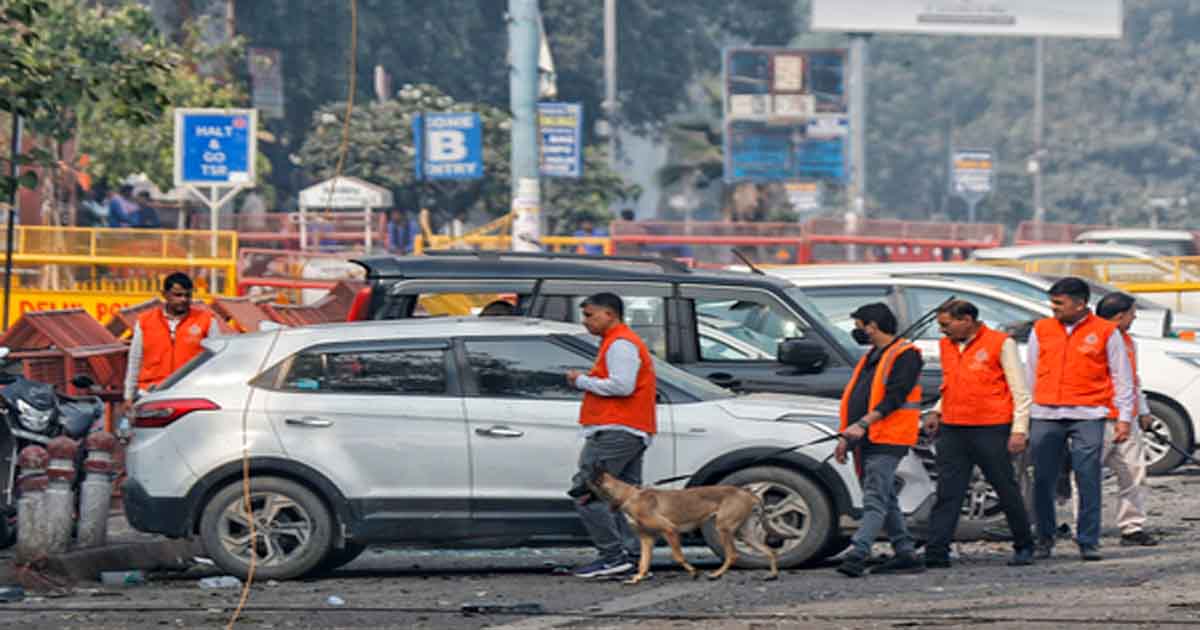
The investigation into last year’s Red Fort car blast in Delhi unearthed several crucial details about the attack and the manner in which the Faridabad module had been established.
Investigators were particularly struck by the meticulous planning behind the attack and the precision with which members of the Faridabad module had carried out their assigned tasks.
The members of the module not only managed to stay under the radar of security agencies but also procured thousands of kg of ammonium nitrate without attracting suspicion.
Despite the elaborate planning, however, the Red Fort blast was triggered prematurely, and the execution of the attack ultimately fell short of what the perpetrators had intended.
An official said that the bigger picture that one needs to look into is the radicalisation aspect.
“The module was not merely planning a major attack aimed at causing mass casualties. It had a much larger agenda, which was to overthrow the government in New Delhi,” the official added.
The literature recovered from the Faridabad module, also known as the ‘Doctor’s module’, along with its plans, points to an agenda that went far beyond carrying out terror attacks.
According to the official, the module also intended to impose Sharia law in India. To achieve this objective, its members had allegedly planned to overthrow the Union government, the official said.
Another official said that the mindset of these doctors part of the Faridabad module was dangerous.
“However, the bigger danger is that many more within the country may try and replicate what this module did or may be in the process of doing so,” the official said.
Such radicalisation modules tend to create a chain effect.
Outfits such as the Islamic State and Al-Qaeda inspire such modules to come up in large numbers across the country.
These terror groups are aware that to throw out a government and implement the Sharia law cannot be undertaken by one single module. The idea is to have scores of such modules across the country.
Although these modules would not be interconnected their goals would remain the same, the official said.
An Intelligence Bureau official said that one must also take into account the modus operandi of the Faridabad module.
“They were not just planning on creating an uprising by relying heavily on propaganda material. This group operated in seclusion and planned on a series of deadly attacks across North India. The idea was to inflict maximum damage and then pressurise the government to step down,” the official added.
Post the multiple blasts, such modules usually tend to focus on messaging.
The attack coupled with propaganda makes a module extremely dangerous. Such a modus-operandi also tends to stress out the security mechanism in the country.
Now imagine if multiple such modules are in operation and carry out similar activities simultaneously.
They manage to cover the length and breath of the country, while also posing an immense challenge to the security agencies, the official said.
With their ground operations severely curtailed, the Islamic State and Al-Qaeda have increasingly focused on region-specific radicalisation efforts, aiming to establish Faridabad-style modules in different pockets across states.
These modules are designed to function independently, without any operational links with one another. This makes it difficult for investigators to establish connections between them and trace the wider network behind their activities.
In many ways, such modules resemble lone actors. Their members operate without direct contact with other groups, acquire the skills required to manufacture explosives on their own and independently arrange the materials needed for their activities.
They are also largely self-funded, leaving investigators with little or no financial trail to follow. Modules inspired by the Islamic State and Al-Qaeda have been structured to function much like lone actors, thereby making detection and investigation more challenging, an official said.
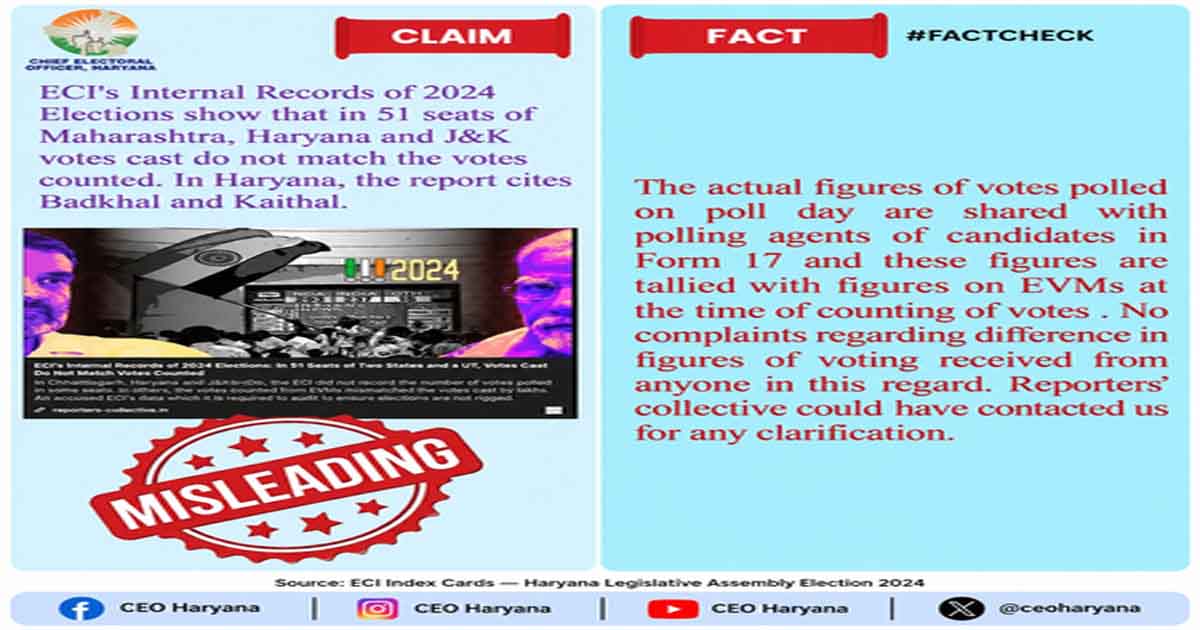
The Chief Electoral Officer (CEO), Haryana, has termed a media report alleging discrepancies between votes polled and votes counted in 51 Assembly constituencies during the 2024 elections as misleading, stating that the actual polling figures were shared with candidates’ polling agents and subsequently tallied with the votes recorded in Electronic Voting Machines (EVMs).
In a fact-check clarification issued on its official social media platforms, the CEO, Haryana, responded to a media report, which claimed that internal records of the Election Commission of India (ECI) showed mismatches between votes cast and votes counted in 51 seats across Maharashtra, Haryana, and Jammu and Kashmir.
The report had specifically cited Badkhal and Kaithal constituencies in Haryana.
The CEO said the actual figures of votes polled on polling day are shared with the polling agents of candidates through Form 17. These figures are then tallied with the figures recorded on EVMs at the time of counting.
“No complaints regarding differences in the figures of votes received from anyone in this regard. Reporters’ Collective could have contacted us for any clarification,” the CEO said.
Citing the ECI’s official index card for the Kaithal Assembly constituency, the CEO provided a breakdown of the total electorate and votes polled to counter the allegations.
According to the index card, Kaithal had 2,23,449 registered electors, while the total number of votes polled through EVMs stood at 1,67,285. In addition, 1,566 valid postal votes were recorded, taking the total number of votes polled, including postal ballots, to 1,68,851.
The CEO said the report had attempted to mislead readers by claiming that the ECI counted 1,67,070 more votes than were cast, whereas the actual number of votes polled, including postal ballots, was 1,68,851.
The index card also recorded 512 votes deducted from EVM votes on account of test votes, rejected votes and other reasons, while 1,427 valid postal votes were counted. The total valid votes polled stood at 1,68,200.
The CEO Haryana’s clarification comes amid questions raised over discrepancies in election data and the accuracy of figures recorded during the 2024 Assembly polls. The authority maintained that the official polling records and the figures available on the ECI website provide the correct account of votes polled in the constituency.

Two men arrested for forcibly pulling a woman’s gold chain and fleeing in Kandivali, a case of theft registered against both

‘Took time to get used to Indian food but learnt slowly’: Sonia Gandhi shares her love for India’s cuisines

Red Fort car blast probe exposes blueprint for spread of terror modules across India

‘Conspiracy, not accident’: NCP on Ajit Pawar death

Shehzad Poonawalla presents winning trophy for ‘Rise and Fall 2’ to Maharashtra CM, Devendra Fadnavis

Rahul, Cong ecosystem want to force regime change: BJP after Neha Bora praises B’desh Gen-Z protest

BJP pays tribute to ex-President Abdul Kalam, recalls his enduring influence on generations of India’s youth

Attack on democratic rights: INDIA Bloc leaders on detentions of anti-ECI protestors

Congress trying to protect 3 crore Bangladeshi infiltrators in voter list: HM Shah

Online betting: ED conducts searches at 20 premises in Mumbai, Pune, Hyderabad
-

 Crime4 years ago
Class 10 student jumps to death in Jaipur
-

 Maharashtra2 years ago
Mumbai Local Train Update: Central Railway’s New Timetable Comes Into Effect; Check Full List Of Revised Timings & Stations
-

 Maharashtra2 years ago
Mumbai To Go Toll-Free Tonight! Maharashtra Govt Announces Complete Toll Waiver For Light Motor Vehicles At All 5 Entry Points Of City
-

 Maharashtra2 years ago
False photo of Imtiaz Jaleel’s rally, exposing the fooling conspiracy
-

 National News2 years ago
Ministry of Railways rolls out Special Drive 4.0 with focus on digitisation, cleanliness, inclusiveness and grievance redressal
-

 Maharashtra2 years ago
Maharashtra Elections 2024: Mumbai Metro & BEST Services Extended Till Midnight On Voting Day
-

 National News2 years ago
J&K: 4 Jawans Killed, 28 Injured After Bus Carrying BSF Personnel For Poll Duty Falls Into Gorge In Budgam; Terrifying Visuals Surface
-

 Crime2 years ago
Baba Siddique Murder: Mumbai Police Unable To Get Lawrence Bishnoi Custody Due To Home Ministry Order, Says Report