
National News
Begin the change from Gujarat, Telangana leaders dare Amit Shah

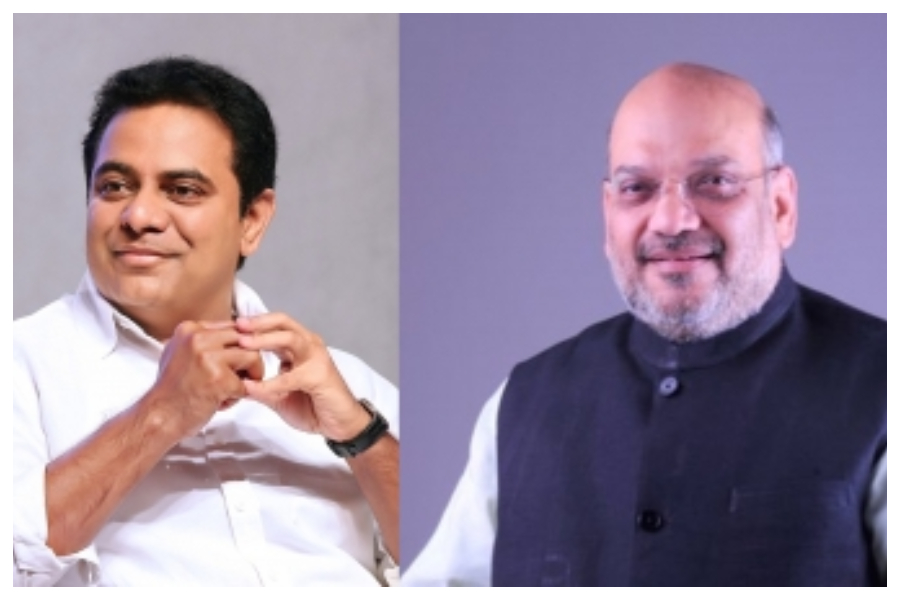
Telangana is considered as mini-India because of its true cosmopolitan nature and the language sentiments here not being as strong as in Tamil Nadu or Karnataka, but Union Home Ministers Amit Shahs recent statement that Hindi should be the alternative to English for communication among Indians has drawn the ire of all.
Political parties and academicians see this as an attempt to impose a particular language on India though unity in diversity is the country’s strength. They warn that this regional chauvinism will boomerang.
Some political leaders have slammed the BJP for what they call its double-standards on the language issue, and dared the party to start imposing Hindi from Gujarat.
The ruling Telangana Rashtra Samithi (TRS) has come down heavily on the BJP for doing politics over language, saying the saffron party wants to decide not only what one should eat and wear, but also the language one should communicate in.
“Why don’t we let people of our great nation decide what to eat, what to wear, who to pray to and what language to speak,” said TRS working President K.T. Rama Rao, who warned that language chauvinism or hegemony will boomerang.
He also believes that rejecting English will be a great disservice to the youngsters of this nation who have global aspirations.
“Already our students in different states are missing the English language to be competent. While it is the wish and will of citizens to practice what they want, imposition is not right. After Amit Shah spoke, we have seen on national channels many BJP MPs toeing the line of the �one nation one language’ theory. That’s more dangerous than the agenda Amit Shah has brought. This questions the identity of states and different regional languages,” TRS leader Manne Krishank told IANS.
He also believes that the BJP is adopting dual standards on the language issue.
“In February, the Gujarat government took a decision that all sign boards should be in Gujarati. The government of India ruled by the BJP is pushing states that they should practice Hindi, whereas Gujarat is talking about Gujarati. Instead of preaching states down south, they should start from Gujarat if they really believe in practicing what the preach. Let them start from Gujarat,” said Krishank, who is the convenor of the social media wing of the TRS and also chairman of the Telangana State Mineral Development Corporation (TSMD).
“It’s an absolutely uncalled for remark by Amit Shah against the very spirit of the Indian Constitution. Not just the federal concept of the Constitution, but the very spirit of unity in diversity. Enforcing a particular language upon the entire country, particularly in southern India, is an attempt of expansionist imperialism.
“I mean, they want to somehow take control of the region and therefore they are using language now. But I think India is mature enough to understand this dubious politics of region, religion and now again language. This is essentially to establish their dominance,” said senior Congress leader Dasoju Sravan Kumar.
He believes there is no language problem in almost the entire south India.
“You don’t see language problems, particularly in the context of Telangana, where there are people who speak Urdu and Hindi. There are people who come from all over India — Gujaratis, Parsis, Rajasthanis, Tamilians, Malayalis and others.
Telangana is like a mini-India where people come from various religions, regions and languages. Per se, this kind of Hindi enforcement by the government of India will only boomerang and Telangana will strongly extend the rebuttal,” said Sravan Kumar, who is a national spokesman of the Congress.
“Language is part of the DNA. How can my DNA be changed just because Amit Shah enforces something? Everybody speaks their mother tongue based on culture, history and traditions. And you suddenly come and say you should speak in Hindi. First you change Gujaratis, and then come to us,” added the Congress leader.
Academician K. Nageshwar has also found fault with the Union minister’s statement.
“Diversity of language, culture, tradition, belief, faith, customs and an underlying unity is India’s true soul. Don’t convert India into a hegemonic regimented society,” said Nageshwar.
He reminded Amit Shah that there is no single language of India. There are several languages of India and linguistic diversity demands equal treatment of all.
The former member of legislative council observed that promoting a language that advantages one set of Indians over others is a recipe for division over diversity.
He wondered why can’t Amit Shah talk of making any south Indian language mandatory in Hindi-speaking states to forge national unity.
“It’s my choice. Let me speak what I want to speak. Why are you forcing me to speak Hindi? It makes no sense. If somebody wants to learn, they are anyway learning. These days there is so much awareness.
“Tamilians are also learning Hindi if they like and if they think that it helps them in business. Language is not a national identity. Language is a medium of communication,” said Sravan Kumar, who also served as assistant professor in human resource management at the Institute of Public Enterprise.
“If you go to Gujarat, how many people speak Hindi there? They speak Gujarati. How many people in Rajasthan speak Hindi? They speak Rajasthani. In Maharashtra they speak Marathi. Language enforcement is essentially some kind of expansionist thinking, imperialist thinking. This is our language and all should practice it. This is a sort of tyrannical and dictatorial tendency,” he said.
Krishank is of the view that the talk of Hindi as alternative language to English is BJP’s style of politics.
“First food, then dress and now language. We have seen it in Karnataka. Hijab, Hilal and now Hindi. They are doing triple H politics,” he remarked.
The TRS leader also reminded Amit Shah that Hindi is spoken in different states differently.
“Someone from Bihar speaks one Hindi, someone from Uttar Pradesh speaks another Hindi. We in Hyderabad speak Deccani which is a different dialect from Hindi. If their �nahin’ is �na’ for someone, it is �nakko’ for me. It’s �Bhao’ in Maharashtra and it’s �Bhai’ in another place.
“More than necessity or anything, comfort level has to be seen. For instance, when Nirmala Sitharaman speaks in Parliament in English, it is understood. We appreciate that she is a good orator, but when she speaks Hindi, she makes so many mistakes. It looks as if she is speaking some other language. This is how it is.
“If tomorrow a Hyderabadi goes and speaks, it will be totally different. In Bollywood movies, Hyderabadi Hindi is shown for comedians. What they are trying to do is mere politics. Imposition of politics through language,” Krishank said.
He believes that it also matters with whom one is communicating.
“If we are visiting another state, whom we are communicating with? If I am communicating with an auto rickshaw driver it is different, but what if I am going for a meeting of corporate heads. Are they going to make it mandatory for every corporate industry to work in Hindi? If I am going to an MNC in Mumbai to work, will I go and give an interview to the MD in Hindi,” he asked.


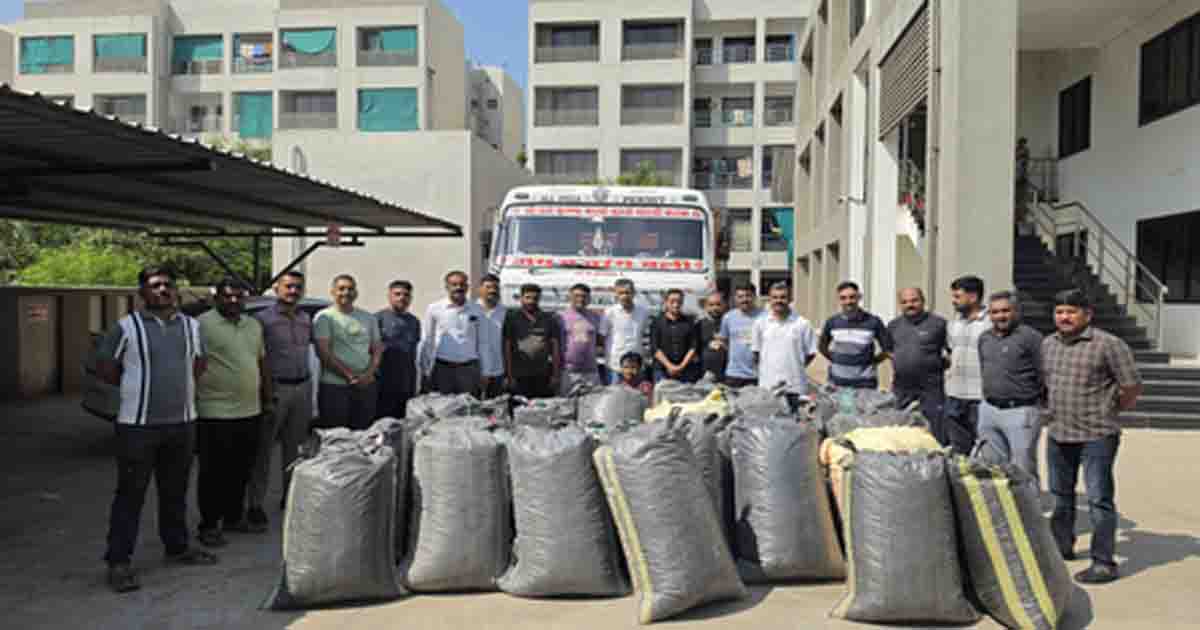
Ahmedabad, Oct 10: The Ahmedabad Rural Police have seized 696.94 kg of poppy husk concealed beneath steel coils in a truck travelling from Nagpur in Maharashtra to Sanand in Gujarat and arrested the driver, while two other suspects have been identified in connection with the alleged interstate trafficking operation.
The narcotic substance, packed in 36 sacks, was valued at Rs 1.045 crore, while the total value of the seized property, including the truck, steel coil, mobile phones and cash, was estimated at Rs 1.47 crore, police said on Saturday.
The joint operation was conducted by the Special Operations Group (SOG) and the Anti-Narcotics Wing (ANW) of Ahmedabad Rural Police following a tip-off received by SOG Sub-Inspector I.K. Sheikh that a truck-trailer was carrying a large consignment of poppy husk concealed beneath steel coils.
The coils were reportedly being transported from Nagpur for delivery to Tata Motors in Sanand, said the police.
Acting on the information, police teams tracked the vehicle and received specific information that it would pass along the Kheda-Dholka highway on the night of October 8. The teams intercepted the vehicle and inspected its cargo.
When the tarpaulin covering the steel coils was removed, they found 36 black and yellow sacks containing the suspected narcotic substance concealed beneath the coils.
Police identified the arrested driver as Bhairaram Tarad, 33, a resident of Barmer district in Rajasthan.
According to the police, the consignment had allegedly been loaded into the trailer near Jhabua in Madhya Pradesh by a person identified as Santosh, who is now wanted in the case.
The driver was allegedly promised freight charges of Rs two lakh to transport the consignment to its intended recipient in Gujarat.
Police have also detained Jetaram Kadwasha, a resident of Samakhiyali in Kutch district, who is suspected of being the receiver who ordered the consignment. He is being questioned, while efforts are underway to apprehend Santosh.
A case has been registered at Dholka Rural Police Station under Sections 8(c), 15(c) and 29 of the Narcotic Drugs and Psychotropic Substances (NDPS) Act.
Further investigation is underway to establish the source of the consignment and the roles of the other suspects.
The seized property includes the truck-trailer valued at Rs 20 lakh, a steel coil worth around Rs 22.22 lakh, two mobile phones valued at Rs 7,000 and cash amounting to Rs 32,010, in addition to the poppy husk.
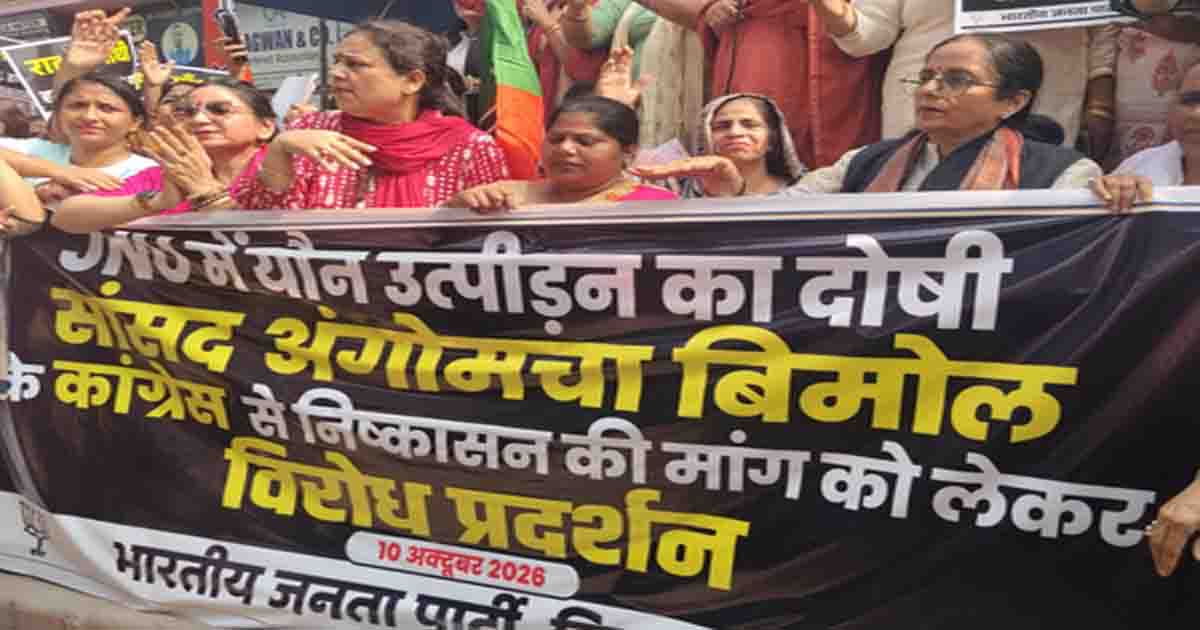
New Delhi, Oct 10: The Delhi BJP Mahila Morcha staged a protest on Saturday to demand the expulsion from Congress and the arrest of MP and JNU Professor Angomcha Bimol Akoijam accused of sexual harassment of female students.
A large number of Mahila Morcha workers gathered near the Laxmi Nagar Metro Station in East Delhi, and raised slogans against the MP.
As soon as they began marching towards the Congress headquarters on Deen Dayal Upadhyaya Marg, the Delhi Police detained them after they had walked only a short distance and took them to Shakarpur Police Station, a Delhi BJP leader said.
The protest was led by BJP Mahila Morcha National Secretary and Rajya Sabha MP Sangeeta Yadav and Delhi BJP General Secretary Yogita Singh, in the presence of State Vice President Sarika Jain, Mahila Morcha President Archana Gupta and In-charge Aarti Mehra.
Rajya Sabha MP Sangeeta Yadav said, “We are standing here to defend the dignity of daughters. At a prestigious educational institution like JNU, a person accused of sexually harassing female students under the guise of being a professor, and who is also a Congress MP continues to move around freely.”
“The Congress is the most glaring example of an ‘anti-women’ mindset. A party that cannot protect its daughters has no right to remain in power,” she added.
“We (BJP) demand his (Akoijam’s) immediate expulsion from the party (Congress) and immediate arrest. The BJP Mahila Morcha will not remain silent. The slogan of ‘Beti Bachao, Beti Padhao’ will be meaningful only when those responsible are punished. Ensuring the safety of every daughter in Delhi is our responsibility,” she said.
Delhi BJP General Secretary Yogita Singh said that the Congress has always treated women merely as a vote bank.
“A sitting MP is accused of sexually harassing female students at JNU, and the Congress is shielding him. The party should be ashamed,” she added.
“How long will the dignity of our daughters continue to be violated? How long will the Congress protect its leaders accused of wrongdoing?” Yogita Singh asked.
“If Angomcha Bimol Akoijam is not arrested today, no other daughter will be safe tomorrow. Our struggle will continue from the streets to Parliament. We demand justice, not compromise,” she said.
BJP Mahila Morcha General Secretary Archana Gupta said, “A Congress MP has been accused of harassing female students at JNU. This exposes the Congress party’s double standards — speaking about women’s empowerment on public platforms while allowing the exploitation of women within its ranks.”
“We demand that the accused be expelled from the party and sent to jail. The BJP Mahila Morcha stands with every daughter. Break the silence and deliver justice,” she added.
Richa Pandey, Delhi BJP Vice-President, said the Congress is ‘anti-women’.
“The party is shielding MP Angomcha Bimol Akoijam, who is accused of exploiting JNU’s female students. This is an insult to our daughters,” she added.
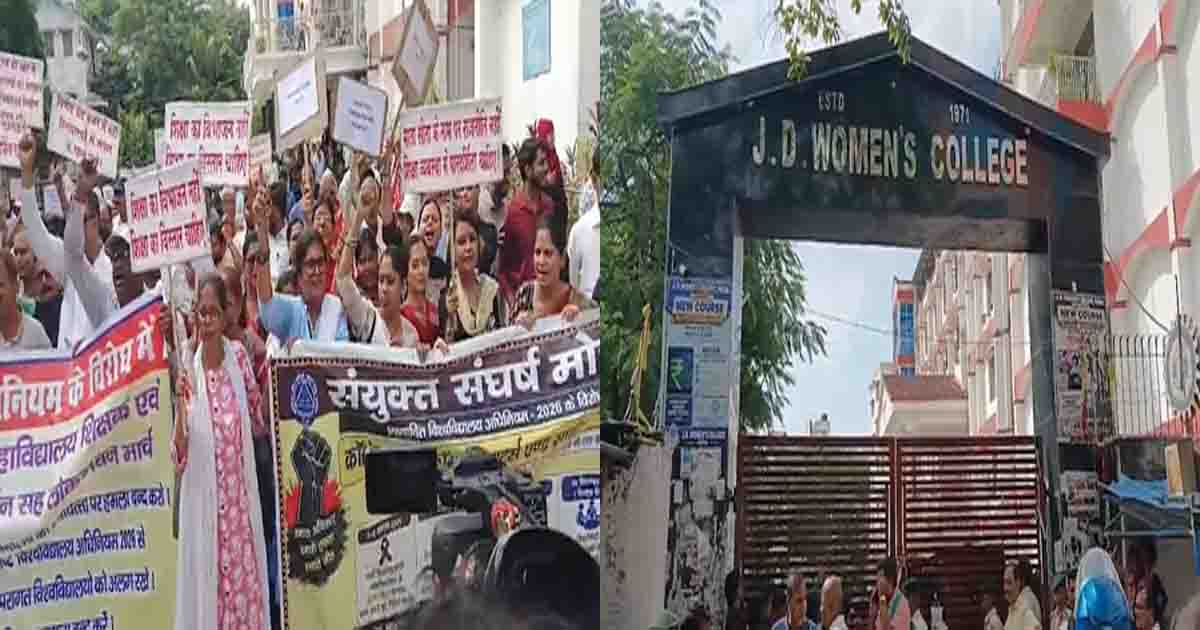
Patna, Oct 10: Bihar police on Saturday detained more than 50 teaching and non-teaching staff during a protest at JD Women’s College here against the proposed establishment of Mata Sita Women’s University.
The demonstrators, who had gathered from different parts of Bihar, raised slogans against the government’s plan to detach women’s colleges from Patliputra University and bring them under the proposed university.
The protesters said the concerns of teachers and the institutions should be addressed before any changes are made to the existing administrative and academic structure of women’s higher education in the state.
Rajeshwari Kumari, a participant in the agitation, said the government should implement the original 1976 Act instead of introducing amendments that would separate women’s colleges from their existing university arrangements.
According to Kumari, the Act envisioned a centralised and organised university system for women in Bihar. The protesters argued that the original framework should be considered before restructuring women’s higher education.
They also pointed out that several universities in Bihar already have two, four, or five women’s colleges under their jurisdiction. They questioned whether detaching selected colleges to establish a separate university would address the challenges facing women’s education.
The protesters demanded consultations on the academic requirements, administrative arrangements and existing status of women’s colleges before the government proceeds with the proposed changes.
They called for an integrated and equitable academic framework that would address the needs of women students and the institutions providing higher education.
Teaching and non-teaching staff and heads of departments from Patna University and various constituent colleges participated in the demonstration.
Those involved in leading the protest included Santosh Kumar of Commerce College, Dr Seema of the Chemistry Department at JD Women’s College, and Heena of the Philosophy Department, among others.
Police detained several participants to maintain law and order.
Despite the detentions, the protesters said they would continue their agitation until their demands were considered. Their principal demands include implementing the original 1976 Act and holding consultations with teachers and the institutions concerned before changing the structure governing women’s colleges.

696 kg of poppy husk worth Rs 1.04 crore seized from truck carrying steel coils in Gujarat

JNU sexual crime: Delhi BJP women ask Congress to expel its MP-cum-professor

Pakistan blasphemy laws under scrutiny over relentless minority persecution

Amitabh Bachchan gets emotional listening to late mother Teji Bachchan’s voice ahead of 84th birthday

Over 50 detained during protest against proposed Mata Sita Women varsity in Patna

Gift to President Putin part of PM Modi bid to globally display India’s heritage

PM Modi’s warm camaraderie with Putin, Xi on full display at BRICS Summit

INDIA bloc begins protest march against ECI

Complaint against Netflix & Mukesh Chhabra for inappropriate language on ‘India’s Got Latent 2’

Maha Congress stages agitation against Gyanesh Kumar
-

 Crime4 years ago
Class 10 student jumps to death in Jaipur
-

 Maharashtra2 years ago
Mumbai Local Train Update: Central Railway’s New Timetable Comes Into Effect; Check Full List Of Revised Timings & Stations
-

 Maharashtra2 years ago
Mumbai To Go Toll-Free Tonight! Maharashtra Govt Announces Complete Toll Waiver For Light Motor Vehicles At All 5 Entry Points Of City
-

 Maharashtra2 years ago
False photo of Imtiaz Jaleel’s rally, exposing the fooling conspiracy
-

 National News2 years ago
Ministry of Railways rolls out Special Drive 4.0 with focus on digitisation, cleanliness, inclusiveness and grievance redressal
-

 Maharashtra2 years ago
Maharashtra Elections 2024: Mumbai Metro & BEST Services Extended Till Midnight On Voting Day
-

 National News2 years ago
J&K: 4 Jawans Killed, 28 Injured After Bus Carrying BSF Personnel For Poll Duty Falls Into Gorge In Budgam; Terrifying Visuals Surface
-

 Crime2 years ago
Baba Siddique Murder: Mumbai Police Unable To Get Lawrence Bishnoi Custody Due To Home Ministry Order, Says Report