
Business
Andhra Pradesh joins WEF’s global network of advanced manufacturing hubs

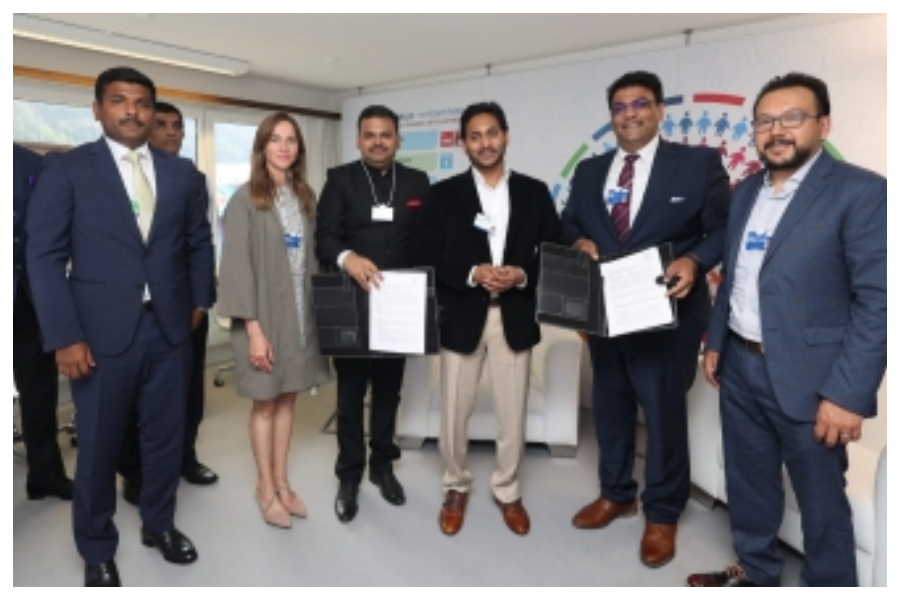
Andhra Pradesh has joined the Global Network of Advanced Manufacturing Hubs (AMHUBs) of the World Economic Forum (WEF).
The state government and WEF exchanged the platform partnership on “Shaping the Future of Advanced Manufacturing and Value Chains”.
An agreement to this effect was signed on the sidelines of the annual meeting of WEF which began at Davos on Sunday. Officials from both sides inked the agreement in the presence of Chief Minister Y.S. Jagan Mohan Reddy.
AMHUBs engages regional production ecosystems, including stakeholders from public and private sectors, academia and civil society to support the development and scaling of local efforts aimed at preparing industry for the future of manufacturing and production. It highlights and amplifies regional success stories at the global level through the WEF’s platform for shaping the future of advanced manufacturing and value Chains
The project disseminate and distil global learnings from the WEF’s efforts to regional hubs so they can learn from a global pool of experiences and identify tangible action areas
The chief minister held discussion with Pedro Gomez Head of Shaping the Future of Mobility and D. Maya Ben Dror of Sustainable Automotive and Mobility, WEF. They briefed on Shaping the Future of Mobility and “Moving India” initiative of which Andhra Pradesh is the first state selected.
Jagan Mohan Reddy has stressed the need for modernisation of manufacturing sector to make the state as a manufacturing hub with focus on green energy, and advocated about key infrastructure and port-led industrialisation while there was appreciation for the education and health policies being pursued by the government and the state was seen as a potential area for investments.
The chief minister discussed the evolution of green mobility and challenges associated with the battery disposal to ensure the transition to green mobility is net zero. He discussed ideas where renewable energy sources could be integrated with electric mobility charging infrastructure and also to generate green hydrogen to make the transition greener and enable sustainable manufacturing.


New Delhi, Oct 9: PhonePe and the Digital Publisher Content Grievances Council (DPCGC), a self-regulatory body under the aegis of the Internet and Mobile Association of India (IAMAI), have announced the signing of a Memorandum of Understanding (MoU).
The partnership aims to facilitate seamless SRO certification for all merchants, champion regulatory compliance, and drive merchant education for all merchant partners onboarding on PhonePe’s Payment Gateway.
Under applicable Indian regulations, over-the-top (OTT) or Publishers of Online Curated Content (OCCPs) are legally required to be members of a recognised self-regulatory organisation (SRO) for grievance redressal.
Pioneering a compliance-first approach, PhonePe enforces this regulatory requirement as a mandatory prerequisite during its merchant onboarding process.
DPCGC is a Level II SRO formed under the IT Rules, 2021, which is registered with the Ministry of Information and Broadcasting.
Through the MoU, PhonePe and DPCGC aim to drive merchant education and awareness.
Recognising the limited awareness among OTT/OCCPs regarding SRO compliance, the joint initiative will educate both existing and prospective merchants on regulatory requirements and seamlessly facilitate their SRO certification through DPCGC.
The partnership further strengthens PhonePe’s position as a trusted, robust, and compliant payment partner tailored for the rapidly growing OTT ecosystem.
Dr. Subho Ray, President of IAMAI, said, “DPCGC, established under the IT Rules, is committed to efficiently addressing concerns and grievances related to OTT platforms through self-regulation.
This collaboration between DPCGC and PhonePe will foster greater alignment and adherence to the Code of Ethics, expanding the reach of self-regulation and strengthening its benefits for both the industry and its users.”
Deep Agrawal, Head of Payments at PhonePe, added, “At PhonePe, compliance and trust are at the core of everything we build. The OTT segment has exploded in terms of coverage and penetration over the last couple of years.
Agrawal further stated that our MoU with DPCGC will allow us to educate the OTT platforms to seamlessly drive higher awareness about customer grievance redressal, reinforcing PhonePe as the most trusted & compliant growth partner for India’s booming OTT ecosystem.”

The Directorate of Revenue Intelligence (DRI) has seized 1.3 kg of gold biscuits worth Rs 1.8 crore in a smuggling operation involving luggage trolleys. Two accused transported the gold from Kuala Lumpur, Malaysia, and concealed the biscuits by sticking them to luggage trolleys.
The accused allegedly targeted unsuspecting passengers who picked up these trolleys and crossed customs. They reportedly followed the passengers and later retrieved the gold from the trolleys, using innocent travellers as unwitting carriers without their knowledge.
Acting on intelligence inputs, DRI officials seized the gold. The investigation is expected to focus on the alleged smuggling network and the modus operandi used to transport the gold through unsuspecting passengers.
Earlier, on October 4, the DRI had seized a cumulative 15.59 kg of narcotic drugs, including amphetamine, cocaine and heroin, in three separate intelligence-led operations, the Finance Ministry said. Five people were arrested under the provisions of the Narcotic Drugs and Psychotropic Substances (NDPS) Act, 1985.
In one operation, the DRI, in coordination with the Central Bureau of Narcotics (CBN), had intercepted a car suspected of carrying amphetamine at the Ujjain-Dewas Toll Plaza in Madhya Pradesh.
When signalled to stop, the driver had allegedly broken through the barricade and sped away. The officers pursued the vehicle in a high-speed chase lasting approximately 1.5 hours before intercepting it near Bicholi Mardana in Indore.
A detailed search of the vehicle led to the discovery of the contraband concealed inside the spare tyre mounted on the rear door of the Thar, according to the statement.
Earlier, on October 2, the DRI’s Mumbai Zonal Unit had busted an international syndicate involved in smuggling 8.5 kg of gold worth Rs 12.65 crore into India and trafficking 1,168 carats of diamonds worth Rs 1.09 crore out of the country to Dubai through Chhatrapati Shivaji Maharaj International Airport (CSMIA).
The DRI had arrested eight members of the syndicate for their alleged involvement in trafficking valuables into and out of the country.
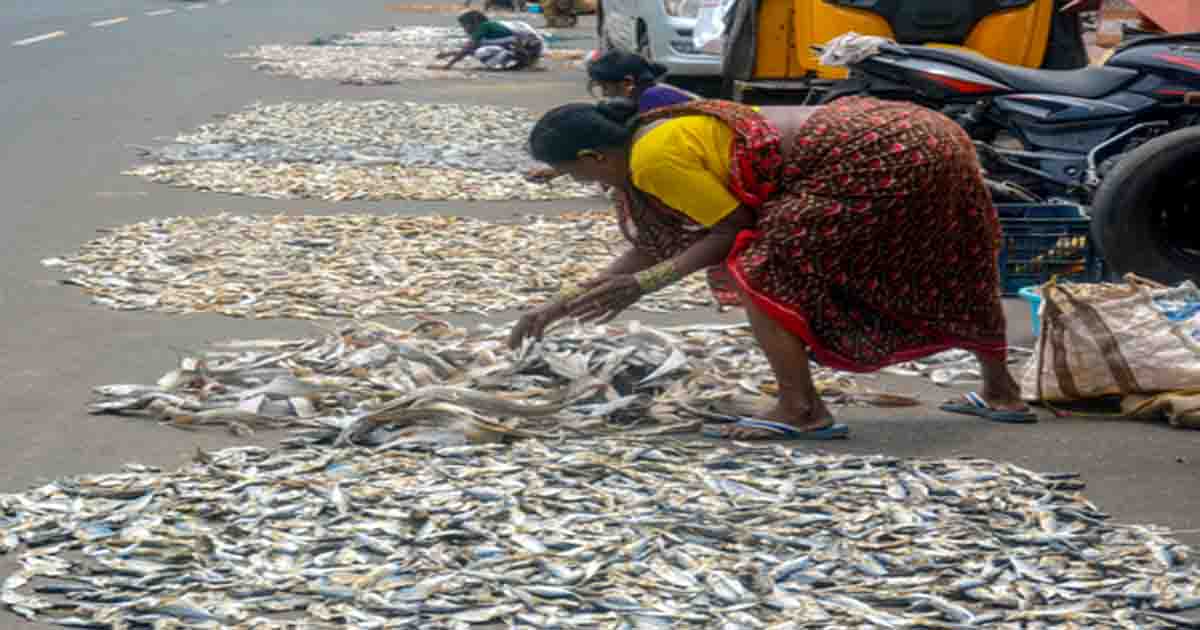
New Delhi, Oct 8: India’s decision to ratify Phase 1 of the World Trade Organization’s Agreement on Fisheries Subsidies is a pragmatic step to curb illegal, unreported and unregulated fishing while preserving its policy space on issues that directly affect small-scale and artisanal fishers, an official statement said on Thursday.
The statement from the Ministry of Fisheries, Animal Husbandry & Dairying said India deposited its Instrument of Acceptance on July 20, 2026, and that the ratified phase targets IUU fishing, overfished stocks and unregulated high‑seas fishing.
“It does not cover the more difficult questions of overcapacity and overfishing, including subsidies for fuel, gear, ice, vessel construction and modernisation,”
“Those issues belong to Phase 2, where India continues to seek fair and differentiated treatment for developing countries,” the statement said citing views of Dr. M. Krishnan, former Principal Scientist & Head, ICAR – CIFE and Dr. P. Krishnan, Director, BOBP-IGO.
India supports measures aimed at the most harmful fishing practices but insists conservation rules must not reduce the development space of coastal communities that depend on marine fisheries for livelihoods.
“For India, the challenge is not whether to support conservation, but how to ensure that conservation does not come at the cost of equity,” the statement, calling the country’s position principled and practical.
India made clear that its ratification of Phase 1 does not weaken its demand for a longer transition period and more flexible treatment in Phase 2. The call for a 25-year transition period for developing countries within their exclusive economic zones remains part of the broader negotiating position.
India also insists that subsidy disciplines should be assessed using a per-fisher benchmark, rather than through comparisons that overlook vast differences in scale, capacity and state support.
Across the Bay of Bengal region, fisheries are a source of food security, employment and social stability for millions of small-scale fishers rather than merely an economic activity.
Hence, any multilateral discipline on subsidies must recognise the realities of artisanal and coastal fisheries in developing countries, where support is often aimed at livelihood protection rather than industrial expansion.

Fadnavis criticises Congress on SIR; releases parliamentary footage of Kapil Sibal defending process

CM Adityanath announces renaming of Noida airport as Narendra Modi International Airport

Seven killed as truck collides with workers’ vehicle in Kutch

Israel to award brave Indian pilot Captain Smit Machchhar with Presidential Award for Civilian Heroism

No permission for Jantar Mantar protest, Delhi Police seek closure of 57 metro stations

Gift to President Putin part of PM Modi bid to globally display India’s heritage

PM Modi’s warm camaraderie with Putin, Xi on full display at BRICS Summit

Complaint against Netflix & Mukesh Chhabra for inappropriate language on ‘India’s Got Latent 2’

INDIA bloc begins protest march against ECI

Maha Congress stages agitation against Gyanesh Kumar
-

 Crime4 years ago
Class 10 student jumps to death in Jaipur
-

 Maharashtra2 years ago
Mumbai Local Train Update: Central Railway’s New Timetable Comes Into Effect; Check Full List Of Revised Timings & Stations
-

 Maharashtra2 years ago
Mumbai To Go Toll-Free Tonight! Maharashtra Govt Announces Complete Toll Waiver For Light Motor Vehicles At All 5 Entry Points Of City
-

 Maharashtra2 years ago
False photo of Imtiaz Jaleel’s rally, exposing the fooling conspiracy
-

 National News2 years ago
Ministry of Railways rolls out Special Drive 4.0 with focus on digitisation, cleanliness, inclusiveness and grievance redressal
-

 Maharashtra2 years ago
Maharashtra Elections 2024: Mumbai Metro & BEST Services Extended Till Midnight On Voting Day
-

 National News2 years ago
J&K: 4 Jawans Killed, 28 Injured After Bus Carrying BSF Personnel For Poll Duty Falls Into Gorge In Budgam; Terrifying Visuals Surface
-

 Crime2 years ago
Baba Siddique Murder: Mumbai Police Unable To Get Lawrence Bishnoi Custody Due To Home Ministry Order, Says Report