
Crime
ED raids eight locations linked to ex-Cong MLA Amba Prasad in Jharkhand

Ranchi, July 4: The Enforcement Directorate (ED) on Friday carried out raids at eight locations linked to close associates of former Congress MLA Amba Prasad from Jharkhand’s Barkagaon Assembly constituency.
The raids are part of an ongoing money laundering probe involving a prominent company engaged in coal transportation, infrastructure, and the power sector.
According to sources, simultaneous searches were conducted in Ranchi, Hazaribagh, and Barkagaon.
Among the locations searched are the residence of Amba Prasad’s aide Sanjeet in Kishoreganj (Ranchi) and the homes of her personal assistants — Sanjeev Sao, Manoj Dangi, and Pancham Kumar — in Barkagaon.
Security forces have been deployed in large numbers at all the premises where raids are being conducted.
This move comes months after the ED conducted a similar crackdown between March 12 and March 14 this year, targeting Amba Prasad, her father, and former Minister Yogendra Sao, brother Ankit Raj, and several other relatives and associates.
During those raids, the agency had seized Rs 35 lakh in cash, digital devices, fake stamps of banks and government offices, handwritten receipts, diaries, and other incriminating documents.
Officials believe that the current searches are based on evidence and leads gathered during the earlier raids. The ED is now closely examining documents related to financial transactions, land deals, and mining activities.
Ten companies reportedly registered in the names of Amba Prasad and her family members are under scrutiny.
Earlier, the ED had questioned Amba Prasad, her father Yogendra Sao, and her brother Ankit Raj at its zonal office in Ranchi in connection with the same case.
Amba Prasad was elected to the Jharkhand Assembly from Barkagaon in 2019 on a Congress ticket. Her parents — Yogendra Sao and Nirmala Devi — have also represented the same constituency in the past.


Hyderabad, Oct 14: After a 72-year-old woman in Hyderabad lost Rs 2.20 crore to fraudsters who threatened her with money laundering charges and displayed fake arrest warrant, Hyderabad Police has issued a fresh advisory cautioning citizens to stay alert against digital arrest fraud.
The woman, a resident of Nampally, received a video call from someone claiming to be a CBI officer, alleging that a parcel containing illegal drugs has been booked in the victim’s name and that a bank account linked to the victim is involved in money laundering.
The caller displayed a fake arrest warrant and threatened to arrest her. On the pretext of security deposits, the victim was forced to transfer multiple amounts to different mule accounts. The victim suffered a total financial loss of Rs 2.20 crore.
After this and a couple of other cases in which the victims lost Rs 3.15 crore, the police have strongly advised the general public to remain vigilant and not fall prey to cyber criminals.
M. Srinivasulu, Additional Commissioner of Police (Crimes & SIT), said in a press release on Wednesday that the Cyber Crime Police Station Hyderabad City, in coordination with the local police stations, has conducted several awareness programmes and door-to-door campaigns to educate citizens on digital arrest scams and their modus operandi, which contributed to a reduction in the number of reported digital arrest cases. However, a few such cases continue to be reported.
Digital arrest is a scam designed to extort money from victims using fear, deceit, and intimidation. Cyber criminals impersonate Police Officers, CBI, ED, Customs, TRAI, or other government authorities and threaten innocent citizens with arrest, criminal prosecution, or account freezing to coerce victims into paying a “fine” or “security deposit” to avoid legal action.
According to the police official, fraudsters contact victims through phone calls, WhatsApp, SMS, or video calls. They may claim that a mobile number, bank account, Aadhaar, parcel, or identity document has been linked to a criminal activity. The caller poses as an officer of the police, CBI, ED, NCB, customs, or another government agency. Fraudsters may use fake identity cards, forged notices, official-looking letterheads, logos, and fabricated case documents. They set up a fake police station with uniforms for video call backgrounds.
The victim is falsely accused of involvement in drug trafficking, money laundering, terror financing, illegal transactions, identity theft, or a money-laundering investigation. In some cases, the fraudster claims that a parcel containing illegal substances has been intercepted in the victim’s name.
The victim is instructed to remain on a continuous video call, stay alone in a room, keep the camera switched on, and avoid contacting family members, lawyers, or other persons. The fraudsters threaten immediate arrest, handcuffing, or harm to the victim’s reputation if instructions are disobeyed, the Additional Commissioner said.
Fraudsters demand bank statements, account balances, identity documents, and details of investments. They may send fabricated arrest warrants, court orders, or account-freezing notices to make the allegations appear genuine.
The victim is instructed to transfer money to designated bank accounts under the pretext of security deposits, verification of legitimate funds, bail, or temporary transfer of funds for investigation. If the funds are short, they coerce the victim to break the Fixed Deposits/Security bonds/apply for bank loans, etc. Fraudsters may promise to return the money after verification.
After receiving the money, the fraudsters may demand additional payments by inventing new charges or allegations. Eventually, they disconnect communications, block the victim, and become unreachable.
Additional Commissioner said citizens should educate their family members, particularly senior citizens and other vulnerable individuals, about digital arrest scams and their modus operandi. Family members should be advised to immediately inform a trusted family member whenever they receive such threatening calls or video calls and never transfer money or share financial or personal information under pressure.
Citizens have been urged not to panic if they receive threatening video calls or messages claiming to be from CBI, RBI, ED, Customs, Judiciary, Cyber Crime Police, Narcotics Bureau, FedEx, BSNL, TRAI, or similar agencies. No government agency or law enforcement authority will demand money over phone or video calls. There is no concept of “digital arrest” or online enquiry in the system.
They should end the suspicious call and contact the concerned agency through its officially published contact details. Do not allow the caller to isolate you or prevent you from seeking independent assistance. Always take support from your family members or a trusted person.
Save phone numbers, call logs, WhatsApp chats, video-call details, bank account information, transaction IDs, and screenshots to be taken immediately.
“If you fall victim to any such cyber fraud, immediate reporting can help in freezing and recovering part or all of your lost amount,” added the official.

New Delhi, Oct 14: A Delhi court has issued fresh summons to YouTuber Dhruv Rathee in an eight-year-old criminal defamation case filed by Vikas Pandey over a video titled “BJP IT Cell Part 2”, with the social media influencer now having been served at his residence in Gurugram.
The case, pending before the Saket Court, relates to allegations that the video was defamatory. The video was also retweeted by Delhi Chief Minister Arvind Kejriwal in 2018, who later admitted before the Supreme Court that he had made a mistake by retweeting it.
In its order, the court acknowledged the prolonged attempts to serve summons on Rathee, who ordinarily resides in Austria, and permitted fresh summons to be served through dasti service, while allowing the complainant to accompany the process server. Rathee has now been physically served with the summons at his Gurugram residence. The matter is scheduled to be heard next on October 17.
The proceedings against Rathee had remained pending amid unsuccessful attempts to serve him with the summons since 2019, with the complainant claiming that his continued absence from India had stalled the case.
The matter had previously reached the Supreme Court in connection with a retweet of the same video by Aam Aadmi Party (AAP) national convenor Arvind Kejriwal.
In February 2024, Kejriwal had told the apex court that he had made a mistake by retweeting the video.
A bench of Justices Sanjiv Khanna (later CJI and now retired) and Dipankar Datta had granted a stay on the proceedings pending before the trial court while hearing his plea challenging the Delhi High Court’s refusal to quash the summons issued against him.
Earlier, the Delhi High Court had upheld the summoning order, observing that retweeting defamatory content could attract the offence of defamation under Section 499 of the Indian Penal Code (IPC).
Pandey, founder of the social media page ‘I Support Narendra Modi’, had alleged that the retweet tarnished his reputation.
Crime
Fake RTO app used to hack phone, siphon Rs 24.40 lakh; Gujarat Police nab account provider in Bengal

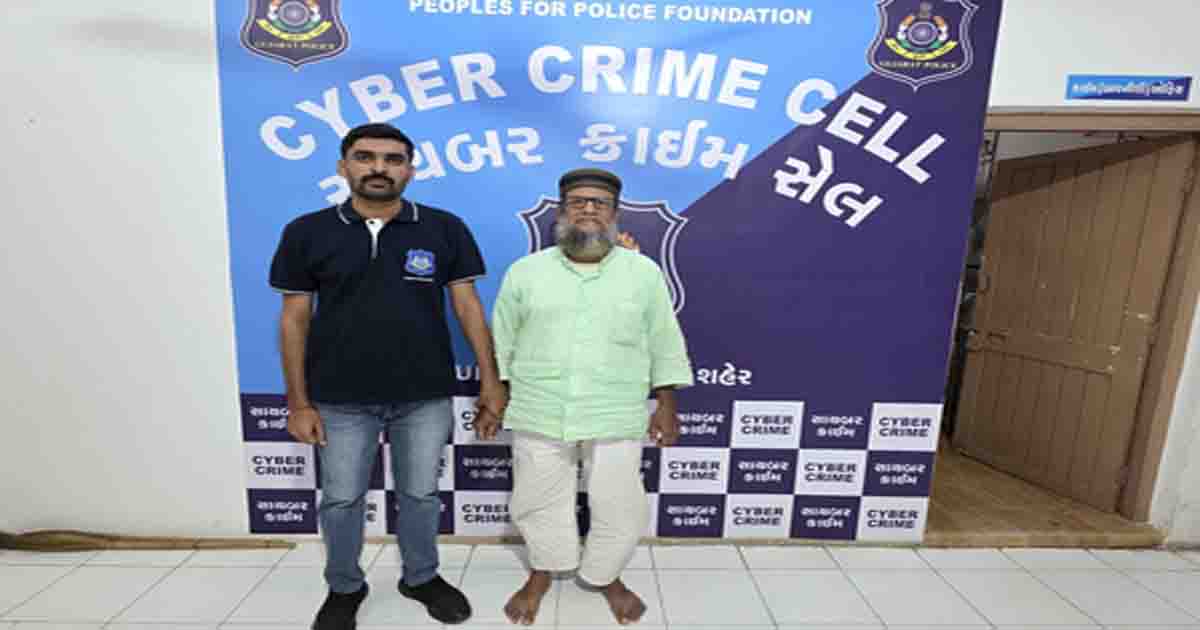
Surat, Oct 14: The Surat City Police Cyber Crime Branch have arrested a 54-year-old man in West Bengal for allegedly providing a bank account to cyber fraudsters to route proceeds from a Rs 24.4 lakh fraud in which a complainant’s mobile phone was hacked through a fake Regional Transport Office (RTO) e-challan APK file, officials said on Wednesday.
The accused, Arikul Islam, a resident of Basubati village in West Bengal’s Hooghly district, allegedly opened a current bank account in the name of a charitable trust he had established and handed it over to an absconding accused in exchange for a commission of Rs 50,000.
Police said the accused had allegedly sent the complainant a fake digital RTO e-challan application, named E-Chalan.apk, and induced them to download it.
The application was used to hack the complainant’s mobile phone, following which Rs 24.4 lakh was transferred from their bank account to three separate bank accounts without their knowledge.
A case was registered at the Cyber Crime Police Station under Sections 318(4), 336(2), 338, 336(3), 340(2), 61(2) and 3(5) of the Bharatiya Nyaya Sanhita, 2023, and Sections 66(C) and 66(D) of the Information Technology Act, as amended in 2008.
Investigators found that Rs 12,42,117 had been transacted through the current account held at Ujjivan Small Finance Bank between November 29, 2025, and May 3, 2026.
The arrest followed technical investigations conducted by a team led by Police Inspector M.C. Nayak, acting on instructions from senior officials.
“Two other accused, Ritik Bali, 26, and Tinku Parmar, 44, both residents of Badnagar in Madhya Pradesh’s Ujjain district, had been arrested earlier in the case,” the police said.
In its public advisory, the Cyber Crime Branch cautioned people against downloading APK files or applications sent by unknown persons under the pretext of RTO challans, banking services, customer support, KYC updates, government schemes, appointment bookings or grocery services.
Police also urged people not to click on suspicious links received through SMS or email and advised victims of financial cyber fraud to call the national cybercrime helpline, ‘1930’, immediately, as prompt reporting can improve the chances of freezing the funds in beneficiary bank accounts.

Hyderabad Police cautions citizens against digital arrest fraud

Delhi court summons Dhruv Rathee in 2018 defamation case

Fake RTO app used to hack phone, siphon Rs 24.40 lakh; Gujarat Police nab account provider in Bengal

Drugs worth Rs 1 crore seized in Greater Noida, three arrested

Israeli military says killed Hamas Commander in Gaza City

INDIA bloc begins protest march against ECI

Maha Congress stages agitation against Gyanesh Kumar

Complaint against Netflix & Mukesh Chhabra for inappropriate language on ‘India’s Got Latent 2’

Delhi court grants three-week interim bail to influencer Swatantra Bhardwaj

Bombay HC warns Vijay Mallya against posting court documents on social media
-

 Crime4 years ago
Class 10 student jumps to death in Jaipur
-

 Maharashtra2 years ago
Mumbai Local Train Update: Central Railway’s New Timetable Comes Into Effect; Check Full List Of Revised Timings & Stations
-

 Maharashtra2 years ago
Mumbai To Go Toll-Free Tonight! Maharashtra Govt Announces Complete Toll Waiver For Light Motor Vehicles At All 5 Entry Points Of City
-

 Maharashtra2 years ago
False photo of Imtiaz Jaleel’s rally, exposing the fooling conspiracy
-

 National News2 years ago
Ministry of Railways rolls out Special Drive 4.0 with focus on digitisation, cleanliness, inclusiveness and grievance redressal
-

 Maharashtra2 years ago
Maharashtra Elections 2024: Mumbai Metro & BEST Services Extended Till Midnight On Voting Day
-

 National News2 years ago
J&K: 4 Jawans Killed, 28 Injured After Bus Carrying BSF Personnel For Poll Duty Falls Into Gorge In Budgam; Terrifying Visuals Surface
-

 Crime2 years ago
Baba Siddique Murder: Mumbai Police Unable To Get Lawrence Bishnoi Custody Due To Home Ministry Order, Says Report