
National News
Trinamool to go for organisational polls in next 2 months

At a time when West Bengal Chief Minister Mamata Banerjee is going for her overzealous plan to reach beyond the boundaries of the state, Trinamool Congress for the first time since its inception in 1998 has decided to go for an organisational election – a move indicative enough that the party is trying to put up democratic face.
Recently the party general secretary Partha Chatterjee said that the party’s organisational polls will be conducted soon. This will be for the first time that the party would be selecting the members of the National Working Committee selected by the members of the party. The party sources indicated that there will be a huge reshuffle in the party hierarchy in the next three months.
“The delegates and voters’ list will be finalised by the end of January and the name of the poll observer will be announced. The entire process of the election and the formation of the new committee will be completed by March 31. A notification on the organisational polls will be issued soon,” a senior party leader told IANS on condition of anonymity.
Political experts are of the opinion that Trinamool Congress established by Mamata Banerjee who owned her political lineage from Congress prior to the forming had its ideological roots on her genetic acceptability. “She was successful in creating an image that has been wholeheartedly accepted by the people of West Bengal but when she is trying to reach out to the people of the nation – the party image will become more important than her personal charisma and this is perhaps why Trinamool Congress is trying to give the party a democratic face,” a senior political expert said.
In the last few months Trinamool Congress after coming to power for the third time has tried to use the political vacuum created by Congress. The party has worked extensively not only to expand its base in the North-Eastern states but also in the Western tip of the country like Goa.
She has already roped in Sushmita Dev, the former Congress MP and ironically a close aide of Rahul, to enlarge TMC’s footprints in Assam and other northeastern states. So far Goa is concerned TMC is likely to use it as a launching pad in national politics and brand itself as a vibrant opposition against the BJP, expediting induction-spree across the country.
In Goa, where the TMC is eyeing to take a frog jump in national politics, it has inducted many influential faces including former CM Luizinho Fuleiro, tennis player Leander Peas, actor Nafisa Ali and Mirinalini Deshprabhu.
The Mamata Banerjee-led party also plans to traverse through all the prominent states of north India. “The TMC has a brain behind it to make it a national party with national and secular outlook and acts,” said a TMC leader.
In its south India move, the TMC’s first focus is on Karnataka and efforts are on to induct some Congress leaders. “There is also a plan to take the TMC into the next Assembly polls due in 2023 in the state. So, the party is zeroing on an influential face,” reliable source said.
Now some questions automatically arise. The first is what is going to be new in the organisational polls that will make Trinamool Congress more acceptable at the national level.
“Previously Trinamool Congress made some experiments to move beyond the state but that was not successful but now they are making serious attempts to take advantage of the political situation. In that case if the leaders from outside the state are not allowed to enter into the decision-making body and responsible posts, then the party is sure to lose its steam on the national platform. So, the party is bringing in major changes in the constitution to include the national leaders into the party-fold,” a senior political scientist said.
“The relevance of Mamata Banerjee or her family will never lose its relevance in the family but the party is now going for a makeover to get a democratic look so that it becomes acceptable to the people of the country,” he added.


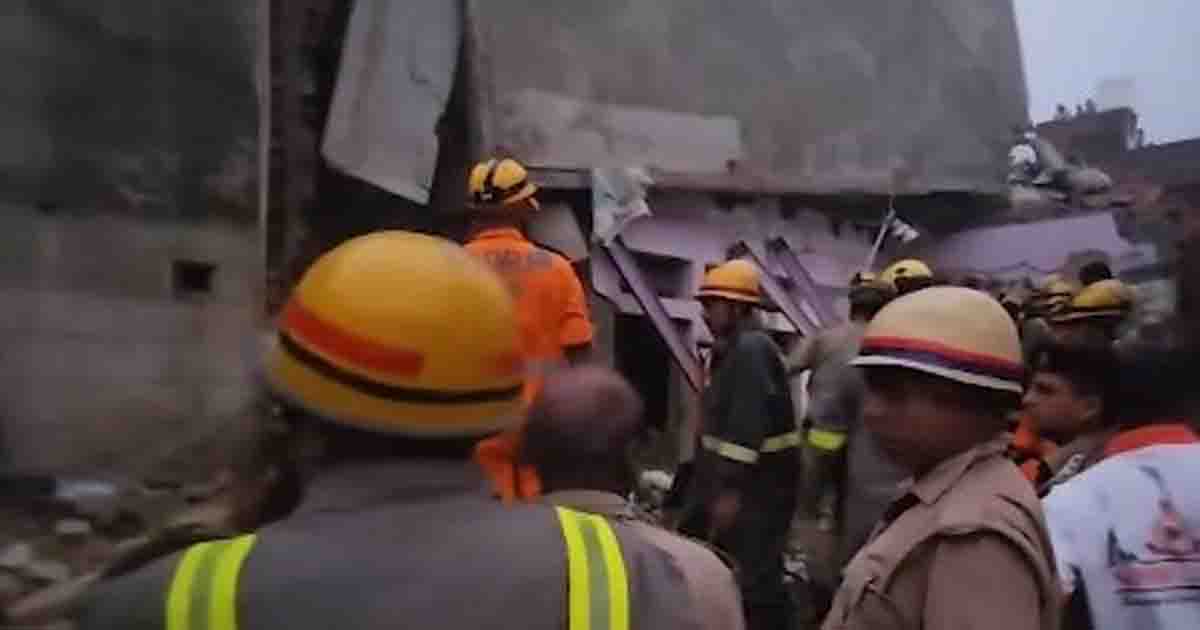
Varanasi, Oct 15: A massive explosion triggered the collapse of a two-storey building in Uttar Pradesh’s Varanasi on Thursday, leaving two people injured and a woman trapped under the debris, officials said.
The incident took place in the Paigambarpur area under the Sarnath police station area of Varanasi.
According to preliminary information, an illegal firecracker manufacturing unit was operating inside the house. The explosion is suspected to have occurred due to highly inflammable materials on the premises.
Two people were injured in the incident and have been taken to hospital for treatment, while efforts are underway to rescue a woman trapped under the rubble.
Speaking to media, DCP Rajesh Pandey said: “Information was received at 5 p.m. that a two-storey building had collapsed. Upon reaching the spot, we found firecrackers scattered around the place, so it is being considered that the incident took place due to the explosion of firecrackers.”
He said that according to locals, a woman is trapped under the debris and a rescue operation is currently underway to pull her out.
Uttar Pradesh Chief Minister Yogi Adityanath has directed officials to reach the site immediately and expedite relief operations, NDTV reported.
Further, CM Adityanath has instructed officials to ensure proper medical treatment for those injured. The officials have also been directed to contact the families of the injured and provide them with all possible assistance.
In August, eleven people were killed, and five others suffered serious injuries after an explosion ripped through an illegal firecracker manufacturing and storage facility in Chilla Shahbazi village, under the Pipri police station area in UP’s Kaushambi.
The UP government had then announced a reward of Rs 25,000 each for three absconding suspects wanted in connection with the blast.
Superintendent of Police Satyanarayan Prajapat announced a reward of Rs 25,000 each for information leading to the arrest of three absconding accused – Shakeel, Kahaksha Bano, and Adil, said an official statement.
Earlier, as part of action against the accused in the firecracker factory explosion, the police arrested the main accused, Naushad, following an encounter on the Terah Mile-Syed Sarawan road in the Charwa police station area, an official said.
New Delhi, Oct 15: The Supreme Court on Thursday asked the Centre to take the issue of circulation of Child Sexual Exploitation and Abuse Material (CSEAM) on social media platforms seriously, while indicating that it would suggest measures to address the problem.
A bench of Justices J.B. Pardiwala and K. Vinod Chandran made the observations while hearing a plea seeking criminal action against social media intermediaries for allegedly failing to report child sexual abuse material to the authorities, as required under the law.
The Justice Pardiwala-led Bench asked Solicitor General Tushar Mehta, appearing for the Centre, whether the government had filed its response in the matter.
SG Mehta informed the top court that the Centre had filed its reply along with suggestions on tackling the problem. Counsel appearing for the petitioner also referred to concerns relating to the dark web, prompting the Solicitor General to assure the Supreme Court that the Centre was taking the matter seriously.
Stressing the gravity of the issue, the bench said it was a “very, very serious matter” and asked the Centre to deal with it seriously and study the top court’s forthcoming order.
As per the case status reflected on the official website of the apex court, the matter has been tentatively listed for further hearing on December 10.
The proceedings stem from an application filed by Just Rights for Children Alliance (JRCA) seeking effective implementation of the Supreme Court’s September 23, 2024, judgment in Just Rights for Children Alliance v. S. Harish, which dealt with the obligations of social media intermediaries to report suspected offences involving child sexual abuse material.
In its previous hearing on September 24, the Supreme Court had granted the Centre the “last opportunity” to file its counter-affidavit and an action-taken report detailing the steps taken to implement the directions issued in the 2024 judgment and curb the circulation of CSEAM on social media platforms.
It had also directed the Centre to explain the measures taken to implement its 2024 judgment and the safeguards proposed to prevent future lapses by social media intermediaries. It had further asked the Centre to serve a draft Standard Operating Procedure (SOP) for dealing with CSEAM cases before the next hearing.
Under its 2024 judgment, the Supreme Court clarified that compliance with the Information Technology Act, 2000, would not absolve social media intermediaries of their statutory obligations under the Protection of Children from Sexual Offences (POCSO) Act. It held that intermediaries must report the commission or likely commission of offences under the POCSO Act not only to the National Center for Missing & Exploited Children (NCMEC), but also to the Special Juvenile Police Unit (SJPU) or local police, in accordance with the applicable statutory provisions.
The matter has also drawn the attention of the National Human Rights Commission (NHRC). Earlier in the day, NHRC member Priyank Kanoongo flagged the continued delay in compliance with the Supreme Court’s directions, saying that the 2024 judgment remained to be implemented. In a post on X, Kanoongo questioned why social media companies were allegedly resisting mandatory reporting of child sexual abuse to the police and raised concerns over the circulation and monetisation of such material on online platforms.
The NHRC has separately taken cognisance of media reports alleging that paid advertisements on Instagram promoted child sexual abuse material and directed users to Telegram channels where such content was allegedly being offered for sale.

Thiruvananthapuram Oct 15: For families who lose loved ones in road accidents, the debate over whether the fault lies with reckless driving or unsafe roads offers little comfort.
But figures placed before the Kerala Assembly on Thursday underline the scale of the challenge.
Nearly half of the road accident deaths reported in the state between 2021 and 2026 occurred on national highways.
Figures provided by the Minister’s office point out that of the 11,697 accident deaths that took place between 2023 and 2025 on the roads in the state, 5,991 took place on the NH.
Public Works Minister P.K. Basheer told the Assembly that overspeeding and traffic violations were the main causes of road accidents.
Road construction defects alone could not explain the deaths, he said in reply to questions from MLAs.
The minister, however, acknowledged that road deficiencies also contributed to accidents, pointing to the need for safer roads alongside stricter enforcement of traffic rules.
The figures bring renewed attention to accident-prone stretches where a moment of carelessness, a dangerous curve or inadequate road safety measures can have devastating consequences for families.
The government has identified accident-prone locations, known as black spots, through scientific studies conducted by the National Transportation Planning and Research Centre (NATPAC).
Joint inspections involving the police, Motor Vehicles Department and the agencies responsible for roads are also conducted at places where accidents occur frequently.
These inspections are intended to identify the causes of accidents and recommend corrective measures.
Basheer said the condition of a road, its accident history and existing safety risks were assessed before estimates were prepared for road rehabilitation.
Safety measures were included in the plans based on these assessments.
Both temporary and permanent remedies were being implemented at dangerous black spots on national highways, he said.
The measures include solar-powered blinkers, rumble strips, speed humps, reflective road signs, road markings and road studs to alert motorists to potential hazards.
Metal crash barriers and wire-rope barriers are also being installed along dangerous curves and road medians to reduce the risk and severity of accidents.
Yet, the minister’s reply points to a challenge that goes beyond engineering.
While improvements to road infrastructure can reduce risks, overspeeding and violations of traffic rules remain major causes of crashes.
For road users and their families, safer journeys will depend on both better-designed roads and responsible driving.

Building collapses in Varanasi due to firecracker explosion, two rescued

Take child sexual abuse material circulation on social media seriously, SC tells Centre

Kerala: 5,991 road accident deaths occurred on national highways in three years

SC refers Rajpal Yadav cheque bounce cases to mediation for amicable settlement

NEET-PG 2026: SC issues notice on plea seeking candidate-wise disclosure of questions, options, and answers

INDIA bloc begins protest march against ECI

Maha Congress stages agitation against Gyanesh Kumar

Mumbai Cyber Cell arrests 6 members of organized gang in major operation; Beware of cyber fraudsters; Digital arrest has no legal status; DCP Bajrang Bansode

Complaint against Netflix & Mukesh Chhabra for inappropriate language on ‘India’s Got Latent 2’

Bombay HC warns Vijay Mallya against posting court documents on social media
-

 Crime4 years ago
Class 10 student jumps to death in Jaipur
-

 Maharashtra2 years ago
Mumbai Local Train Update: Central Railway’s New Timetable Comes Into Effect; Check Full List Of Revised Timings & Stations
-

 Maharashtra2 years ago
Mumbai To Go Toll-Free Tonight! Maharashtra Govt Announces Complete Toll Waiver For Light Motor Vehicles At All 5 Entry Points Of City
-

 Maharashtra2 years ago
False photo of Imtiaz Jaleel’s rally, exposing the fooling conspiracy
-

 National News2 years ago
Ministry of Railways rolls out Special Drive 4.0 with focus on digitisation, cleanliness, inclusiveness and grievance redressal
-

 Maharashtra2 years ago
Maharashtra Elections 2024: Mumbai Metro & BEST Services Extended Till Midnight On Voting Day
-

 National News2 years ago
J&K: 4 Jawans Killed, 28 Injured After Bus Carrying BSF Personnel For Poll Duty Falls Into Gorge In Budgam; Terrifying Visuals Surface
-

 Crime2 years ago
Baba Siddique Murder: Mumbai Police Unable To Get Lawrence Bishnoi Custody Due To Home Ministry Order, Says Report