
National News
Submit records connected with 2016 demonetisation decision: SC to Centre

The Supreme Court on Wednesday directed the Centre and the Reserve Bank of India (RBI) to submit relevant records in connection with the government’s 2016 demonetisation decision for its perusal.
After hearing detailed arguments on a batch of petitions challenging the demonetisation move, a bench headed by Justice S.A. Nazeer reserved the judgment.
The bench, also comprising Justices B.R. Gavai, A.S. Bopanna, V. Ramasubramanian and B.V. Nagarathna, said: “Counsel of the Union of India and Reserve Bank of India are directed to produce the relevant records.”
Attorney General R. Venkataramani represented the Centre and senior advocate Jaideep Gupta represented the RBI, and senior advocates P. Chidambaram and Shyam Divan appeared for some of the petitioners.
Reserving the judgment on the petitions, the top court directed the parties to file written submissions by December 10.
The AG contended that he will submit the relevant records in a sealed cover.
On Tuesday, Justice Nagarathna said the courts will not go into the merits of the decision, but it can always go into the manner it was taken, two things are totally different.
“Because it is an economic policy court cannot fold its hand and sit. Merits of the decision, it is for the government in its wisdom it knows what is best for the people, but while taking that decision what was the material on record, relevant considerationsa,” said Justice Nagarathna.
Chidambaram, representing a petitioner, said the government should confidently defend the decision and also the decision-making process (involved in 2016 demonetisation), and added they should place those documents before the court.
He said that if the government were to adopt a route through Parliament, then the parliamentarians would have stopped the policy but they did not follow the legislative route.
Chidambaram submitted that the RBI Governor must be fully aware of the fact that in 1946 and 1978, the central bank opposed demonetisation and they resorted to plenary power of legislature.
“Surely the history of RBI is published by the RBI. They must be deemed to know that also,” he said, urging the court to see the documents to see whether the decision-making was fair and not arbitrary.
The Centre had told the Supreme Court that the November 2016 decision to withdraw legal tender of Rs 500 and 1,000 currency notes was one of the critical steps in the series of transformational economic policy steps and this decision was taken after extensive consultation with the RBI and advance preparations.
The Union Ministry of Finance, in an affidavit, said: “The withdrawal of legal tender character of a significant portion of total currency value was a well-considered decision. It was taken after extensive consultation with the RBI and advance preparations.”
It further added that demonetisation was also a part of larger strategy for combating the menace of fake money, terror financing, black money and tax evasion.
“The notification issued on 08.11.2016 was a major step to fight the menace of fake currency notes, storage of unaccounted wealth and financing of subversive activities,” it said.


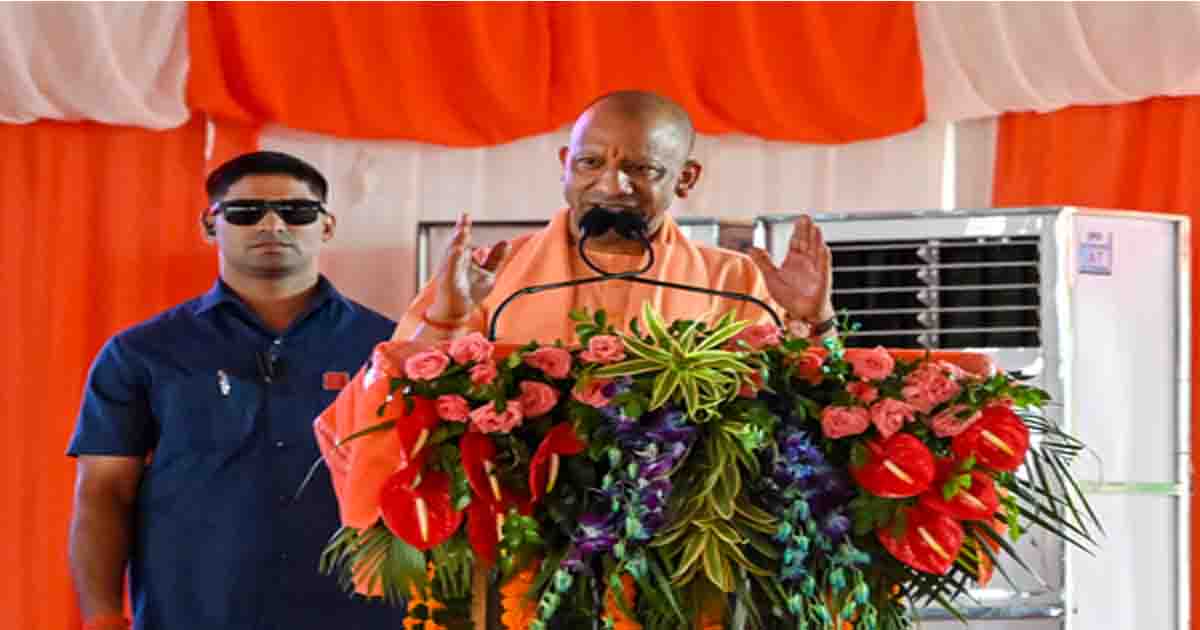
Lucknow, Oct 17: Uttar Pradesh Chief Minister Yogi Adityanath on Saturday took a jibe at the previous Samajwadi Party (SP) government in the state, saying that the SP and education are like the “two banks of a river who can never meet”.
The Chief Minister was addressing the Teachers’ and Graduates’ Conference in Lucknow.
Attacking the Akhilesh Yadav-led Samajwadi Party, CM Adityanath said: “The ‘Saifai Syndicate’ used to undermine the recruitment process and create an identity crisis (for the youth). People from Uttar Pradesh were even refused rooms in hotels for being associated with the state.”
“During the ongoing Sharadiya Navratri, various events are taking place. Durga Pujas are being organised, Ramlilas are being performed, and there is an atmosphere of celebration today, but before 2017 there used to be chaos and unrest,” he alleged.
Alleging that curfew and riots had become a part of the state, CM Adityanath said mothers used to be concerned about their daughters’ safety till they returned home from school.
“Today, there is celebration, not unrest. Daughters are safe; and should anyone dare to compromise their safety, the police have the perfect ‘remedy’ waiting at the very next street corner,” he remarked.
“An atmosphere of security has paved the way for investment, which consequently led to employment opportunities. We have provided government jobs to 9.5 lakh youths, while another 65 lakh youths have secured employment through investments in the private sector,” he added.
The Uttar Pradesh CM asserted that no one can raise a question about a single recruitment that has taken place in the past nine-and-a-half years, under the Bharatiya Janata Party-led double-engine government.
“There is complete transparency, fairness and honesty. A spirit of honouring the talent of Uttar Pradesh’s youth is evident,” he said.
CM Adityanath remarked: “The Samajwadi Party and education are like the two banks of a river—they can never meet!”
Likening the SP to that of a crocodile, the Chief Minister said: “If they (SP) claim they want to do something for education, it is akin to a crocodile coming to the riverbank and saying, ‘Climb onto my back; I will carry you safely to the other side’. That is precisely the situation with the ‘Samajwadis’—they are enemies of education who cannot be trusted.”
“They (SP) are the ones who created an identity crisis for the youth and have wreaked havoc on the education system,” he said while emphasising that crisis in the education sector means crisis for the society and the country.
“SP’s goons used to take over the educational institutions. The (SP government) did nothing for the benefit of teachers, since education and youth were never on their agenda. In contrast, we have provided free cashless medical treatment of up to Rs 5 lakh per family every year to teachers and education staff (in Uttar Pradesh),” CM Adityanath added.
The Chief Minister also asserted: “Today, Uttar Pradesh is not in need of identity, instead those who created an identity crisis for the state are the very ones now struggling for an identity of their own.”

Singrauli, Oct 17: Mild earthquake tremors were felt in the Singrauli district of Madhya Pradesh on Saturday, India Meteorological Department (IMD) officials said.
According to preliminary data, the intensity of the earthquake was measured at 3.5 on the Richter scale.
The epicentre was located at a depth of around 10 km below the surface, officials added.
The tremor was recorded on Saturday at 2:12 p.m.
Officials monitoring seismic activity confirmed that the quake had an intensity of 3.5, with the focus situated around 10 km beneath the earth’s surface.
The information is based on initial readings and remains subject to further verification by scientific agencies.
Residents in parts of Singrauli reported feeling the mild shaking during the afternoon hours.
While the intensity was relatively low, the sudden tremor caused momentary concern among people in the affected areas.
No immediate reports of damage to buildings or injuries have been received so far.
Earthquake monitoring agencies are examining the preliminary data to determine the exact location of the epicentre and assess any aftershock possibilities.
A magnitude of 3.5 is generally classified as a light earthquake, which is often felt by people nearby but rarely causes significant structural damage, especially when the focus is at a moderate depth of around 10 km.
Authorities in Singrauli have advised the public to remain calm and follow standard safety guidelines in case of any further seismic activity.
Local administration is closely tracking the situation and is in coordination with relevant scientific bodies for updated information.
This is not the first time the region has experienced mild seismic activity, though such events of low intensity usually pass without major incident.
Experts note that earthquakes of this magnitude are relatively common in various parts of the country and typically do not pose a serious threat when the depth is around 10 km.
Further details are awaited as agencies continue to analyse the complete data set.
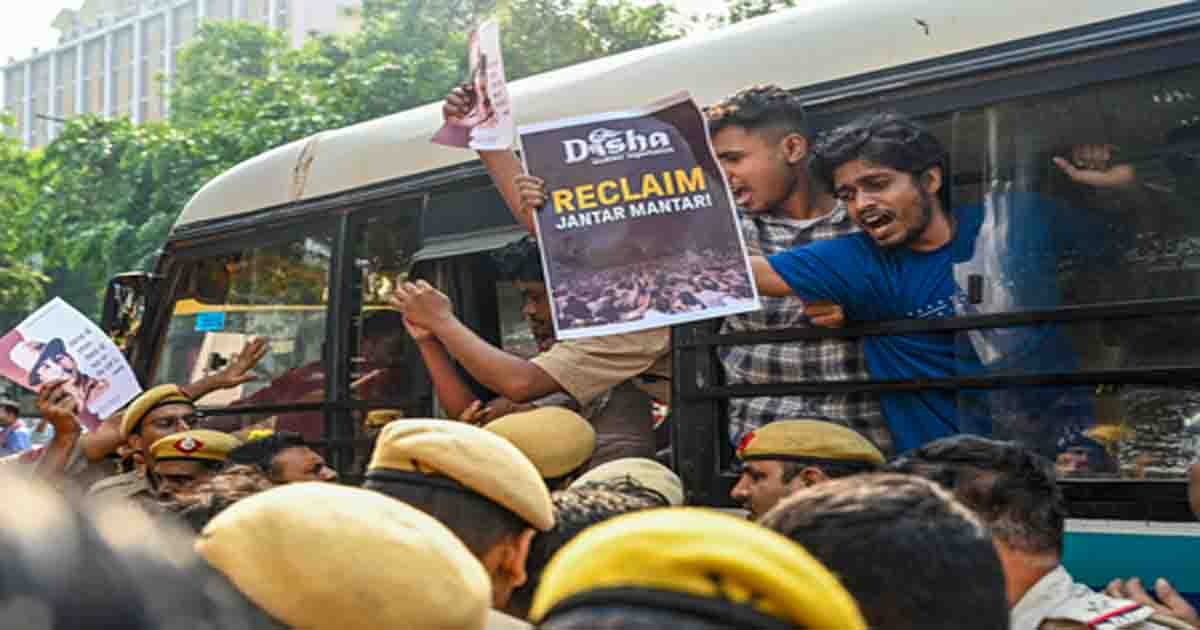
Leaders of the INDIA Bloc on Saturday condemned the detention of people protesting against the Election Commission of India (ECI), alleging that the police action undermined the fundamental principles of democracy and restricted citizens’ right to express dissent.
The Opposition leaders criticised the detentions of protesters and activists in the national Capital, arguing that peaceful demonstrations were an essential part of a democratic system and that the authorities should not use restrictions to silence those questioning the government or constitutional institutions.
The criticism came after Cockroach Janata Party (CJP) founder Abhijeet Dipke was detained from Connaught Place ahead of his proposed ‘Lehra Do Tiranga’ march in Delhi on Friday. He was subsequently placed under preventive arrest.
All India Students’ Association (AISA) President Neha Bora was also detained on Friday and later released with certain conditions.
Reacting to the developments, Samajwadi Party Rajya Sabha member Awadhesh Prasad told media that opposing injustice had always been a central principle of socialist politics.
“It has always been the nature of us socialists to stand against injustice. Wherever injustice occurs, the Samajwadi Party has consistently raised its voice against it. If this is being described as an undeclared Emergency, then it certainly appears to be so. If restrictions are imposed on protests and demonstrations, it affects the Fundamental Right to freedom of speech and expression. This situation is similar to an Emergency,” Prasad said.
CPI(M) Rajya Sabha member V. Sivadasan also criticised the police action, alleging that protesters had been detained for prolonged periods without being adequately informed about the reasons for their detention.
“Students, youth, and workers were detained by this police. Including the police officers, they don’t know what the reason is. Only because of directions from the Home Ministry were these endless students and protesting people detained for long hours, including girl students. The girl students, women members of different political parties, were detained for long hours in the police station. It is basically against human rights,” Sivadasan told media.
He further referred to the detentions of Abhijeet Dipke and Neha Bora, claiming that hundreds of students had also been arrested or detained during the demonstrations.
“They were manhandled. These things are not suitable for a democratic nation. Our fight will continue,” Sivadasan said.
Congress spokesperson Surendra Rajput also launched a sharp attack on the BJP over the detention of people participating in the ‘Lehra Do Tiranga’ march.
“Those who oppose the Tricolour can only be the sons of the British. Those who have arrested the people who carried out the Tiranga March can only be the followers of the British. Just like the British used to do it with the freedom fighters, the anti-national and anti-people BJP has done the same,” Rajput told media.
Shiv Sena (UBT) leader, Priyanka Chaturvedi, also questioned the detention of people participating in a march involving the National Flag, maintaining that the right to protest and express disagreement with the government was fundamental to democracy.
“Detaining someone for hoisting the Tricolour is not right. Protesting is a democratic right, as Sushma Swaraj ji and Arun Jaitley ji used to say. This is not just the Opposition’s right, but everyone has the right to express their dissent towards the government,” Chaturvedi told media.
“However, the way detentions are taking place and the designated protest site has been de-notified, shows that the foundation of democracy is weakening,” she added.
The INDIA Bloc leaders’ remarks came amid continuing protests against the ECI over allegations of irregularities in the Special Intensive Revision (SIR) of electoral rolls and demands for the resignation of Chief Election Commissioner Gyanesh Kumar.

Samajwadi Party, education two banks of river who can’t meet: UP CM Yogi Adityanath

Tanker attacked northeast of Saudi Arabia: UKMTO

MP: Mild earthquake tremors felt in Singrauli

Maha CM calls emerging technologies key to India’s youth

Iran IRGC says supertanker exploded after hitting mine in Hormuz Strait

Rahul, Cong ecosystem want to force regime change: BJP after Neha Bora praises B’desh Gen-Z protest

BJP pays tribute to ex-President Abdul Kalam, recalls his enduring influence on generations of India’s youth

Attack on democratic rights: INDIA Bloc leaders on detentions of anti-ECI protestors

INDIA bloc begins protest march against ECI

Maha Congress stages agitation against Gyanesh Kumar
-

 Crime4 years ago
Class 10 student jumps to death in Jaipur
-

 Maharashtra2 years ago
Mumbai Local Train Update: Central Railway’s New Timetable Comes Into Effect; Check Full List Of Revised Timings & Stations
-

 Maharashtra2 years ago
Mumbai To Go Toll-Free Tonight! Maharashtra Govt Announces Complete Toll Waiver For Light Motor Vehicles At All 5 Entry Points Of City
-

 Maharashtra2 years ago
False photo of Imtiaz Jaleel’s rally, exposing the fooling conspiracy
-

 National News2 years ago
Ministry of Railways rolls out Special Drive 4.0 with focus on digitisation, cleanliness, inclusiveness and grievance redressal
-

 Maharashtra2 years ago
Maharashtra Elections 2024: Mumbai Metro & BEST Services Extended Till Midnight On Voting Day
-

 National News2 years ago
J&K: 4 Jawans Killed, 28 Injured After Bus Carrying BSF Personnel For Poll Duty Falls Into Gorge In Budgam; Terrifying Visuals Surface
-

 Crime2 years ago
Baba Siddique Murder: Mumbai Police Unable To Get Lawrence Bishnoi Custody Due To Home Ministry Order, Says Report