
National News
P. Chidambaram poses 20 tough questions on Rs 6 lakh Cr NMP


Senior Congress leader and former Union Finance Minister P. Chidambaram on Friday posed 20 questions on the Centre’s proposed National Monetization Pipeline (NMP) intended to ‘monetise’ certain assets and earn Rs 6,00,000 crore revenue over the next four years.
Stating that the government should answer the questions, he demanded to know the NMP objectives and whether it was solely intended to raise the revenues over the next four years.
Referring to the criteria adopted upfront to identify the PSUs that would be disinvested or privatised during the previous UPA government, Chidambaram queried whether the same is the case with the current NDA regime.
Pointing out that for infra projects like roads/highways, a PPP policy already exists, he asked what is the difference, if any, between this (PPP) model and the one that would be adopted by the Centre under the NMP, while addressing the media in the country’s commercial capital.
Moreover, if an asset is ‘monetised’ for 30-50 years, what is the value of the piece of paper that declares the government to be the ‘owner’ of that asset, what kind of asset will be returned to the government at the end of the period or would it be a “fully depreciated asset” worth practically nothing.
“Since the NMP is silent on the subject, will the government stipulate in the contract that the amount of depreciation should be put in a Depreciation Reserve Account which was used only to maintain, upgrade or add to the asset so that at the end of the lease period a valuable asset is returned to the government,” Chidambaram asked.
He also sought answers on whether there will be provision in the contract to prevent asset-stripping by the lessee, the terms included in the Invitation to Bid (ITB) to ensure that the ‘monetisation’ process does not create monopolies or duopolies in that sector, especially to prevent such (monopolies/duopolies) emerging in the ports, airports, telecom and power sectors.
The finance expert queried whether the lessee will manage the current levels of employment and the policy of reservations, or other policies, subject to sectoral regulators, etc., in the ‘monetised’ asset.
Harking to the UPA which identified the Railways as a ‘strategic sector’, he asked what are the other sectors the Centre has identified as ‘core’ or ‘strategic’ that would be kept out of the NMP purview.
“Has the government examined the impact of implementation of the NMP on the prices of goods and services in the sector/industry concerned? What will the government or the regulator do in case prices are increased by the lessee of the ‘monetized’ asset,” Chidambaram demanded.
Referring to the government’s revelation of the expected revenue of Rs 6,00,000 crore in four years, he asked whether the government would shed light on the total capital investment in the identified assets that are expected to yield the aforesaid revenue.
“The identified assets must be currently yielding a certain revenue every year. Has the government calculated the difference between the current revenue (undisclosed) and the expected revenue (of Rs 6,00,000 crore) over a period of four years? If so, what is the difference between the two amounts each year during the four year period,” Chidambaram asked.
On the government’s announcement that the NMP would be co-terminus with the National Infrastructure Pipeline (NIP) that is expected to require Rs 100 lakh crore, the ex-FM sought to know how the Rs 6,00,000 crore over a four year period be sufficient to finance a Rs 100 lakh crore NIP.
Furthermore, he sought an assurance from the Centre that the expected sum of Rs 6,00,000 crore “would not be merged with general revenues or used for general expenditure”.
Chidambaram further posed if the Rs 6,00,000 crore, when released, would not be diverted to partly-finance the fiscal deficit (Rs 5,50,000-crore in 2021-2022) or retiring old debts.
The Congress leader asked if the government floated a consultation paper on NMP, consulted various stakeholders including the workers or trade unions and demanded to know the outcome/minutes of these consultations.
He also asked whether the NMP was discussed in Parliament, and if not, whether the Centre plans to consult the Opposition Parties or debate in parliament.
Chidambaram said that the US is contemplating measures to contain monopolization and unfair trade practices of giants like Google, Amazon and Facebook, China has announced plans to rein in its giant tech firms and South Korea contained the influence of its huge family-controlled business conglomerates.
“Does the government intend to introduce similar measures while implementing the NMP,” Chidambaram asked, saying the Centre “is obliged to answer these questions”, and the media must demand replies from the government.


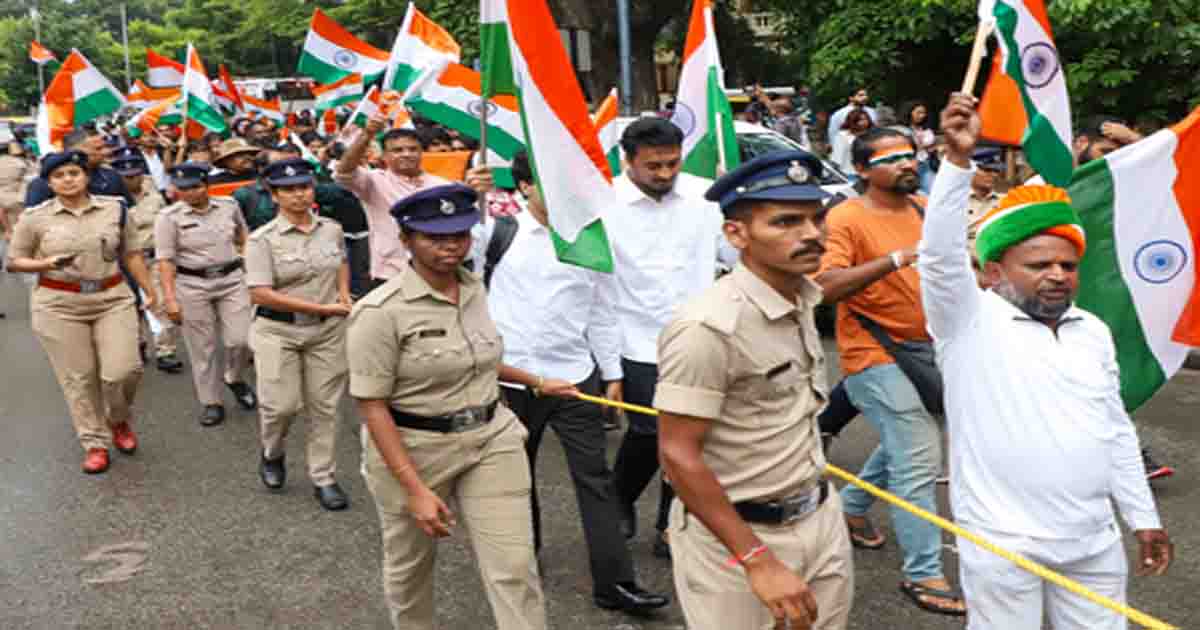
New Delhi, Oct 16: Amid dramatic scenes, detentions by law enforcers and a congregation of Tricolour-waving people in Connaught Place to support the CJP’s ‘Lehra Do Tiranga’ march, the Delhi Police on Friday circulated on social media a list of rules related to respecting the national flag.
In a post on social media, the police cautioned people against disrespecting the Tricolour while waving it to express patriotism.
The Delhi Police said on X, “Our Tricolour deserves the highest respect. Let patriotism reflect in every gesture. Respect the Flag. Uphold the Pride.”
Within hours of detaining Cockroach Janta Party (CJP) founder and convener Abhijeet Dipke for giving a call for an unauthorised march, the police took to social media and circulated a list of 12 rules culled out from the Flag Code of India.
The police cautioned people against disrespecting the tricolour – an offence that invites imprisonment of up to three years with a fine.
Circulating the rules, the police reminded citizens that the “Flag shall not be intentionally allowed to touch the ground or floor, or trail in water; it shall not be used to cover a speaker’s desk, nor draped over a speaker’s platform; it shall not be draped over the hood, top, sides or back of any vehicle, train, boat or aircraft or used as a covering for a building”.
While the CJP’s proposed venue for the Tiranga march – Central Park in Connaught Place (CP) – remained out of bounds on Friday evening, many people gathered around the circular Central Park, on roads converging at the central Delhi park and gates of Rajiv Chowk Metro station till after sunset.
Left student leader Neha Bora and some of her All India Students’ Association supporters were detained and ferried away by the police, while other small groups of slogan shouters were detained from Barakhamba Road and other spots.
Later, Rajya Sabha MP and Communist leader John Brittas marched in Connaught Place with supporters while holding the tricolour in hand.
The police continued to use social media to educate people about the respect to be shown towards the national flag, reminding them about the illegality of intentional display of the flag with ”saffron” down.
In their message on X, the police quoted the rules and said that the tricolour shall not be used as part of any costume or uniform, or embroidered or printed on cushions, handkerchiefs, napkins or dress material.
“No lettering of any kind shall be placed on the National Flag, and the Flag shall not be used as a receptacle for receiving, delivering, holding or carrying anything, except flower petals placed inside before it is unfurled on special occasions and National Days,” reminded the Delhi Police on X.
According to the Prevention of Insults to National Honour Act, 1971, a person who brings into contempt the Indian National Flag shall be punished with imprisonment for a term which may extend to three years, or with a fine, or with both.
Earlier, Dipke was detained after being served two notices by the Delhi Police, urging him to refrain from staging the gathering at Connaught Place, as the New Delhi Municipal Council (NDMC) has not given permission for it and prohibitory orders are in place at the proposed venue.
According to officials, one of the notices was issued on behalf of the New Delhi district authorities under the Delhi Police Act, instructing individuals not to visit Central Park, as Section 163 of the Bharatiya Nagarik Suraksha Sanhita (BNSS) is currently in force.
A second notice was issued to Dipke by the South West Delhi authorities, reminding him that he, along with CJP co-conveners Ashutosh Ranka and Saurav Das, were previously ‘bound down’ (placed under a legal undertaking) following their preventive detention at the airport and subsequent production before a court.

New Delhi, Oct 16: The National Human Rights Commission (NHRC) has taken suo motu cognisance of a media report regarding the alleged assault and inhuman treatment of a married woman by her husband and family members in Gujarat Surendranagar district. In a separate matter, the NHRC has also taken suo motu cognisance of a media report regarding the alleged contamination of borewell water in Maharashtra Nashik district.
Observing that the contents of the media report, if true, raise serious issues of violation of human rights, the apex human rights body has issued notices to the Surendranagar District Magistrate and Superintendent of Police, seeking a detailed report within two weeks.
The NHRC said the report is expected to include the current health status of the victim and details of any compensation paid to her.
According to the media report, the woman and the man she was living with, were allegedly tracked down by the husband and family members of the woman. They were enraged over her living with the man.
They brought them both back to Surendranagar under the pretext of conducting a “purification ritual”.
The woman was allegedly beaten with sticks, kicked and tied to a tree. The accused also allegedly forced the man accompanying her to rape her.
The incident reportedly came to light after a video of the alleged assault was circulated on social media.
In another matter, the NHRC has also taken suo motu cognisance of a media report regarding the alleged contamination of borewell water in Dattanagar locality near the Ambad Industrial Area in Maharashtra’s Nashik district due to the seepage of chemical-laden factory effluents.
The apex human rights body has issued a notice to the Maharashtra Chief Secretary, seeking a detailed report on the matter within two weeks.
It has also sought comments from the Maharashtra State Pollution Control Board.
The NHRC observed that the contents of the media report, if true, raise serious issues of violation of human rights.
According to the media report, carried on October 7, residents of Dattanagar have allegedly been receiving contaminated borewell water for the past two months due to the seepage of chemical-laden effluents allegedly discharged from factories in the adjoining industrial area.
The report stated that children had been advised not to attend schools, while doctors had advised women in the locality to avoid pregnancy.
The residents are reportedly spending around Rs 5,000 per month on purchasing clean drinking water, besides incurring substantial expenses on medical treatment.
National News
‘With arrival of SSR, SIR has become zero’: Akhilesh Yadav’s swipe at EC’s new revision exercise in 17 states

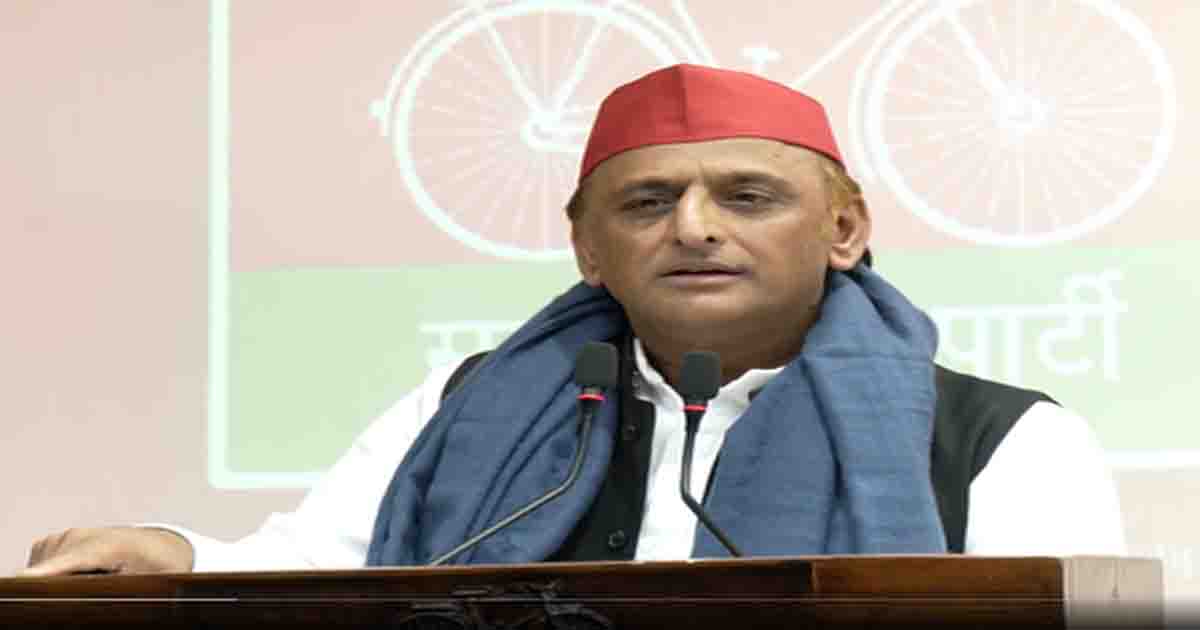
Lucknow, Oct 16: Samajwadi Party (SP) chief Akhilesh Yadav on Friday trained guns at the Election Commission’s new drive titled Special Summary Revision (SSR), stating that it has made the Special Intensive Revision (SIR) “null and void”.
“SIR (voter revision drive) has become zero because SSR has arrived. Isn’t that correct? If the SSR exercise is being conducted, then SIR has become zero now,” Akhilesh Yadav alleged in his address at a gathering here.
The SSR exercise was rolled out by the poll panel on Thursday. In a notification, the EC directed the special revision of electoral rolls in 17 states and Union Territories and also mandated, for the first time, sharing of “machine-readable” versions of voter lists with the political parties.
The SP supremo, taking potshots at the SSR exercise, presented a young voter with multiple registrations in different districts, questioning the efficacy of the drive.
“This young man did not even know how many voter registrations existed in his name. He applied for only one. Look at the gift that the BJP has given him by colluding with the Election Commission,” Akhilesh Yadav said.
Notably, the machine-readable/PDF list of electoral rolls has long been a pending demand of political parties. With the new directives, the panel officials will now provide copies of draft and final electoral rolls to political parties not in image format but in ‘machine-readable’ PDF format.
The SP supremo, unconvinced with the EC’s new revision exercise, remained unsparing in his criticism of the EC and accused it of conspiring with the ruling BJP dispensation for facilitating ‘vote chori’.
He said that when the EC’s wrongdoings were caught during the voter revision exercise across poll-bound states under the SIR, they called it a “minor mistake”, “but this is not an erroneous step but a conspiracy and plot to loot the mandate of people”.
“The protest is taking place because their (EC and BJP) theft is being exposed and their actions are being uncovered. Why are they trying to steal votes? Why are they engaging in theft, conspiracies and manipulation through SIR or SSR?” Akhilesh Yadav asked.
Notably, the SSR drive will be held in 17 states and UTs, where the polling has been completed. According to EC officials, the elections in these states are scheduled next year.
The SSR, an annual exercise, seeks to enrol new eligible voters and update the electoral rolls. Under this, the applicants aren’t expected to submit documents to prove their citizenship or get mapped through previous electoral rolls.

Kajol gives us a glimpse of today’s Anjali as ‘Kuch Kuch Hota Hai’ turns 28 years old

India-US trade deal 98-99 percent done: US official

CJP Tiranga march: Delhi Police circulate list of rules for respecting national flag

NHRC seeks reports on assault on woman in Gujarat, contaminated borewell water in Maharashtra

‘With arrival of SSR, SIR has become zero’: Akhilesh Yadav’s swipe at EC’s new revision exercise in 17 states

Rahul, Cong ecosystem want to force regime change: BJP after Neha Bora praises B’desh Gen-Z protest

BJP pays tribute to ex-President Abdul Kalam, recalls his enduring influence on generations of India’s youth

Mumbai Cyber Cell arrests 6 members of organized gang in major operation; Beware of cyber fraudsters; Digital arrest has no legal status; DCP Bajrang Bansode

INDIA bloc begins protest march against ECI

Maha Congress stages agitation against Gyanesh Kumar
-

 Crime4 years ago
Class 10 student jumps to death in Jaipur
-

 Maharashtra2 years ago
Mumbai Local Train Update: Central Railway’s New Timetable Comes Into Effect; Check Full List Of Revised Timings & Stations
-

 Maharashtra2 years ago
Mumbai To Go Toll-Free Tonight! Maharashtra Govt Announces Complete Toll Waiver For Light Motor Vehicles At All 5 Entry Points Of City
-

 Maharashtra2 years ago
False photo of Imtiaz Jaleel’s rally, exposing the fooling conspiracy
-

 National News2 years ago
Ministry of Railways rolls out Special Drive 4.0 with focus on digitisation, cleanliness, inclusiveness and grievance redressal
-

 Maharashtra2 years ago
Maharashtra Elections 2024: Mumbai Metro & BEST Services Extended Till Midnight On Voting Day
-

 National News2 years ago
J&K: 4 Jawans Killed, 28 Injured After Bus Carrying BSF Personnel For Poll Duty Falls Into Gorge In Budgam; Terrifying Visuals Surface
-

 Crime2 years ago
Baba Siddique Murder: Mumbai Police Unable To Get Lawrence Bishnoi Custody Due To Home Ministry Order, Says Report