
National News
‘Do you want my son to commit suicide’: Sheezan’s mother speaks out

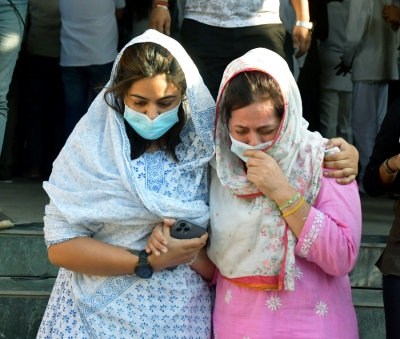
TV actor Sheezan Khan’s mother and his sisters — actresses Shafaq and Falaq Naaz — held a press conference in Mumbai in which they rubbished the allegations of ‘love jihad’ or that Tunisha was forced to wear the hijab.
The family asserted that Tunihsa’s mother ignored the state of her daughtere’s mental health. If she had paid some attention to it, Tunisha would have been alive today, the family alleged.
“Tunisha was like my sister.” Falak clarified. “All this talk about the hijab, dargah are baseless. Following a religion is our own personal choice. People are saying we forced her to wear a hijab, but the picture from one of her ‘Ali Baba: Dastan-e-Kabul’ shoots.”
She added that Tunisha was in her costume and no one forced her to wear a hijab.
Sheezan’s mother referred to the claim by Tunisha’s mother that Falaq had taken her daughter to a dargah. “You give us proof,” she countered.
She also opened up on Vanita Sharma’s accusation that Sheezan had slapped Tunisha. “If your child is being tortured on sets like this, will you just sit and talk on the phone? She used to talk to me over the phone, then why didn’t she tell me or take any action? She could have come to my place and we would have slapped Sheezan. Was she waiting for her daughter to take this extreme step?”
Sheezan’s mother also added that for her, Tunisha was like a 10-year-old child and she shared an incident when she was running high fever, her mother called her to take care of her daughter. Sheezan’s sister took care of Tunisha and Vanita Sharma texted saying that no one ever cared for her like them.
The distraught mother added: “One more thing, Vanita has lost her only child and her lawyer was busy taking a power of attorney. You have lost a child. Your mission should only be to find out why your child took this step. The truth should come out. How can a mother do this?
“Tunisha was like a younger daughter to me. She’s gone and I too want justice for her. But now, Vanita is after my son. What do you want, Vanita ji? Your daughter has committed suicide, do you want my son to commit suicide too? You are torturing him.”
Sheezan’s sister also claimed that Tunisha’s mental health was ignored and if it was given proper attention, she might have been alive. Sheezan’s lawyer Shailendra Mishra even denied that his client had any “mysterious girlfriend”.
Sheezan’s sister responded to the allegation by Tunisha’s mother that she had not been made a part of the family, but the fact is that she was invited to Sheezan’s birthday and even came on Diwali. She was also a part of the launch party of the show.
Mishra, the lawyer, added that Tunisha’s uncle in Chandigarh and her mother controlled her daughter’s finances.
“Tunisha used to panic a lot upon hearing the name of Sanjeev Kaushal. On the instigation of Sanjeev Kaushal, Tunisha’s mother broke her phone and tried to strangulate her. Sanjeev Kaushal and Tunisha’s mother used to control Tunisha’s life,” the lawyer alleged.
He added: “Tunisha was very happy with the time she spent with Sheezan’s family. Her so-called uncle, Pawan Sharma, was her former manager. He was fired four years ago because Tunisha was unhappy with his interference and his behaviour.”
The lawyer also claimed that Tunisha never got the love she needed from her mother and that if she had got that love at home, she would not have tried to find it outside.
He continued: “This was not Tunisha’s first relationship. She had two break-ups before, but she was never depressed like this. She knew Sheezan and his family for the past six months since the show started. When Sheezan wanted to break up, they both discussed the matter and decided to focus on their respective careers. Sheezan’s arrest is illegal.”
Sheezan’s sister alleged that Tunisha was forced to work since childhood and she was mentally traumatised because of that. If proper treatment had been administered to her, she would have been alive today.
The mother added that Sheezan and Tunisha connected with each other because he understood her trauma. They also claimed that Tunisha’s mother ignored her daughter’s mental health and forced her to work. She was even forced to act in music videos because her mother forced to. Tunisha wanted to travel on holidays, but she couldn’t.
Sheezan’s mother said: “We went to meet Tunisha’s mother and we wanted to improve their bond. She needed treatment for her mental health. Later, Tunisha and her mother came and asked for the doctor’s number.”
Sheezan’s sister Falaq addressed the love jihad charge and said: “Tunisha was like my sister. I met her on the sets of a shoot in Ladakh. Since then, I have acted like an elder sister to her. We could never see her in trouble. All this talk about hijab and dargah are baseless.” She added: “Why are you stuck in religious matters? You should be talking about mental health.”
Shafaq added: “It was being claimed that Tunisha had started speaking in Urdu. Kisi language se kya lena dena. We live in India. So, accepting a certain language or a religion does not prove anything. This is a very wrong assumption. Religion is very personal and we will never force anyone.”
The family claimed repeatedly that even after looking at her mental health, Tunisha’s mother always focused on her work.
Sheezan’s lawyer asserted that Tunisha had panic attack on December 16 and her mother was asked to be with her, but she was not there.
“Sheezan has never changed his statement from Day 1 and their break-up was not the reason for her suicide,” the lawyer said. “Tunisha was deprived of love from her childhood. Sheezan never ditched here; they decided mutually to focus on their respective careers. Tunisha was mentally depressed. She was even questioned about her tattoo and never allowed to travel alone,” he added.
The young actress committed suicide on December 24. She hanged herself in the make-up room of her co-star and former boyfriend, Sheezan Mohammed Khan.
Sheezan’s judicial custody has been extended for 14 days, after he was arrested for allegedly abetting Tunisha’s suicide. He was arrested by Valiv Police in Palghar district on December 26.



The Income Tax Department has recently nudged select taxpayers who have invested in residential and commercial properties in the UAE to avail of the Foreign Assets of Small Taxpayers – Disclosure Scheme, 2026 (FAST-DS), offering a one-time opportunity to declare these overseas assets which have been undisclosed so far, according to Finance Ministry sources.
The scheme provides a time-bound window to regularise eligible disclosures by paying 30 per cent tax on the fair market value and an equal amount of penalty in addition to tax. A crucial feature of the scheme is that it is fully online, trust-based, and self-declaratory.
A valid declaration brings immunity from further assessment, penalty and prosecution under the Black Money (Undisclosed Foreign Income and Assets) and Imposition of Tax Act, 2015 (Black Money Act). The scheme further provides an opportunity to taxpayers to report unaccounted assets and income on payment of a Rs 1 lakh fee to avoid a penalty of Rs 10 lakh each year prescribed in the Black Money Act.
Till now, approximately 1,100 taxpayers have filed applications under the scheme, which is open till December 31, 2026, sources said.
The Central government has launched the Foreign Assets of Small Taxpayers – Disclosure Scheme, 2026 (FAST-DS), offering a one-time opportunity to disclose foreign assets and income that have been undisclosed so far.
To facilitate taxpayers, the Department has created a facility in the e-filing portal where a taxpayer can see information with respect to assets reported on their PANs by the foreign jurisdictions under Automatic Exchange of Information (AEOI), popularly known as CRS/FATCA. Taxpayers can log in to the e-filing portal and download this information for the three-year period 2022-2024.
Sources informed that the information received under AEOI from the signatories of CRS/FATCA frameworks has only been displayed in the e-filing portal. Department receives information under other multilateral frameworks which has not been displayed in the portal due to various risk factors or non-disclosure commitments. Further, the Income Tax Department collects information from other sources as well. The Department decided, in a high-level meeting on October 23, that such information may also be shared with relevant taxpayers, wherever possible, to enable them to take advantage of the scheme.
The Income Tax Department has also planned outreach programmes to create awareness among taxpayers, corporates as employers, educational institutes, professional bodies and industry associations. The Central Board of Direct Taxes (CBDT), which is the apex body that heads the Income Tax Department, has also made a Committee in each region under the Principal Chief Commissioner to help taxpayers resolve their queries and concerns.
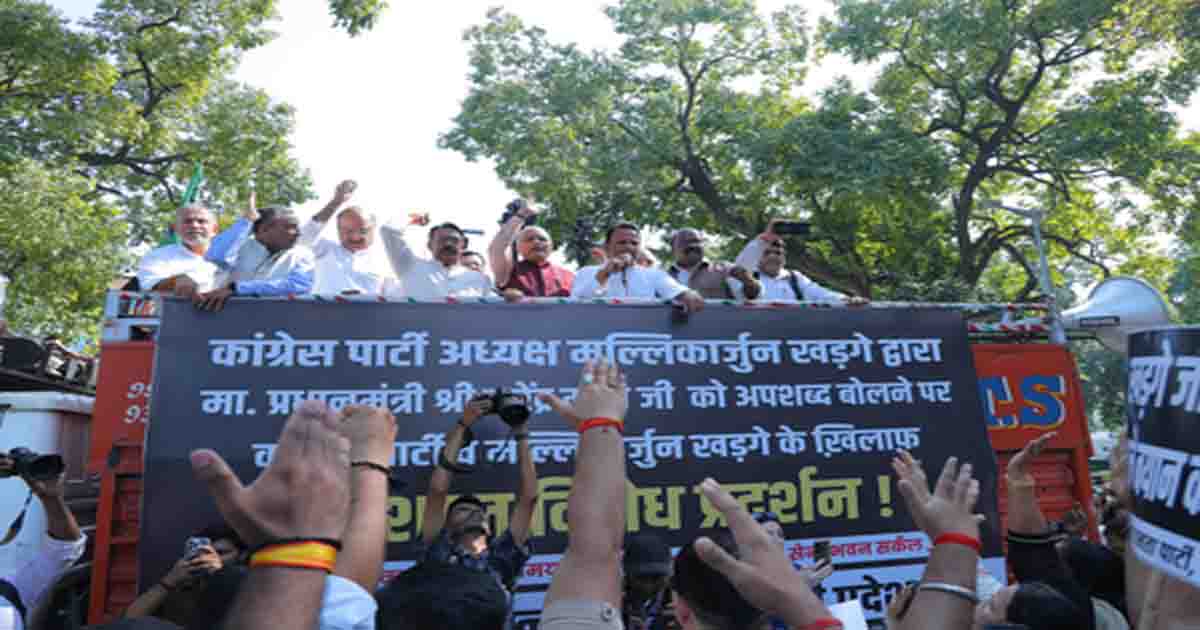
Demanding an apology, Delhi BJP President Harsh Malhotra on Monday led a massive protest near the residence of Congress President Mallikarjun Kharge at Rajaji Marg, opposing his alleged insulting remarks about the late father of Prime Minister Narendra Modi during a meeting in Patna a day earlier.
Malhotra said, “We have gathered at Kharge’s residence today to tell him that PM Modi is not merely a senior leader of the Bharatiya Janata Party, but one of the top leaders in the world and the Prime Minister of India. Kharge must apologise for his remarks.”
Our movement and protest will continue till Kharge apologises, he said, adding that wherever Kharge goes to address the public, the citizens and BJP workers will demand answers from him.
Malhotra said the entire Congress, whether it is Rahul Gandhi or Congress President Kharge, has become frustrated.
“After suffering continuous electoral defeats, they are unable to understand what to do. They repeatedly resort to creating an atmosphere of anarchy and behave as though they do not respect the law,” he said.
“They want to stage protests outside the Supreme Court, organise rallies and attempt to enter the Supreme Court premises, and at times even reach the gates of Parliament. They are people who do not respect constitutional institutions or the laws of the country,” he said.
Malhotra said that a few months ago, they attempted to shut down Delhi, which affected the entire business community of the city.
“Even today, without caring about the law, they are continuously attempting to hold protests and demonstrations at various places in Delhi, including Connaught Place, in violation of the law. By mobilising disruptive and anarchic elements, they are attempting to create an atmosphere of anarchy in Delhi and across the country,” he said.
Malhotra said Congress leaders’ frustration is increasing because the people are not with them.
“Their own people and workers are not with them, and whenever by-election results are announced, and the Congress and opposition parties suffer defeats there as well, their frustration increases further,” he said.
The protest against Kharge was joined by Delhi BJP In-charge Vinay Sahasrabuddhe and 2,000 workers of the Delhi BJP Purvanchal, Yuva and OBC Morchas.
The protest, conducted by Delhi BJP General Secretary Mohan Lal Gihara, saw party workers march towards Kharge’s residence after the leaders addressed the gathering.
Police attempted to stop the workers by putting up barricades at the Kushak Road turn. When the workers broke through the barricades and proceeded further, a heavy police contingent stopped them near Sena Bhawan.
The police then detained around 200 senior office-bearers and workers, including Delhi BJP President Malhotra, and took them to Mandir Marg Police Station in five buses.
Sahasrabuddhe said that PM Modi comes from an ordinary family and is serving the country, reaching the office of Prime Minister after immense struggle.
“An attempt has been made to insult that journey. The kind of objectionable language used by the Congress President does not befit the president of the country’s oldest political party,” he said.
Delhi BJP Vice President Rajesh Bhatia said that the Congress’ cheap mentality has once again been exposed.
Delhi BJP General Secretary Mohan Lal Gihara said that Kharge has crossed all limits of decency.
Delhi Purvanchal Morcha President Santosh Ojha said that by insulting the Prime Minister’s father, Kharge has also insulted the Purvanchal community.
Yuva Morcha President Rajat Chaudhary said that the youth rejects Congress’ politics of abusive language.
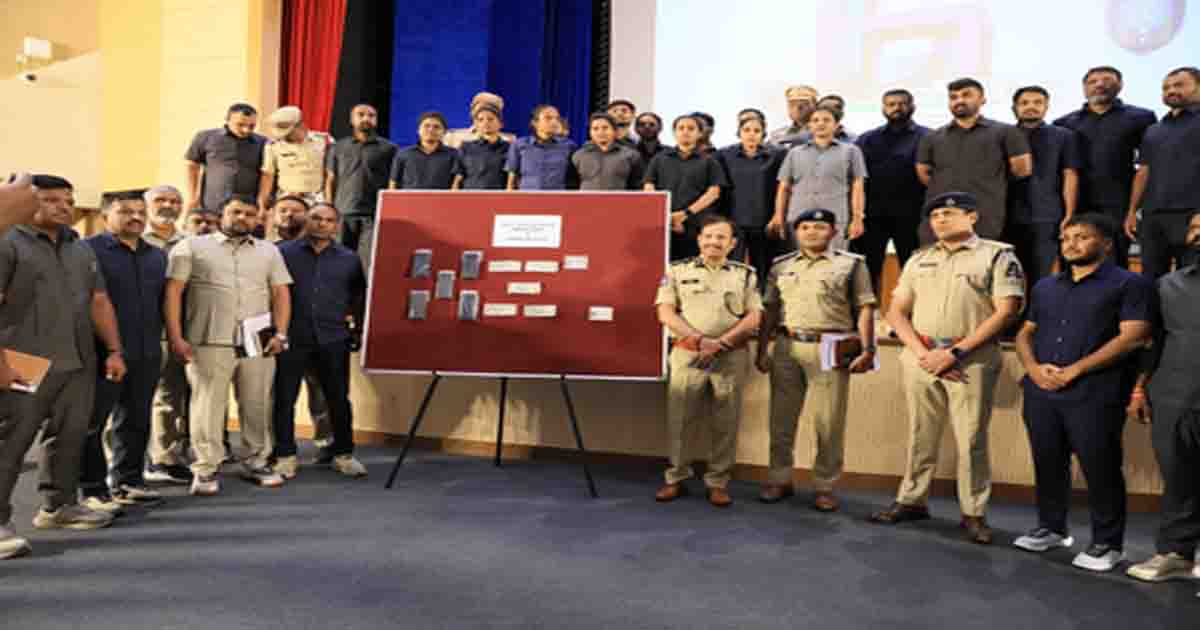
More than five months after Tanuja Ranjan, wife of retired Indian Police Service (IPS) officer Ray Vinay Ranjan, was brutally murdered at their residence in Hyderabad, police on Monday arrested four Nepalese.
Those arrested include the domestic worker, Dharma Tiruwa alias Kalpana, who had worked at the victim’s residence.
The arrests were made following a five-month-long investigation spanning several states and the India-Nepal border.
Hyderabad Police Commissioner V. C. Sajjanar announced the arrests at a press conference.
A Special Investigation Team (SIT), probing rising property offences committed by Nepali gangs across the three Police Commissionerates, arrested four accused near Nampally Railway Station on Monday (October 26).
Dharma alias Kalpana, 26, is from Surkhet district in Nepal. Ganesh B.K. alias Ganesh Bishwakarma alias Dinesh Thapa, 31, is a labourer who was residing in Pune; Chandra Bahadur Tamang alias Ranjeet Thapa alias Shanker Chandra Lama alias Kancha, 44, a cook whose listed Indian address is in Gurugram, Haryana; and Ganesh Bahadur Shahi, 37, a watchman who was residing in Pune.
Police said two other accused remained absconding and that teams were continuing efforts to trace them. The police had earlier arrested two other accused in the case.
Police said the accused entered the house in Prashasan Nagar on the night of May 7–8, restrained Tanuja Ranjan and smothered her. They allegedly escaped with 225 grams of gold jewellery and other valuables.
The police investigation revealed that Dharma came to Hyderabad in June 2025 through a relative and began working as a domestic help at the Jubilee Hills residence for a monthly salary of about Rs 20,000. During her employment, she allegedly remained in contact with Bikas, a Nepal national based in Pune, who repeatedly asked about her employer, the household’s assets and the valuables inside the house. He eventually proposed a robbery in return for a share of the proceeds. In April 2026, Dharma travelled to Pune to visit her ailing father and came into contact with other members of the alleged gang.
On May 4, when her employer left for Bengaluru, she allegedly alerted the group. The police account says Ganesh Bahadur Shahi, Shanker Chandra Lama and Sunil Pariyar met at Kalamboli in Raigad district, Maharashtra, on May 4 and travelled to Pune in a hired Maruti Ertiga. The next day, they met other alleged accomplices, including Ganesh B.K., before setting out for Hyderabad.
On the morning of May 7, Ganesh B.K. and Suresh Shahi allegedly met Dharma near her workplace, surveyed the premises and discussed how the group could enter the house. Two groups allegedly carried out the operation.
According to police, the gang assembled at Ravindra Bar near the Mahatma Gandhi Bus Station area on the evening of May 7. It allegedly split into two groups under a plan devised by Sujan Shahi, also known as Suresh Shahi. One group, comprising Ganesh B.K., Suresh Shahi and Shanker Lama, was assigned to enter the house and carry out the robbery. The other, comprising Ganesh Bahadur Shahi, Sunil Pariyar and Netra Shahi, allegedly remained near Nampally railway station as a lookout team.
During the intervening night of May 7 and 8, Dharma allegedly opened the door to let the others in. Police said Tanuja woke up during the incident. The attackers allegedly gagged and restrained her, causing her death by suffocation. The group then searched the house, broke open cupboards and took gold jewellery and other valuables.
After leaving through the rear gate, the accused allegedly travelled to Nampally and joined the lookout team.
Investigation revealed that the group subsequently travelled towards Kazipet, moved into isolated hilly terrain and divided the stolen property into nine equal shares. Members then split into smaller groups, fled towards Nepal and disposed of the valuables at different locations.
On May 22, Task Force teams arrested Sunil Bahadur Aauji alias Sunil Pariyar and alleged receiver Dilip Bahadur Mijar alias Sonar. Police recovered 26 grams of the stolen property from them.
The investigation continued across Bengaluru, Mumbai, Pune, Surat, Patna, Delhi, Lucknow and Uttarakhand. The SIT also carried out field inquiries near the India-Nepal border, spending more than five months gathering intelligence in remote and hilly areas.
Police said local informers helped the team track the suspects’ alleged hideouts, travel routes, employment and contacts.

Income Tax Dept nudges taxpayers owning undeclared properties in UAE

Delhi BJP protests near Kharge official residence over remark on PM Modi

Maha: State Board approves Wildlife Sanctuary status for two reserves; notifies 14 new conservation reserves

Nepali gang arrested for murder of retired IPS officer’s wife in Hyderabad

Raj Thackeray slams urban planning, traffic crisis in Navi Mumbai; says he awaits power in Maharashtra

Rahul, Cong ecosystem want to force regime change: BJP after Neha Bora praises B’desh Gen-Z protest

Attack on democratic rights: INDIA Bloc leaders on detentions of anti-ECI protestors

BJP pays tribute to ex-President Abdul Kalam, recalls his enduring influence on generations of India’s youth

INDIA bloc begins protest march against ECI

Maha Congress stages agitation against Gyanesh Kumar
-

 Crime4 years ago
Class 10 student jumps to death in Jaipur
-

 Maharashtra2 years ago
Mumbai Local Train Update: Central Railway’s New Timetable Comes Into Effect; Check Full List Of Revised Timings & Stations
-

 Maharashtra2 years ago
Mumbai To Go Toll-Free Tonight! Maharashtra Govt Announces Complete Toll Waiver For Light Motor Vehicles At All 5 Entry Points Of City
-

 Maharashtra2 years ago
False photo of Imtiaz Jaleel’s rally, exposing the fooling conspiracy
-

 National News2 years ago
Ministry of Railways rolls out Special Drive 4.0 with focus on digitisation, cleanliness, inclusiveness and grievance redressal
-

 Maharashtra2 years ago
Maharashtra Elections 2024: Mumbai Metro & BEST Services Extended Till Midnight On Voting Day
-

 National News2 years ago
J&K: 4 Jawans Killed, 28 Injured After Bus Carrying BSF Personnel For Poll Duty Falls Into Gorge In Budgam; Terrifying Visuals Surface
-

 Crime2 years ago
Baba Siddique Murder: Mumbai Police Unable To Get Lawrence Bishnoi Custody Due To Home Ministry Order, Says Report