
Maharashtra
‘Woman’s right to choose…’ Bombay HC allows termination of 32-week pregnancy with foetal abnormalities

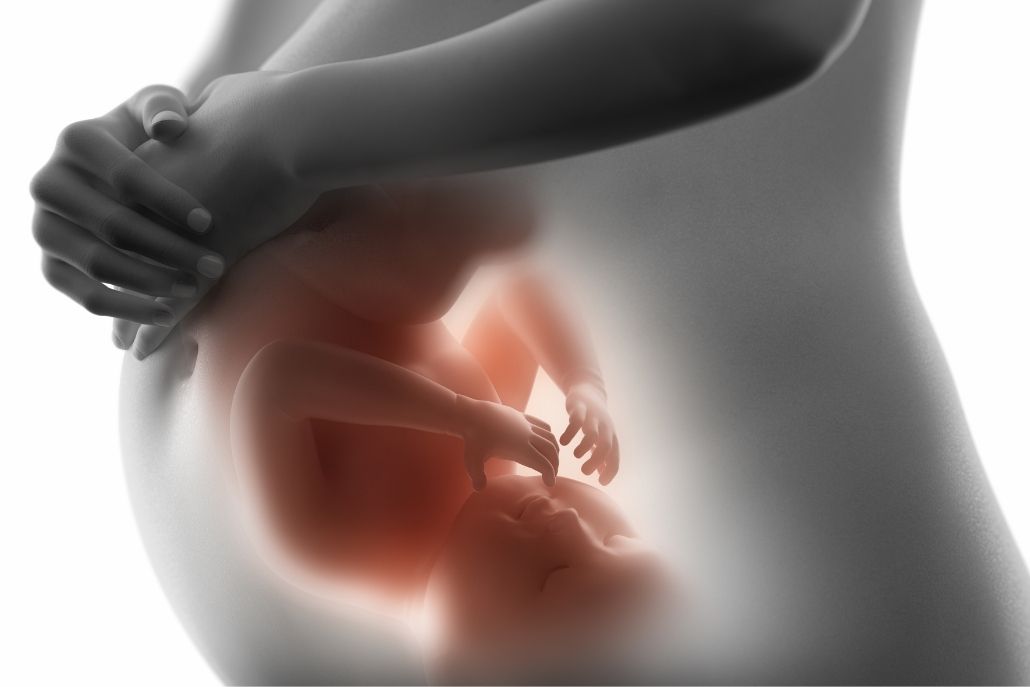
A woman has the right to choose whether to continue her pregnancy or not and the decision is hers and hers alone to make, the Bombay High Court said while allowing a married woman to terminate her 32-week pregnancy after the foetus was detected with severe abnormalities.
The woman had approached HC seeking to terminate her pregnancy after a sonography revealed the foetus had severe abnormalities and that the baby would be born with physical and mental disabilities.
“Given a severe foetal abnormality, the length of the pregnancy does not matter. The petitioner has taken an informed decision. It is not an easy one. But that decision is hers, and hers alone to make. The right to choose is of the petitioner’s. It is not the right of the Medical Board,” the court said in its order.
Refusing termination of pregnancy only on grounds of delay would not only be condemning the foetus to a less than optimal life but would also be condemning the mother to a future that will almost certainly rob her of every positive attribute of parenthood, the HC said.
Denial of her right to dignity
“It would be a denial of her right to dignity, and her reproductive and decisional autonomy. The mother knows today there is no possibility of having a normal healthy baby at the end of this delivery,” the court said.
“Accepting the Medical Board’s view is not just to condemn the foetus to a substandard life but is to force on the petitioner and her husband an unhappy and traumatic parenthood. The effect on them and their family cannot even be imagined,” it added.
The petitioner’s foetus is detected with both microcephaly and lissencephaly, and this is what the future portends, the bench said.
Asserting that the rights of the woman should never be compromised in the “blind application of a statute”, the court said, “Justice may have to be blindfolded; it can never be allowed to be blindsided. We are agnostic about the relative positions of parties. We can never be agnostic about where justice needs to be delivered.”
Moral dilemma
It said cases such as this often raise profound moral questions and dilemmas, but it is immutable that the “arc of the moral universe always bends towards justice”.
The bench said the existence of the foetal anomaly, as well as its severity, was certain as also the fact that it was detected late.
“Because it is difficult to predict at birth what problems will occur, microcephalic babies need constant and regular follow up and check-ups with health care providers. There is no known cure or standard treatment for it. In more extreme cases, microcephalic babies need intervention almost constantly,” the court said.
Most disturbingly, the prognosis for children with lissencephaly depends on the degree of brain malformation, it added.
The bench noted the medical board did not take into account the social and economic position of the couple.
“It ignores their milieu entirely. It does not even attempt to envision the kind of life, one with no quality at all to speak of, that the petitioner must endure for an indefinite future if the Board’s recommendation is to be followed,” the HC said.
“The Board really does only one thing: because late, therefore no. And that is plainly wrong, as we have seen,” the court said while allowing the pregnancy to be terminated.

Maharashtra
Kasturba Marg Police recover 100 stolen mobile phones, return them to their original owners

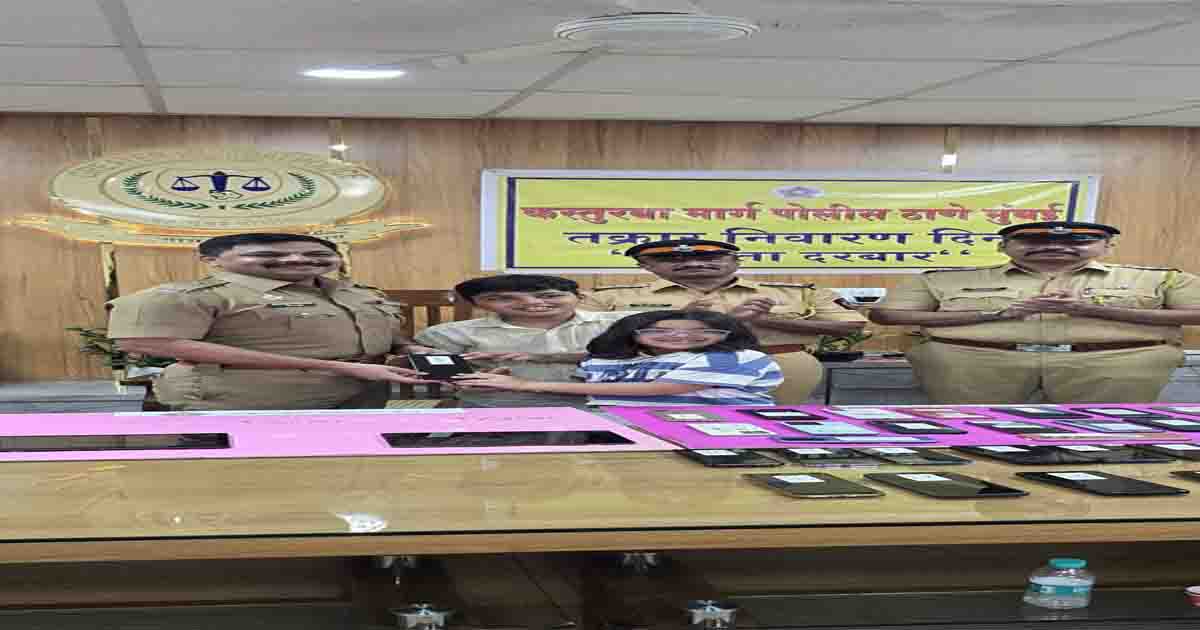
Acting on complaints regarding stolen and lost mobile phones within the jurisdiction of the Kasturba Marg Police Station in Mumbai, police analyzed data from the CEIR portal and conducted technical investigations. By verifying device details, IMEI numbers, and user information, officers from the Kasturba Marg Police Station tracked down and recovered a total of 100 mobile phones from locations across Mumbai and other parts of Maharashtra.
The total estimated value of the 100 recovered mobile phones is ₹2,270,658. Of these, 18 phones have already been returned to their respective owners/complainants, including: 1) Rajendra Puri, 2) Khush Saw, 3) Kripa Lodhiya, 4) Shreya Satam, 5) Atul Sathe, 6) Priyanka Mistri, 7) Banu Tarang, 8) Prem Gupta, 9) Adya Shaikh, 10) Shweta Shah, 11) Sandhya Pandit, 12) Deepak Sawdekar, 13) Saurabh Jhangar, 14) Ketan Shete, 15) Onkar Raut, 16) Jayalal Yadav, 17) Lakshmi Appa Kripagiri, and 18) Praveen Dubey. The process of returning the remaining phones to their owners is currently underway.
This operation was carried out under the supervision of the DCP (North, Zone 3), Mumbai, by the team at Kasturba Marg Police Station, led by Balasaheb Bunkar.
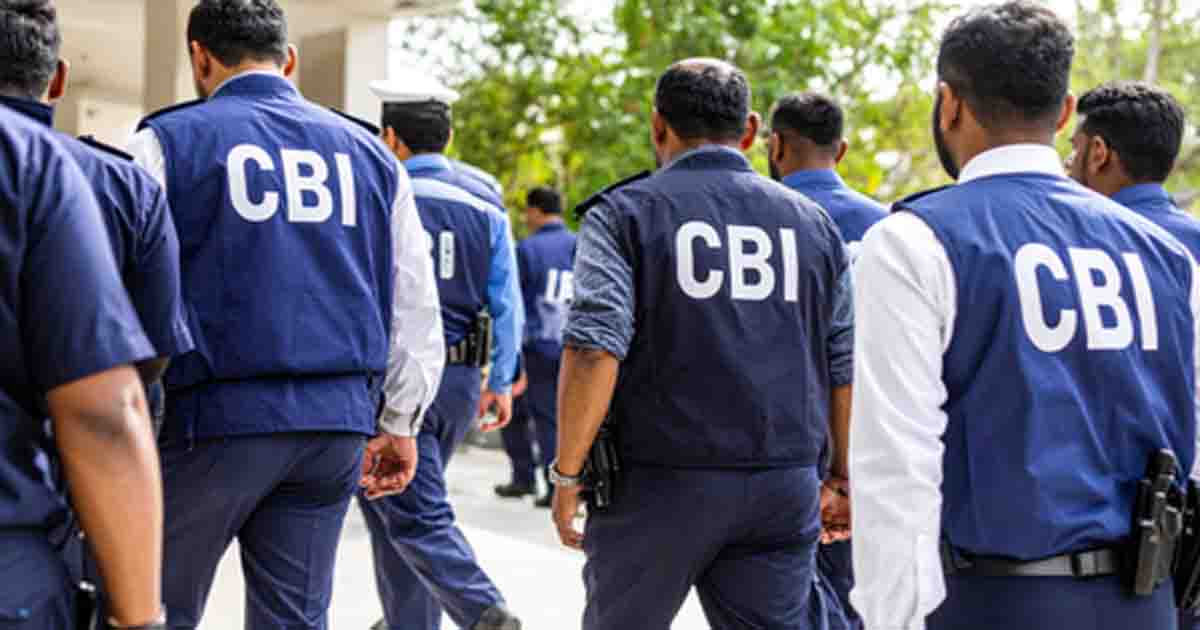
Mumbai, Oct 3: The Central Bureau of Investigation (CBI) conducted searches at multiple premises in Mumbai and registered a Rs 93.44 crore bank fraud case against officials of Hanjer Biotech Energies on the complaint of Punjab National Bank, an official said on Saturday.
The CBI conducted searches on Friday at multiple premises linked to the directors of Hanjer Biotech Energies in Mumbai, the CBI said in a statement.
The CBI registered the instant case on September 30, 2026, on the complaint of Punjab National Bank, SAM Branch, Mumbai, against Hanjer Biotech Energies, its directors and guarantors, unknown public servants and unknown private persons.
The accused were booked for offences of criminal conspiracy for cheating and offences under the Prevention of Corruption Act, resulting in alleged wrongful loss of approximately Rs 93.44 Crore to the bank.
It was alleged that the accused entered into a criminal conspiracy, obtained term loan of Rs 135 crore on the invoices of its related party and diverted/siphoned off the funds for other purposes for which it was not sanctioned, causing loss to the bank, the CBI said.
During the searches on Friday, incriminating bank documents and property documents relevant to the investigation were recovered and seized.
Investigation is continuing to ascertain the full extent of the conspiracy, identify the role of all involved persons, including public servants and private individuals, and trace the end-use of the loan funds, the CBI said.
In a separate case on Friday, the CBI arrested an Executive Engineer of the Central Public Works Department (CPWD), Mumbai, his relative and three officials of a Mumbai-based real estate group, in a Rs 50 lakh bribery case related to the issuance of a No-Objection Certificate (NOC) for a land parcel.
Vikrant Verma, Executive Engineer, CPWD Mumbai; Saurav Gupta, Verma’s relative based in Pune; and Arvind Semwal, Vice President, Baya Company, were among those named in the FIR by the Central Bureau of Investigation (CBI) on Thursday, an official said.
The arrested accused were produced before the Special CBI Judge in Mumbai on Friday, the official said in a statement.
Maharashtra
Monsoon Withdraws Further from Maharashtra; Hot and Humid Weather Alert Issued for Konkan Region

MUMBAI PRESS — The India Meteorological Department (IMD) announced on Saturday, October 3, 2026, that the Southwest Monsoon has withdrawn from parts of Maharashtra, as well as the remaining regions of North India, Gujarat, and Madhya Pradesh.
The current withdrawal line of the Southwest Monsoon passes through Harnai, Baramati, Parbhani, and Brahmapuri in Maharashtra, extending northeastward through Raipur, Ranchi, and Supaul. Weather officials stated that conditions are favorable for further retreat from most parts of Marathwada, Vidarbha, and additional areas of Madhya Maharashtra over the next 2 to 3 days.
Hot and Humid Stretch for Coastal Maharashtra
Residents in the coastal belt should prepare for elevated discomfort over the weekend. The IMD has issued a hot and humid weather warning for Konkan & Goa prevailing from October 3 through October 5.
Following this dry and muggy stretch, mild weather activity is expected to return to the region. Isolated to scattered rainfall is forecast across Konkan & Goa and Madhya Maharashtra between October 6 and October 9.
Southern and Northeastern Forecast
While monsoon forces retreat from central and northern parts of India, southern states are bracing for heavy downpours. Isolated heavy rainfall is predicted over Kerala, Mahe, Tamil Nadu, Puducherry, and Karaikal from October 4 to October 6, with South Interior Karnataka expected to receive heavy spells on October 5 and 6.
In the northeast, isolated heavy rainfall is expected to continue over Assam, Meghalaya, and Arunachal Pradesh through October 3.
Advisory for Fishermen
Due to lower-tropospheric cyclonic circulations over the Arabian Sea, the IMD has urged fishermen not to venture into the sea along and off the Kerala coast, Lakshadweep, Maldives, and the Comorin area on October 3. Farmers in heavy rainfall zones have also been advised to ensure proper field drainage and move harvested crops to covered storage to prevent crop damage.

Deported narco-trafficking kingpin Navpreet Singh sent to 10-day police custody

Kasturba Marg Police recover 100 stolen mobile phones, return them to their original owners

Iran to pursue US seizure of commercial ship during truce in international courts: official

SP changes 2 MLC candidates in UP; fields Akash Agrawal, Sanjay Tripathi

Capt Smit Machchhar under excellent medical care, recovering well: Indian Embassy in UAE

Gift to President Putin part of PM Modi bid to globally display India’s heritage

PM Modi’s warm camaraderie with Putin, Xi on full display at BRICS Summit

Corporators of all parties in trouble! Corporators of all major parties including Shiv Sena (UBT), BJP and Congress are facing legal challenges.

Complaint against Netflix & Mukesh Chhabra for inappropriate language on ‘India’s Got Latent 2’

Maha Congress stages agitation against Gyanesh Kumar
-

 Crime4 years ago
Class 10 student jumps to death in Jaipur
-

 Maharashtra2 years ago
Mumbai Local Train Update: Central Railway’s New Timetable Comes Into Effect; Check Full List Of Revised Timings & Stations
-

 Maharashtra2 years ago
Mumbai To Go Toll-Free Tonight! Maharashtra Govt Announces Complete Toll Waiver For Light Motor Vehicles At All 5 Entry Points Of City
-

 Maharashtra2 years ago
False photo of Imtiaz Jaleel’s rally, exposing the fooling conspiracy
-

 National News2 years ago
Ministry of Railways rolls out Special Drive 4.0 with focus on digitisation, cleanliness, inclusiveness and grievance redressal
-

 Maharashtra2 years ago
Maharashtra Elections 2024: Mumbai Metro & BEST Services Extended Till Midnight On Voting Day
-

 National News2 years ago
J&K: 4 Jawans Killed, 28 Injured After Bus Carrying BSF Personnel For Poll Duty Falls Into Gorge In Budgam; Terrifying Visuals Surface
-

 Crime2 years ago
Baba Siddique Murder: Mumbai Police Unable To Get Lawrence Bishnoi Custody Due To Home Ministry Order, Says Report