
Business
Union Budget 2022-2023 garners mixed response from country’s leading educationalists


The Union Budget gains applause for digitalization of education and making it accessible at the grassroots level. Still, many believe more could have been done to elevate the quality of education as well.
The leading names among the country’s higher education fraternity welcomed the Union Budget 2022, announced by Finance Minister Nirmala Sitharaman on February 1. The sector appreciated the budget being in line with promoting human capital through digital tools such as the ‘one class one TV channel’ programme proposed under the PM e-Vidya scheme.
It laid out a progressive vision the Government holds for capitalizing on India’s demographic advantages by suggesting a digital university, creating a conducive environment for inter-university collaborations, and introducing a number of skill development programmes. The Union budget 2022-2023 has allocated Rs 63,449.37 crore to the Department of School Education and Literacy, an increase of about 6.6 per cent (Rs 9,000 crore) over the current financial years. It sets a straight road for the Government to achieve its long-term mission of increasing the employability of the country’s youth by promoting upskilling, reskilling and several learning measures equipping them with new-age skills.
Dilip Puri, Founder & CEO, Indian School of Hospitality, appreciated the move stating, “We welcome the new initiatives introduced by the Government in the Union Budget 2022 to revive and boost our economy. The Government has identified areas that need financial assistance and support, and a clear focus is laid on the education sector. The setting up of digital universities is a progressive move by the Government – by reaching out to every student in the remote corners of our country, they will give them access to education by collaborating with world-class institutes and educators. We hope the execution comes through swiftly and accelerates the growth of edtech. We are also delighted that the Government showed specific interest to promote and facilitating upskilling and reskilling programmes. We hope through continuous skilling avenues we are able to direct our efforts towards skilling aspirants and increase employability in the hospitality sector.”
Shishir Jaipuria, Chairman FICCI Arise and Chairman Seth Anandram Jaipuria Group of Educational Institutions, also commended the government’s efforts in aligning the budget provisions with the progressive elements of National Education Policy 2020.
Shishir Jaipuria said, “The Union Budget 2022 takes forward the vision of universalizing quality education as enshrined in the National Education Policy 2020. The decision to expand the PM e-VIDYA scheme to 200 TV channels and to also develop high-quality e-content in all spoken languages will benefit the students of grades 1 to 12, who suffered learning loss due to the closure of schools during the Covid-19 pandemic.
“The formation of Digital University, as announced in the budget, will be a laudable initiative. The Digital University will help to make world-class education accessible in different Indian languages to all students, even in far-flung areas. The simultaneous proposal to train teachers to build their competency and empower them to develop quality e-content will ensure better learning outcomes. I welcome the move to set up 750 e-labs in science and mathematics and 75 skilling e-labs that will nurture scientific temperament and critical thinking skills important for 21st-century learners.
“Going beyond the e-learning initiatives, the government has rightly decided to designate five academic institutions as ‘centres of excellence to deliver courses in urban planning and design. The move will take forward the vision of India-specific urban development. The budget 2022 is aimed at providing a major push to e-learning, reduce learning gaps and make education inclusive.”
Niranjan Hiranandani, Provost – HSNC University appreciated the government’s construct of a well-rounded budget, promoting equal accessibility of education and growth mindset among students, irrespective of their backgrounds.
Hiranandani said, “Industry lauds & welcomes the thrust to the digital ecosystem while focussing on building and upgrading the digital infrastructure for quality education. Setting up of digital universities will enhance the availability of education to the rural students following the hub and spoke model. With easy access to education in regional language, every student will get an opportunity to empower and equip themselves.
“Moreover, measures for quality e-content appear promising to educate teachers effectively for better e-teaching outcomes. Besides, there is a surge in the scope of personalized learning, especially in the digital ecosystem. The budget also puts required emphasis on skilling, which makes an individual employable and sustainable. The skilling courses will not just encourage learners to apply critical thinking and creativity but also make them industry-ready, which is evidence of shaping the youth of India for a better future.”
Understanding the need for skill-based education, Bikram Agarwal, CFO, Seth Anandram Jaipuria Group of Educational Institutions, praised the budget offerings.
Agarwal said, “The most important takeaway of the Union Budget 2022 is the slew of decisions that have been taken to empower the digital learning ecosystem in the country. The formation of Digital University and the initiative to create quality e-content in all Indian languages will make learning inclusive for all. Besides these moves to nurture academic rigour, the decision to launch the DESH-Stack e-portal will help to skill and upskill learners.
“At the same time, the Government aims to improve learning at Agriculture University by revising and revamping the syllabus to address the practical needs of modern agriculture. I also appreciate the decision to involve academia in defence research and development for better designing and development of military platforms and equipment. The scope of this budget is quite wide. It touches upon several aspects of the education sector and is to be lauded.”
While many applauded these moves, some believed that the government could have done more. The budget critics felt that this year saw lesser investments and initiatives relative to the last year’s budget for promoting quality education across all strata of society.
Reacting to the budget, Professor Tarun Jain, Associate Professor of Economics, IIM Ahmedabad, said, “The Finance Minister has mentioned supplementary teaching through additional TV channels (PM eVidya) to make up for the education loss of the last two years. This is minuscule given the tremendous learning loss that our children have experienced. Significant investments in improving school quality are critical for ensuring that our demographic dividends are actually realized. This has to run against the reality that barely 8 per cent of rural students and 23 per cent of urban students have access to the Internet.
Even when students have Internet access, the quality of online education remains poor. We have to benchmark the budget commitments against the aspirations of the Indian people. High-quality education is both a critical component of what young people hope for, and also have some of the highest returns on investment in the economy. Thus, the Government should consider boosting investments in public education considerably.”
Overall the Union Government received a favourable response for its budgetary recommendations to promote skill-based learning powered by digitalization. From short-term skilling programmes to upskilling, reskilling, apprenticeships and lifelong learning, a wide range of training opportunities have been put across by setting up thousands of skill centres and special training centres. The budget ensured that the Government’s focus on skill training would continue to make youth employable, further contributing to the country’s growth and economic health.


Mumbai, Oct 12: Domestic equity benchmark indices opened higher on Monday amid positive factors like gains in Asian markets and a decline in crude oil prices.
Nifty began trading session at 22,593.20, up 72.75 points or 0.32 per cent.
Meanwhile, Sensex opened at 72,771.32, up 298.99 points or 0.41 per cent.
In early deals, mostly sectoral indices were trading in positive territory. Nifty Media, Nifty Auto and Nifty Chemicals jumped up to 1 per cent.
Similarly, Nifty Realty, Nifty Oil & Gas, Nifty Cement, Nifty Metal and Nifty IT surged between 0.81 per cent to 0.64 per cent. However, other sectoral indices were also trading marginally higher.
On the downside, Nifty PSU Bank just slipped 0.01 per cent.
Market experts said external headwinds are dominating domestic tailwinds, adding that the market is going through a stage wherein external headwinds are dominating domestic tailwinds.
Elevated crude prices and high US bond yields will continue to impact market. FIIs will continue to sell in the near term, and DIIs will continue to absorb FII selling, according to them.
Moreover, an impressive GDP growth estimate of 7.1 per cent for FY27 and improving corporate profitability provide strong fundamental support to the market, the experts said.
“Therefore, investors can accumulate fairly valued growth stocks ignoring uncertainty and volatility in market. For investors with medium-to-long-term horizon, this market provides value buying opportunities. Patience is key,” they added.
They further noted that if crude declines sharply following favourable developments in the Middle East, the market can rally significantly from current levels.
Technically, Friday’s bounce and inside bar formation set up an environment for a rise to 22,800-23,200. However, inability to close above 22,575 will keep trend within bear grip. Downside marker for day may be kept at 22,295, Friday’s reaction low, another analyst said.
In addition, asian markets opened cautiously today in early hours as investors braced for earnings season which could test elevated technology valuations.
Oil prices eased on prospects of higher Russian supplies following agreement to halt attacks on energy facilities.

New Delhi, Oct 11: Indian Railways has announced 3,548 graduate-level vacancies for jobs under the Non-Technical Popular Categories (NTPC–Graduate), which provide opportunities for graduates to work across different functional areas of railway operations and administration, according to an official statement issued on Sunday.
The recruitment through Centralised Employment Notification issued by the Railway Recruitment Boards (RRBs) covers four categories of posts, including Chief Commercial Cum Ticket Supervisor, Goods Train Manager, Junior Accounts Assistant Cum Typist, and Senior Clerk Cum Typist. These positions offer career opportunities across commercial services, train operations, accounts and administration, supporting the efficient functioning of railway services across the country, the statement said.
Of the total 3,548 vacancies, as many as 2,750 are for Goods Train Manager, followed by 371 for Senior Clerk Cum Typist, 300 for Junior Accounts Assistant Cum Typist, and 127 for Chief Commercial Cum Ticket Supervisor.
The posts offer initial basic pay under the Seventh Central Pay Commission. Chief Commercial Cum Ticket Supervisor carries an initial basic pay of Rs 35,400 per month at Pay Level 6, while the other three categories carry an initial basic pay of Rs 29,200 per month at Pay Level 5. Applicable allowances and service conditions will be governed by the relevant rules.
The online application process commenced on October 8, and eligible candidates can submit their applications until 11:59 p.m. on November 6. The last date for payment of the examination fee is November 8, while the application modification window is scheduled from November 9 to 18 November.
Candidates must possess a degree from a recognised university or its equivalent and fulfil the prescribed post-specific eligibility conditions. The notified age limit is 18-33 years as on January 1, 2027, with applicable age relaxations for eligible categories under the prescribed rules.
The selection process comprises a first-stage Computer-Based Test (CBT), a second-stage CBT, followed by document verification and medical examination, as applicable. The recruitment framework also provides applicable reservation and age-relaxation benefits, along with scribe assistance and compensatory time for eligible candidates with disabilities, in accordance with the prescribed provisions.
Another provision under CEN No. 06/2026 is the dispensation of the Computer-Based Typing Skill Test (CBTST) for the posts of Junior Accounts Assistant Cum Typist and Senior Clerk Cum Typist. Candidates are nevertheless expected to possess basic computer and typing proficiency, which will be assessed after joining, as specified in the notification, the statement said.
Candidates can access the detailed notification, vacancy distribution, eligibility criteria and recruitment updates through the official Railway Recruitment Boards website:https://rrb.indianrailways.gov.in
Business
BMC to crack down on illegal debris disposal, impose Rs 25,000 fine for tracking violations

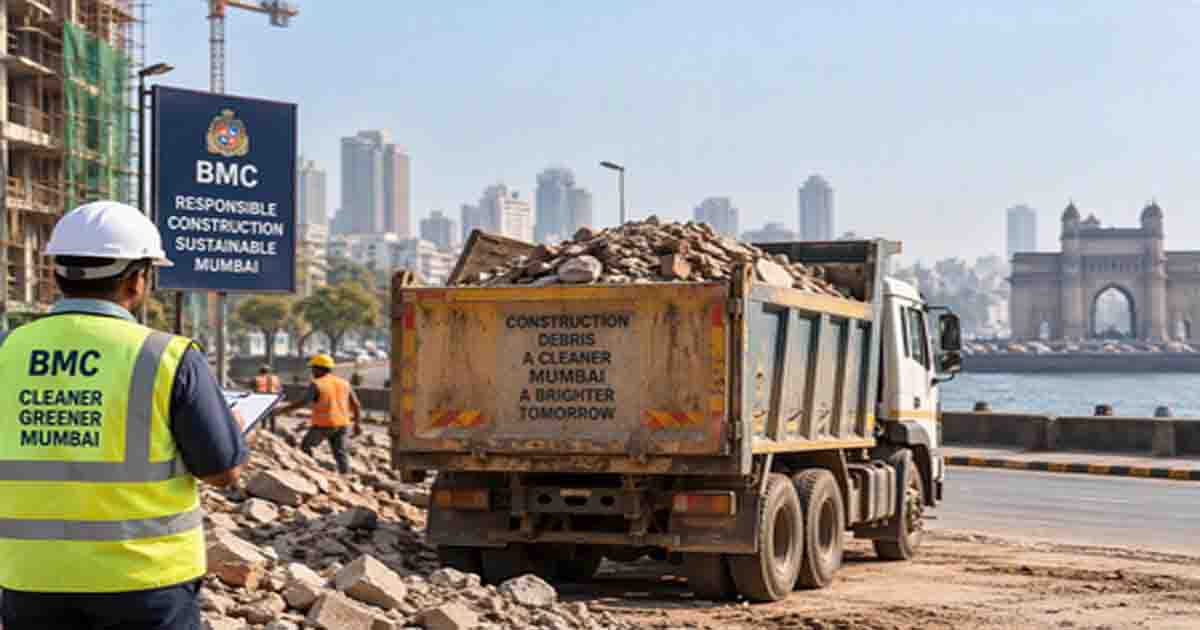
Mumbai, Oct 11: As air quality concerns begin to resurface following the withdrawal of the monsoon, the Brihanmumbai Municipal Corporation (BMC) is reportedly set to tighten enforcement of construction and demolition (C&D) waste management rules across the city.
Starting Monday, the civic body will levy a penalty of Rs 25,000 on every vehicle found transporting construction debris or excavation material without an active and authorised Vehicle Tracking and Monitoring System (VTMS).
Construction sites that fail to register on the BMC’s Mumbai Debris Control and Tracking System (MDCTS) portal will also face a fine of Rs 25,000 for each violation.
The move comes amid growing concerns over illegal dumping of construction waste and its impact on Mumbai’s environment and air quality. In a circular issued to all 26 municipal wards, the BMC has directed officials to begin inspections and enforcement drives immediately.
Mumbai generates more than 8,000 tonnes of construction and demolition waste every day, significantly exceeding the city’s treatment capacity.
The two processing facilities at Dahisar and Shilphata can collectively handle only around 1,200 tonnes of debris daily, creating a large gap that has led to rampant illegal dumping.
Civic officials said debris is frequently discarded along roadsides, vacant plots, drains, creeks, water bodies and mangrove areas, as per the report.
To improve monitoring and accountability, the BMC launched the MDCTS portal on August 24. The digital platform is designed to track C&D waste from its point of generation to authorised disposal or processing facilities.
It also allows civic authorities to monitor debris-carrying vehicles in real time, detect route deviations and identify suspected cases of illegal dumping.
The civic body has made registration on the portal mandatory for contractors, government agencies and private developers undertaking construction activities.
Registered entities are required to submit detailed waste management plans, while vehicles transporting debris must be fitted with GPS-enabled VTMS devices and follow approved transportation routes.
According to BMC data, the MDCTS portal recorded 220 registrations between August 24 and October 9. These included 109 builders and developers, 44 transporters, 19 BMC contractors, 17 external buyers of debris and soil, 15 corporate entities and four government agencies. No registrations were received from individual citizens during the period.

Shiv Sena(UBT) condemns crackdown on anti-govt protests in ‘Saamana’

CMRL-Exalogic scam: Pinarayi Vijayan, Riyas named first accused in two separate cases

Paper leak issue: MPSC Chairman Bhimanwar goes on leave, Pune protesters call off stir

Maha BJP: Was MPSC protest for students or Rohit Pawar’s political launch?

Rahul Gandhi move to meet CJI ‘childish attempt’ to pressure judiciary: Bihar BJP chief

Gift to President Putin part of PM Modi bid to globally display India’s heritage

PM Modi’s warm camaraderie with Putin, Xi on full display at BRICS Summit

INDIA bloc begins protest march against ECI

Complaint against Netflix & Mukesh Chhabra for inappropriate language on ‘India’s Got Latent 2’

Maha Congress stages agitation against Gyanesh Kumar
-

 Crime4 years ago
Class 10 student jumps to death in Jaipur
-

 Maharashtra2 years ago
Mumbai Local Train Update: Central Railway’s New Timetable Comes Into Effect; Check Full List Of Revised Timings & Stations
-

 Maharashtra2 years ago
Mumbai To Go Toll-Free Tonight! Maharashtra Govt Announces Complete Toll Waiver For Light Motor Vehicles At All 5 Entry Points Of City
-

 Maharashtra2 years ago
False photo of Imtiaz Jaleel’s rally, exposing the fooling conspiracy
-

 National News2 years ago
Ministry of Railways rolls out Special Drive 4.0 with focus on digitisation, cleanliness, inclusiveness and grievance redressal
-

 Maharashtra2 years ago
Maharashtra Elections 2024: Mumbai Metro & BEST Services Extended Till Midnight On Voting Day
-

 National News2 years ago
J&K: 4 Jawans Killed, 28 Injured After Bus Carrying BSF Personnel For Poll Duty Falls Into Gorge In Budgam; Terrifying Visuals Surface
-

 Crime2 years ago
Baba Siddique Murder: Mumbai Police Unable To Get Lawrence Bishnoi Custody Due To Home Ministry Order, Says Report