
Politics
Places of Worship Act put to test as Gyanvapi mosque case goes to Supreme Court

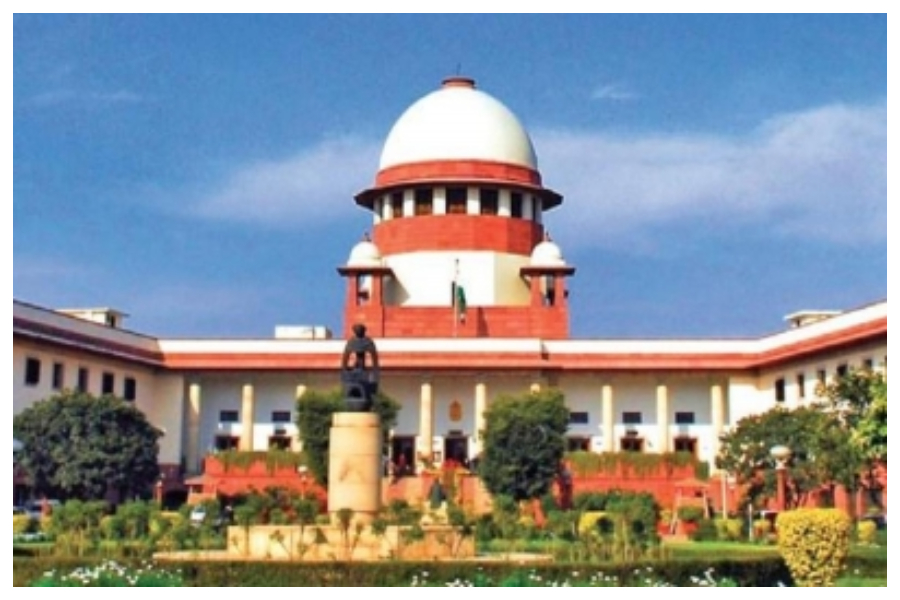
The three-page legislation — The Places of Worship Act, 1991 — is at the centre of the row over videographic survey carried out at the Gyanvapi mosque in Varanasi, where a Shivling was purportedly discovered.
The law has been invoked by the Committee of Management, Anjuman Intezamia Masajid Varanasi, which manages the Gyanvapi mosque, before the Supreme Court, saying mischievous attempts were being made to change the character of the mosque, which existed for 500 years.
In the Ayodhya judgment, the Supreme Court had said that the Act is intrinsically related to the obligations of a secular state and it reflects the commitment of India to equality of all religions.
However, in the Gyanvapi mosque matter, the Act will be put to legal scrutiny and face a test, in view of the ethos of secularism.
A bench comprising Justices D.Y. Chandrachud, Surya Kant, and P.S. Narasimha observed that the survey of a structure to ascertain its religious nature is not barred under the Act.
The committee moved the top court under Order 7, Rule 11 of the Civil Procedure Code against the maintainability of the suit, filed by five Hindu women seeking enforcement of their right to worship Goddess Shringar Gauri and other deities inside the mosque.
The masjid committee has also questioned the appointment of a commissioner for the video survey of the mosque, as it was barred under the Places of Worship (Special Provisions) Act, 1991, and pointed at the fallout of entertaining a suit in gross violation of the provisions of the 1991 Act.
The counsel representing the masjid committee argued in the apex court that similar mischief is being attempted in connection with four-five other mosques and objected to the trial court order to protect an area which had been used for the last 500 years by Muslims as ‘wuzu khana’ (ablution pond).
The Places of Worship Act, 1991 had its own share of controversies. The then Union Home Minister, S.B. Chavan, while moving the Bill in the Lok Sabha had said that it is a measure to provide and develop our glorious traditions of love, peace and harmony.
However, the BJP, then main Opposition party, had opposed the Bill tooth and nail, and termed it as another attempt by the Congress government to appease the minorities.
The Central government notified the Act to forestall fresh claims by any community about the previous designation of any religious place of worship and also subsequent attempts to regain land, on which they stood.
The Places of Worship Act, 1991 begins by saying, “An Act to prohibit conversion of any place of worship and to provide for the maintenance of the religious character of any place of worship as it existed on the 15th day of August, 1947, and for matters connected therewith or incidental thereto.”
Section 4 of the Act says, “It is hereby declared that the religious character of a place of worship existing on the 15th day of August, 1947 shall continue to be the same as it existed on that day.”
The Section 4(2) of the Act says any suit, appeal or other proceeding with respect to the conversion of the religious character of any place of worship, existing on August 15, 1947, is pending before any court, tribunal or other authority, the same should abate, and no fresh suit or legal proceedings would be instituted.
And, the proviso to this section clarifies that only those litigations are allowed, where conversion has taken place in the religious character after August 15, 1947. The offence under the Act is punishable with imprisonment for a term which may extend to three years and also a monetary penalty.
According to the Act, if a person attempts to convert any place of worship, or is part of a conspiracy, she/he can face a jail term.
The Act has put the Ram Janmabhoomi-Babri Masjid dispute outside its domain of operation. However, the Supreme Court in its Ayodhya judgment cited its importance. In November 2019, the Supreme Court ruled in favour of the Hindu side paving the way for the construction of Ram temple in Ayodhya.
The apex court had then said The Places of Worship Act is intrinsically related to the obligations of a secular state and it reflects the commitment of India to the equality of all religions.
“Above all, The Places of Worship Act is an affirmation of the solemn duty which was cast upon the state to preserve and protect the equality of all faiths as an essential constitutional value, a norm which has the status of being a basic feature of the Constitution. There is a purpose underlying the enactment of The Places of Worship Act. The law speaks to our history and to the future of the nation,” the top court had said.
The five-judge bench had said: “Historical wrongs cannot be remedied by the people taking the law in their own hands. In preserving the character of places of public worship, the Parliament has mandated in no uncertain terms that history and its wrongs shall not be used as instruments to oppress the present and the future.”
The apex court had said The Places of Worship Act imposes a non-derogable obligation towards enforcing “our commitment to secularism under the Indian Constitution and the law is hence a legislative instrument designed to protect the secular features of the Indian polity, which is one of the basic features of the Constitution”.
“Non-retrogression is a foundational feature of the fundamental constitutional principles of which secularism is a core component. The Places of Worship Act is thus a legislative intervention which preserves non-retrogression as an essential feature of our secular values,” it had said.
On May 20, 2022, the top court noted that ascertaining the religious character of a place of worship through a procedure known to the law, will not fall foul of The Places of Worship Act, 1991. The top court has shifted the trial of the suit by the Hindu parties from civil judge, senior division, to the district judge.
The top court said its May 17 interim order — protecting the ‘Shivling’, purportedly discovered during the survey, and free access to Muslims for ‘namaz’ — will remain operational for eight weeks, after the district judge’s decision in the matter, so as to allow the aggrieved parties to appeal against the decision.
The Supreme Court has scheduled the Gyanvapi case for hearing in July.


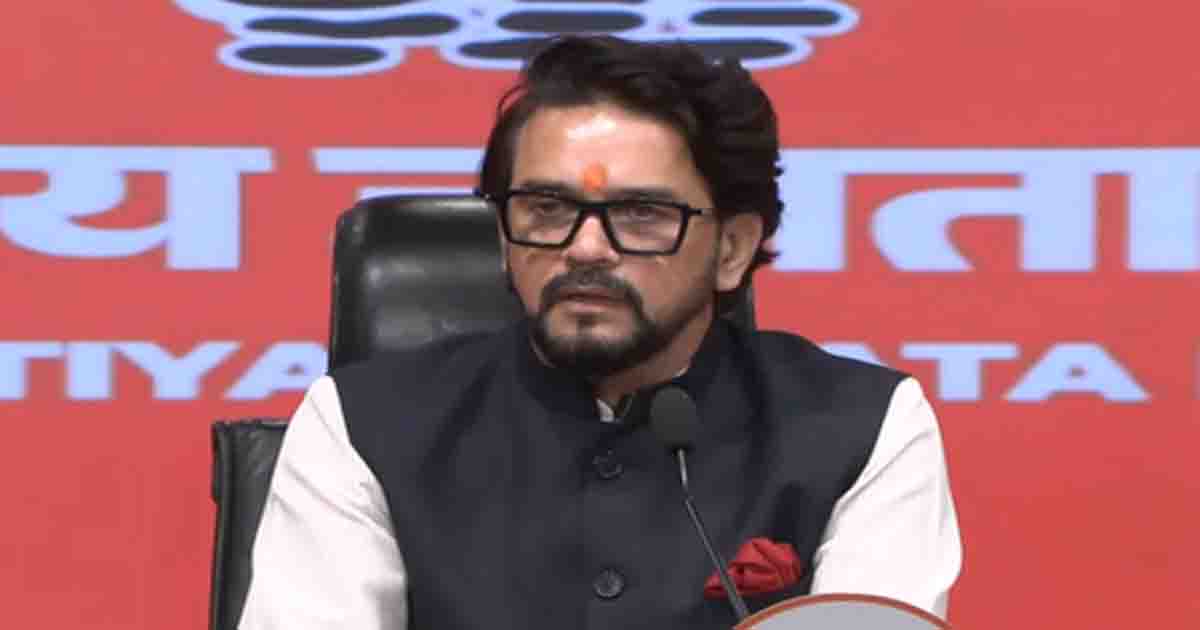
New Delhi, Oct 12: BJP MP Anurag Thakur on Monday launched a sharp attack on Lok Sabha Leader of Opposition (LoP) Rahul Gandhi, accusing him of making “baseless” allegations against constitutional institutions and attempting to “create political instability” amid the ongoing controversy over the Special Intensive Revision (SIR) of electoral rolls.
Addressing a press conference at the BJP headquarters in New Delhi, Thakur alleged that Rahul Gandhi lacked a proper understanding of facts, rules and laws and was instead focused on creating disorder and questioning constitutional authorities.
“Rahul Gandhi may be the Leader of the Opposition, but he is a leader who knows neither the facts nor the arguments, rules, regulations or laws. He only knows how to spread anarchy, create instability, undermine constitutional offices and institutions, and tarnish India’s image across the world,” Thakur said.
The BJP MP also questioned Rahul Gandhi’s repeated allegations of “vote theft”, claiming that the Congress leader was effectively challenging the people’s mandate without presenting sufficient evidence to support his claims.
“Rahul Gandhi keeps talking about ‘vote theft’, but in reality, he is challenging the public’s mandate. He makes baseless claims. He is a leader dealing in empty rhetoric. His entire political agenda is built on hollow statements, baseless accusations, meaningless actions, protests, facts… Ground reality is that there is nothing substantial in his statements. He repeatedly makes allegations and then goes to court and apologises. That is his track record,” Thakur said.
He further accused the Congress leader of making the Election Commission of India (ECI), electronic voting machines (EVMs) and the Chief Election Commissioner (CEC) a “scapegoat to target” whenever the party suffers electoral defeats, instead of accepting the outcome of elections.
“Rahul ji, the country doesn’t need noise, allegations or political statements, but truth, evidence, and clear answers,” he added.
Referring to the INDIA bloc’s efforts to raise its concerns over the SIR exercise before the judiciary, Thakur questioned the opposition’s attempt to seek a discussion with the Chief Justice of India (CJI) while the matter was sub judice.
“How can he seek a discussion with the CJI if this SIR issue is sub judice? The CJI made it clear that he should file a petition,” Thakur said.
“You know that Rahul Gandhi has faced setbacks in court several times in the past and has apologised. Now he thinks that if he goes out on the streets and repeatedly tells lies, people will start believing them to be true. Rahul Gandhi and the Congress party have a very clear strategy: if they cannot rule, they will spread anarchy,” he added.
Thakur maintained that Rahul Gandhi and the Congress had the right to raise their concerns and approach the judiciary, but accused them of behaving as though they were above established constitutional procedures and institutions.
“The people of the country have every right to present their case before the court. Rahul Gandhi, you too have every right to present your views. But Rahul Gandhi and the Congress party consider themselves an extra-constitutional body,” he said.
The BJP leader also challenged the Congress to make public the evidence it had claimed to possess in support of its allegations against the Election Commission, insisting that criticism of constitutional institutions must be backed by verifiable facts.
“There might be allegations against the ECI, but where is the evidence? Rahul Gandhi had said that he would present the evidence, but it is still not made public… Disagreement is fine, but if allegations are made against the Constitutional institutions, then there must be evidence,” he added.
“The responsibility lies not only with the government but also with the LoP,” he added.
This comes amid the Congress-led INDIA Bloc’s march towards the Supreme Court, seeking the resignation of Chief Election Commissioner (CEC) Gyanesh Kumar over the controversy surrounding the Special Intensive Revision (SIR) of electoral rolls.
Opposition leaders have alleged irregularities in the revision exercise and raised concerns over the electoral rolls, while the BJP has defended the process and accused the Congress of politicising the issue.
The INDIA Bloc leaders had also sought an appointment with Chief Justice of India (CJI) Surya Kant to discuss their concerns. However, the CJI declined their request and advised them to approach the court through a petition in accordance with the established legal procedure.
Following this, a bus carrying Congress President Mallikarjun Kharge, Rahul Gandhi and other INDIA Bloc leaders departed from the Constitution Club of India towards the Supreme Court.
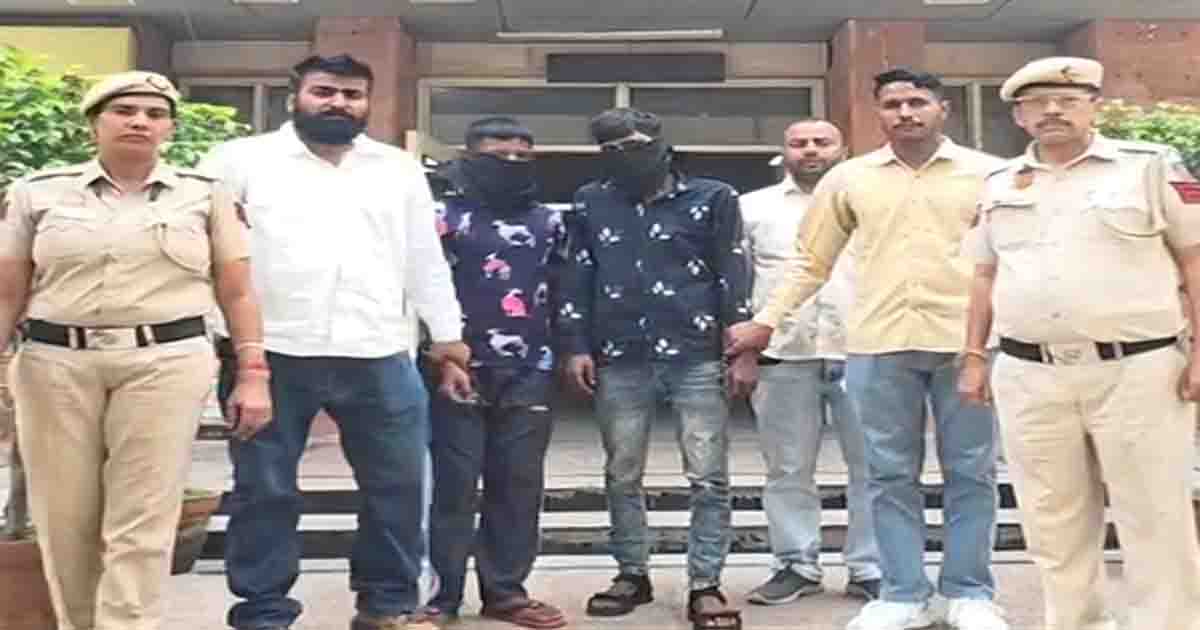
New Delhi, Oct 12: Delhi Police solved a robbery case in New Usmanpur area by arresting two accused, including a proclaimed bad character (BC) of Bhajanpura police station. The mobile phone robbed from the victim has also been recovered, officials said.
According to police, the incident took place on October 8, when Man Singh, 28, a resident of South Gamri in Delhi who works as a taxi driver, was walking from 4.5 Pusta towards the parking area at 5th Pusta to collect his vehicle at around 5 a.m.
When he reached a garbage dump, three persons allegedly intercepted him. One of them grabbed him from behind and choked him, while another pressed a knife-like object against his stomach.
Meanwhile, the third accused took his mobile phone and wallet containing Rs 1,500 and his driving licence from his trouser pocket. They also snatched an earring from his ear before fleeing towards Khajuri Chowk.
Following the complaint, a case was registered under FIR No. 639/2026 dated October 8 under Sections 309(4) and 3(5) of the Bharatiya Nyaya Sanhita (BNS), and an investigation was initiated.
A police team under the supervision of Seelampur ACP cracked the case, arresting the key suspect.
The team analysed footage from more than 150 CCTV cameras and developed local intelligence, leading to the identification and arrest of the two accused on October 9.
The accused have been identified as Arif alias Khujli, 25, a resident of Gali No. 4, 5th Pusta, Gamri, Delhi, and Dilshad Sheikh, 24, a resident of Gali No. 24, 5th Pusta, Gamri, Bhajanpura, Delhi.
During verification, Arif was found to be a “bad character” of Bhajanpura police station, with six previous cases related to robbery, theft and offences under the Arms Act. Dilshad was previously involved in two robbery cases, police said.
During interrogation, both accused confessed to their involvement in the crime and disclosed information about a third associate. On October 10, during police custody remand, the victim’s robbed mobile phone was recovered at Arif’s instance.
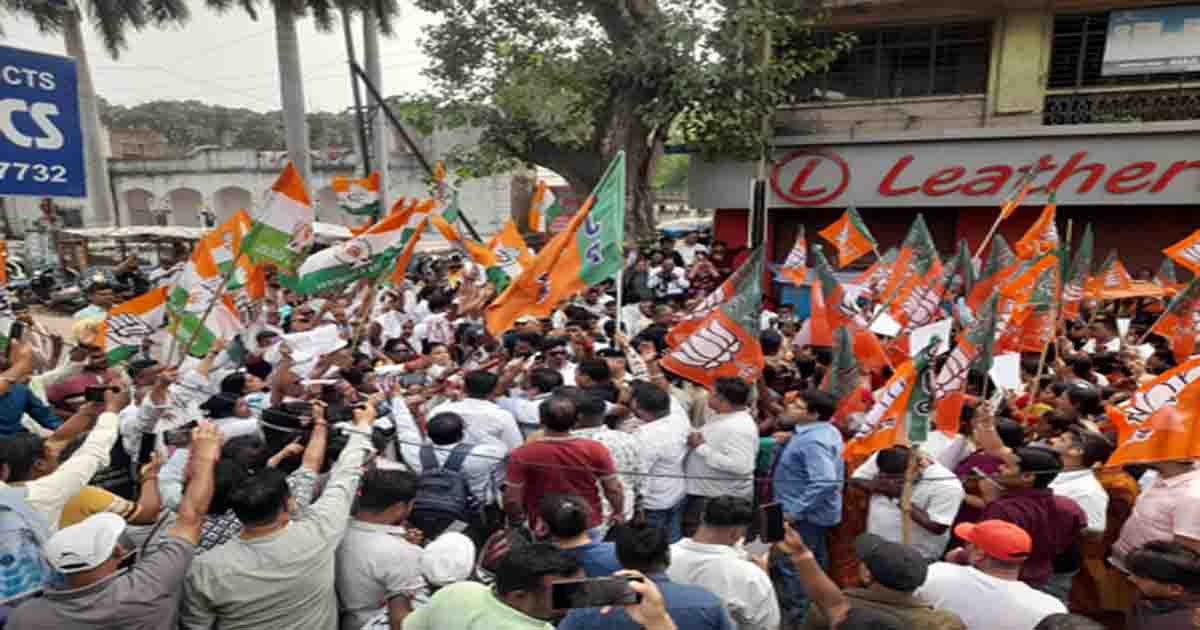
Jamshedpur, Oct 12: More than 10 persons were injured after a protest over the JNU episode triggered a violent clash between BJP and Congress workers outside the Congress headquarters, Tilak Pustakalaya, in Jharkhand’s Jamshedpur on Monday.
Those injured in the stone-pelting and scuffle included former BJP district President Dinesh Kumar and a Congress Vice President. Both sustained serious head injuries. The incident sparked chaos in the area. Police deployed additional forces in view of the tense situation prevailing in the area.
The BJP Mahanagar Mahila Morcha had planned a protest outside the Congress headquarters demanding action against Manipur Congress MP and former JNU professor Dr Angomcha Bimol Akoijam, including his arrest and dismissal. Bimol Akoijam has been accused of sexual harassment of women students at the varsity.
As per the scheduled programme, BJP workers gathered at the G Town Club ground in Bistupur at around 11.30 a.m. and marched towards the Congress office.
As the BJP workers reached the Congress headquarters, workers of the two parties came face-to-face.
Both sides started sloganeering, followed by a heated exchange of words, which soon escalated into violence. Sticks and stones were allegedly used by both sides to target each other. Several workers from both parties were left bleeding in the clash.
It was not immediately clear which side initiated the violence.
Local police rushed to the spot after receiving information about the incident and brought the situation under control. A heavy police contingent was deployed in the Bistupur area of Jamshedpur as a precautionary measure.
Police officials said the injured were taken to hospital for treatment. Authorities are examining video footage and other evidence to identify those involved in the violence.
Police said strict legal action would be taken against those found responsible for disturbing law and order and indulging in stone-pelting.
A detailed investigation into the incident is underway, they said.

Rahul Gandhi only knows how to spread anarchy, create instability: BJP

Ananya Panday on making hosting debut at IIFA Awards 2027: ‘This experience is even more special’

Delhi Police solve Usmanpur robbery case, arrest two accused; stolen mobile phone recovered

BJP, Congress workers clash in Jamshedpur, over 10 injured in stone-pelting

Actor Imran Khan is an American citizen, alleges veteran politician Kirit Somaiya

Gift to President Putin part of PM Modi bid to globally display India’s heritage

PM Modi’s warm camaraderie with Putin, Xi on full display at BRICS Summit

INDIA bloc begins protest march against ECI

Complaint against Netflix & Mukesh Chhabra for inappropriate language on ‘India’s Got Latent 2’

Maha Congress stages agitation against Gyanesh Kumar
-

 Crime4 years ago
Class 10 student jumps to death in Jaipur
-

 Maharashtra2 years ago
Mumbai Local Train Update: Central Railway’s New Timetable Comes Into Effect; Check Full List Of Revised Timings & Stations
-

 Maharashtra2 years ago
Mumbai To Go Toll-Free Tonight! Maharashtra Govt Announces Complete Toll Waiver For Light Motor Vehicles At All 5 Entry Points Of City
-

 Maharashtra2 years ago
False photo of Imtiaz Jaleel’s rally, exposing the fooling conspiracy
-

 National News2 years ago
Ministry of Railways rolls out Special Drive 4.0 with focus on digitisation, cleanliness, inclusiveness and grievance redressal
-

 Maharashtra2 years ago
Maharashtra Elections 2024: Mumbai Metro & BEST Services Extended Till Midnight On Voting Day
-

 National News2 years ago
J&K: 4 Jawans Killed, 28 Injured After Bus Carrying BSF Personnel For Poll Duty Falls Into Gorge In Budgam; Terrifying Visuals Surface
-

 Crime2 years ago
Baba Siddique Murder: Mumbai Police Unable To Get Lawrence Bishnoi Custody Due To Home Ministry Order, Says Report