
Politics
Diversionary tactic, follow 1991 law in letter and spirit, says Congress

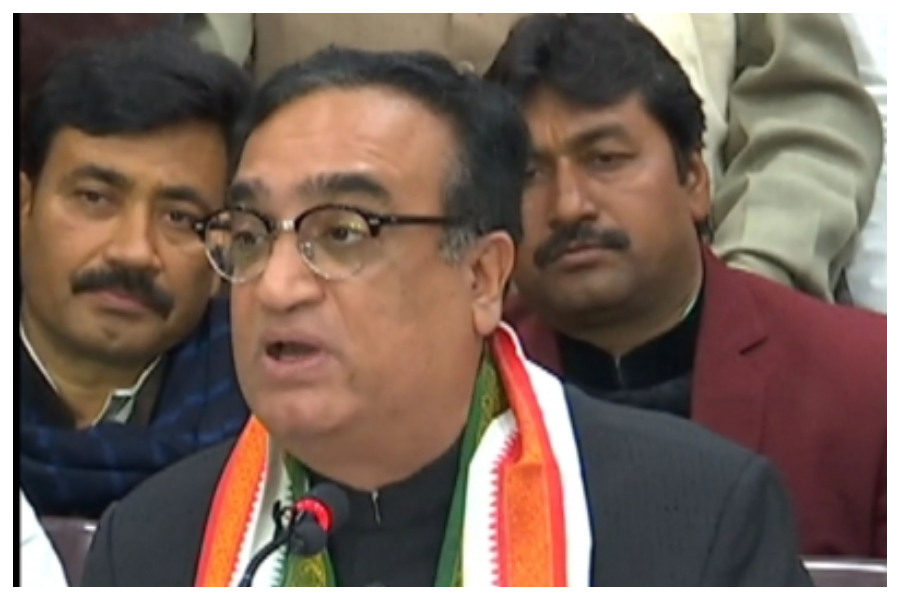
Terming the Gyanvapi case a “diversionary tactic” of the ruling BJP, the Congress has demanded strict adherence to the provision of the 1991 Act in letter and spirit saying any kind of change in the status of places of worship would lead to a massive conflict.
Seeking maintenance of status quo at the places of worship, Congress General Secretary Ajay Maken said: “The matter is under the purview of the Supreme Court and we hope justice would be delivered as the case of Ram Janmabhoomi-Babri Masjid land dispute was decided on the basis of the Places of Worship Act, 1991, which says that the religious character of a place of worship shall continue to be the same as it existed” on August 15, 1947.”
Dubbing it a “political” move, the Congress says its a “diversionary” tactic by the BJP to push the issues of inflation, unemployment and rupee downfall into the back-burner.
Recently, former Home Minister and senior Congress leader P. Chidambaram had said that the status quo on all places of worship should be maintained else it would lead to a conflict.
“Places of Worship Act was passed by the Narasimha Rao government with the lone exception of Ram Janmabhoomi. All other places should have the status quo as any kind of change could lead to a huge conflict,” he had said.
The Congress is in a catch 22 situation as the party in its ‘Chintan Shivir’ has come up with a social and economic agenda to counter the BJP. The party leaders, who deliberated over the issue, said that ideological differences with the BJP is core to the Congress politics and to fight for the people’s cause is the key takeaway from the brainstorming session. But the party has now been put on test in Gyanvapi row which could be a new controversy in political discourse as it has rethink about the strategy on the issue.
“The data of caste census of backward classes by the Congress-UPA government is deliberately not being made public by the Union government. The direct goal behind this is to deprive the backward classes of their rights. The Indian National Congress resolves to begin a decisive struggle for the demand to make the caste census data public and get the backward classes their rights,” the party has said in its resolution.
The Congress thought to fight the BJP and counter it on Hindutva through a social and economic agenda but now the party has to adopt a new stance–even Rahul Gandhi has alleged that -“Distracting people won’t change facts. India looks a lot like Sri Lanka,” Rahul tweeted.
To counter BJP’s Hindutva, Congress interim President Sonia Gandhi has announced two major mass contact programmes — one is the agitational programme against inflation to restart from June 15 and the footmarch ‘Bharat Jodo’, from October 2.
The Congress resolution also mentioned about the fight for all sections of society and particularly about the caste census, which is a big OBC push and the Congress leaders pointed that it may affect the BJP’s social engineering in many states, especially in the election-going states.


National News
Oppn to meet CJI tomorrow, govt created atmosphere of fear ahead of youth agitation: Kharge

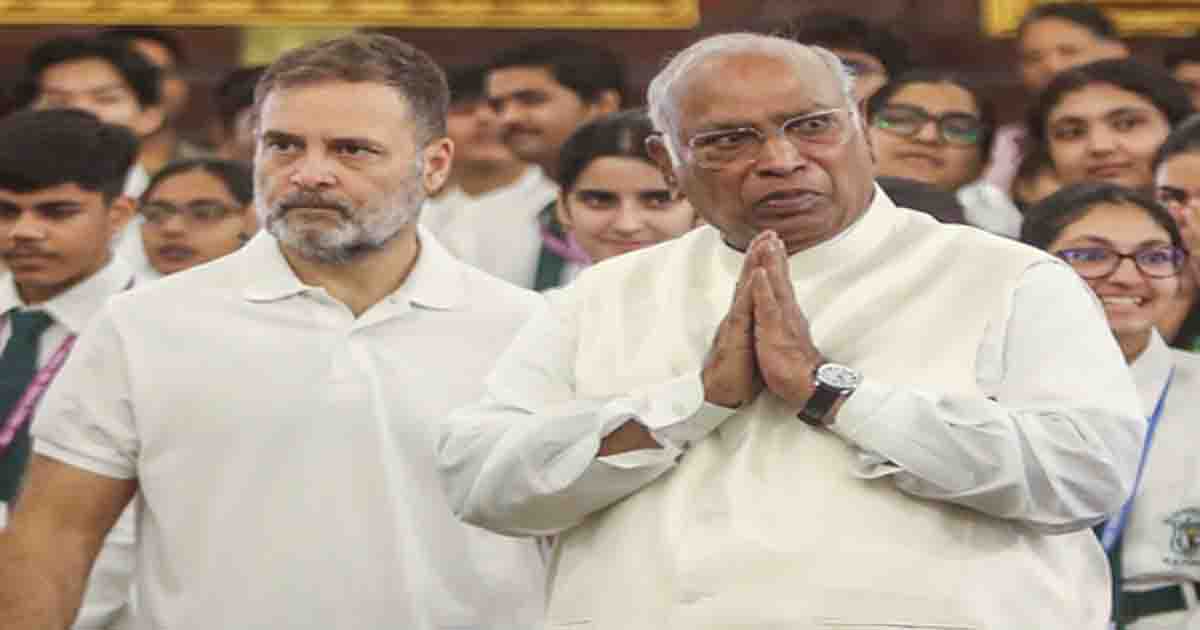
New Delhi, Oct 11: Congress President Mallikarjun Kharge on Sunday said that opposition leaders would meet the Chief Justice of India (CJI) to apprise him of their concerns, alleging that Prime Minister Narendra Modi and Home Minister Amit Shah were creating an atmosphere of chaos in the country.
Kharge said he had written a letter seeking an appointment with the CJI, adding that the Leader of the Opposition in the Lok Sabha, Rahul Gandhi, had also written to him. The party has sought time between 4 p.m. and 5 p.m. for the meeting.
“Tomorrow, we are also going to meet the Chief Justice of India. I have written a letter, and Rahul has also written a letter. We have sought a time between 4 and 5 (p.m). Now, let us see. We will also apprise him. We cannot demand anything from him. We will only request him with folded hands. These are the things that should be kept in mind,” he said.
Alleging that the government was creating an atmosphere of fear ahead of the announced youth agitation, the Congress chief questioned the deployment of a large number of security personnel.
“In the country, chaos is being created by the Prime Minister and Home Minister. Nearly 32,000 policemen and nearly 7,500 CRF were deployed yesterday, which itself shows how much fear he has got because of the announced youth agitation,” he said.
Kharge also compared the situation with the Emergency. “Yesterday also, youths were agitating, but even during the Emergency, such things did not happen. During the Emergency, we were all ministers. No trains were stopped, no flights were stopped, nothing. People used to move freely,” he said.
Recalling his experience as a Karnataka minister during the Emergency, when D. Devaraj Urs was the Chief Minister, he said that people were not unnecessarily arrested.
“I was the Education Minister at that time, and Devaraj Urs was the Chief Minister of the state. We never unnecessarily arrested any people. In fact, many people used to come and request Devaraj Urs, ‘Kindly arrest us.’ Then he refused to arrest them. He said, ‘On what ground can I arrest?'” Kharge said.
The Congress President also targeted the Chief Election Commissioner (CEC) over the legal protection provided to the head of the Election Commission of India and its members under the 2023 law, alleging that the government had introduced the legislation to protect them from legal action.
“To create such an atmosphere, PM Modi brought the 2023 Act to protect the Chief Election Commissioner and members. That immunity he gave. That immunity is not even for the President of India, not the Chief Justice, but that is given to one Election Commissioner,” he said.
His remarks come amid the Congress’s continuing allegations of electoral irregularities and its criticism of the government’s handling of protests.
National News
Rejected by people in Bengal, Mamata Banerjee in Delhi to keep herself relevant: Dilip Ghosh
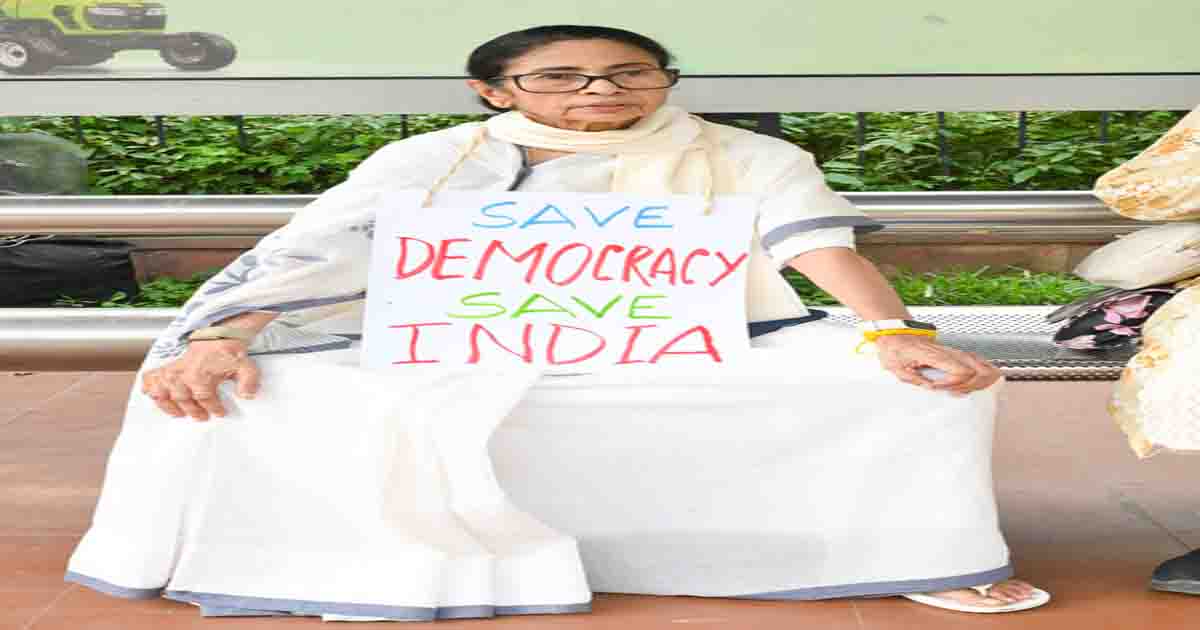
Kolkata, Oct 11: After being rejected by the people of West Bengal, former Chief Minister Mamata Banerjee is currently in New Delhi with a herculean attempt to keep herself relevant in national politics, said state Panchayat Affairs and Rural Development Minister and BJP’s former national vice-president, Dilip Ghosh, on Sunday.
Ghosh, also the BJP’s former state president, ridiculed her, claiming she would now go to neighbouring Bangladesh and join any movement there to keep herself more relevant.
“She and her party, Trinamool Congress, have been completely rejected by the people of West Bengal. The combined vote share of the two factions of Trinamool Congress in the recently concluded bypolls to two Assembly constituencies in West Bengal has been less than three per cent. Trinamool Congress is non-existent in West Bengal. So, she has gone to New Delhi to keep herself relevant in the media. She should now go to neighbouring Bangladesh and join any movement there to keep herself more relevant. But still her party will never benefit,” said Ghosh while speaking to the media persons.
Ghosh also launched a scathing attack against the Cockroach Janata Party (CJP)’s ongoing protest in New Delhi over the demand for the resignation of the Chief Election Commissioner (CEC), Gyanesh Kumar, which Mamata Banerjee has been supporting.
“There is foreign funding behind this movement. A conspiracy by the anti-national forces is behind this movement. The government has done the right thing in taking action in the larger interest of the country and its people,” said Ghosh.
Ghosh is not the first state BJP leader from West Bengal to ridicule Mamata Banerjee over her eagerness to be a part of the CJP movement.
On Saturday, BJP’s current state president in West Bengal and the party’s Rajya Sabha member, Samik Bhattacharya, without directly naming Congress and the Trinamool Congress faction led by Mamata Banerjee, said that a “half-dead” political force had joined hands with a “dead” force to stay relevant over the CJP movement.
“On the occasion of Mahalaya today, the former West Bengal Chief Minister has gone to New Delhi instead of staying in the state. We want her to stay here during this festivity time and visit various puja pandals. We want to see her doing that. Where have all the big Trinamool Congress leaders gone?” Bhattacharya asked on Saturday.

Kathmandu, Oct 11: At least four hydropower projects in the Budhi Gandaki River basin in western Gorkha district have been affected by massive floods that struck early Sunday morning, the Independent Power Producers’ Association, Nepal (IPPAN) said.
The latest floods, reminiscent of the devastating floods in the Bhote Koshi and Trishuli rivers on August 26, swept away parts of several settlements and damaged bridges, roads and infrastructure at hydropower project sites in the Budhi Gandaki River basin and its tributaries.
In a statement, IPPAN, an association of private-sector power developers in Nepal, said four hydropower projects along the Budhi Gandaki River and its tributary streams, with a combined installed capacity of 412.09 MW, had been affected.
According to IPPAN, the main camp area of the 341-MW Budhi Gandaki Hydropower Project was swept away by the floodwaters. Some construction equipment at the project, which is under construction, was also washed away.
Some houses in the camp area of the 24.5-MW Dobhan Khola Hydropower Project were damaged, while a Bailey bridge near the project site was swept away, IPPAN said.
The floods also damaged a Bailey bridge supporting construction work at the 30.59-MW Yaru Khola Hydropower Project, while construction materials and equipment were washed away.
An access road and the bridge connecting the project site of the 16-MW Machha Khola Hydropower Project were also damaged, according to IPPAN.
At a time when Nepal aspires to become a major hydropower exporter in South Asia, the latest disaster highlights the vulnerability of the country’s clean energy infrastructure to sudden floods, landslides and other climate-related hazards.
The devastating floods in the Bhote Koshi and Trishuli rivers on August 26 caused extensive damage to hydropower projects, solar energy facilities, electricity transmission infrastructure and transport networks. The energy sector, particularly hydropower projects, was among the hardest hit.
The August 2026 floods affected 12 hydropower projects and one solar power project, including 281.1 MW of operational capacity and 395.02 MW under construction, according to the World Bank’s Global Rapid Post-Disaster Damage Estimation (GRADE).
Damage to transmission lines and substations also disrupted the transmission of 149.6 MW of electricity to the national grid, bringing the total affected capacity to approximately 430.7 MW, or 10.6 per cent of Nepal’s total installed hydropower and solar capacity at the end of fiscal year 2025-26, which ended in mid-July, according to the report.
The August disaster claimed 1,455 lives, while 5,285 people remained missing, according to the National Disaster Risk Reduction and Management Authority.

Oppn to meet CJI tomorrow, govt created atmosphere of fear ahead of youth agitation: Kharge

Rejected by people in Bengal, Mamata Banerjee in Delhi to keep herself relevant: Dilip Ghosh

More massive floods in Nepal affect 4 hydropower projects

Five-year-old girl kidnapped, killed in Hyderabad; police search for sacked security guard

Delhi Police arrest 13 for gambling; seize over Rs 2 lakh cash

Gift to President Putin part of PM Modi bid to globally display India’s heritage

PM Modi’s warm camaraderie with Putin, Xi on full display at BRICS Summit

INDIA bloc begins protest march against ECI

Complaint against Netflix & Mukesh Chhabra for inappropriate language on ‘India’s Got Latent 2’

Maha Congress stages agitation against Gyanesh Kumar
-

 Crime4 years ago
Class 10 student jumps to death in Jaipur
-

 Maharashtra2 years ago
Mumbai Local Train Update: Central Railway’s New Timetable Comes Into Effect; Check Full List Of Revised Timings & Stations
-

 Maharashtra2 years ago
Mumbai To Go Toll-Free Tonight! Maharashtra Govt Announces Complete Toll Waiver For Light Motor Vehicles At All 5 Entry Points Of City
-

 Maharashtra2 years ago
False photo of Imtiaz Jaleel’s rally, exposing the fooling conspiracy
-

 National News2 years ago
Ministry of Railways rolls out Special Drive 4.0 with focus on digitisation, cleanliness, inclusiveness and grievance redressal
-

 Maharashtra2 years ago
Maharashtra Elections 2024: Mumbai Metro & BEST Services Extended Till Midnight On Voting Day
-

 National News2 years ago
J&K: 4 Jawans Killed, 28 Injured After Bus Carrying BSF Personnel For Poll Duty Falls Into Gorge In Budgam; Terrifying Visuals Surface
-

 Crime2 years ago
Baba Siddique Murder: Mumbai Police Unable To Get Lawrence Bishnoi Custody Due To Home Ministry Order, Says Report