
National News
Mumbai Weather Update: City Wakes Up To Thick Smog, Despite Pollution Control Norms; AQI Remains In Unhealthy Range At 257

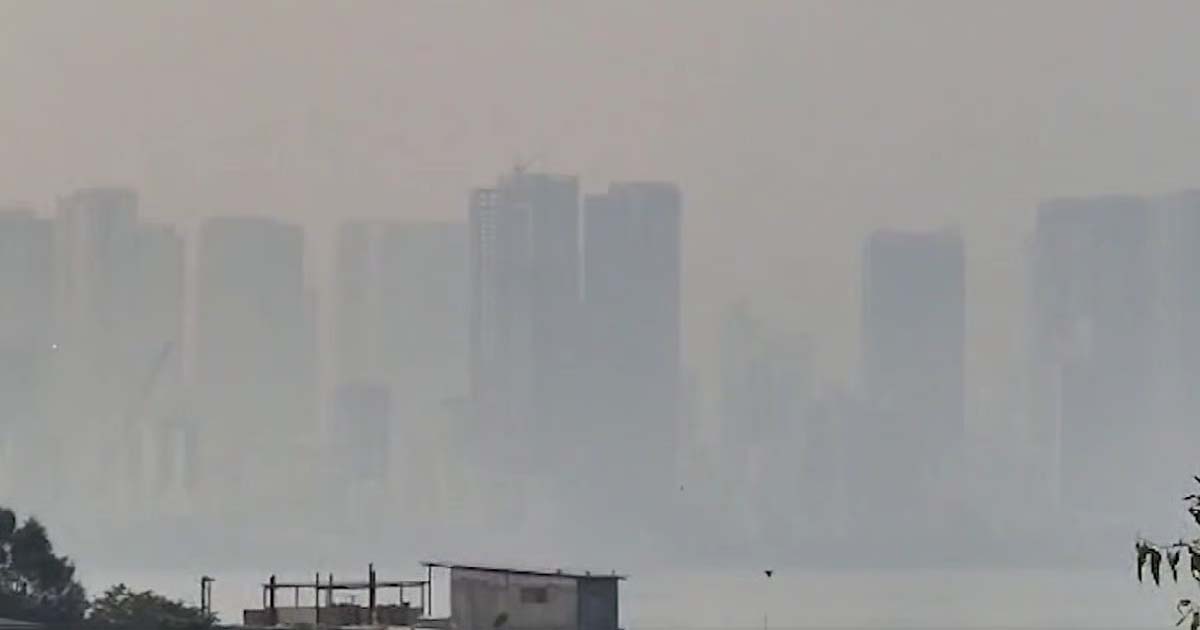
Mumbai: Mumbai woke up to a pleasantly cool Wednesday morning with clear blue skies and a mild winter nip, offering residents a refreshing start to the day. Yet, a dense layer of smog and haze lingered stubbornly over the city, showing a worrying spike in pollution and sharply reduced visibility.
While the India Meteorological Department (IMD) forecast clear skies with temperatures ranging between 16°C and 33°C, the city’s deteriorating air quality overshadowed the otherwise ideal winter conditions.
The pollution surge coincides with the frenetic pace of construction and infrastructure development across Mumbai. Dust from private construction sites and massive government projects, such as metro lines, bridges and road expansions, has majorly contributed to suspended particulate matter in the atmosphere. As these activities intensify, so does the city’s struggle to maintain breathable air.
By today morning, AQI.in recorded Mumbai’s overall Air Quality Index (AQI) at 257, placing it in the ‘unhealthy’ category. The shift is stark, considering the relatively moderate AQI levels seen earlier in November. Many residents reported symptoms consistent with exposure to high PM2.5 levels, including burning eyes, throat irritation, and a persistent acrid smell in the air. The city’s skyline appeared noticeably faded from several high points, reflecting the widespread impact of the pollution spike.
Multiple areas reported severe air quality levels. Wadala Truck Terminal topped the chart with an alarming AQI of 355, classified as severe. Deonar (320) and Worli (306) followed closely, while Colaba (297) and BKC (290) also hovered near the severe threshold. These locations, already prone to pollution due to heavy traffic and industrial operations, continued to show dangerously high particulate concentrations.
Suburban pockets, though slightly better, did not escape the pollution wave. Kandivali East recorded an AQI of 121 and Powai 140, both in the poor range, while Santacruz (167), Malad West (190), and Bhandup West (193) stayed firmly within the poor-to-unhealthy bracket. Although the AQI varied across neighbourhoods, much of Mumbai remained enveloped in a greyish haze, underscoring the citywide nature of the problem.
To put the numbers in perspective, AQI between 0–50 is classified as Good, 51–100 Moderate, 101–150 Poor, 151–200 Unhealthy, and anything above 200 is considered Hazardous. With several pockets already in the severe zone, the air quality crisis continues to loom large despite the pleasant winter chill.


National News
As 6 MPs of Uddhav Thackeray-led Shiv Sena-UBT set to join Shinde faction, Sanjay Raut unveils legal action plan

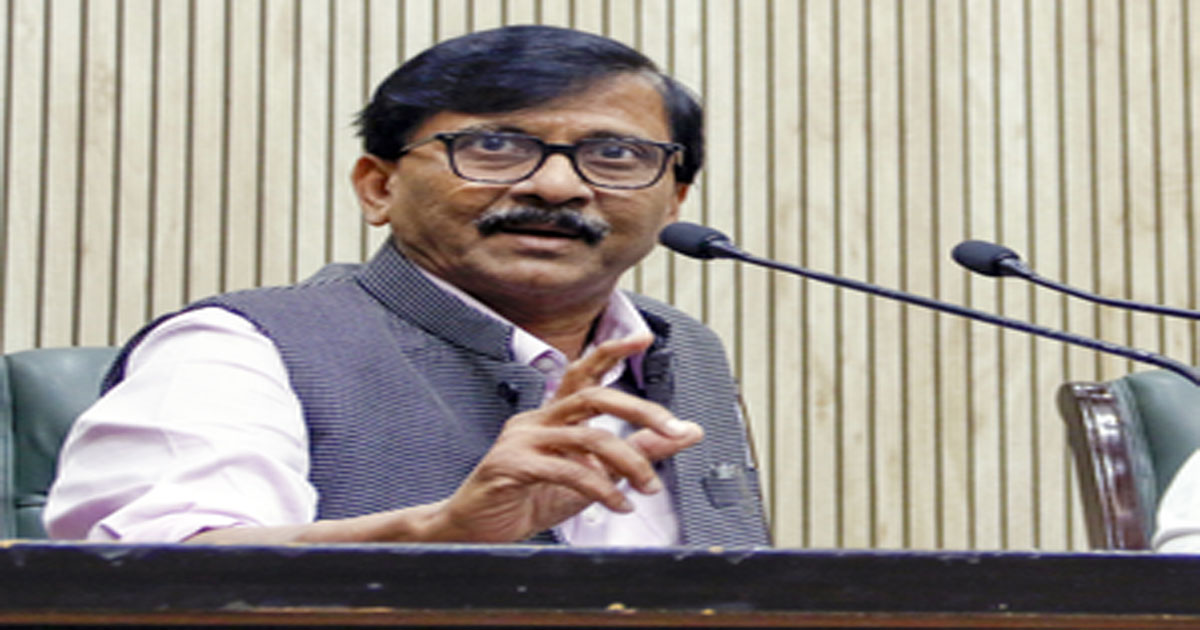
New Delhi, June 18: As six out of the party’s nine Lok Sabha MPs are on the verge of defecting to Deputy Chief Minister Ekanth Shinde-led Shiv Sena, the Shiv Sena-UBT leadership has moved into high alert.
The Shiv Sena-UBT has initiated a strict legal strategy to corner the rebel MPs and seek their disqualification.
The political tremor became evident during a crucial Parliamentary Party meeting convened by the Uddhav Thackeray-led faction in Delhi on Thursday.
Despite a strict party whip, only three Lok Sabha MPs attended, virtually confirming a vertical split in the Parliamentary wing.
Addressing a press conference following the high-stakes meeting, Shiv Sena-UBT Rajya Sabha MP and Chief Spokesperson Sanjay Raut said those who were present at the meeting included Arvind Sawant (Mumbai South), Anil Desai (Mumbai South-Central) and Rajabhau Waje (Nashik).
However, six MPs skipped the meeting including Omraje Nimbalkar (Dharashiv), Sanjay Jadhav (Parbhani), Sanjay Deshmukh (Yavatmal-Washim), Nagesh Ashtikar (Hingoli), Bhausaheb Wakchaure (Shirdi) and Sanjay Dina Patil (Mumbai North-East).
Raut announced that the Shiv Sena-UBT has already initiated disciplinary and legal procedures to create a blockade for the defecting MPs.
“Only three of our Lok Sabha MPs attended the Parliamentary Party meeting today. We have issued official ‘Show-Cause Notices’ to all the absent lawmakers, giving them a strict timeline of seven days to submit their explanations,” he said.
Emphasising that the Shiv Sena-UBT will fight on all fronts, Raut added, “We will fight this battle on the streets, and we will fight it in the courts. Our ground preparation to ensure their disqualification has begun in full swing.”
The Shiv Sena-UBT leader laid down the legal roadmap that the Uddhav Thackeray-led faction intends to pursue over the coming weeks, shifting the spotlight onto the anti-defection framework.
“The party (Shiv Sena-UBT) will first exhaust all internal Constitutional and legislative processes within the Lower House of Parliament. If the Lok Sabha Speaker (Om Birla) acts in accordance with the rules, the law, and the strict guidelines laid down by the Supreme Court of India, these six MPs will inevitably face disqualification,” he asserted.
“If the legislative process fails to yield a fair resolution, the Uddhav Thackeray-led faction is prepared to challenge the matter directly before the Supreme Court,” Raut said.
Political circles in Maharashtra are abuzz with speculation that the six rebel MPs might officially join Eknath Shinde’s faction around June 19, coinciding with the Shiv Sena’s Foundation Day.
The next seven days will be crucial as the political battle moves from internal party notices to a full-blown Constitutional showdown.
Crime
Villagers protest after youth’s death in encounter in Bihar’s Bhojpur; family questions police action
Patna, June 18: Tension gripped Bilauti village in Bihar’s Bhojpur district on Thursday after the death of Bharat Bhushan Tiwari, who succumbed to injuries sustained during a police encounter a day earlier.
The incident has triggered widespread protests, with family members and villagers alleging that the police used excessive force and demanding an impartial investigation.
Bharat Bhushan Tiwari was injured during an encounter on Wednesday when a joint team of the Shahpur police and the Special Task Force (STF) attempted to arrest him following reports that he had been brandishing a firearm and allegedly firing at police personnel.
He was initially taken to Shahpur Referral Hospital before being referred to Patna Medical College and Hospital (PMCH), where he later died during treatment.
However, the deceased’s family has strongly disputed the police version of events.
Speaking amid the protests, Bharat Bhushan’s mother questioned the circumstances of the encounter and accused the police of shooting her son despite his surrender.
“My son was dedicated to social welfare. He had surrendered, yet the police shot him. Why was he shot after surrendering?” she asked.
She further claimed that her son had been influenced by others and was not the owner of any licensed firearm.
“He had a hot temper, but someone from the village gave him the pistol and misled him. He surrendered, yet they fired five shots at him,” she alleged.
The grieving mother also described her son as someone who frequently helped people in the village and said the family was struggling to understand why such action was taken against him.
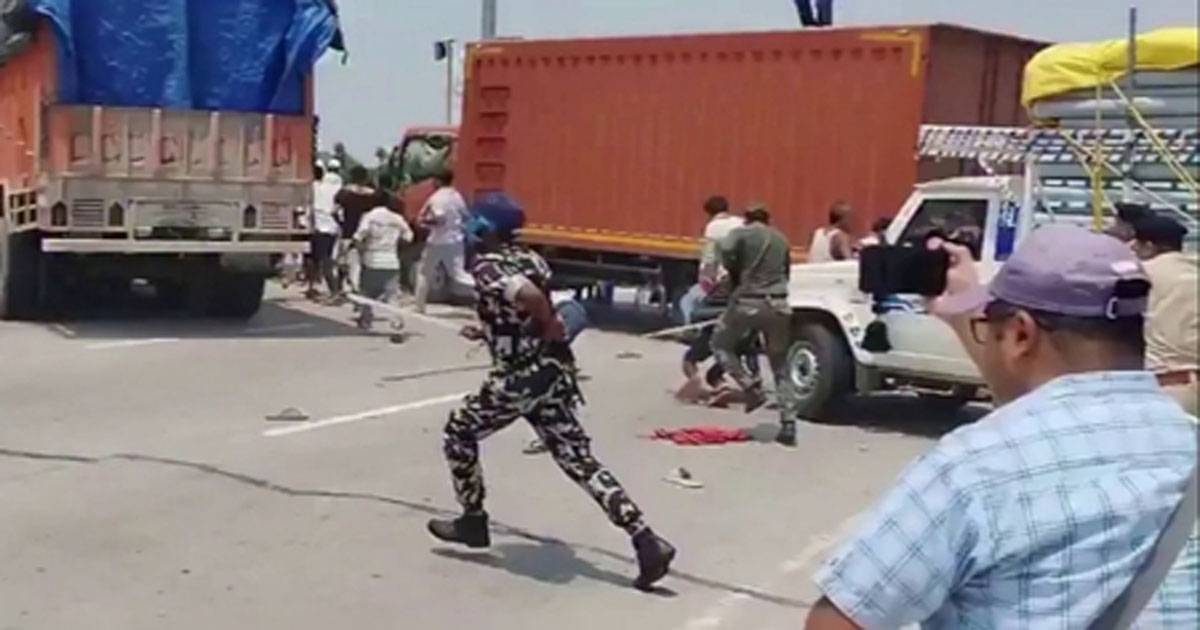
Anger over the incident spilled onto the streets as hundreds of villagers gathered near Bilauti village and blocked the Ara-Buxar four-lane highway.
Protesters placed the deceased’s body on the road and raised slogans against the police administration.
Witnesses estimated that between 1,000 and 1,500 people participated in the demonstration, causing major traffic disruptions and long queues of vehicles on both sides of the highway.
Villagers alleged that the encounter was staged and questioned the legality of the police action.
“There is no provision for killing a person who is surrendering. If someone wants to surrender in a case, can the police shoot him dead? An impartial inquiry must be conducted,” one protester said.
Another villager claimed that Bharat Bhushan had no criminal background and was known locally for social work.
The controversy comes days after a video allegedly showing Bharat Bhushan Tiwari brandishing a firearm went viral on social media.
According to police, officers initially visited his residence to investigate the video, during which he allegedly threatened personnel with a pistol.
Police stated that when officers returned with STF support to arrest him on Wednesday morning, he opened fire on the team, forcing them to retaliate in self-defence.
The encounter resulted in multiple gunshot injuries to Tiwari.
The incident has already led to departmental action. Following the circulation of videos from the operation, Shahabad Range DIG Dr Satyaprakash ordered the suspension of the Shahpur Station House Officer (SHO), along with a sub-inspector and a constable, citing alleged negligence and lapses in handling the situation.
Following Thursday’s protests, additional police personnel were deployed in the area to maintain law and order.
Ahmedabad, June 18: A 17-year-old NEET aspirant died after falling from the sixth floor of a residential apartment building in Ahmedabad’s New Ranip area, just three days before the nationwide NEET-UG retest scheduled for June 21.
According to Sabarmati Police, the teenager, a student preparing for the medical entrance examination, fell from the balcony area of a flat in Aristo Anandam Apartments.
Police received information about the incident at around 4.30 a.m. on Thursday and reached the scene to begin an investigation.
An accidental death case has been registered under the provisions of the Bharatiya Nagarik Suraksha Sanhita pending further inquiry.
The body was sent for post-mortem examination, and an inquiry was conducted to establish the exact cause of death.
Sabarmati Police Inspector Yuvrajsinh Vaghela said the incident occurred during the night.
“The incident occurred around 2-3 a.m. We received the information around 4.30 a.m. No suicide note has been recovered as of now. The cause cannot be ascertained at present, including whether the student was under stress. Investigation is going on,” he told Media.
Police said they are examining the circumstances surrounding the death and are speaking with family members, friends and others known to the student.
No official conclusion has been drawn regarding the reason behind the incident.
The death comes days before the rescheduled National Eligibility-cum-Entrance Test (Undergraduate), one of India’s largest competitive examinations for admission to medical courses.
The National Testing Agency (NTA) announced the retest after cancelling the original NEET-UG 2026 examination conducted on May 3 following allegations of a paper leak and other irregularities.
The re-examination was approved by the Central government after concerns were raised about the integrity of the test process.
More than 22 lakh candidates were affected by the cancellation, which triggered widespread uncertainty among students and parents across the country.
The NTA has said additional security measures have been introduced for the retest, while the Supreme Court has been informed that strengthened safeguards are in place to protect the integrity of the examination.
In recent days, authorities have intensified preparations for the June 21 examination.
The Indian Air Force has assisted in transporting question papers to multiple locations across the country. The NTA has launched training programmes for examination staff and issued advisories warning students against misinformation and fake paper leak claims circulating online.
Police have not linked the student’s death to the examination, and investigators said the cause of the incident remains under investigation.

Public representatives have high confidence in Shinde’s work, Uddhav Thackeray MPs did not have confidence in his leadership: Milind Deora

Mumbai Municipal Corporation and Customs Department sign MoU for conservation and restoration of Mahim Fort

Operation Tiger rebel MPs in Maharashtra should be disqualified: Abu Asim Azmi

Additional Municipal Commissioner (Western Suburbs) Dr. Vipin Sharma reviewed the functioning of the Hospital Management and Information System.

As 6 MPs of Uddhav Thackeray-led Shiv Sena-UBT set to join Shinde faction, Sanjay Raut unveils legal action plan

G7 Summit: PM Modi, Prez Trump discussed West Asia, India-US trade deal & bilateral cooperation across sectors: MEA

Trump, Netanyahu hold phone talks after Iranian missile fire: Israeli state media

Virar Citizens Protest Demolition Drive In Arnala; Police Block Lal Bawta March, Sit-in Held On Road

Indian equity markets trade higher as Iran-Israel tensions ease

Rubio says Hamas disarmament key to Gaza rebuild
-

 Crime4 years ago
Class 10 student jumps to death in Jaipur
-

 Maharashtra2 years ago
Mumbai Local Train Update: Central Railway’s New Timetable Comes Into Effect; Check Full List Of Revised Timings & Stations
-

 Maharashtra2 years ago
Mumbai To Go Toll-Free Tonight! Maharashtra Govt Announces Complete Toll Waiver For Light Motor Vehicles At All 5 Entry Points Of City
-

 Maharashtra2 years ago
False photo of Imtiaz Jaleel’s rally, exposing the fooling conspiracy
-

 National News2 years ago
Ministry of Railways rolls out Special Drive 4.0 with focus on digitisation, cleanliness, inclusiveness and grievance redressal
-

 Maharashtra2 years ago
Maharashtra Elections 2024: Mumbai Metro & BEST Services Extended Till Midnight On Voting Day
-

 National News2 years ago
J&K: 4 Jawans Killed, 28 Injured After Bus Carrying BSF Personnel For Poll Duty Falls Into Gorge In Budgam; Terrifying Visuals Surface
-

 Crime2 years ago
Baba Siddique Murder: Mumbai Police Unable To Get Lawrence Bishnoi Custody Due To Home Ministry Order, Says Report