
Politics
‘Minister taken to hospital’, says Kejriwal on viral picture of Satyendar Jain

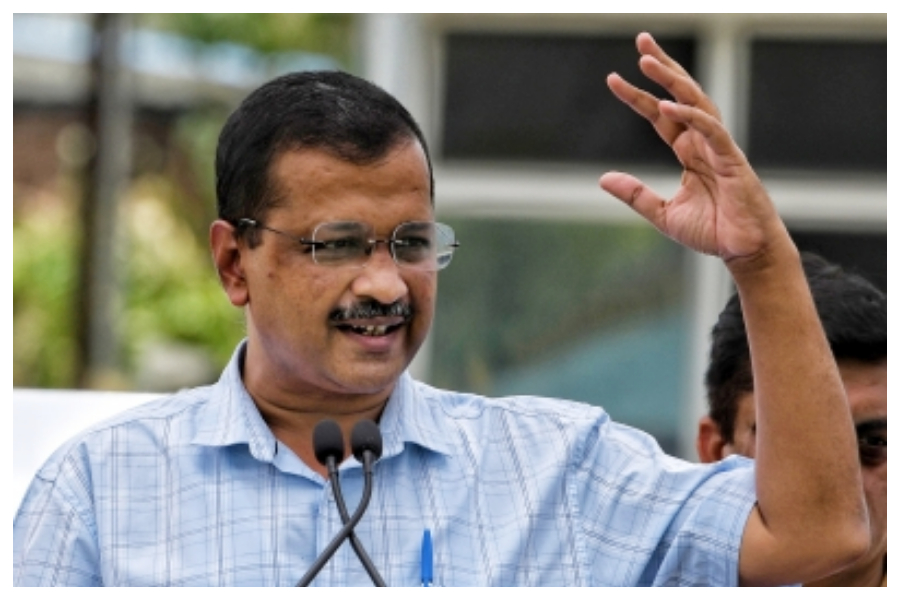
Delhi Chief Minister Arvind Kejriwal on Friday said that Minister Satyendar Jain was taken to a hospital the previous day after a picture of the arrested Minister went viral. Kejriwal, however, refused to make any comment on Jain.
In the viral picture that went viral on Thursday, Satyendar Jain can be seen in a car with what appears to be blood on his face.
He is currently in the custody of the Enforcement Directorate in a money laundering case.
“He is in ED custody and I cannot say much since we have no direct contact. I am in no position to make any comment on this. He was taken to hospital yesterday. Whatever happened in the hospital… when he was a little better, he was taken back,” Delhi Chief Minister said.
Kejriwal was inspecting the trees transplanted at a site in Mayur Vihar. He said that the government’s tree transplantation policy has helped prevent a dip in the national capital’s green cover despite a large number of development projects being undertaken in the city.
“Delhi’s green cover should have decreased to 15-16 per cent considering the development works being undertaken, but the Tree Transplantation Policy brought in October 2020 prevented it,” he said after the inspection.



New Delhi, Oct 10: Around 200 people have been detained by the Delhi Police from Jantar Mantar and surrounding areas as they gathered for the Cockroach Janata Party (CJP)-led protest against Chief Election Commissioner (CEC) Gyanesh Kumar on Saturday, officials said.
The detentions come as Delhi Police remains on high alert ahead of the CJP’s proposed protest at Jantar Mantar, with security tightened across the national Capital.
Earlier in the day, CJP founder Abhijeet Dipke and spokespersons Saurav Das and Ashutosh Ranka were detained at Delhi’s Indira Gandhi International (IGI) Airport as they arrived ahead of the protest.
Delhi Police personnel entered the aircraft carrying Dipke after it landed at IGI Airport.
Dipke posted the video showing the Delhi Police team entering the flight as he, along with other CJP members, Saurav Das and Ashutosh Ranka, were detained from the flight itself.
In a video posted on his social media handle, Dipke was heard telling the police, “…I have come here to be arrested; arrest me.”
The CJP announced the detentions in a post on its social media handle, stating: “Abhijeet Dipke DETAINED! Saurav Das DETAINED! Ashutosh Ranka DETAINED!”
Social media influencer Dhruv Rathee was also detained at his residence in Gurugram. According to a post on the X handle of the CJP, around 50 police personnel in plain clothes reached Rathee’s residence in Gurugram at around 8 a.m. and took him into custody.
Meanwhile, vehicles are being checked at Delhi’s borders, while police personnel have been equipped with body cameras to record any untoward incidents during the demonstration.
Security arrangements have also been strengthened at the residences of Chief Election Commissioner Gyanesh Kumar and Leader of the Opposition in the Lok Sabha, Rahul Gandhi.
Drone surveillance is being conducted at key locations, while several Metro stations, including Supreme Court and Mandi House, have been closed as part of the security measures.
At New Delhi Railway Station, drone surveillance is underway, with Delhi Police and Rapid Action Force (RAF) personnel deployed across the premises. Security marches are being conducted, and drones are being used to monitor the situation.

New Delhi, Oct 10: Cockroach Janta Party (CJP) founder Abhijeet Dipke and other CJP members, Saurav Das and Ashutosh Ranka, were detained at Delhi’s Indira Gandhi International (IGI) Airport as they arrived ahead of the announced protest at Jantar Mantar, police said on Saturday.
Delhi Police personnel entered the aircraft carrying Dipke after it landed at IGI Airport.
Dipke posted the video showing the Delhi Police team entering the flight as he, along with other CJP members, Saurav Das and Ashutosh Ranka, were detained from the flight itself.
In a video posted on his social media handle, Dipke was heard telling the police, “…I have come here to be arrested; arrest me.”
The CJP announced the detentions in a post on its social media handle, stating: “Abhijeet Dipke DETAINED! Saurav Das DETAINED! Ashutosh Ranka DETAINED!”
They were detained ahead of the CJP’s proposed protest at Jantar Mantar later in the day against Chief Election Commissioner (CEC) Gyanesh Kumar over alleged irregularities in the Special Intensive Revision (SIR) of electoral rolls in the country.
Dipke had left Mumbai for Delhi earlier in the morning to lead the protest against CEC Gyanesh Kumar.
Earlier in the morning, YouTuber Dhruv Rathee was also detained from his residence in Gurugram by Gurugram Police, ahead of the planned protest at Jantar Mantar in Delhi.
Rathee had attended a protest against the SIR of electoral rolls in Bengaluru on Thursday.
The reported detention comes as Delhi Police remains on high alert ahead of the CJP’s proposed protest at Jantar Mantar, with security tightened across the national Capital.
Meanwhile, vehicles are being checked at Delhi’s borders, while police personnel have been equipped with body cameras to record any untoward incidents during the demonstration.
Security arrangements have also been strengthened at the residences of Chief Election Commissioner Gyanesh Kumar and Leader of the Opposition in the Lok Sabha, Rahul Gandhi.
Drone surveillance is being conducted at key locations, while several Metro stations, including Supreme Court and Mandi House, have been closed as part of the security measures.

Washington, Oct 10: Ashley St. Clair, the mother of one of billionaire Elon Musk’s children, has alleged that she was offered a financial arrangement worth nearly $40 million in exchange for remaining silent about their relationship, a claim Musk has publicly denied.
In an interview published by The New York Times on Friday, St. Clair, a former conservative social media influencer, said she rejected a proposed nondisclosure agreement because it would have prevented her from discussing Musk and their relationship indefinitely.
The proposed arrangement included a $15 million lump-sum payment and $100,000 a month for 21 years, according to St. Clair. Together, those amounts would total $40.2 million.
Musk disputed the allegation after an earlier report about the proposed agreement.
“She was never offered that and has a history of making false claims,” Musk wrote on X, according to the newspaper.
St. Clair, who gave birth to a child in 2024, said the proposed confidentiality agreement was sent to her two months after childbirth by Jared Birchall, Musk’s financial manager.
She alleged that the document was transmitted through Signal, an encrypted messaging application, and would have restricted her ability to discuss the relationship even with members of her family.
According to St. Clair, the restrictions would also have extended to her heirs.
She said she rejected the agreement because she considered the proposed conditions unacceptable, particularly where they concerned her children.
The newspaper reported that Musk did not respond to its requests for comment on the interview.
St. Clair’s account comes as she appears in “Musk,” a nearly four-hour documentary directed by Oscar-winning filmmaker Alex Gibney examining the technology entrepreneur’s personal life, business interests and public influence.
The former influencer told the newspaper that her decision to participate in the documentary was partly motivated by concerns about the influence of wealth and power.
She said she had become increasingly uncomfortable with the expectation that people should trust powerful individuals simply because of their financial success.
St. Clair described meeting Musk in 2023 after he contacted her through Twitter, now known as X, where she had developed a following by promoting conservative political positions.
At the time, she was working for the conservative satirical publication The Babylon Bee and raising a child from an earlier relationship.
She said the two began communicating regularly and subsequently developed a personal relationship.
During a trip to St. Barts in January 2024, Musk raised the possibility of having a child together, according to her account.
St. Clair said she initially viewed the relationship positively but became concerned after learning more about Musk’s custody dispute with musician Grimes, with whom he shares three children.
She also described becoming increasingly disillusioned with the political movement surrounding President Donald Trump, which she had previously supported.
In the interview, St. Clair acknowledged having promoted political positions and rhetoric that she now regrets, including commentary concerning race, gender and transgender people.
She said her changing views developed gradually and were not solely the result of her personal dispute with Musk.
Musk has criticised Gibney’s documentary, accusing the filmmaker of assembling accounts from people with grievances against him or little personal knowledge of him.
The allegations surrounding the proposed financial agreement remain disputed, and the interview does not establish that Musk personally authorised the terms described by St. Clair.
Musk is the chief executive of Tesla and SpaceX and the owner of X. His business interests span electric vehicles, space exploration, artificial intelligence and digital communications, giving him a prominent role in American technology and public affairs.

200 people detained in Delhi ahead of CJP Jantar Mantar protest

Anil Kapoor reveals his 39-year-old ‘Mr. India’ jacket was bought from ‘Chor Bazaar’

Diljit Dosanjh ahead of Aura World Tour: Every corner had a little love waiting

CJP Dipke, Ranka, Das detained at Delhi Airport ahead of Jantar Mantar protest

Musk’s ex-partner alleges $40 million silence offer: US media

Gift to President Putin part of PM Modi bid to globally display India’s heritage

PM Modi’s warm camaraderie with Putin, Xi on full display at BRICS Summit

INDIA bloc begins protest march against ECI

Complaint against Netflix & Mukesh Chhabra for inappropriate language on ‘India’s Got Latent 2’

Maha Congress stages agitation against Gyanesh Kumar
-

 Crime4 years ago
Class 10 student jumps to death in Jaipur
-

 Maharashtra2 years ago
Mumbai Local Train Update: Central Railway’s New Timetable Comes Into Effect; Check Full List Of Revised Timings & Stations
-

 Maharashtra2 years ago
Mumbai To Go Toll-Free Tonight! Maharashtra Govt Announces Complete Toll Waiver For Light Motor Vehicles At All 5 Entry Points Of City
-

 Maharashtra2 years ago
False photo of Imtiaz Jaleel’s rally, exposing the fooling conspiracy
-

 National News2 years ago
Ministry of Railways rolls out Special Drive 4.0 with focus on digitisation, cleanliness, inclusiveness and grievance redressal
-

 Maharashtra2 years ago
Maharashtra Elections 2024: Mumbai Metro & BEST Services Extended Till Midnight On Voting Day
-

 National News2 years ago
J&K: 4 Jawans Killed, 28 Injured After Bus Carrying BSF Personnel For Poll Duty Falls Into Gorge In Budgam; Terrifying Visuals Surface
-

 Crime2 years ago
Baba Siddique Murder: Mumbai Police Unable To Get Lawrence Bishnoi Custody Due To Home Ministry Order, Says Report