
Business
Make GIFT IFSC more competitive to attract foreign investments: FM Sitharaman

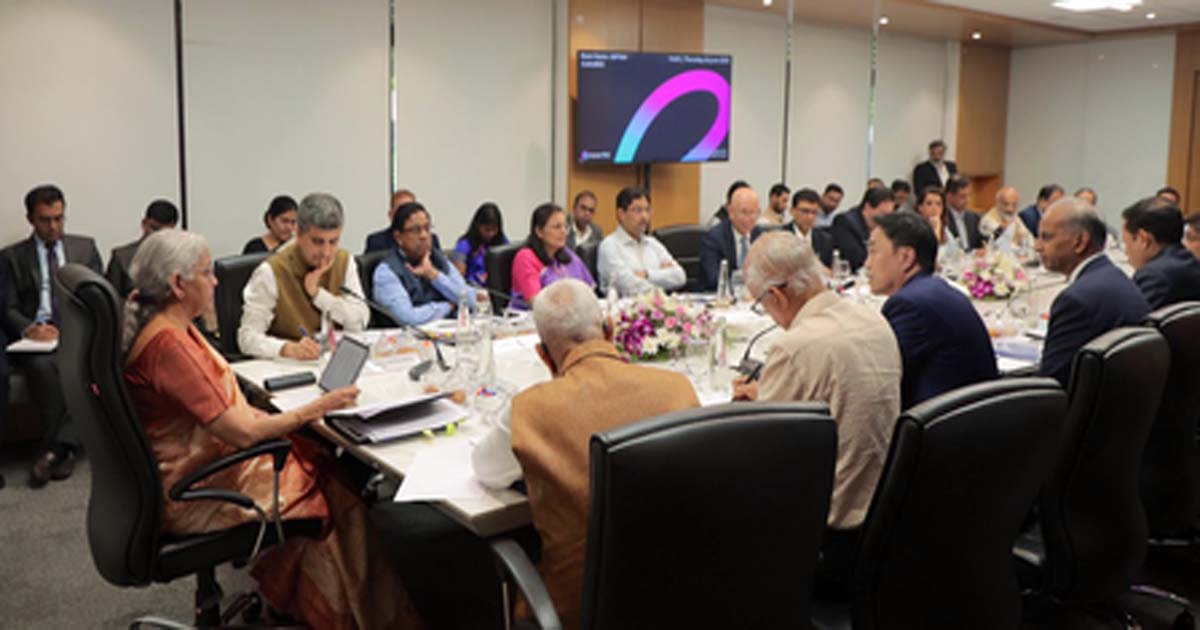
New Delhi, June 27: GIFT International Financial Services Centre (IFSC) should be developed as a prominent gateway for global capital flows into India to feed the needs of high-growth sectors over the next two decades, Finance Minister Nirmala Sitharaman has stressed.
She underscored the importance of developing GIFT City into a dynamic smart city, equipped with integrated, modern, and sustainable living infrastructure, and stated that establishing such world-class amenities is essential to attracting top-tier talent from both domestic and international markets.
During her visit to IFSC at GIFT City in Gandhinagar, the Finance Minister reviewed the progress and interacted with key market participants.
While commending the GIFT IFSC’s role in enhancing India’s global financial standing and acknowledging its impact on reshaping international financial engagement by Indian companies and individuals, she stressed on fast-tracking the reforms in next few years itself, to enable growth to align with the vision of ‘Viksit Bharat’ by 2047
Reiterating GIFT IFSC’s core mandate for focussing on bringing foreign capital into India through structured and well-regulated channels, FM Sitharaman also laid emphasis on the importance of Indian financial sector regulators to take initiatives for identifying aspirational needs of GIFT IFSC in this direction.
The Finance Minister indicated that the twin advantages of India pertaining to technology and availability of a very large domestic market and its financing needs must be leveraged to gain competitive advantage.
Given India’s status as a major gold importer, she stressed on the need to scale up operations at the India International Bullion Exchange (IIBX) by expanding stakeholder participation and strengthening price discovery, thereby positioning GIFT IFSC as a global bullion hub.
She also interacted with MDs and CEOs, chairpersons, founders and CFOs from banking, insurance, capital markets, funds industry, finance companies, payment services providers, aircraft and ship leasing firms, fintech firms, ITFS platform providers and foreign universities.


Mumbai, Feb 2: Gold and silver extended their decline on Monday, as hike in margin requirements are set to take effect on Chicago Merchantile Exchange (CME) in the US.
MCX gold February futures fell 1.77 per cent to Rs 1,45,132 per 10 grams on an intra-day basis. Meanwhile MCX silver March futures dipped 6.88 per cent to Rs 2,47,386 per kg.
Analysts said the free fall of gold and silver from their record highs started after the US President Donald Trump selected Kevin Warsh as the next US Fed Chairman. Investors reacted negatively because Warsh is considered more aggressive on interest-rate policy than earlier chairs, they added.
The decline was further supported by a stronger U.S. dollar, higher Treasury yields, and upbeat US inflation data (PPI and core PPI). As import duty was kept unchanged in the Union Budget the domestic premium in bullion suffered, said Rahul Kalantri, VP Commodities, Mehta Equities Ltd.
In international markets silver could find support near $68, while gold may hold around $4,510 this week, analysts forecasted. Spot gold recovered considerably after dropping 4 per cent in early morning session on Monday, during the Asian trading hours.
“Gold has support at Rs 1,39,650 to Rs 1,36,310 zone while resistance at Rs 1,48,850 and Rs 1,50,950. Silver has support at Rs 2,48,810 and Rs 2,37,170 while resistance at Rs 2,78,810 and Rs 2,95,470,” the analyst said.
According to them, the broader market trend for COMEX gold remains constructive, even as the recent vertical rally pushed momentum indicators into overbought territory, leading to heat-driven profit booking and mild price digestion from elevated levels.
Structural supply deficits and steady industrial demand continue to underpin the bullish bias in silver. Persistent safe-haven demand, steady central-bank accumulation, and expectations of accommodative global monetary conditions continue to underpin prices of yellow metal.
A recent report from WhiteOak Capital Mutual Fund said that investors should trim precious metals allocation back to a safe‑haven allocation level, especially on the silver as its valuation had reached the most over-extended level relative to historical periods.

New Delhi, Jan 31: From February 1, the government is bringing a new tax structure for cigarettes, tobacco products and pan masala, aiming to tighten regulation and keep tax levels high on these so-called ‘sin goods’.
An additional excise duty will now be charged on cigarettes and tobacco products, along with a new health and national security cess on pan masala.
These new levies will replace the earlier system under which these products were taxed at 28 per cent GST along with a compensation cess that has been in place since the launch of GST in July 2017.
The government is also introducing a new MRP-based valuation system for several tobacco products such as chewing tobacco, filter khaini, jarda scented tobacco and gutkha.
Under this system, GST will be calculated based on the retail price printed on the packet, instead of factory value.
This move is expected to reduce tax evasion and improve revenue collection. Pan masala manufacturers will now have to take fresh registration under the new health and national security cess law starting February 1.
They will also be required to install CCTV cameras that cover all packing machines and store the video recordings for at least two years.
In addition, companies must inform excise authorities about the number of machines in their factories and their production capacity.
If any machine remains non-functional for 15 days in a row, manufacturers will be allowed to claim a reduction in excise duty for that period.
Even after the new changes, the government has ensured that the overall tax burden on pan masala, including 40 per cent GST, will remain around the current level of 88 per cent.

Mumbai, Jan 31: The Indian equity benchmarks gained around 1 per cent during the week, though the trading sessions were volatile but with a cautiously constructive tone amid mixed global cues and rising geopolitical tensions.
Risk appetite weakened toward the end of the week ahead of the Union Budget 2026-27, with volatility resurfacing amid sustained FII outflows and rupee depreciation leading to losses in the last trading session.
Nifty added 1.09 per cent during the week and dipped 0.39 per cent on the last trading day to 25,320. At close, Sensex was down 296 points or 0.36 percent at 81,537. It added 0.90 per cent during the week.
Sectoral indices traded mixed this week with diversified consumer services stocks and hardware tech stocks logging the worst-performance, dipping 2.5 to 3.7 per cent. FMCG, media and software stocks slide over 1 per cent.
Metal stocks as well as oil and gas were the top weekly gainers up over 2 per cent, however Nifty metal index plummeted over 5 per cent on the last trading session. Profit booking also intensified in IT amid a firmer dollar and global liquidity concerns, and caution over incoming Fed Chair, analysts said.
Select pockets of weakness were observed in autos and beverages amid intensifying competitive pressures.
Broader indices posted stronger gains during the week, with the Nifty Midcap100 up 2.25 per cent, while Nifty Smallcap100 gained 3.2 per cent.
The markets opened the week with a subdued sentiment due to renewed tariff-related concerns and mixed corporate earnings, although optimism surrounding the India–EU trade agreement lent support, particularly to trade-oriented sectors.
Market sentiment improved mid-week following a favourable economic survey that reinforced expectations of robust FY27 growth and a benign inflation outlook.
Analysts said that markets remain wary that a potentially stronger inflation focus could prolong tight financial conditions and weigh on emerging markets.
Looking ahead, markets are expected to remain largely event-driven, with the Union Budget acting as the key domestic trigger, they said.
Cyclical sectors may continue to show relative resilience if supported by policy measures, while IT and export-oriented stocks are likely to remain sensitive to global macro cues, analysts added.

Mumbai Police Rebuts Social Media Claims About Missing Children; Warns Action Against Rumours

Mumbai: Western Railway Announces Special Trains For Shab-e-Barat 2026; Check Timings

‘Drunk’ SUV Driver Ploughs Into Crowd After Hitting Several Vehicles In Sangli; 11 Injured

Mumbai: BMC hammers down on additional construction on footpaths of Mohammad Ali Road and Ibrahim Merchant Marg, action taken by ‘B Ward’ administrative division

Mumbai: Police impose strict security measures on graveyards and shrines during Shab-e-Barat, prohibitory orders

Mumbai Traffic Update: Heavy Vehicles Banned In City From February 1 During Peak Hours; What’s Allowed & What’s Not?

BMC Election Results 2026 Winners List: Check Ward-Wise Names Of Candidates Who Secured Victory

Sensex, Nifty open lower amid tariff-related concerns

Mumbai BMC Results Samajwadi Party Wiped Out From Govindi

Sensex, Nifty close week with gains over positive cues
-

 Crime3 years ago
Class 10 student jumps to death in Jaipur
-

 Maharashtra1 year ago
Mumbai Local Train Update: Central Railway’s New Timetable Comes Into Effect; Check Full List Of Revised Timings & Stations
-

 Maharashtra1 year ago
Mumbai To Go Toll-Free Tonight! Maharashtra Govt Announces Complete Toll Waiver For Light Motor Vehicles At All 5 Entry Points Of City
-

 Maharashtra1 year ago
False photo of Imtiaz Jaleel’s rally, exposing the fooling conspiracy
-

 National News1 year ago
Ministry of Railways rolls out Special Drive 4.0 with focus on digitisation, cleanliness, inclusiveness and grievance redressal
-

 Maharashtra1 year ago
Maharashtra Elections 2024: Mumbai Metro & BEST Services Extended Till Midnight On Voting Day
-

 National News1 year ago
J&K: 4 Jawans Killed, 28 Injured After Bus Carrying BSF Personnel For Poll Duty Falls Into Gorge In Budgam; Terrifying Visuals Surface
-

 Crime1 year ago
Baba Siddique Murder: Mumbai Police Unable To Get Lawrence Bishnoi Custody Due To Home Ministry Order, Says Report