
Politics
Mahatma Gandhi’s personal belongings to bring nearly Rs 5 crore in UK auction

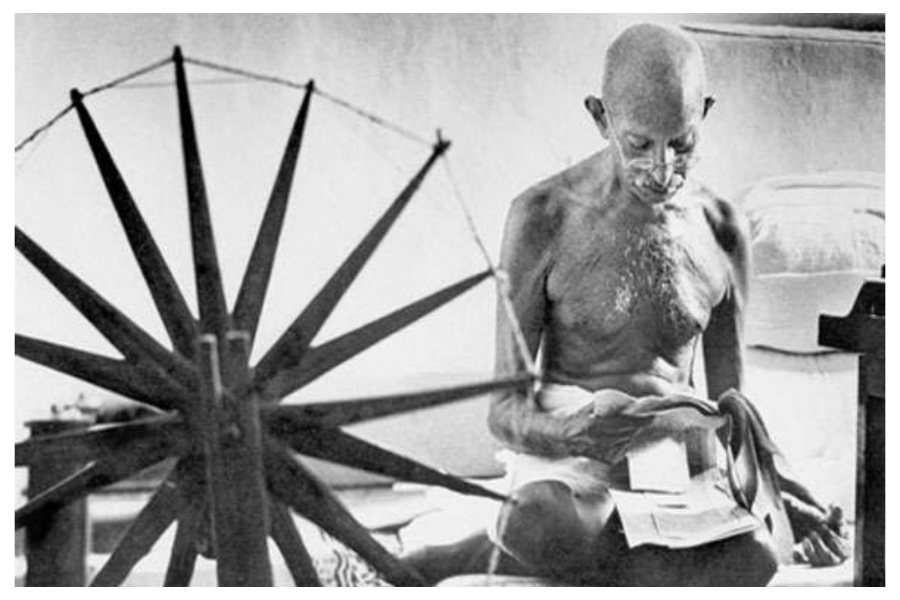
Mahatma Gandhi’s personal belongings kept in Britain will be auctioned and are likely to fetch Rs 4.74 crore (5,00,000 British pounds), a media report said.
According to the report, there are 70 items belonging to Gandhi including his hand-made khadi loincloths, letters he wrote while he was imprisoned and two pairs of his sandals, a pair of his sunglasses, an inkwell from his desk and a pair of spectacles, along with other items that will be auctioned.
The online sale, which will end on May 21, is being arranged by East Bristol Auctions in the UK which sold a pair of Gandhi’s spectacles for 260,000 British pounds in 2020.
These items are considered “important to the history of the world”, the report said, adding that a standout in the collection is what is believed to be the last photograph taken of Mahatma Gandhi while he was alive.
In the black and white picture, which was taken by his personal doctor in 1947 at Birla House in New Delhi, Gandhi can be seen seated, possibly with a spinning wheel or similar wooden tool, wearing a hat, and draped in a linen cloth.
Another highlight of the auction is Gandhi’s trademark loincloth which is expected to fetch between 15,000 and 25,000 pounds. The special piece of cloth has his signature ‘Bapu’ on it.
The other important item for online sale is a handmade sash which was probably given to him before commencing his famous Salt March in the 1930s. This includes a photograph of the sash being presented to him. The sash is expected to fetch between 6,000 and 8,000 pounds.


International News
EAM Jaishankar and US counterpart Rubio discuss advancing ties, regional developments

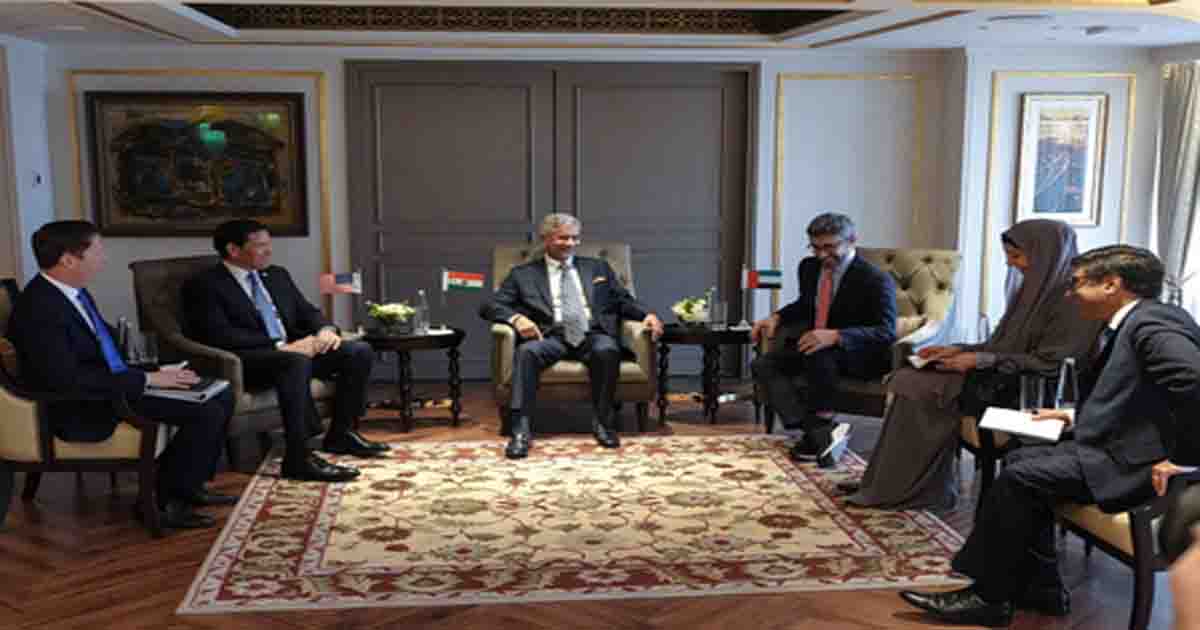
External Affairs Minister (EAM) S Jaishankar held a meeting with US Secretary of State Marco Rubio in Mumbai on Tuesday, with discussions focusing on further advancing bilateral ties.
During the meeting, the two ministers exchanged views on regional developments. Foreign Secretary Vikram Misri, US Ambassador to India Sergio Gor and other officials were also present at the meeting.
“Pleased to meet US Marco Rubio in Mumbai today. We shared views on further advancement of our ties, focusing on trade, energy, technology, defence and people-to-people ties. Also exchanged views on regional developments,” EAM Jaishankar stated on X after the meting.
Rubio said that he and EAM Jaishankar discussed energy security and defence cooperation.
“In Mumbai, Indian External Affairs Minister S Jaishankar and I discussed energy security and defense cooperation while reaffirming the importance of advancing the U.S.-India strategic partnership,” the US Secretary of State posted on X.
Earlier, EAM Jaishankar, Marco Rubio and UAE Foreign Minister Sheikh Abdullah bin Zayed Al Nahyan held a meeting in Mumbai, with discussions held on regional energy security and advancing shared economic priorities.
“It was great to meet with Indian External Affairs Minister S Jaishankar and UAE Foreign Minister Sheikh Abdullah bin Zayed Al Nahyan to discuss regional energy security and advance our shared economic priorities,” Rubio stated on X after the meeting.
Following the meeting, Ambassador Gor also took to X and wrote: “The US, India, and UAE have real opportunities to advance cooperation on energy, trade, technology, and regional connectivity. Marco Rubio, S Jaishankar, and UAE Foreign Minister Sheikh Abdullah bin Zayed Al Nahyan in Mumbai for a discussion on turning our close ties into concrete results!”
Earlier in the day, Marco Rubio arrived in Mumbai for an official visit to India. For his visit to Mumbai, Rubio is accompanied by his wife, Jeanette Rubio and US Ambassador to India Sergio Gor.
The Ministry of External Affairs (MEA) extended a warm welcome to Rubio as he arrived in Mumbai for his second visit to India, noting that it provides an opportunity to further advance cooperation across various pillars of the India-US Comprehensive Global Strategic Partnership.
“Welcome to Mumbai, US Secretary of State Marco Rubio, on your second visit to India! He was received by Shri Ashish Shelar, Minister of Culture, Electronics, IT and AI, Government of Maharashtra at the airport. The visit provides an opportunity to further advance cooperation across the various pillars of the India-US Comprehensive Global Strategic Partnership,” the MEA posted on X.
After concluding his engagements in Mumbai, Rubio will travel to Gujarat’s Jamnagar for talks that will include “enhanced energy cooperation”, the US State Department said.
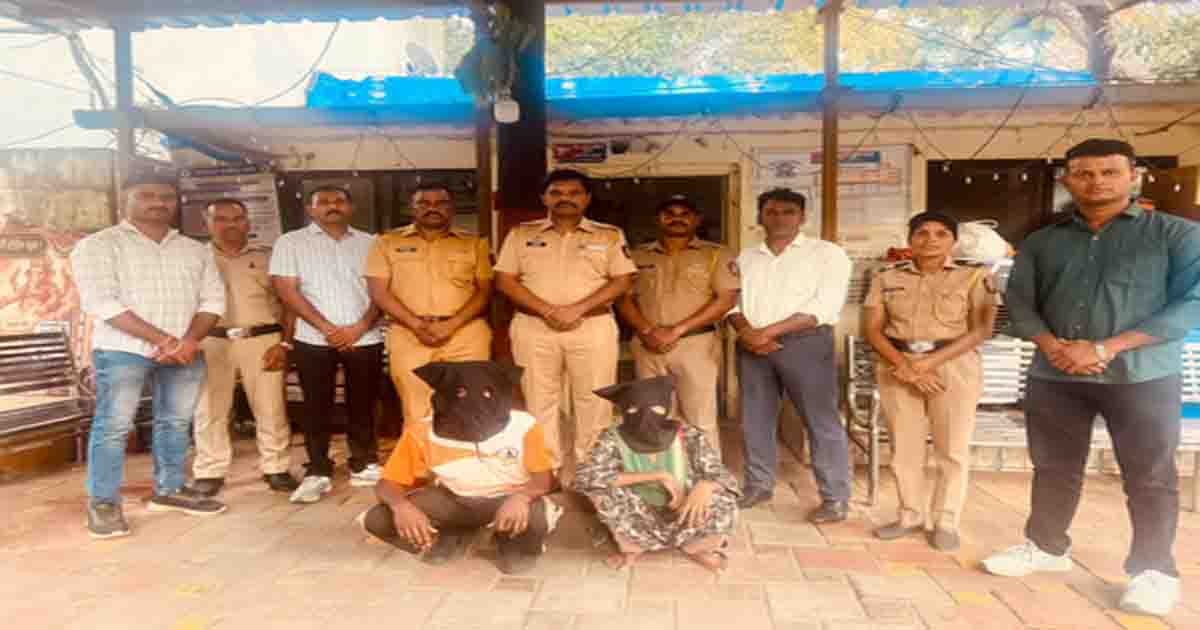
Palghar Police have solved the murder of a 52-year-old woman, Sajani Vinod Waghari, who was allegedly bludgeoned to death with a hammer following a minor dispute in the Saphale police station area. Two accused have been arrested in connection with the crime, police said on Tuesday.
The accused have been identified as Nilesh Dharamaji Chibhade (35), a resident of Bambar Pada, Jamshar Post, Jawhar taluka, and Ujwala Navsu Khutade (33), a resident of Dabhosa in Jawhar taluka, both in Palghar district.
According to police, Waghari, a resident of Adwan Sawarpada in Palghar taluka, was found injured near an iron bridge at Tepacha Pada on October 15, 2026. She was immediately taken to the Saphale Primary Health Centre, where doctors examined her and declared her dead.
Initially, a case of accidental death (No. 32/2026) was registered at Saphale Police Station under Section 194 of the Bharatiya Nagarik Suraksha Sanhita (BNSS), 2023.
However, during the inquest and subsequent medical examination, doctors found a serious injury behind the woman’s ear, apparently caused by a weapon. The injury had resulted in excessive blood loss, leading to her death.
Following the medical findings, police suspected murder and registered a case (No. 119/2026) under Section 103(1) of the Bharatiya Nyaya Sanhita (BNS) on October 15.
Considering the seriousness of the crime, Palghar Superintendent of Police Yatish Deshmukh directed the formation of separate teams from the Local Crime Branch and Saphale Police Station to investigate the case.
The teams pursued leads through confidential information and technical analysis, which eventually helped identify the two suspects.
During interrogation, the accused allegedly confessed to attacking Waghari on the head with a hammer following a minor altercation, police said.
Both were subsequently arrested and produced before a court, which remanded them to five days of police custody until October 22.
The murder case was cracked under the guidance of SP Yatish Deshmukh, Additional Superintendent of Police Vinayak Narale and Sub-Divisional Police Officer of Palghar division Umesh Gawali. Further investigation is being conducted by Assistant Police Inspector Datta Shelke of Saphale Police Station.
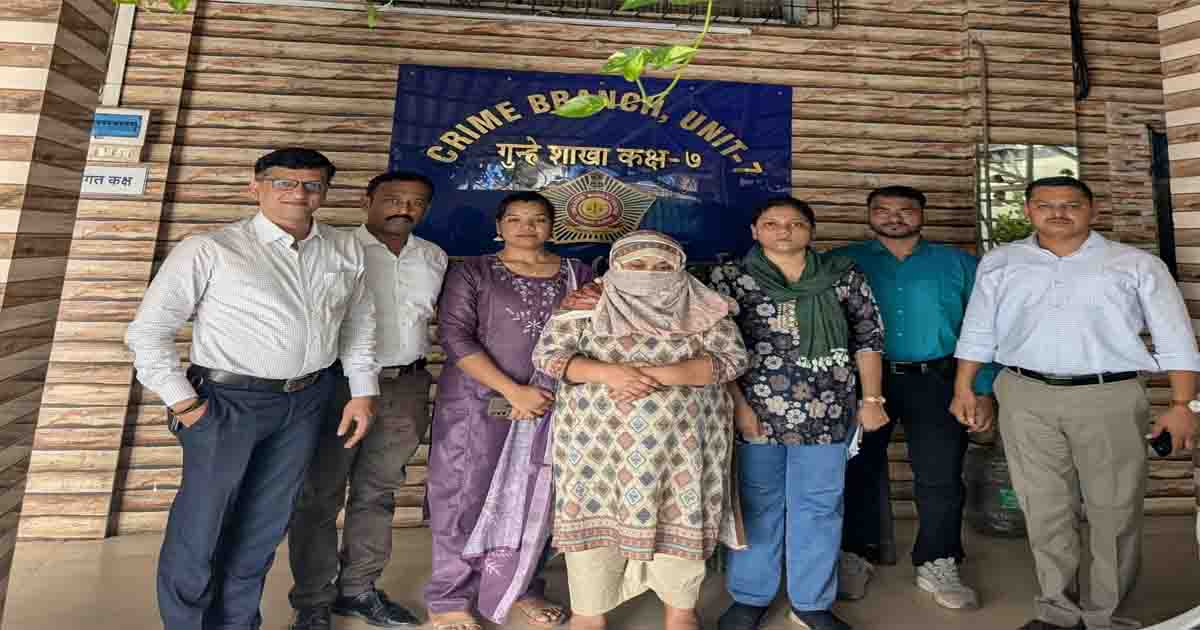
Mumbai: A woman has been arrested by a team from Crime Branch Unit 7 in connection with an extortion case. The accused allegedly extorted approximately 40 million rupees (4 crore rupees) from a resident of Ghatkopar by threatening to defame her using an obscene video and threatening her with death. She was also demanding further payments.
The complainant works as a manager at a jewelry store. Between December 2024 and January 2025, an acquaintance—a woman—engaged the complainant in an obscene video chat via WhatsApp. The accused then threatened to circulate this footage to the police, the courts, and the CBI, claiming that the complainant would be summoned for investigation. Fearing public disgrace, the complainant paid a total of 40 million rupees to the accused. The woman continued to demand more money and threatened that if further payments were not made, she would break the complainant’s limbs and kill her. Taking into account the gravity of the matter, Crime Branch Unit 7 (Ghatkopar, Mumbai) laid a trap for the woman who had been demanding extortion money. On October 19, she was caught red-handed at RK Restaurant, LBS Road, Ghatkopar West, Mumbai, while accepting a sum of 5 lakh rupees from the complainant. Following the complainant’s report, a case was registered at the Ghatkopar Police Station under Sections 308(2) and 308(7) of the Bharatiya Nyaya Sanhita (BNS). The Crime Branch has taken over the investigation, and the woman has been arrested; further inquiries are being conducted by Unit 7, Ghatkopar.
This operation was carried out by a team comprising Mumbai Police Commissioner Deven Bharti, Joint Police Commissioner Anil Kumbhare, Additional Commissioner Krishnakant Upadhyay, and DCP Nanath, along with the personnel of Unit 7.

EAM Jaishankar and US counterpart Rubio discuss advancing ties, regional developments

Maha: Woman beaten to death with hammer over minor dispute in Palghar; two arrested

Woman arrested for extorting ₹4 crore by blackmailing victims with obscene videos

Major crackdown by Mumbai Crime Branch, 2 kg heroin worth ₹10 crore seized, three accused arrested.

Model Shraddha Dubey, wanted in businessman Shiva Sharma death case, arrested in Nagpur

Rahul, Cong ecosystem want to force regime change: BJP after Neha Bora praises B’desh Gen-Z protest

Attack on democratic rights: INDIA Bloc leaders on detentions of anti-ECI protestors

BJP pays tribute to ex-President Abdul Kalam, recalls his enduring influence on generations of India’s youth

INDIA bloc begins protest march against ECI

Maha Congress stages agitation against Gyanesh Kumar
-

 Crime4 years ago
Class 10 student jumps to death in Jaipur
-

 Maharashtra2 years ago
Mumbai Local Train Update: Central Railway’s New Timetable Comes Into Effect; Check Full List Of Revised Timings & Stations
-

 Maharashtra2 years ago
Mumbai To Go Toll-Free Tonight! Maharashtra Govt Announces Complete Toll Waiver For Light Motor Vehicles At All 5 Entry Points Of City
-

 Maharashtra2 years ago
False photo of Imtiaz Jaleel’s rally, exposing the fooling conspiracy
-

 National News2 years ago
Ministry of Railways rolls out Special Drive 4.0 with focus on digitisation, cleanliness, inclusiveness and grievance redressal
-

 Maharashtra2 years ago
Maharashtra Elections 2024: Mumbai Metro & BEST Services Extended Till Midnight On Voting Day
-

 National News2 years ago
J&K: 4 Jawans Killed, 28 Injured After Bus Carrying BSF Personnel For Poll Duty Falls Into Gorge In Budgam; Terrifying Visuals Surface
-

 Crime2 years ago
Baba Siddique Murder: Mumbai Police Unable To Get Lawrence Bishnoi Custody Due To Home Ministry Order, Says Report