
Business
IndusInd Bank’s stock hits 20 pc lower circuit, erases Rs 14,000 cr in market value


Mumbai, March 11: IndusInd Bank shares were locked in a 20 per cent lower circuit on Tuesday as the lender’s internal review projected an adverse impact of approximately 2.35 per cent on its net worth (as of December 2024).
The steep fall erased around Rs 14,000 crore in the bank’s market value. The stock hit a 52-week low of Rs 720.35, to go below the lower band on the NSE.
The bank’s net worth is expected to decline by nearly Rs 2,100 crore after accounting discrepancies of 2.35 per cent of its net worth were found in its derivatives portfolio during an internal review.
The Hinduja-promoted lender plans to absorb this loss in its Q4 earnings or the first quarter of the next fiscal year (FY26).
The internal review findings have sparked a string of target price cuts from several brokerages for the bank’s stock amid fresh turmoil, days after the Reserve Bank of India allowed only a one-year extension to Chief Executive Officer, Sumant Kathpalia.
The bank has appointed an external agency to independently review and validate its internal findings on the derivatives portfolio, as per the Reserve Bank of India’s September 2023 guidelines on bond investment classification and valuation.
IndusInd Bank will face a “litmus test” from the succession viewpoint and the board is likely to evaluate both external as well as internal candidates, Citi said. Recent developments have raised the risk perception and impact disclosed borrowings cost too, it added.
“We downgrade IIB to ‘HOLD’ from ‘BUY’ as we cut multiple to 1.0x from 1.4x driven by uncertainties relating to earnings quality and future leadership. Woes continue for IIB since an irregularity was unearthed in derivative accounting,” said Gaurav Jani from PL Capital- Prabhudas Lilladher.
This discrepancy spanned across a 5-7 year period till March 31 2024, however, due to an RBI directive, there are no irregularities with effect from Apr 1 2024.
“In our view, this episode had a bearing on RBI’s decision to extend MD and CEO’s tenure only for 1 year. Valuation is 0.9x on FY27 ABV and we trim target price to Rs 1,000 from Rs 1,400,” said Jani.


New Delhi, Oct 10: Zoho’s Chief Scientist and Co‑founder Sridhar Vembu on Saturday said that Indian startups are making major advances in low-cost rockets in threat to SpaceX.
“Directly due to Prime Minister Narendra Modi’s government policy, Indian startups are making major advances in low-cost rockets and that poses a threat to SpaceX in the same way the Chinese EVs threaten Tesla,” Vembu posted on X responding to a post by Starlink Founder Elon Musk.
Further, the tech leader also said medicine prices in India are among the lowest globally and pointed to the Unified Payments Interface (UPI) as an example of low‑cost payment infrastructure.
“India has among the lowest drug prices in the world (and is still going lower). People who visit India buy medicines to take home quite regularly now,” the X post said.
“Prime Minister Narendra Modi has worked hard to create a competitive economy where the benefits flow to the average Indian,” Vembu wrote, adding that the Indian government does not tolerate monopolies.
“He has also actively promoted and encouraged a massive surge in startups, and that is the best signal of a highly competitive economy,” the post said.
Vembu supported India’s economic and digital policies, hailing the country’s low data costs and competitive markets.
He said Indians routinely use dual‑SIM phones with large data plans because they are affordable.
“India has among the lowest data prices in the world. It is so good that I don’t even bother to connect to local Wi-Fi when I travel in India and just tether my phone to work on my computer,” he said.
In a separate post on Friday, Vembu said Indians have made major contributions to US technology prowess but warned that many on US visas face the prospect of uprooting lives built through hard work.
“A big part of America no longer wants us,” the Zoho Co-founder said.

New Delhi, Oct 9: India has disconnected over 82 lakh fraudulent mobile connections through the Artificial Intelligence and Facial Recognition powered Telecom SIM Subscriber Verification (ASTR) tool, Union Minister of State for Communications and Rural Development Dr Chandra Sekhar Pemmasani said on Friday.
Addressing the International Telecommunication Union (ITU) Roundtable on “Implementing ITU Standards to Combat Fraudulent Communications” on the sidelines of the India Mobile Congress (IMC) 2026 here, the minister said the country has built a robust and layered defence mechanism against telecom-related fraud and cybercrime.
He noted that organised fraud networks are becoming increasingly sophisticated, with scams involving impersonation, so-called digital arrests, AI-generated voice cloning and deepfakes posing significant challenges. According to the minister, Indians lost more than Rs 22,800 crore to such fraud in 2024.
Dr Pemmasani said India has adopted a five-layered approach to tackle fraudulent communications. This includes real-time blocking of spoofed international calls, identification and disconnection of suspicious mobile connections through the ASTR platform, citizen participation via the Sanchar Saathi initiative, intelligence sharing through the Digital Intelligence Platform (DIP), and targeted action against emerging fraud channels.
Highlighting the impact of these initiatives, he said the Sanchar Saathi app has been downloaded around 25 million times, enabling citizens to actively participate in reporting suspected fraud and misuse of telecom resources.
The minister added that the Digital Intelligence Platform currently connects more than 1,600 organisations, including telecom service providers, banks and law-enforcement agencies, facilitating real-time information sharing to detect and prevent fraudulent activities.
He further said that the Financial Fraud Risk Indicator has helped avert suspected financial losses exceeding Rs 5,000 crore over the past 15 months by enabling timely intervention against fraudulent transactions.
Emphasising the need for international collaboration, Dr Pemmasani said fraud has become a global problem that requires coordinated global solutions.
He underscored the importance of adopting international standards for digital verification of caller identities across networks to curb cross-border fraud.
Welcoming the ITU’s proposal for joint trials among governments, regulators, telecom operators and technology companies, he said India is ready to participate and contribute to the development of global frameworks for trusted communications.
Business
Skill training institutes no less than IITs, IIMs: PM Modi urges youth to champion skill development

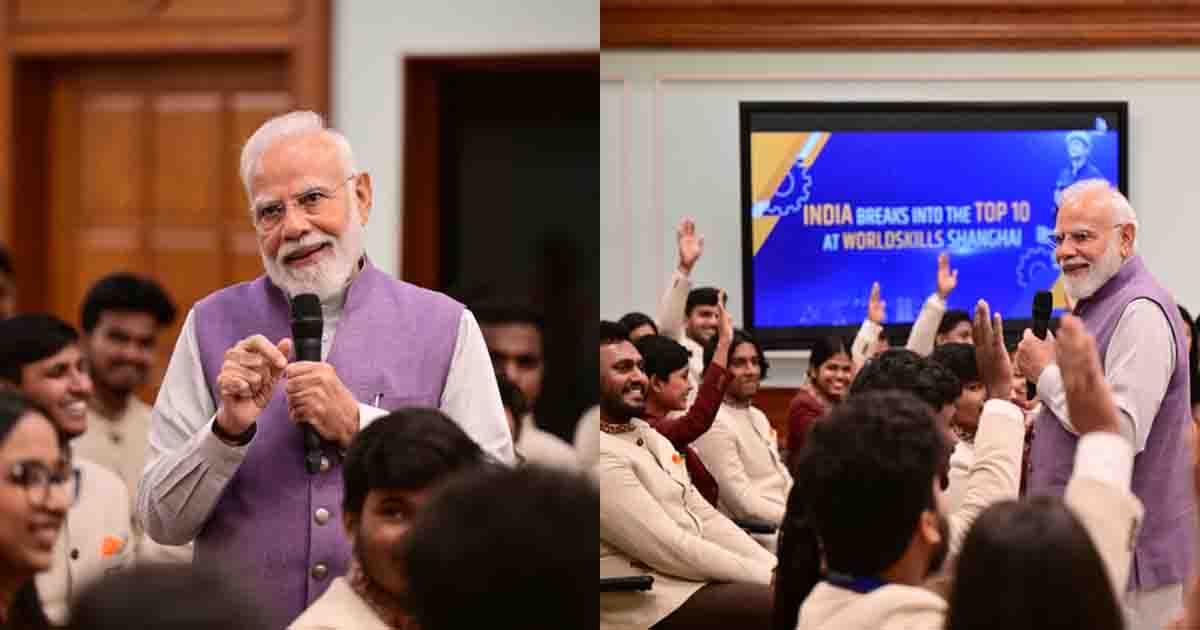
New Delhi, Oct 9: Prime Minister Narendra Modi on Friday met members of India’s contingent that delivered an impressive performance at the WorldSkills Competition Shanghai 2026, congratulating the young participants for showcasing their talent and skills on the global stage.
The interaction took place at the Prime Minister’s residence at 7, Lok Kalyan Marg, where PM Modi lauded the competitors for their achievements and encouraged them to continue excelling in their respective fields.
Sharing details of the meeting on social media, the Prime Minister praised the participants for their outstanding performance at the international skills competition and said it was a pleasure to interact with and motivate the young achievers.
The Prime Minister underlined the objective behind establishing a separate Ministry for Skill Development and said that the importance of skill training institutions is no less than that of IITs and IIMs. He encouraged the participants to share their experiences and suggestions with the government to help improve India’s skill training system.
India recorded its best-ever performance at the 48th WorldSkills Competition, held from September 22 to 27 at the National Exhibition and Convention Center (NECC) in Shanghai. The country secured six silver medals and 20 Medallions for Excellence, finishing 10th in the overall rankings.
The latest result marks a significant improvement from the previous edition of the competition held in France’s Lyon in 2024, where India finished 13th with four bronze medals and 12 Medallions for Excellence.
The improved ranking reflects the growing capabilities of India’s skilled workforce and its rising presence in global skills competitions.
According to the Ministry of Skill Development and Entrepreneurship, the six-day event brought together more than 1,400 young competitors from nearly 70 countries and regions.
India fielded its largest-ever contingent, comprising 70 competitors, who participated in 63 skill categories spanning emerging technologies, advanced manufacturing, engineering, creative industries and specialised services.
After four days of intense competition, winners were honoured during the closing ceremony held in Shanghai on September 27. The event celebrated excellence in technical expertise, innovation, precision and craftsmanship, drawing participants, industry leaders, experts and international delegations from across the world.
India’s participation in WorldSkills Shanghai 2026 was coordinated by the National Skill Development Corporation (NSDC) under the Ministry of Skill Development and Entrepreneurship, with support from Sector Skill Councils, industry partners, training institutions and technical experts.

696 kg of poppy husk worth Rs 1.04 crore seized from truck carrying steel coils in Gujarat

JNU sexual crime: Delhi BJP women ask Congress to expel its MP-cum-professor

Pakistan blasphemy laws under scrutiny over relentless minority persecution

Amitabh Bachchan gets emotional listening to late mother Teji Bachchan’s voice ahead of 84th birthday

Over 50 detained during protest against proposed Mata Sita Women varsity in Patna

Gift to President Putin part of PM Modi bid to globally display India’s heritage

PM Modi’s warm camaraderie with Putin, Xi on full display at BRICS Summit

INDIA bloc begins protest march against ECI

Complaint against Netflix & Mukesh Chhabra for inappropriate language on ‘India’s Got Latent 2’

Maha Congress stages agitation against Gyanesh Kumar
-

 Crime4 years ago
Class 10 student jumps to death in Jaipur
-

 Maharashtra2 years ago
Mumbai Local Train Update: Central Railway’s New Timetable Comes Into Effect; Check Full List Of Revised Timings & Stations
-

 Maharashtra2 years ago
Mumbai To Go Toll-Free Tonight! Maharashtra Govt Announces Complete Toll Waiver For Light Motor Vehicles At All 5 Entry Points Of City
-

 Maharashtra2 years ago
False photo of Imtiaz Jaleel’s rally, exposing the fooling conspiracy
-

 National News2 years ago
Ministry of Railways rolls out Special Drive 4.0 with focus on digitisation, cleanliness, inclusiveness and grievance redressal
-

 Maharashtra2 years ago
Maharashtra Elections 2024: Mumbai Metro & BEST Services Extended Till Midnight On Voting Day
-

 National News2 years ago
J&K: 4 Jawans Killed, 28 Injured After Bus Carrying BSF Personnel For Poll Duty Falls Into Gorge In Budgam; Terrifying Visuals Surface
-

 Crime2 years ago
Baba Siddique Murder: Mumbai Police Unable To Get Lawrence Bishnoi Custody Due To Home Ministry Order, Says Report