
Crime
Gutkha scam: CBI seeks TN govt’s approval to prosecute ex-ministers, top cops


The Central Bureau of Investigation (CBI) has sought Tamil Nadu government’s approval to prosecute two former ministers, as many retired Directors General of Police, and eight others in the multi-crore Gutkha scam that had rocked the state during the AIADMK regime.
According to sources in Tamil Nadu home department, the CBI’s anti-corruption unit has written a letter to get sanction for proceeding against two former ministers — C. Vijayabaskar the former state health minister, and B.V. Ramana, the former tax minister in the AIADMK government. It has also sought permission for action against two former DGPs — T.K. Rajendran and S. Geroge — who had worked as the Commissioner of Police, Chennai during the previous government.
Notably, sanction is necessary to prosecute former ministers and former senior IPS officers.
The incident related to the current case occurred in 2017 when bribes to the tune of Rs 39.91 crore were given to several politicians including ministers, bureaucrats, and former police officers for supporting and facilitating the storage and transport of Gutkha, which is a banned product, in Chennai.
The Income Tax department had unearthed the scam while it conducted a raid on the premises of a major Gutkha manufacturer in the country. The gutkha manufacturer, according to the CBI had in the records seized by the Income Tax department marked the bribes they had paid to politicians including ministers and police officers. The IT department, according to sources had sent the report to the government of Tamil Nadu but no action was taken against the perpetrators of the crime.
The CBI had taken over the investigation in 2018 and had charge-sheeted six of the accused including three officials. The second charge sheet, according to sources will be filed after the sanction is obtained for prosecution against the other accused, including former ministers and top police officers.


Crime
Pune: Pimpri-Chinchwad Cyber Police Bust ‘Scam Call Centre’ Plot In Navi Mumbai Before It Began

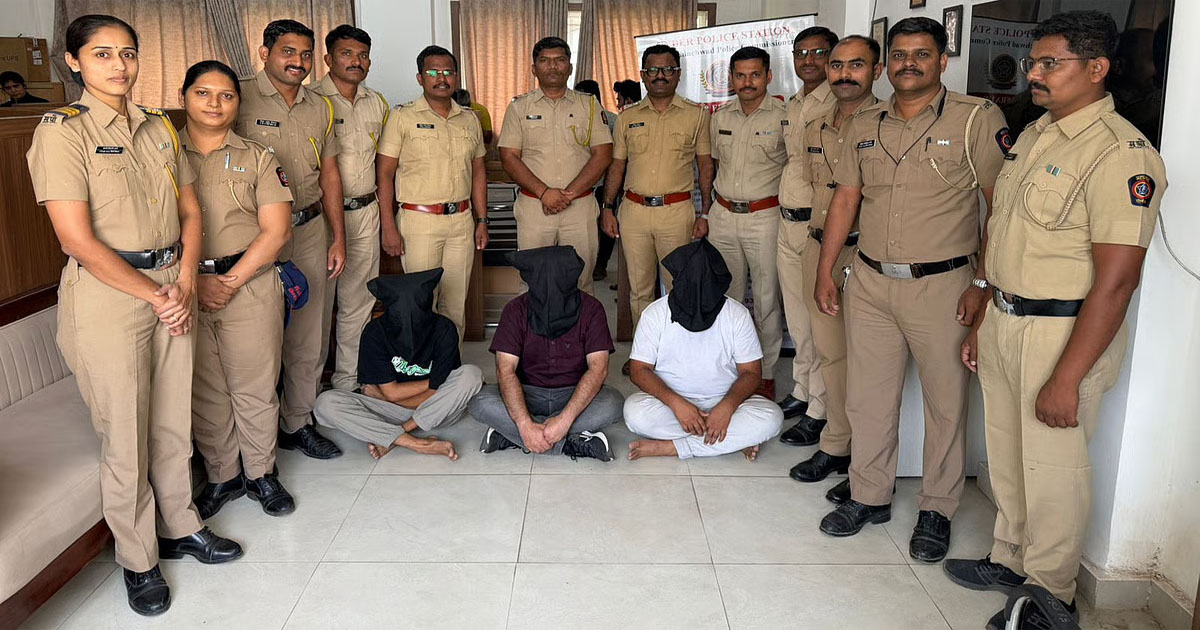
Pimpri-Chinchwad: The Cyber Police Station of Pimpri-Chinchwad Police Commissionerate (PCPC) has arrested three men who were preparing to start a cyber fraud call centre in Navi Mumbai. The accused had earlier worked in similar scam operations in Bangkok and Myanmar. Police said the gang was planning to target people with fake investment schemes, officials announced on Saturday.
The accused have been identified as Sushil Bhagwan Juwatkar (42), Pankaj Raj Kapoor (38), and Nishchal Tankbir Bareilly (27), all currently based in Navi Mumbai. The operation was carried out by the cyber police under the guidance of senior officers, including Pimpri-Chinchwad Commissioner of Police Vinoy Kumar Choubey.
According to Deputy Commissioner of Police (Crime) Dr Shivaji Pawar, the case came to light after a local businessman was cheated of Rs 2.09 crore. The fraudsters lured him with promises of high returns through IPOs and stock market investments. During the probe, police tracked a transaction of Rs 1.25 lakh to a bank account, which became a key lead in the case.
Further investigation led police to Sushil Juwatkar in Navi Mumbai. His associates, Pankaj Kapoor and Nishchal Bareilly, were also detained. Police found that Pankaj and Nishchal had experience working in cyber fraud call centres abroad. Acting on Juwatkar’s instructions, they were planning to set up a similar illegal operation locally.
During the raid, police seized several items used in cyber fraud activities. These included six mobile phones, three passports, two laptops, hard discs, POS machines, QR code scanners, debit cards, and multiple bank account kits and rubber stamps. Officials said these materials were intended to run a fake call centre and carry out financial fraud.
Police have also managed to freeze ₹62 lakh from the defrauded amount, providing partial relief to the victim. Efforts are ongoing to trace the remaining money and identify more links in the network.
Senior officers said the timely action helped prevent a large-scale cyber fraud operation from starting in the region. The investigation is still underway, and police are looking into possible connections with other cybercrime networks.
Crime
Mumbai: Former BMC Corporator Ramesh Suresh Kamble Booked For Fake Caste Certificate Fraud In 2002 BMC Polls
Mumbai: A case has been registered at Chembur Police Station against a former municipal corporator for allegedly contesting elections using a fake caste certificate and defrauding the government and the public.
The complaint was filed by Chitra Anant Salunke (63), an advocate and resident of Chembur, who runs a legal firm along with her son. The accused has been identified as Ramesh Suresh Kamble, a former corporator from Ward No. 192 (Borla North–Deonar Abattoir).
According to the complaint, Kamble contested the 2002 Brihanmumbai Municipal Corporation (BMC) elections from a seat reserved for Scheduled Castes by allegedly submitting a caste certificate claiming he belonged to the Hindu Mahar community. He won the election with 4,721 votes and served as corporator.
However, the runner-up candidate, Rajendra Vaman Waghmare, later raised objections and filed a complaint with the Divisional Caste Scrutiny Committee at Konkan Bhavan, Navi Mumbai. Following an inquiry, the committee, on November 11, 2005, concluded that Kamble was not from a Scheduled Caste but was a Christian by birth, based on documentary evidence including school records and a baptism certificate from a church in Matunga.
The committee declared his caste certificate, issued by the Sub-Divisional Officer, Mulund, in 1998, as invalid. Kamble challenged the decision in multiple courts, including the Small Causes Court, the Bombay High Court, and later the Supreme Court. However, all courts upheld the findings of the caste scrutiny committee.
Following the disqualification, Waghmare was declared elected and served as corporator for the remaining term. The complaint further alleges that Kamble knowingly used forged documents to obtain the caste certificate and subsequently contested and held public office from February 2002 to November 23, 2006, thereby gaining undue benefits.
Based on the complaint, police have registered a case against Kamble under IPC Sections 193, 199, 406, 420, 465, 466, 467, 468, 469, 470, and 471 for forgery, cheating, and criminal breach of trust. Further investigation is underway.

Mumbai: The body of a 55-year-old man was found between Jogeshwari and Ram Mandir railway tracks on Thursday at around 3 pm. Initially, the police suspected it to be a case of suicide. However, the deceased’s brother filed a complaint against the man’s wife, alleging abetment of suicide. Following the complaint, the Borivali Railway Police registered a case of abetment of suicide on Thursday.
The police identified the deceased as Nitin Chavan, an artist who made statues and lived in Nalasopara. His wife, Madhura Chavan, 47, works with an NGO. The couple reportedly argued frequently over household matters. The police said that initially they suspected it to be a case of suicide.
However, the deceased’s brother approached the GRP (Government Railway Police) and claimed that his brother had shared a video with him before his death. In the video, the deceased reportedly said that he was fed up with his wife and intended to commit suicide.
Passengers informed the police that a man had died after coming under a local train, though it has not yet been confirmed which train was involved. The police have registered a case and are investigating the matter.

Mayor’s instructions to maintain water supply in Mumbai, focus on water management, alternative sources and solutions

Taxes, margins eat half of Pakistan’s petrol price, consumers cry: Report

Mumbai: Stolen goods worth over Rs 84 lakh handed over to original owners, stolen goods are distributed within four months on the initiative of the DCP

Inspection of ongoing cleaning works in Methi River and eastern suburbs, planning of work in accordance with the drain in all three parts of the river: Additional Municipal Commissioner

Mumbai LPG Crisis: Chaotic Rush Seen Outside Chembur Bharatgas Agency As 200-300 People Queue Since 5 AM For Gas Cylinders

Married Mumbai Woman Mocked In Andheri Society Over ‘Lift Kissing’ CCTV Video, Files Police Complaint

LPG Crisis In Maharashtra: Cyber Crime On Rise Amid Shortage, 2 Women Lose ₹4 Lakh In ‘Gas Update’ Online Scam In Kalyan-Dombivli

Mahayoti’s big gift to the people of Mumbai… Now there is no tax for houses up to 500 square feet, the Municipal Corporation has increased this limit to 700 square feet.

Dhurandhar 2 Box Office Collection Day 1: Ranveer Singh Starrer Takes An Exceptional Opening; Crosses ₹100 Crore Mark

T20 WC: ‘You just have to control your emotions and express yourself,’ says Piyush Chawla on handling pressure in final
-

 Crime4 years ago
Class 10 student jumps to death in Jaipur
-

 Maharashtra1 year ago
Mumbai Local Train Update: Central Railway’s New Timetable Comes Into Effect; Check Full List Of Revised Timings & Stations
-

 Maharashtra1 year ago
Mumbai To Go Toll-Free Tonight! Maharashtra Govt Announces Complete Toll Waiver For Light Motor Vehicles At All 5 Entry Points Of City
-

 Maharashtra2 years ago
False photo of Imtiaz Jaleel’s rally, exposing the fooling conspiracy
-

 National News1 year ago
Ministry of Railways rolls out Special Drive 4.0 with focus on digitisation, cleanliness, inclusiveness and grievance redressal
-

 Maharashtra1 year ago
Maharashtra Elections 2024: Mumbai Metro & BEST Services Extended Till Midnight On Voting Day
-

 National News2 years ago
J&K: 4 Jawans Killed, 28 Injured After Bus Carrying BSF Personnel For Poll Duty Falls Into Gorge In Budgam; Terrifying Visuals Surface
-

 Crime1 year ago
Baba Siddique Murder: Mumbai Police Unable To Get Lawrence Bishnoi Custody Due To Home Ministry Order, Says Report