
National News
Delhi Elections 2025: Police Raids Punjab CM Bhagwant Mann’s Delhi Residence, Claims Chief Minister Atishi

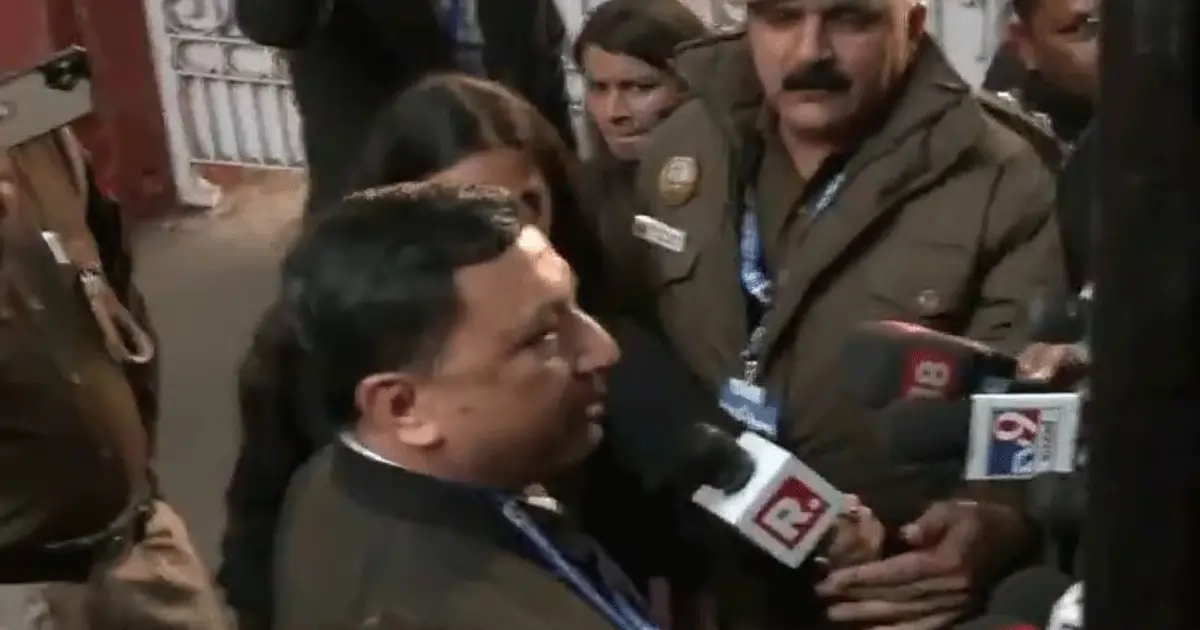
New Delhi: As the Delhi Assembly polls approach, allegations and counter-allegations from political parties in the Union Territory have intensified. Delhi Chief Minister Atishi, in a social media post, made a sensational claim stating that the Delhi Police had reached Punjab CM Bhagwant Mann’s residence in Delhi to conduct a raid.
Attacking the BJP over the alleged incident, she said, “The BJP people are openly distributing money, shoes, and blankets in broad daylight—that doesn’t get noticed. Instead, they rush to raid the residence of an elected Chief Minister.”
“Wow, BJP! The people of Delhi will give their answer on the 5th (election day)!” she added.
Atishi’s post claiming a raid at Bhagwant Mann’s residence comes amid reports of massive security deployment outside Kapurthala House, the official residence of Punjab CM Bhagwant Mann in Delhi.
Shortly after Atishi’s post, Returning Officer OP Pandey told media outside Mann’s residence, “We have got a complaint about money distribution. We have to dispose of the complaint in 100 minutes. Our FST had come here which was not allowed to enter. I have come here to request them to let us enter along with a cameraperson. The complaint of money distribution was received on the cVIGIL app.”
Notably, the police yesterday seized a large amount of cash and liquor have been seized from a car with a “Punjab government” sticker in Delhi. According to reports, AAP pamphlets were also found in the car.
Congress leader Sandeep Dikshit stated, “I wrote a letter to the LG about 25 days ago, informing him about Punjab-registered vehicles and Punjab Police bringing large amounts of money into Delhi. Today, that claim has been proven true. There is also information that Punjab Bhawan is being used as an office for the AAP. The police should raid Punjab Bhawan and investigate what is hidden inside its rooms.”


Chaos unfolded in Maharashtra’s Sangli on Sunday when an SUV ploughed into a crowd after ramming several vehicles on Tilak Road near the Ganpati Temple. According to reports, 11 people, including five police personnel, were injured in the incident.
The accused driver has been identified as Praniket Dattatrey Panchal from the Barshi Road area in Latur. The vehicle first hit several vehicles before ploughing into a crowded stretch where people were walking to attend the Krushnamai Festival.
After the incident, the driver was pulled out of the vehicle by an angry mob and assaulted. The crowd also vandalised the SUV.
The accused was later rescued by the police.
According to reports, the driver was under the influence of alcohol when incident occured. The injured were rushed to hospitals for treatment. Police stated that the driver has been booked and further investigation is underway.
National News
Fierce govt-Oppn showdown in LS over Rahul Gandhi’s mention of ex-Army chief’s unpublished memoir (Lead)


New Delhi, Feb 2: The Lok Sabha witnessed uproarious scenes and a huge pandemonium with opposition and treasury benches getting into a face-off over the citing of an ‘unpublished’ book by former Army Chief Mukund Naravane.
LS Speaker Om Birla’s repeated attempts to bring order in the House failed utterly as the Congress party persisted with demands to quote Naravane’s memoirs while the government strongly objected, terming it ‘theatrics’.
The ruckus broke out after the Leader of Opposition (LoP), Rahul Gandhi, led the opposition charge during the debate on Motion of Thanks to the President’s address on Monday.
The Congress MP started his speech by targeting the Centre over an article in a magazine, based on the memoirs of former Army chief Naravane. This invited a quick and direct counter from Defence Minister Rajnath Singh, and also Home Minister Amit Shah.
Gandhi said that the BJP questions the Congress party’s patriotism but blocks a book penned by a top officer of the Armed Forces.
As he started citing lines from the memoir, loud protests erupted from the treasury benches.
Rajnath Singh strongly objected to Gandhi’s quoting from the book, stating that the claims were vague as the book had not even published.
“What is the government scared of?” asked Rahul while doubling down his charge.
LS Speaker Om Birla advised the opposition members to refrain from citing any unverified subject, stating that this would amount to a breach of parliamentary norms.
As the opposition resorted to slogan-shouting, prompting a counter from HM Amit Shah. He urged the Speaker to direct the LoP to stop misleading the House with falsified claims.
The ruckus over Gandhi’s claims, where he stated that Chinese tanks were hurtling towards the Indian border, continued unabated as the opposition insisted on raising these charges while the treasury benches, including Union Ministers, erupted in protest.
The parliamentary rulebook was also cited by some BJP members, but the chaos and pandemonium persisted.
At one point, Samajwadi Party (SP) chief Akhilesh Yadav also rallied behind Rahul Gandhi and stated that since the China border is a sensitive matter, the Congress leader should be allowed to speak on the same.
Congress MPs also pointed fingers at the Speaker, claiming that the ruling party lawmakers have quoted false claims on the Nehru rule multiple times, but they were always given a free hand.
National News
Pak boycott of T20 WC match: India shouldn’t have played after ‘Op Sindoor’, says Oppn; cowardice, hits back BJP

New Delhi, Feb 2: Following Pakistan’s decision to boycott its high-profile T20 World Cup match against India, the Opposition on Monday termed the move the ‘biggest slap on the face’ of the Board of Control for Cricket in India (BCCI). Several Opposition leaders also questioned India’s participation in matches against Pakistan after ‘Operation Sindoor’. Meanwhile, the BJP said Pakistan’s decision was inconsequential and it was another example of its cowardice.
Speaking to media, Shiv Sena (UBT) MP Priyanka Chaturvedi said Pakistan’s boycott exposed the failure of cricketing diplomacy.
“This is the biggest slap on the face of the BCCI. The BCCI is the most powerful and richest cricket body in the world and an influential member of the ICC. After the terror attack and ‘Operation Sindoor’, we repeatedly raised Pakistan’s role in promoting terrorism on global platforms. Families of the 26 people who lost their lives kept appealing that matches should not be played with Pakistan,” she said.
Congress MP Ujjwal Raman Singh echoed similar concerns, stating that Pakistan should have been stopped from playing India immediately after ‘Operation Sindoor’.
“At that time, we raised the question of why India was still playing Pakistan. Terror attacks were carried out, innocent people were killed, and it was a serious issue. Yet matches continued. Now Pakistan is pretending to be the victim, while our people suffered losses. The ICC should take strict action. In a way, Pakistan is slapping us in the face, and India should take a firm stand,” he said, adding that the ICC’s representatives appeared to be failing in enforcing discipline.
Congress leader Pratap Singh Khachariyawas said, “Pakistan is meaningless and acting irrationally. Pakistan is not loyal even to Imran Khan or to its own people, so how can it be loyal to India? What Pakistan says about India makes no difference, because India has defeated Pakistan every time.”
Samajwadi Party MP Rajeev Kumar Rai said India missed an opportunity to take a decisive stand earlier.
“It is our mistake. We should not have given Pakistan the opportunity to refuse playing against us. A better decision should have been taken immediately after ‘Operation Sindoor’.
Congress MP Tariq Anwar said, “It is unfortunate that Pakistan refused at the very last moment, just when the time had come to play the match. It’s against the norms. There are few days left, then they are taking this decision. This is wrong.”
Congress spokesperson Surendra Rajput said the situation raised serious questions for the ruling party and cricket authorities.
“India will not tolerate threats. Whoever wants to leave can leave. But the BJP and the BCCI will have to answer how a country like Pakistan, and even smaller nations like Bangladesh, feel confident enough to issue threats or boycotts against India. The BJP must respond clearly,” he said.
In contrast, BJP leaders dismissed Pakistan’s decision as irrelevant. BJP MP Damodar Agrawal said, “It is their matter whether they play or not. There is no need for any reaction from our side.”
BJP spokesperson Pratul Shah Deo criticised Pakistan’s history, calling the boycott another example of its cowardice.
“Pakistan has a long history of retreat. In 1947–48, when it intruded into Kashmir, the Indian Army pushed them back. The same pattern was seen in 1965. During ‘Operation Sindoor’ as well, history repeated itself. We will appeal to the ICC to ban Pakistan’s cricket team for violating ICC norms,” he said.
BJP MP Sanjay Jaiswal said Pakistan benefited financially from Indian viewership.
“It is better if they do not come. They earn revenue from Indian television channels. On their own, they will not even be able to pay their cricketers,” he said.
BJP MLA Ram Kadam said India’s strength had already been proven on and off the field.
“Our players have shown that even on Pakistan’s home ground, they are capable of defeating them. Whether in the sky or on the ground, India has taught Pakistan lessons. This is a transformed India under Prime Minister Narendra Modi that enters enemy territory and acts decisively,” he said.
BJP Maharashtra President Amit Satam said, “This is Pakistan’s nature. Over the past many years, Pakistan has always behaved in this manner, and every time they show the same nature.”
BJP State President Sanjay Saraogi stated that Pakistan’s global standing had weakened further after Operation Sindoor.
“Our brave soldiers entered Pakistan and destroyed terrorist hideouts, leaving them shaken. Pakistan has no status left. It would be better if they do not play with India,” he said.
BJP MP Praveen Khandelwal emphasised national security over sports.
“India is not concerned about this issue. The safety of our country is paramount. Pakistan creates chaos, and it does not matter whether they play or not,” he said.
BJP MP Naresh Bansal concluded by saying that Pakistan’s boycott would not affect India.
“This is their decision. If they do not play, we will still go ahead and play,” he added.

‘Drunk’ SUV Driver Ploughs Into Crowd After Hitting Several Vehicles In Sangli; 11 Injured

Mumbai: BMC hammers down on additional construction on footpaths of Mohammad Ali Road and Ibrahim Merchant Marg, action taken by ‘B Ward’ administrative division

Mumbai: Police impose strict security measures on graveyards and shrines during Shab-e-Barat, prohibitory orders

Mumbai: Sewri–Worli Elevated Road Back On Track As Prabhadevi Rehabilitation Hurdle Finally Cleared

Fierce govt-Oppn showdown in LS over Rahul Gandhi’s mention of ex-Army chief’s unpublished memoir (Lead)

Mumbai Traffic Update: Heavy Vehicles Banned In City From February 1 During Peak Hours; What’s Allowed & What’s Not?

BMC Election Results 2026 Winners List: Check Ward-Wise Names Of Candidates Who Secured Victory

Sensex, Nifty open lower amid tariff-related concerns

Mumbai BMC Results Samajwadi Party Wiped Out From Govindi

Sensex, Nifty close week with gains over positive cues
-

 Crime3 years ago
Class 10 student jumps to death in Jaipur
-

 Maharashtra1 year ago
Mumbai Local Train Update: Central Railway’s New Timetable Comes Into Effect; Check Full List Of Revised Timings & Stations
-

 Maharashtra1 year ago
Mumbai To Go Toll-Free Tonight! Maharashtra Govt Announces Complete Toll Waiver For Light Motor Vehicles At All 5 Entry Points Of City
-

 Maharashtra1 year ago
False photo of Imtiaz Jaleel’s rally, exposing the fooling conspiracy
-

 National News1 year ago
Ministry of Railways rolls out Special Drive 4.0 with focus on digitisation, cleanliness, inclusiveness and grievance redressal
-

 Maharashtra1 year ago
Maharashtra Elections 2024: Mumbai Metro & BEST Services Extended Till Midnight On Voting Day
-

 National News1 year ago
J&K: 4 Jawans Killed, 28 Injured After Bus Carrying BSF Personnel For Poll Duty Falls Into Gorge In Budgam; Terrifying Visuals Surface
-

 Crime1 year ago
Baba Siddique Murder: Mumbai Police Unable To Get Lawrence Bishnoi Custody Due To Home Ministry Order, Says Report