
Business
Ashwini Vaishnaw flags off Swarnanagari Express, connecting Jaisalmer to Delhi

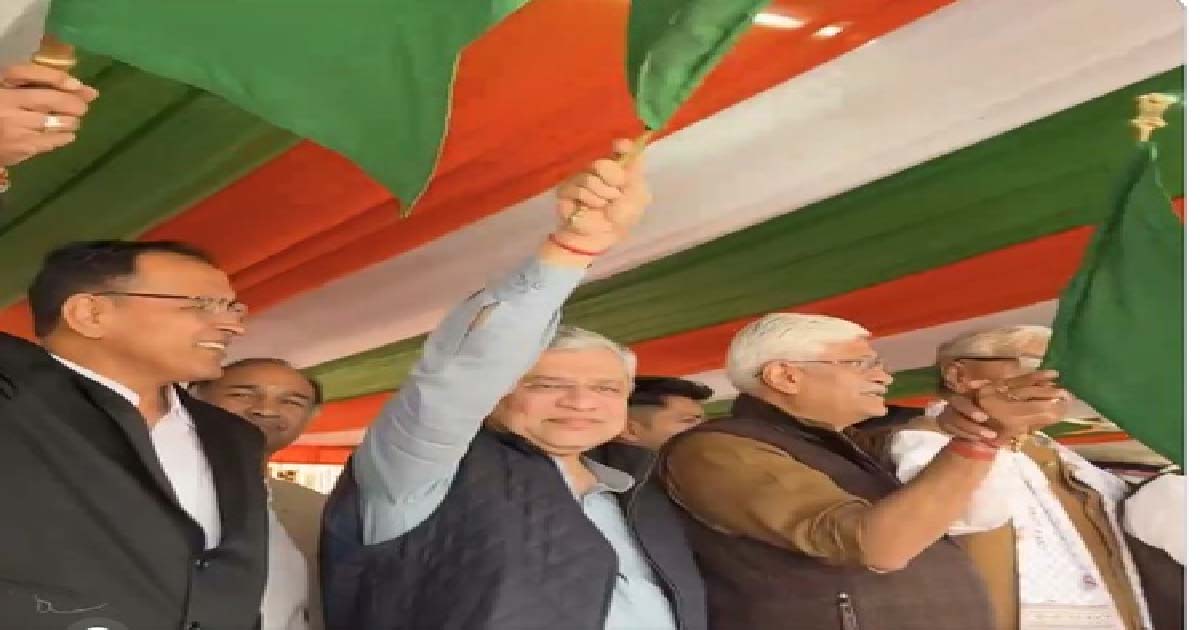
Jaipur, Nov 29: Railway Minister Ashwini Vaishnaw and Union Tourism Minister Gajendra Singh Shekhawat jointly flagged off the Swarnanagari Express on Saturday, which will connect Jaisalmer with Delhi.
During the inauguration ceremony, responding to the request of Union Minister Shekhawat and the locals, the Railways Minister announced the renaming of the newly-launched train from Jaisalmer–Shakur Basti–Jaisalmer to Swarnanagari Express.
He announced that the train will begin regular operations on December 1.
The minister said that development work at Jaisalmer railway station is in its final phase and is expected to be completed within a month.
“Efforts will be made to ensure that Prime Minister Narendra Modi inaugurates the upgraded station,” he said.
Union Minister Vaishnaw also confirmed that the railway line between Jaisalmer and Jodhpur will be upgraded soon.
According to officials, these initiatives will significantly improve connectivity, boost tourism, and strengthen strategic infrastructure in the border region.
Ashwini Vaishnaw said that the connectivity will strengthen national security.
Preparations are underway to connect several regions along the Rajasthan–Pakistan border with new railway lines.
He said that extending rail connectivity to these sensitive areas will significantly enhance the country’s security infrastructure.
Under this initiative, new railway lines are proposed for Anupgarh, Bikaner, Jaisalmer, Barmer, and Bhildi.
The minister arrived in Jaisalmer on Saturday to inaugurate a new train service to Delhi.
The minister also visited stalls under the One Station, One Product scheme and made purchases to promote local artisans.
He said that the Detailed Project Report (DPR) for the proposed border-area railway lines is being prepared and will be completed in the coming months.
“A complete effort will be made to connect the entire border region,” he assured.
He added that railway projects worth approximately Rs 55,000 crore are currently in progress across Rajasthan, including the redevelopment of 85 railway stations.
Work is also advancing on multiple new railway corridors and infrastructure projects.
The new initiatives, officials said, will improve connectivity, boost tourism, and strengthen strategic infrastructure in the border region.

New Delhi, March 19: India’s thermal power plants have adequate coal stocks of around 53.41 million tonnes which are adequate for nearly 23 days at the present rate of consumption, and further stocks are also being built up at the pitheads of coal mining companies as a proactive measure to meet any exigency amid the disruption in oil and gas supplies due to the Iran war, the Ministry of Coal said on Thursday.
The pithead coal stock at the mines of Coal India Limited (CIL), which was 106.78 million tonnes (MT) as on April 1, 2025, has grown to about 125.54 MT as on March, 18, 2026. Further, there is around 5.75 MT of coal at the mines of Singareni Collieries Company Limited (SCCL) and another 15.75 MT coal at the mines of captive/commercial mines and about 12 MT in transit and about 5.49 MT in ports and good-shed sidings, according to a statement issued by the ministry.
Coal is continuing to ensure reliable baseload power to support core industries such as steel and cement that underpin the economic growth of the country. The coal production in the country continues at a pace matching the prevailing demands of the consumer and building adequate stocks at the mine-end for maintaining adequate supplies to the consumers as per their requirements, with the continued support of Railways, the statement said.
Coal India Limited is taking adequate measures to ensure the supply of coal to all consumers, including small, medium, and other consumers. As a proactive step, CIL has planned 29 e-auctions in the month of March, offering about 23.56 MT of coal. Out of these 29 auctions, 5 auctions have already been conducted since March 12, wherein 73.1 lakh ton of coal was offered, and 31.96 lakh ton of coal has been booked, indicating adequacy of coal offered in the e-auctions, the statement said.
In addition to this, CIL has also taken necessary action to ensure coal availability to the small, medium and other consumers through the State Nominated Agencies (SNAs) route and requested the state governments to provide the additional coal requirement, which can be met in full to avoid any energy shortages. The coal offtake of the states through the SNAs is being constantly monitored by CIL to ensure that uninterrupted supplies are ensured, the statement said.
The Ministry of Coal is ensuring a performance-driven ecosystem through sustained policy facilitation, robust monitoring mechanisms, and proactive stakeholder engagement. These concerted efforts are aimed at providing reliable coal availability, enabling uninterrupted operations across critical sectors, and effectively meeting the nation’s growing energy demands, the statement added.
Business
India’s Rs 5 trillion gold hoard fuels boom in fast-growing gold loan market, draws global investors

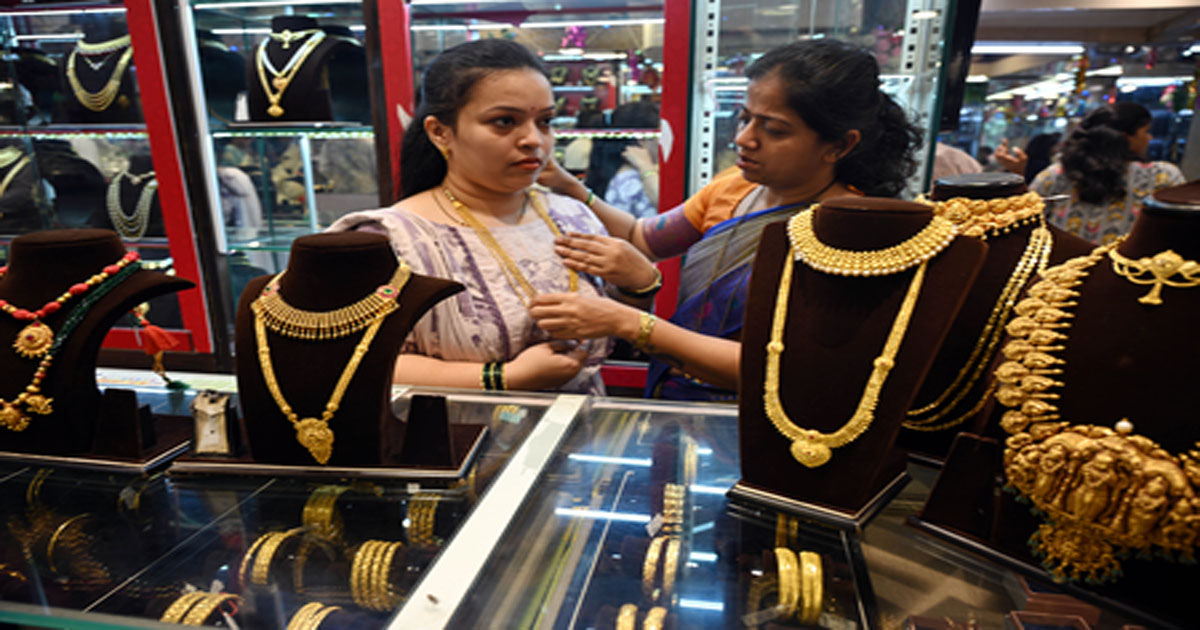
New Delhi, March 19: Indian households are sitting on an enormous reserve of gold, and that wealth is now quietly reshaping the country’s lending market, a report has said.
According to a report by Morgan Stanley, Indian households collectively own more than 34,000 tonnes of gold.
Kotak Mahindra Bank estimates this stockpile to be worth nearly $5 trillion. While most of this gold — around 90 per cent — still lies idle, it is increasingly being used as collateral to raise quick loans.
Gold-backed lending has emerged as one of the fastest-growing segments in India’s retail credit space.
This comes at a time when other forms of consumer loans, especially unsecured personal loans, have slowed due to tighter regulations.
The Reserve Bank of India had tightened rules around unsecured lending in late 2023, limiting easy access to such credit for many borrowers.
As a result, more people are turning to gold loans. These loans are easier to access, often require minimal paperwork, and can be disbursed quickly.
At the same time, a sharp rise in global gold prices has made this option even more attractive.
Since 2024, gold prices have surged significantly, increasing the value borrowers can unlock against their jewellery.
Data from the RBI shows that gold loans more than doubled in just one year, reaching Rs 4 trillion in January from Rs 1.75 trillion a year earlier.
This makes gold loans the fastest-growing retail credit category in India, after home and vehicle loans.
However, the actual size of the gold loan market is believed to be much larger. Experts estimate it to be around Rs 14 trillion, as RBI data does not fully capture lending by non-banking financial companies (NBFCs).
These NBFCs account for nearly half of the gold loan market. The rapid growth of gold loans is also drawing global attention.
Private equity firm Bain Capital is planning to acquire up to a 41.7 per cent stake in Manappuram Finance, a deal recently approved by the RBI.
Meanwhile, Japan’s financial giant Mitsubishi UFJ Financial Group has acquired a 20 per cent stake in Shriram Finance, which is also expanding its gold loan business.

New Delhi, March 19: Pakistan has limited petroleum reserves, with crude oil stocks sufficient for just 11 days, raising concerns over energy security amid disruptions caused by the ongoing Middle East conflict, a report has said.
Briefing the Senate Standing Committee on Petroleum, the secretary petroleum said the country currently has diesel reserves for 21 days, petrol for 27 days, liquefied petroleum gas (LPG) for nine days and jet fuel for 14 days, according to a report in The Express Tribune.
Nearly 70 per cent of Pakistan’s petroleum imports come from the Middle East, and the ongoing conflict has disrupted key shipping routes and supply chains, the official said.
Pakistan is in talks with Iran to secure permission for oil shipments through the Strait of Hormuz, which could allow four vessels to transport crude cargoes if approved.
Officials also warned of a potential gas crisis, with the country likely to face a severe shortage after April 14 due to disruptions in liquefied natural gas (LNG) supplies.
Of the eight LNG cargoes expected in March, only two reached Pakistan, while several shipments scheduled for April may also be affected.
The report also said that the conflict has also led to a sharp rise in global oil prices, with high-speed diesel prices increasing significantly and petrol costs also witnessing a steep jump. Shipment timelines have been impacted as well, with deliveries via the Red Sea now taking nearly 12 days compared to the usual four to five days, it said.
Moreover, authorities are considering measures to prioritise gas supply for domestic consumers, while reducing supply to industries and commercial users to manage shortages.
In a relief measure, the government has decided to provide a subsidy of Rs 23 billion to around 30 million motorcycle and rickshaw owners, funded through savings from austerity measures.
Meanwhile, the government has initiated daily reviews of petroleum stocks to closely monitor the situation.
“The country currently has adequate fuel availability for March, with arrangements in place to ensure supplies through mid-April,” according to officials.

All rhetoric, no action: Saudi Arabia realises Pakistan not dependable security partner

Mumbai Accident: Elderly Woman Hit By Garbage Truck Near Shitladevi Metro Station In Mahim; Suffers Heavy Blood Loss

India’s power plants well stocked with coal as PSUs step up production

India’s Rs 5 trillion gold hoard fuels boom in fast-growing gold loan market, draws global investors

Mumbai Local: 395 Without Tickets Fined At Ghatkopar During Evening Peak Hours, Central Railways Collects Over ₹1 Lakh Fine

Married Mumbai Woman Mocked In Andheri Society Over ‘Lift Kissing’ CCTV Video, Files Police Complaint

Mumbai: JBCN International School In Borivali Gets Bomb Threat, Search Reveals Hoax, Students Safe

Former Arsenal Star Mesut Ozil’s Convoy Gets Involved In Road Accident During Bangladesh Visit

Gold and silver surge on safe haven demand, margin cut

Mumbai Crime Branch Issues LOC Against Lawrence Bishnoi Aide Harry Boxer For Threatening Actor Ranveer Singh
-

 Crime4 years ago
Class 10 student jumps to death in Jaipur
-

 Maharashtra1 year ago
Mumbai Local Train Update: Central Railway’s New Timetable Comes Into Effect; Check Full List Of Revised Timings & Stations
-

 Maharashtra1 year ago
Mumbai To Go Toll-Free Tonight! Maharashtra Govt Announces Complete Toll Waiver For Light Motor Vehicles At All 5 Entry Points Of City
-

 Maharashtra1 year ago
False photo of Imtiaz Jaleel’s rally, exposing the fooling conspiracy
-

 National News1 year ago
Ministry of Railways rolls out Special Drive 4.0 with focus on digitisation, cleanliness, inclusiveness and grievance redressal
-

 Maharashtra1 year ago
Maharashtra Elections 2024: Mumbai Metro & BEST Services Extended Till Midnight On Voting Day
-

 National News1 year ago
J&K: 4 Jawans Killed, 28 Injured After Bus Carrying BSF Personnel For Poll Duty Falls Into Gorge In Budgam; Terrifying Visuals Surface
-

 Crime1 year ago
Baba Siddique Murder: Mumbai Police Unable To Get Lawrence Bishnoi Custody Due To Home Ministry Order, Says Report