
National News
IAF avoids Pak airspace to bring nationals from countries bordering Ukraine

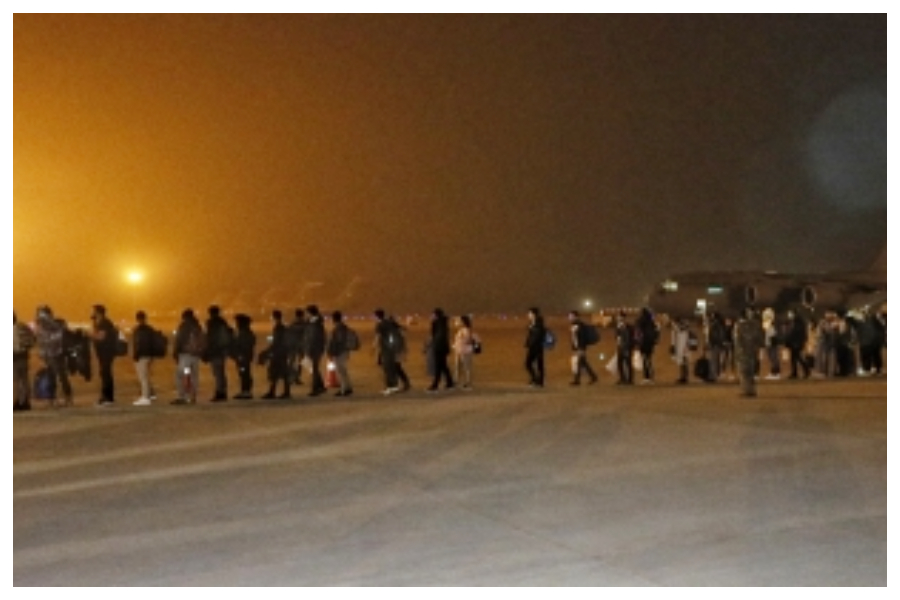
Under ‘Operation Ganga’, the Indian Air Force has avoided the Pakistan airspace to bring back stranded Indian nationals from countries bordering Ukraine as the war entered eighth day. The Indian Air Force till Thursday brought 798 citizens from Hungary, Poland and Romania.
The force had sent four C-17 transport aircraft on Wednesday to bring back the Indian nationals who had crossed the Ukraine border.
All four transport aircraft returned with the 798 citizens to the Hindon airbase in Uttar Pradesh’s Ghaziabad bordering Delhi on Thursday early morning.
The force has also sent three more aircraft to bring another lot of stranded citizens. The Air Force was called in to augment the commercial flights.
About avoiding the Pakistan airspace, a military source said that the decision was taken by the government not to take any military favour from Islamabad. What it costs is an additional around 30 minutes of travel.
“To fly military aircraft from any nation’s airspace, there is a requirement of various permissions from that country so it was decided to avoid it,” source said.
The same aircraft was used to evacuate Indian nationals from Afghanistan after the Taliban took over in August last year. Under Operation Ganga, India has sent 15 aircraft, both commercial and military, till Wednesday. A total 15 more aircraft are also scheduled to land in India on Thursday.
On Wednesday, the Ministry of External Affairs stated that around 17,000 Indian nationals have left war-torn Ukraine borders since the Indian embassy in Ukraine issued its first advisory.
The ministry spokesperson Arindam Bagchi had stated, “We now estimate that nearly 17,000 Indian nationals have left Ukraine borders since our advisories were issued in the last week of January.”
He further said that the embassy in Kyiv has been asked to set up a temporary office in Lviv to facilitate border crossing by the Indian nationals.
He also said that a mechanism has been established for issuing emergency certificates to those who lost their Indian passports which will also help many students.

National News
Major Blow To Naxal Network In Maharashtra: 11 Top CPI (Maoist) Leaders With A Cumulative Bounty Of ₹82 Lakh Surrender

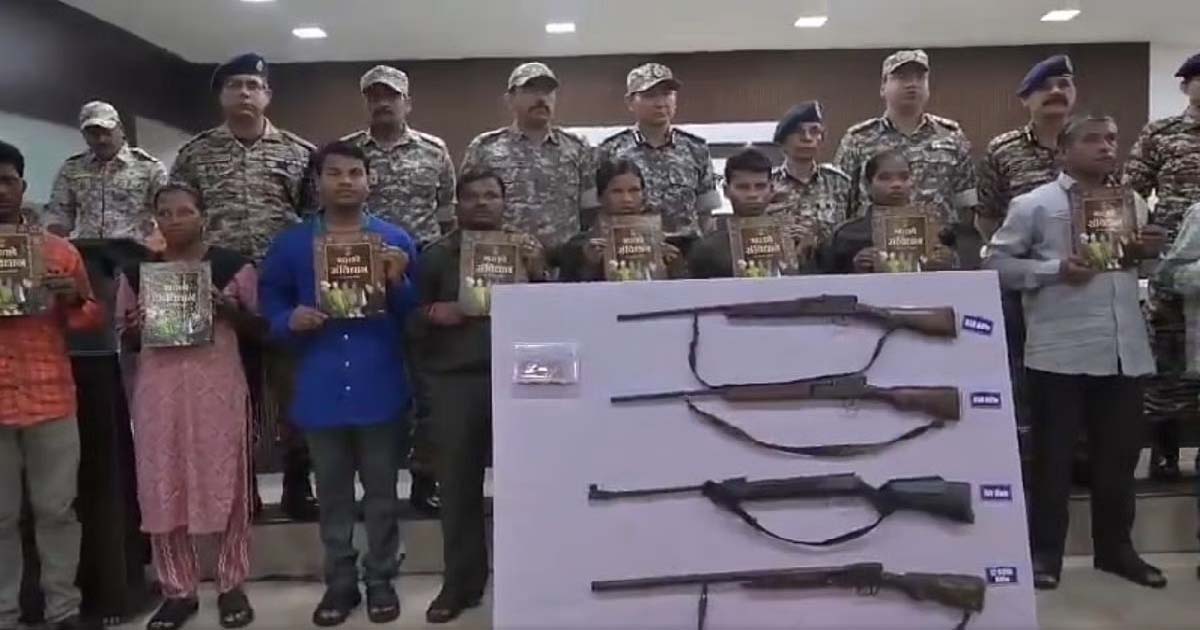
Nagpur: In yet another success to the Maharashtra government’s campaign to end left-wing extremism, 11 CPI (Maoist) commanders and cadres carrying a cumulative bounty of ₹82 lakh surrendered before the Gadchiroli police on Wednesday morning in the presence of Director General of Police Rashmi Shukla.
The surrendered group includes several high-ranking leaders — Divisional Committee Members, Platoon Committee Members and Area Committee Members — marking one of the most significant mass surrenders in recent years. Security was tightened at the venue as four of the Maoists arrived armed and in full uniform.
Among those who surrendered were Ramesh alias Baju Lekami and Bhima alias Kiran Hidma Kowasi, both Divisional Committee Members of the banned outfit. Senior Platoon Committee members Poriya alias Lucky Adama Gota, Ratan alias Sanna Masu Oyam, and Kamala alias Rago Iriya Veladi also laid down arms. Others include Poriya alias Kumari Bhima Veladi, Ramji alias Mura Lachhu Pungati, Sonu Podiyam alias Ajay, Prakash alias Pandu Pungati, Sita alias Jaini Tonde Pallo, and Sainath Shankar Made.
Local officials believe the surrender has delivered a major blow to Maoist operations across the Dandakaranya region, spanning Chhattisgarh, Maharashtra and Telangana. The event was attended by Additional Director General (Special Actions) Dr Tshering Dorje, DIG Ankit Goyal, DIG (CRPF) Ajay Kumar Sharma and Superintendent of Police Neelotpal.
Wednesday’s surrender is being hailed as one of the biggest successes for Gadchiroli police since Bhupathi alias Mallojula Venugopal Rao, a Politburo member of the CPI (Maoist), surrendered before Chief Minister Devendra Fadnavis on October 15 along with 60 others.
“This is the beginning of the end of Naxalism in Gadchiroli. We are committed to the Union government’s deadline of March 31, 2026, to eliminate leftwing extremism from India,” DGP Rashmi Shukla said, adding that over 100 Maoists have surrendered in Gadchiroli district this year.

New Delhi, Dec 10: The Bombay Stock Exchange’s (BSE) subsidiary BSE Index Service on Wednesday announced the launch of four new factor Indices from the universe of BSE large-cap total market capitalisation (TMC) index with 5 per cent stock level capping.
The newly introduced indices are BSE large-cap 100 momentum 30, BSE large-cap 100 low volatility 30, BSE large-cap 100 enhanced value 30, and BSE large-cap 100 quality 30.
“BSE Index Services Pvt. Ltd., a wholly owned subsidiary of BSE, today announced the launch of 4 new BSE factor indices from the BSE 100 large cap TMC index as the universe with 5 per cent stock level capping,” the exchange said in a press release.
These Indices are Reconstituted Quarterly, have a base value of 1000, and the first value date is June 20, 2005, along with the additional screening for the liquidity profile, the release added.
BSE large-cap 100 Momentum 30 will track the performance of the 30 companies in the BSE 100 large-cap TMC that exhibit the most persistence in their relative performance, based on their momentum scores. Constituents are weighted based on their momentum score.
BSE large-cap 100 Low Volatility 30 will measure the performance of the 30 least volatile companies in the BSE 100 large-cap TMC. Constituents are weighted by their inverse volatility.
BSE large-cap 100 Enhanced Value 30 measures the performance of the 30 companies in the BSE 100 large-cap TMC with the most attractive valuations, based on their value scores. Constituents are weighted based on their value score.
BSE large-cap 100 Quality 30 measures the performance of the 30 companies in the BSE 100 large-cap TMC that exhibit the most persistence in their relative performance, based on their momentum scores. Constituents are weighted based on their momentum score.
“Building on the success of factor launches on the BSE 500 universe earlier in the year, we are pleased to expand our factor family with the launch of four new factor indices, this time on the large-cap universe,” BSE Index Services Pvt. Ltd MD & CEO Ashutosh Singh said.
“These indices, in the same vein as our BSE 500 universe factor family, will be reset on a quarterly basis with the introduction of an innovative score-based only weighting method,” he added.
The index said that these new indices can be used for running passive strategies such as ETFs and Index Funds.
It can also be used for benchmarking of PMS strategies, MF schemes and fund portfolios. Additionally, investors can now access a broader spectrum of market opportunities, further enriching their investment strategies with this latest addition to BSE’s suite of indices.

New Delhi, Dec 10: The total installed renewable energy (RE) capacity in India reached 250.64 GW (as on October 31), with solar energy constituting a major chunk, the Parliament was informed on Wednesday.
The solar energy capacity increased from 2.82 GW in March 2014 to 129.92 GW, wind energy capacity increased from 21.04 GW in March 2014 to 53.60 GW, and biomass power capacity has increased from 8.18 GW in March 2014 to 11.61 GW within the given period, Minister of State for New and Renewable Energy, Shripad Yesso Naik, said in a written reply in Lok Sabha.
India is a key driver of this explosive global surge in renewable energy. In the last 11 years, the country’s solar capacity has grown from 2.8 GW to nearly 130 GW, a rise of more than 4,500 per cent. Between 2022 and 2024 alone, India contributed 46 GW to global solar additions, becoming the third-largest contributor.
The country recorded its highest-ever addition of non-fossil capacity in the current financial year at 31.25 GW, including 24.28 GW of solar.
According to reports, the share of India’s electricity generation from renewable energy (RE) capacity, including large hydro, is expected to cross 35 per cent by FY30 from 22.1 per cent in FY25, with expected incremental capacity addition of around 200 GW between FY25 and FY30.
This, in turn, also hinges on the extent of implementation of the ongoing project pipeline, where the projects are bid out and the PPAs are signed, the development of adequate transmission connectivity infrastructure as well as timely bidding for new RE projects, along with the power purchase agreements (PPAs) signing by Central nodal agencies, states the report by rating agency ICRA.
With global mechanisms now shaping industrial competitiveness, India’s shift towards renewable energy has become even more urgent and strategically important.

Preparations for Sunni Dawat-e-Islami’s three-day global Sunni gathering in full swing

Major Blow To Naxal Network In Maharashtra: 11 Top CPI (Maoist) Leaders With A Cumulative Bounty Of ₹82 Lakh Surrender

Azmi demands in Nagpur Assembly that Navi Mumbai Airport be named after Chhatrapati Shahu Maharaj

BSE launches 4 new BSE 100 large-cap TMC universe factor indices

Installed renewable energy capacity in India reaches 250.64 GW: Govt

Kalyan College Namaz Controversy: SIO Demands Action Against Perpetrators

A powerful explosion near Delhi’s Red Fort… High alert across Delhi after the blast; 8 people killed; forensic team arrives at the scene.

Dharmendra’s Fan, An Auto-Rickshaw Driver, Breaks Down Outside Actor’s Mumbai Home After His Discharge, Says ‘Admired Him Since Childhood

SS Rajamouli Faces FIR For ‘Hurting’ Religious Sentiments Over Controversial Lord Hanuman Remark At Varanasi Event In Hyderabad

Mumbai Local Train Update: Megablock On Central, Harbour, Trans-Harbour & Western Railway Lines On Nov 16; Check Details
-

 Crime3 years ago
Class 10 student jumps to death in Jaipur
-
 Maharashtra1 year ago
Mumbai Local Train Update: Central Railway’s New Timetable Comes Into Effect; Check Full List Of Revised Timings & Stations
-
 Maharashtra1 year ago
Mumbai To Go Toll-Free Tonight! Maharashtra Govt Announces Complete Toll Waiver For Light Motor Vehicles At All 5 Entry Points Of City
-

 Maharashtra1 year ago
False photo of Imtiaz Jaleel’s rally, exposing the fooling conspiracy
-
 National News1 year ago
Ministry of Railways rolls out Special Drive 4.0 with focus on digitisation, cleanliness, inclusiveness and grievance redressal
-
 Maharashtra1 year ago
Maharashtra Elections 2024: Mumbai Metro & BEST Services Extended Till Midnight On Voting Day
-

 National News1 year ago
J&K: 4 Jawans Killed, 28 Injured After Bus Carrying BSF Personnel For Poll Duty Falls Into Gorge In Budgam; Terrifying Visuals Surface
-

 Crime1 year ago
Baba Siddique Murder: Mumbai Police Unable To Get Lawrence Bishnoi Custody Due To Home Ministry Order, Says Report