
Crime
Fourth accused in Bulli Bai case arrested by Mumbai Police

In a latest update in the Bulli Bai app controversy, the Mumbai Police has arrested the fourth accused in the case from Odisha.
The accused has been identified as Neeraj Singh.
“Neeraj was involved in the planning and execution of the plot through Bulli Bai app. We will produce him before the concern court and will seek his custodial remand,” a Mumbai Police official said.
Vishal Jha, Shweta Singh and Mayank Rawal were earlier arrested by the Mumbai Police from different states.
The Delhi Police has also arrested a few persons in connection with the Bulli Bai matter.
Both the Mumbai and the Delhi Police are probing the matter.
On January 4, the police arrested Shweta Singh, a resident of Uttrakhand. She was the second and Mayank Rawal was the third person arrested in connection with the controversy.
Apart from the Mumbai Police, the Special Cell of the Delhi Police which was conducting a parallel probe, has also made two arrests.
The special cell arrested Neeraj Bishnoi, the main accused in the case and Aumkareshwar Thakur the main accused behind Sulli Deal.
On January 1, the Bulli Bai app posted photos of several women of a particular religion including journalists, social workers, students and famous personalities. It happened six months after the controversy of Sulli Deals.
Jha was one of the followers of Bulli Bai which led the police to team.
Github which provided space to Sulli Deals, hosted the Bulli Bai app too. However, Github had later removed the user from its hosting platform.
But by then Bulli Bai had sparked a controversy nationwide.
The Bulli Bai app was also being promoted by a Twitter handle with the name @bullibai, with the display picture of a Khalistani supporter.
This Twitter handle claimed that women can be booked from the app and was also promoting Khalistani content.









Crime
Mumbai: Mazgaon Court Stenographer Held For Demanding ₹15 Lakh Bribe, Approaches Special ACB Court For Bail


Mumbai: The stenographer posted at court at Mazgaon, Chandrakant Vasudev, was arrested allegedly for demanding and accepting bribes allegedly on behalf of the Additional Sessions Judge, Civil Sessions Court, Court No. 14, Mazagon. Aejazuddin S. Kazi has again approached the special ACB court for bail. The plea is likely to be heard on Thursday.
Vasudev was arrested on November 10 for allegedly accepting a bribe of Rs 15 lakh in exchange for a favourable verdict in a land dispute case. The special court rejected his first bail plea on November 24. A second bail plea claims no need for further incarceration and investigation can proceed without detaining him.
The prosecution claims Vasudev told the agency that Kazi had instructed him to demand the bribe, and after accepting the amount, Kazi asked him to bring it to his residence. It allegedly started on September 09 when Vasudev told the complainant’s associate in the court washroom to “do something for Saheb (the Judge), and the order will be in your favour”. He later demanded Rs 10 lakh for himself and Rs 15 lakh for the judge at a café. After refusal, he threatened via WhatsApp.
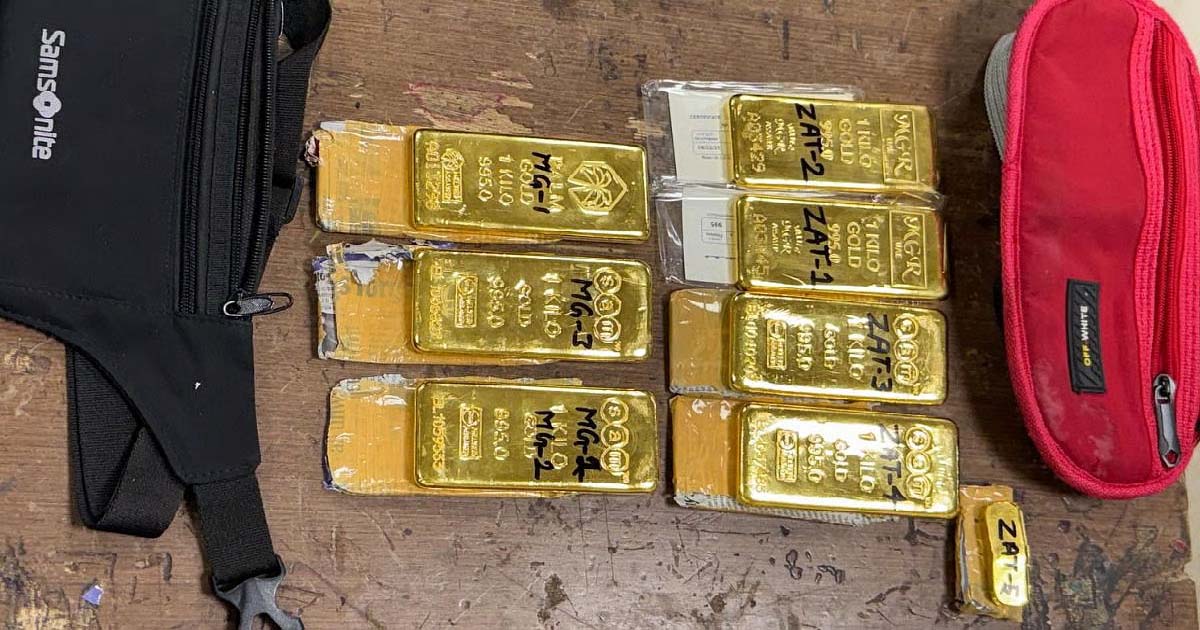
Mumbai: The Directorate of Revenue Intelligence, in its report, stated that gold smuggling in the year 2024–25 remained concentrated in hotspots like Maharashtra, Tamil Nadu, Gujarat and West Bengal, serving as entry points or redistribution hubs due to their strategic location, higher number of flights and transit routes.
In 2024–25, the DRI seized 1,073 kg of gold having a market value of approximately Rs 785 crore, the report stated. Mumbai emerged as the main hotspot for gold smuggling through airports, far surpassing all other locations in both the quantity of gold seized and the number of cases detected, the agency stated in its report.
According to the DRI, gold smuggling syndicates operate through a structured network: masterminds located abroad or in India fund operations, organisers recruit carriers, carriers transport concealed gold into India, and handlers receive gold for delivery to key members of the network in India for further sale.
Sometimes, gold smuggled in forms other than foreign-origin bars, such as wax or jewellery, is melted into 24-carat bar form at illicit facilities, sold domestically, converted into jewellery and integrated into domestic markets. Proceeds are usually repatriated abroad via hawala or illegal forex channels, sustaining a multi-layered, highly networked smuggling operation.
“Air routes, especially flights from the Middle East and Southeast Asia that connect to metro and Tier-II airports, are the primary channel for gold smuggling into India. Smugglers exploit diverse passenger profiles, including women, families and airline crew, to smuggle gold into India. Increasingly, smugglers are also concealing gold inside aircraft cavities for later retrieval by crew, passengers or airport staff. Sometimes, gold concealed in the aircraft during the international leg is retrieved by passengers during the domestic leg of the aircraft. Further, transit passengers smuggle gold via body concealment and hand it over to airport staff,” the report stated.
“A more sophisticated and dangerous method involves concealing gold inside the human body. Syndicates mould gold in wax form into small capsules, which are then inserted into body cavities to evade detection by scanners and manual checks. This trend reflects a growing shift towards high-risk concealment techniques that endanger the carrier’s health,” stated the report.
“The gender profile of gold smuggling carriers for 2024–25 revealed that the majority of individuals apprehended were male. However, the presence of women, making up one-tenth of the persons apprehended, highlights a growing trend of female involvement, possibly due to perceptions of lower suspicion during checks. The domicile profile of gold smuggling carriers in 2024–25 indicates that the overwhelming majority were Indian nationals, which highlights the dominance of domestic carriers in gold smuggling. Carriers from Kenya and Iran contributed modestly, with isolated cases involving carriers from Thailand, Turkey, Afghanistan, Oman, the UAE and the USA,” the report further stated.

New Delhi, Dec 17: Acting on the orders of its special Court at Patna, the National Investigation Agency (NIA) has attached two immovable properties of an accused in a transnational human trafficking and cyber frauds case, the agency said on Wednesday.
The properties involved one flat in Thane, Maharashtra, and a piece of land in Siwan, Bihar.
According to the NIA, “Both had been purchased by the wanted accused Anand Kumar Singh in his wife’s name using money earned illegally from human trafficking activities. The accused, a Cambodia-based Indian national, was involved in trafficking Indian youth to Cambodia for forced criminal cyber frauds, NIA investigations had revealed.”
The special Court of NIA at Patna had established the two properties to be proceeds of crime and had, on December 10, ordered their attachment under section 107 of BNSS. It had further directed that the money obtained after their auction be forfeited.
As per NIA’s investigation, the accused was part of a syndicate engaged in luring vulnerable youth from India with false promises of well-paying legitimate jobs in foreign countries.
Once the victims reached the foreign land, their passports were seized by the syndicate, and they were sold to scam companies. Refusal to work for these companies led to mental and physical torture, NIA found during the investigation.
Efforts are in progress to unearth and dismantle the complete transnational nexus involving the syndicate.
The anti-terror agency last month filed a chargesheet against 10 accused in a Bhubaneswar court in connection with the trafficking of a minor Bangladeshi girl from across the eastern border into Odisha.
The set of charges filed by the National Investigation Agency (NIA), before a Special Court, charged the accused with luring the girl with the promise of employment and then pushing her into immoral trafficking to make money.
The accused had taken advantage of her family’s poor financial condition to execute the trafficking operation, the NIA found during the investigation, which exposed a major human trafficking network.

Mumbai: Mazgaon Court Stenographer Held For Demanding ₹15 Lakh Bribe, Approaches Special ACB Court For Bail

Ruckus in LS as Oppn demands VB-G Ram G Bill to be referred to Standing Committee or JPC

Bengal winter session unlikely this year due to voter list revision pressure

Debt-ridden farmer selling kidney is disgrace to Maharashtra’s conscience, says Shiv Sena(UBT) in ‘Saamana’

Pakistan’s ban fails: Dhurandhar turns into underground sensation

Kalyan College Namaz Controversy: SIO Demands Action Against Perpetrators

Sensex, Nifty open lower amid weak global cues

SS Rajamouli Faces FIR For ‘Hurting’ Religious Sentiments Over Controversial Lord Hanuman Remark At Varanasi Event In Hyderabad

Sensex, Nifty open marginally down amid negative global cues

Veteran Bollywood Actor Dharmendra Passes Away at 89
-

 Crime3 years ago
Class 10 student jumps to death in Jaipur
-
 Maharashtra1 year ago
Mumbai Local Train Update: Central Railway’s New Timetable Comes Into Effect; Check Full List Of Revised Timings & Stations
-
 Maharashtra1 year ago
Mumbai To Go Toll-Free Tonight! Maharashtra Govt Announces Complete Toll Waiver For Light Motor Vehicles At All 5 Entry Points Of City
-

 Maharashtra1 year ago
False photo of Imtiaz Jaleel’s rally, exposing the fooling conspiracy
-
 National News1 year ago
Ministry of Railways rolls out Special Drive 4.0 with focus on digitisation, cleanliness, inclusiveness and grievance redressal
-
 Maharashtra1 year ago
Maharashtra Elections 2024: Mumbai Metro & BEST Services Extended Till Midnight On Voting Day
-

 National News1 year ago
J&K: 4 Jawans Killed, 28 Injured After Bus Carrying BSF Personnel For Poll Duty Falls Into Gorge In Budgam; Terrifying Visuals Surface
-

 Crime1 year ago
Baba Siddique Murder: Mumbai Police Unable To Get Lawrence Bishnoi Custody Due To Home Ministry Order, Says Report