
National News
Yoga a way of life, says Modi after inaugurating Yoga Day celebrations

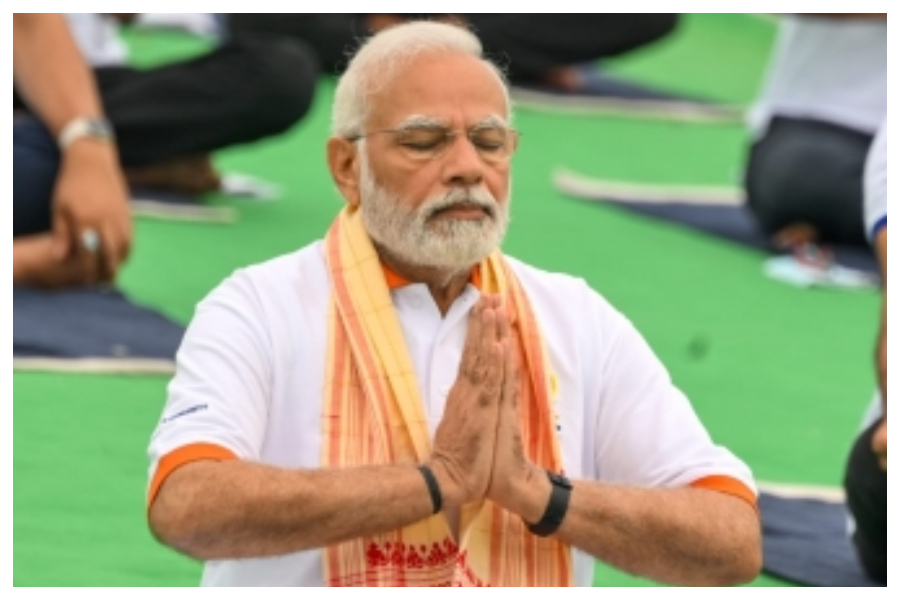
Prime Minister Narendra Modi participated along with thousands of people in a Mass Yoga Demonstration at the Mysore Palace ground here on the occasion of 8th International Day of Yoga (IDY) on Tuesday, and said that ‘Yoga has become a way of life’.
Integrating the ‘Azadi Ka Amrit Mahotsav’ with celebrations of 8th IDY, Mass Yoga demonstrations are being organised at 75 iconic locations across the country under the leadership of 75 Union Ministers, along with the Yoga Demonstration by the Prime Minister. The Yoga demonstrations are also being held by various educational, social, political, cultural, religious, corporate and other civil society organisations and will be attended by crores of people across the country.
The Prime Minister’s Yoga programme at Mysuru is also part of the novel programme
‘Guardian Yoga Ring’, which is a collaborative exercise between 79 countries and United Nations organisations along with Indian Missions abroad to illustrate Yoga’s unifying power that surpasses National boundaries.
Since 2015, the International Day of Yoga (IDY) has been celebrated worldwide on June 21 every year. The theme for this year’s Yoga day is “Yoga for Humanity”. The theme portrays how Yoga served humanity in alleviating suffering during the Covid Pandemic.
Governor of Karnataka Thaawarchand Gehlot, Chief Minister Basavaraj Bommai and Union Minister for Ayush Sarbananda Sonowal were among those present on the occasion.
Speaking on the occasion, the Prime Minister said the yogic energy, which has been nurtured for centuries by the spiritual centers of India like Mysuru, is today giving direction to global health.
“Today yoga is becoming a basis for global cooperation and is providing a belief of a healthy life to mankind,” he added. He said, “Today we see that Yoga has come out of the households and has spread all over the world and this is a picture of spiritual realization, and that of natural and shared human consciousness, especially in the last two years of an unprecedented pandemic,” PM Modi stated.
He further said, “Yoga has now become a global festival. Yoga is not only for any individual, but for the entire humanity. Therefore, this time the theme of International Day of Yoga is – Yoga for humanity.” He thanked the United Nations and all the countries for taking this theme globally.
Quoting the Indian sages, the Prime Minister emphasized “Yoga brings peace for us. The peace from yoga is not merely for individuals. Yoga brings peace to our society. Yoga brings peace to our nations and the world. And, Yoga brings peace to our universe.”
“This whole universe starts from our own body and soul. The universe starts from us. And, Yoga makes us conscious of everything within us and builds a sense of awareness,” he underlined.
The Prime Minister remarked that India is celebrating Yoga Day at a time when the country is celebrating its 75th year of Independence, the Amrit Mahotsav.
This widespread acceptance of Yoga Day, the Prime Minister said, “is the acceptance of that Amrit spirit of India which gave energy to India’s freedom struggle. That is why Mass Yoga demonstrations are being organised at 75 iconic locations across the country which have been witness to the glorious history of India and have been the center of cultural energy.”
“The experience of collective yoga at the historical sites of India is like tying together India’s past, India’s diversity, and India’s expansion”, he elaborated.
He also informed about the novel programme ‘Guardian Yoga Ring’, which is a collaborative exercise between 79 countries and United Nations organisations along with Indian Missions abroad to illustrate Yoga’s unifying power that surpasses national boundaries.
“As the sun moves from the east to the west across the world, the Mass Yoga Demonstrations in the participating countries, if seen from any one point on Earth, will seem to be happening one after the other, almost in tandem, thus underlining the concept of ‘One Sun, One earth’. “These practices of yoga are giving wonderful inspiration for health, balance and cooperation”, he added.
Modi pointed out that Yoga is not just part of life for us, today, it has become a way of life. He said Yoga need not be limited to a particular time and location.
He said, “No matter how stressful we are, a few minutes of meditation relaxes us and increases our productivity. Therefore, we do not have to take yoga as an extra work. We also have to know yoga and we also have to live yoga. We also have to achieve yoga, we also have to adopt yoga. When we start living yoga, Yoga Day will become a medium for us not to do yoga, but to celebrate our health, happiness and peace.”
The Prime Minister said that today is the time to realize the infinite possibilities associated with yoga. “Today our youth are coming in large numbers with new ideas in the field of yoga. He informed about the Startup Yoga Challenge by the Ayush Ministry. The Prime Minister congratulated the winners of 2021 winners of ‘Prime Minister’s Awards for outstanding contribution for Promotion and Development of Yoga’.”


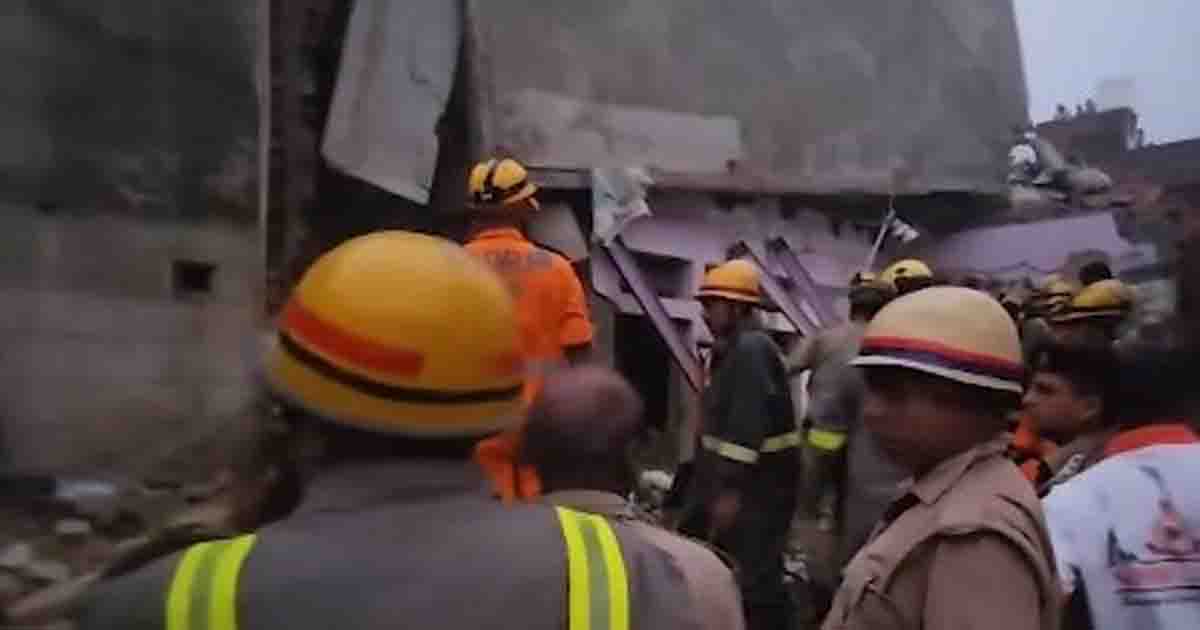
Varanasi, Oct 15: A massive explosion triggered the collapse of a two-storey building in Uttar Pradesh’s Varanasi on Thursday, leaving two people injured and a woman trapped under the debris, officials said.
The incident took place in the Paigambarpur area under the Sarnath police station area of Varanasi.
According to preliminary information, an illegal firecracker manufacturing unit was operating inside the house. The explosion is suspected to have occurred due to highly inflammable materials on the premises.
Two people were injured in the incident and have been taken to hospital for treatment, while efforts are underway to rescue a woman trapped under the rubble.
Speaking to media, DCP Rajesh Pandey said: “Information was received at 5 p.m. that a two-storey building had collapsed. Upon reaching the spot, we found firecrackers scattered around the place, so it is being considered that the incident took place due to the explosion of firecrackers.”
He said that according to locals, a woman is trapped under the debris and a rescue operation is currently underway to pull her out.
Uttar Pradesh Chief Minister Yogi Adityanath has directed officials to reach the site immediately and expedite relief operations, NDTV reported.
Further, CM Adityanath has instructed officials to ensure proper medical treatment for those injured. The officials have also been directed to contact the families of the injured and provide them with all possible assistance.
In August, eleven people were killed, and five others suffered serious injuries after an explosion ripped through an illegal firecracker manufacturing and storage facility in Chilla Shahbazi village, under the Pipri police station area in UP’s Kaushambi.
The UP government had then announced a reward of Rs 25,000 each for three absconding suspects wanted in connection with the blast.
Superintendent of Police Satyanarayan Prajapat announced a reward of Rs 25,000 each for information leading to the arrest of three absconding accused – Shakeel, Kahaksha Bano, and Adil, said an official statement.
Earlier, as part of action against the accused in the firecracker factory explosion, the police arrested the main accused, Naushad, following an encounter on the Terah Mile-Syed Sarawan road in the Charwa police station area, an official said.
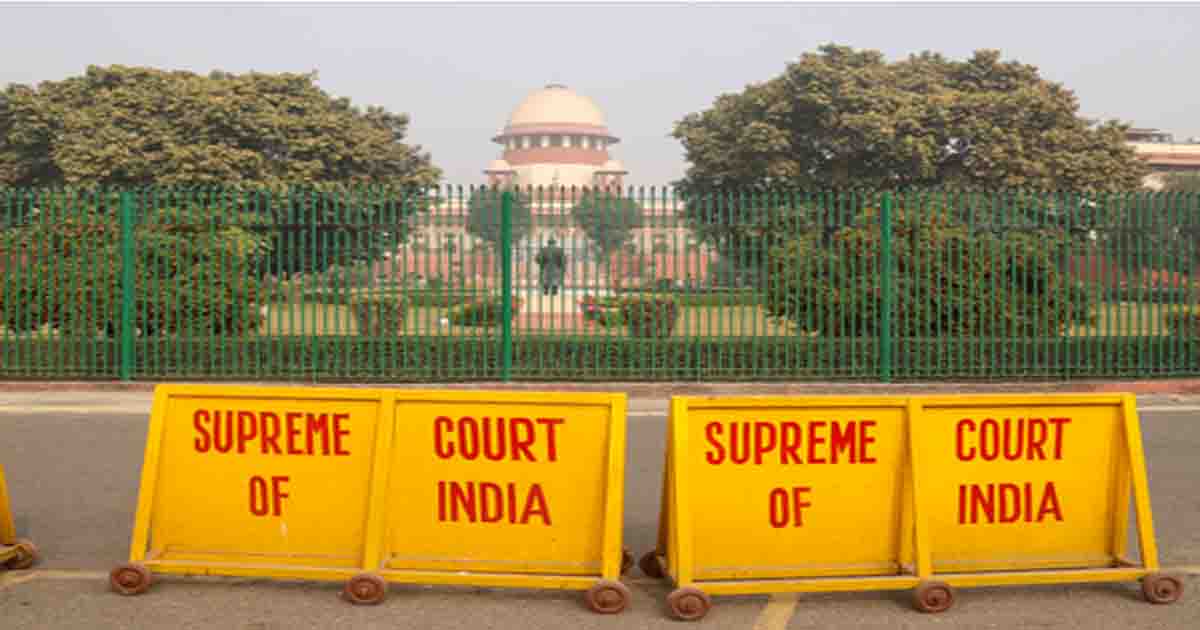
New Delhi, Oct 15: The Supreme Court on Thursday asked the Centre to take the issue of circulation of Child Sexual Exploitation and Abuse Material (CSEAM) on social media platforms seriously, while indicating that it would suggest measures to address the problem.
A bench of Justices J.B. Pardiwala and K. Vinod Chandran made the observations while hearing a plea seeking criminal action against social media intermediaries for allegedly failing to report child sexual abuse material to the authorities, as required under the law.
The Justice Pardiwala-led Bench asked Solicitor General Tushar Mehta, appearing for the Centre, whether the government had filed its response in the matter.
SG Mehta informed the top court that the Centre had filed its reply along with suggestions on tackling the problem. Counsel appearing for the petitioner also referred to concerns relating to the dark web, prompting the Solicitor General to assure the Supreme Court that the Centre was taking the matter seriously.
Stressing the gravity of the issue, the bench said it was a “very, very serious matter” and asked the Centre to deal with it seriously and study the top court’s forthcoming order.
As per the case status reflected on the official website of the apex court, the matter has been tentatively listed for further hearing on December 10.
The proceedings stem from an application filed by Just Rights for Children Alliance (JRCA) seeking effective implementation of the Supreme Court’s September 23, 2024, judgment in Just Rights for Children Alliance v. S. Harish, which dealt with the obligations of social media intermediaries to report suspected offences involving child sexual abuse material.
In its previous hearing on September 24, the Supreme Court had granted the Centre the “last opportunity” to file its counter-affidavit and an action-taken report detailing the steps taken to implement the directions issued in the 2024 judgment and curb the circulation of CSEAM on social media platforms.
It had also directed the Centre to explain the measures taken to implement its 2024 judgment and the safeguards proposed to prevent future lapses by social media intermediaries. It had further asked the Centre to serve a draft Standard Operating Procedure (SOP) for dealing with CSEAM cases before the next hearing.
Under its 2024 judgment, the Supreme Court clarified that compliance with the Information Technology Act, 2000, would not absolve social media intermediaries of their statutory obligations under the Protection of Children from Sexual Offences (POCSO) Act. It held that intermediaries must report the commission or likely commission of offences under the POCSO Act not only to the National Center for Missing & Exploited Children (NCMEC), but also to the Special Juvenile Police Unit (SJPU) or local police, in accordance with the applicable statutory provisions.
The matter has also drawn the attention of the National Human Rights Commission (NHRC). Earlier in the day, NHRC member Priyank Kanoongo flagged the continued delay in compliance with the Supreme Court’s directions, saying that the 2024 judgment remained to be implemented. In a post on X, Kanoongo questioned why social media companies were allegedly resisting mandatory reporting of child sexual abuse to the police and raised concerns over the circulation and monetisation of such material on online platforms.
The NHRC has separately taken cognisance of media reports alleging that paid advertisements on Instagram promoted child sexual abuse material and directed users to Telegram channels where such content was allegedly being offered for sale.
Thiruvananthapuram Oct 15: For families who lose loved ones in road accidents, the debate over whether the fault lies with reckless driving or unsafe roads offers little comfort.
But figures placed before the Kerala Assembly on Thursday underline the scale of the challenge.
Nearly half of the road accident deaths reported in the state between 2021 and 2026 occurred on national highways.
Figures provided by the Minister’s office point out that of the 11,697 accident deaths that took place between 2023 and 2025 on the roads in the state, 5,991 took place on the NH.
Public Works Minister P.K. Basheer told the Assembly that overspeeding and traffic violations were the main causes of road accidents.
Road construction defects alone could not explain the deaths, he said in reply to questions from MLAs.
The minister, however, acknowledged that road deficiencies also contributed to accidents, pointing to the need for safer roads alongside stricter enforcement of traffic rules.
The figures bring renewed attention to accident-prone stretches where a moment of carelessness, a dangerous curve or inadequate road safety measures can have devastating consequences for families.
The government has identified accident-prone locations, known as black spots, through scientific studies conducted by the National Transportation Planning and Research Centre (NATPAC).
Joint inspections involving the police, Motor Vehicles Department and the agencies responsible for roads are also conducted at places where accidents occur frequently.
These inspections are intended to identify the causes of accidents and recommend corrective measures.
Basheer said the condition of a road, its accident history and existing safety risks were assessed before estimates were prepared for road rehabilitation.
Safety measures were included in the plans based on these assessments.
Both temporary and permanent remedies were being implemented at dangerous black spots on national highways, he said.
The measures include solar-powered blinkers, rumble strips, speed humps, reflective road signs, road markings and road studs to alert motorists to potential hazards.
Metal crash barriers and wire-rope barriers are also being installed along dangerous curves and road medians to reduce the risk and severity of accidents.
Yet, the minister’s reply points to a challenge that goes beyond engineering.
While improvements to road infrastructure can reduce risks, overspeeding and violations of traffic rules remain major causes of crashes.
For road users and their families, safer journeys will depend on both better-designed roads and responsible driving.

Building collapses in Varanasi due to firecracker explosion, two rescued

Take child sexual abuse material circulation on social media seriously, SC tells Centre

Kerala: 5,991 road accident deaths occurred on national highways in three years

SC refers Rajpal Yadav cheque bounce cases to mediation for amicable settlement

NEET-PG 2026: SC issues notice on plea seeking candidate-wise disclosure of questions, options, and answers

INDIA bloc begins protest march against ECI

Maha Congress stages agitation against Gyanesh Kumar

Complaint against Netflix & Mukesh Chhabra for inappropriate language on ‘India’s Got Latent 2’

Mumbai Cyber Cell arrests 6 members of organized gang in major operation; Beware of cyber fraudsters; Digital arrest has no legal status; DCP Bajrang Bansode

Bombay HC warns Vijay Mallya against posting court documents on social media
-

 Crime4 years ago
Class 10 student jumps to death in Jaipur
-

 Maharashtra2 years ago
Mumbai Local Train Update: Central Railway’s New Timetable Comes Into Effect; Check Full List Of Revised Timings & Stations
-

 Maharashtra2 years ago
Mumbai To Go Toll-Free Tonight! Maharashtra Govt Announces Complete Toll Waiver For Light Motor Vehicles At All 5 Entry Points Of City
-

 Maharashtra2 years ago
False photo of Imtiaz Jaleel’s rally, exposing the fooling conspiracy
-

 National News2 years ago
Ministry of Railways rolls out Special Drive 4.0 with focus on digitisation, cleanliness, inclusiveness and grievance redressal
-

 Maharashtra2 years ago
Maharashtra Elections 2024: Mumbai Metro & BEST Services Extended Till Midnight On Voting Day
-

 National News2 years ago
J&K: 4 Jawans Killed, 28 Injured After Bus Carrying BSF Personnel For Poll Duty Falls Into Gorge In Budgam; Terrifying Visuals Surface
-

 Crime2 years ago
Baba Siddique Murder: Mumbai Police Unable To Get Lawrence Bishnoi Custody Due To Home Ministry Order, Says Report