
Maharashtra
Mumbai Cyber Cell arrests 6 members of organized gang in major operation; Beware of cyber fraudsters; Digital arrest has no legal status; DCP Bajrang Bansode

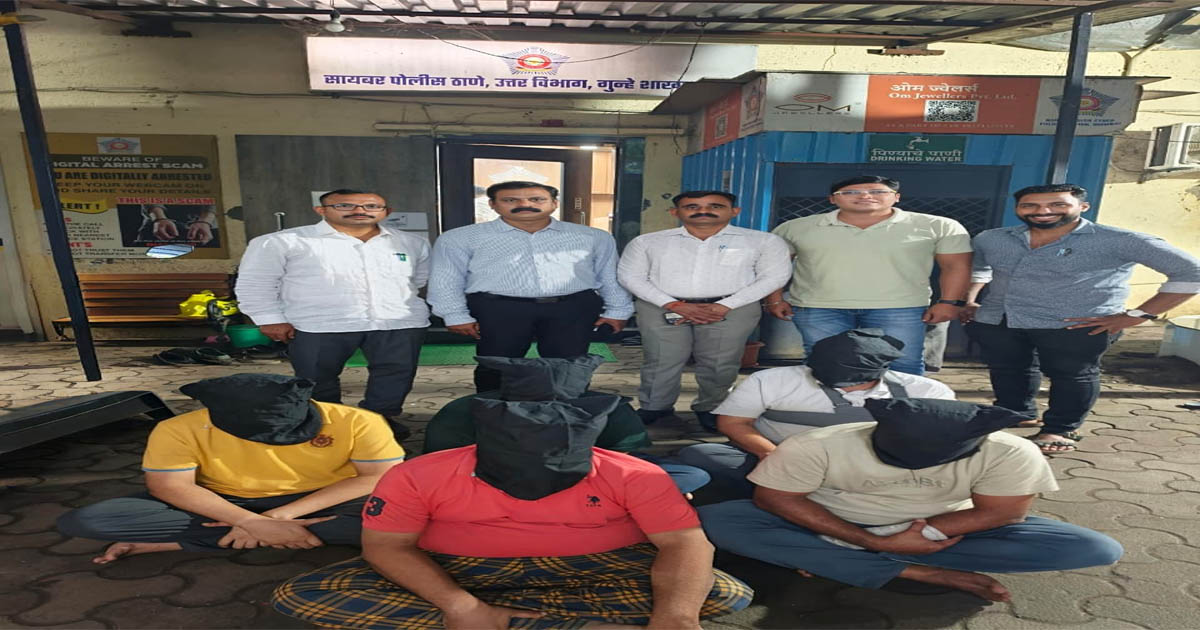
Mumbai: The Mumbai Cyber Cell has claimed to expose a gang that extorted money from victims by using the tactic of “digital arrest”—threatening to implicate them in false cases to instill fear. In one instance, a complainant was defrauded of ₹1.12 crore after being subjected to “digital arrest” and intimidated with threats of legal action regarding a ₹238 crore money laundering case involving a fake SIM card, alongside the receipt of a forged Supreme Court notice. The police successfully apprehended a total of six accused individuals in this case, including the Operations Manager and an IT web developer from IndusInd Bank. The North Cyber Police registered a case under various sections of the BNS (Sections 204, 308(7), 61(2), 318(4), 319(2), 336(2), 336(3), 338, 340(2), 238) and the IT Act (Sections 66, 66). The complainant, a 68-year-old senior citizen residing in Dahisar, was targeted between July 30, 2026, and September 12, 2026. The accused contacted him via WhatsApp video calls, posing as officials from the Department of Telecommunications (Bharatiya Door Sanchar Vibhag). They alleged that a money laundering case involving ₹238 crore had been registered against him in Delhi, claiming his SIM card had been used in the scheme. By sending a fake Supreme Court notice and threatening arrest, they placed the complainant under “digital arrest” and defrauded him of ₹1,12,26,000. The accused orchestrated this highly sensitive crime by concealing their true identities and systematically impersonating police officers—wearing uniforms and utilizing the names, seals, and letterheads of government authorities and national investigative agencies. They repeatedly intimidated the complainant with the threat of arrest during video calls to coerce him into transferring funds to specific bank accounts. To receive the proceeds of the fraud, the cyber criminals utilized current accounts held in various banks under the names of different individuals and companies. The investigation team of the North Cyber Police Station, Mumbai, skillfully handled the case… Through persistent effort and a positive investigation—understanding the modus operandi and tracing leads from the initial-level bank accounts used in the crime—the police identified and arrested individuals involved in buying and selling current accounts to receive fraud proceeds (linked to “digital arrest” scams) and those responsible for layering the illicit funds. Items recovered from the arrested individuals include 2 laptops, 20 mobile phones, bank accounts belonging to 25 different individuals, ATM cards, passbooks, and Aadhaar cards. The arrested individuals are: 1) Rajesh Kumar Mohanlal Jain (54, 12th-grade education; resident of Dadar East, Mumbai; bank account holder); 2) Mohammad Tariq Anwar Momin (49, 12th-grade education; resident of Dadar East, Mumbai; facilitator for opening and supplying bank accounts of various individuals); 3) Shekhar Mukesh Tyagi (28, B.Com/BMA; resident of Sion, Mumbai; Operations Manager at IndusInd Bank); 4) Gaurav Mahesh Goyal (40, BE from IIT Delhi; resident of Goregaon East, Mumbai; web developer); and 5) Ajay Kumar Kaliprasad Sharma (35, BA; resident of Bhiwandi Road, Thane district; facilitator providing mobile-based access). A case has been registered at the Bandra/Prabhadevi Police Station under Sections 420, 409, 120(b), and 34. 6) Chintan Kumar Sureshbhai Desai (age…). (46 years old; educated up to B.A.; resident of Mora Bhagal, Ranadil Road, behind SBI Bank, Surat, Gujarat; the individual responsible for layering the complainant’s funds through associates.)
Modus Operandi of the Accused
Abhay Dev Gold Prali is the Director of the company and is identified as Arrested Accused No. 1. The company holds a registered account with IndusInd Bank. The mobile numbers of both Arrested Accused No. 1 and the other director are linked to this account. Arrested Accused No. 2 purchased two new mobile phones from a shop in Dadar East. Into one phone, he inserted the SIM card belonging to the company’s second director (linked to the aforementioned bank account), and into the other, he inserted the SIM card belonging to Arrested Accused No. 1 (also linked to the same account). Arrested Accused No. 2 handed both phones over to Arrested Accused No. 3, who served as the Operational Manager/Head at IndusInd Bank. Arrested Accused No. 3 kept the phone containing the second director’s SIM card for himself and then handed it over to Arrested Accused No. 5. Meanwhile, he inserted the SIM card linked to Arrested Accused No. 1’s account into the other phone and handed it to Arrested Accused No. 4 (a web developer), who subsequently passed it to Arrested Accused No. 6. Arrested Accused No. 6 traveled by air from Mumbai to Delhi and then to Bijnor, Uttar Pradesh. There, with the help of associates, he transferred the complainant’s funds from the aforementioned account. Through this cyber fraud scheme—which involved subjecting the complainant to “digital arrest”—a total of ₹1,12,26,000 was fraudulently obtained. The said remarkable performance has been done by Police Commissioner Mumbai, Devin Bharti, Joint Police Commissioner Anil Kanbhare, Additional Police Commissioner Crime Krishan Kant Upadhyay, DCP Cyber Cell Bajrang Bansode, ACP Suvarna Shinde.
Appeal to Citizens: Follow these guidelines to stay safe from the “digital arrest” cyber scam. Agencies such as the Police, CBI, ED, RBI, or any government body do not conduct “digital arrests”; there is no such provision in the law. Do not accept video calls from strangers or send money to them. Pay attention to any noticeable changes in the behavior or mood of family members. If you fall victim to a digital arrest scam, immediately inform your family, relatives, or the police. If you receive a call regarding a digital arrest, contact your nearest police station immediately, call the helpline numbers 100 or 1930 for assistance, or register a complaint at http://www.cybercrime.gov.in.

Mumbai, Oct 8: The Enforcement Directorate (ED) attached immovable properties in Mumbai, Pune and Raigad (Maharashtra) worth Rs 567.45 crore in connection with a Rs 48,000 crore collective investment scheme operated by Pearls Agrotech Corporation Limited (PACL) for development of farm land, an official said on Thursday.
The PACL’s properties were attached by ED’s Delhi Zonal Office under the provisions of the Prevention of Money Laundering Act (PMLA), 2002.
The ED has attached 48 immovable properties held in the names of Prateek Kumar, Ansh Prateek Kumar, and entities namely Beaming Infradevelopers, Ganraj Properties, and Greenfield Estates Limited, having a current market value of Rs 567.45 crore.
With this attachment, the ED has so far attached movable and immovable properties worth around Rs 30,235.21 crore, including assets located in India and abroad.
The ED’s investigation was initiated on the basis of an FIR registered by the Central Bureau of Investigation (CBI) in New Delhi under Sections 120-B and 420 of the Indian Penal Code, 1860, dealing with conspiracy and cheating.
Subsequently, the CBI filed a charge sheet and a supplementary charge sheet against 33 accused for their role in running an illegal investment scheme.
According to the charge sheets, the accused entities and individuals operated a massive illegal collective investment scheme, fraudulently mobilising more than Rs 48,000 crore from lakhs of investors across India under the pretext of sale and development of agricultural land.
Investors were induced to invest through cash down payment and instalment payment plans and were made to sign misleading documents such as agreements, powers of attorney and other instruments.
“In most cases, land was never delivered, resulting in unpaid investor dues of around Rs 48,000 crore,” the ED said.
The ED recorded an Enforcement Case Information Report (ECIR) in the case in 2016 and filed a charge sheet in 2018, followed by six supplementary charge sheets in 2022, 2025 and 2026 against the various accused.
“Prateek Kumar was arraigned as an accused (A-13) in the First Supplementary charge sheet dated August 20, 2022, filed in the case immediately, where cognisance was taken by the Special Court vide order dated September 19, 2022,” the ED added.
Subsequently, an open-ended Non-Bailable Warrant (NBW) was issued against Prateek Kumar by the Special Court on April 9, 2025.
These entities are beneficially owned and controlled by Prateek Kumar.
The investigation revealed that these immovable properties were purchased using funds diverted from PACL, which had originally collected money from gullible investors, thereby constituting proceeds of crime.

Kanpur, Oct 8: A woman in Uttar Pradesh’s Kanpur has accused her husband of giving her triple talaq and said on Thursday that she was ousted from their family home after 16 years of marriage and two children. The victim has alleged that her husband was having an affair with a woman living in the same area.
The woman named Afreen has claimed that she caught her husband red-handed cheating on her on July 7 with another woman.
“It has happened multiple times. I have tried to explain and communicate many times; he didn’t agree. Even when I caught him that day, we got into a huge fight. All the relatives were called. When confronted, he said that ‘she is everything to me; I will divorce you. I will stay with her; I will marry her,'” she said, quoting her husband.
The woman also alleged that she was physically abused.
“He used to torment the children and me. He used to beat me up and did not provide for me. I was physically abused, but I persevered through it, thinking that it should not affect my family, my children.”
She said that she was married for 16 years and has two teenage children.
“I have been married for 16 years, and I have two sons. One is 13; the other is 15. His husband’s family did not take any action and just asked me to wait and have patience. I did too, thinking my family would be torn apart,” Afreen added.
According to the woman, at around 9:30 p.m. on August 12, her husband pronounced triple talaq in front of their two sons and threw her out of the house. She subsequently lodged a complaint at Chaman Ganj police station.
Police have registered an FIR under provisions related to dowry harassment, assault, an illicit relationship, and the Muslim Women (Protection of Rights on Marriage) Act.
Speaking on the matter, Kanpur Deputy Commissioner of Police (DCP) (Central), Atul Srivastava, said, “An FIR has been registered in the Chamanganj police station against the accused. Investigations are ongoing in the matter.”
Incidentally, the woman complained that her initial complaints were not being registered by the police, and the FIR was only filed recently in October.
However, when asked, the DCP said mediation was initially being attempted in the matter. After the issue of triple talaq came to light, an FIR was registered immediately.
The woman demanded that her husband should be arrested as soon as possible.
Crime
2021 Antilia bomb-scare: Bombay HC expresses surprise over Vaze’s high-end cars, long stay in hotel

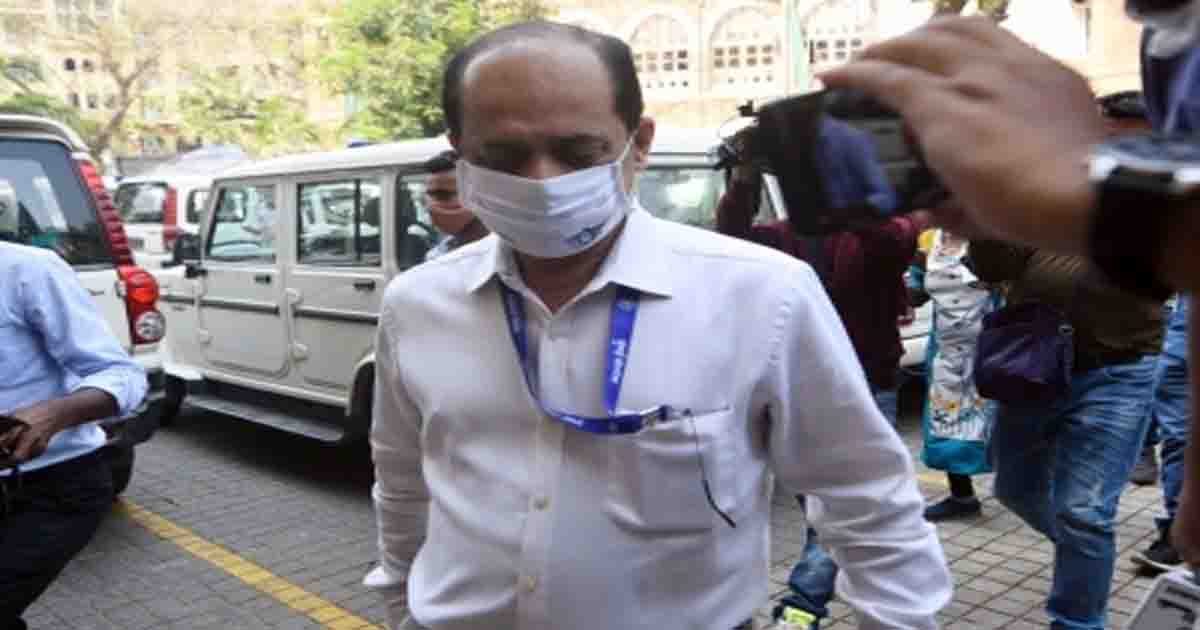
Mumbai, Oct 8: The Bombay High Court on Thursday expressed surprise over the lifestyle, including the use of high-end cars, of former Assistant Police Inspector Sachin Vaze, who is currently in judicial custody in the 2021 Antilia bomb-scare case and Mansukh Hiran murder case, a lawyer said.
A bench of Justices Girish Kulkarni and Neela Gokhale also flagged Vaze’s extended stay of about 100 days in a room booked at the Oberoi hotel, asking how an officer of the rank of Assistant Police Inspector could afford to drive high-end vehicles.
The High Court said that these aspects of Vaze’s financial situation, conduct, and professional record are relevant to assessing the charges against him.
The bench was hearing an appeal filed by the National Investigation Agency (NIA), challenging a September 29 order of a special court granting bail to Vaze.
The High Court last week granted interim stay on the bail order, resulting in Vaze remaining in judicial custody.
Additional Solicitor General Anil Singh, representing the NIA, shared with the High Court witness statements that mentioned that Vaze used expensive and luxury vehicles while he was an Assistant Police Inspector.
During the hearing, Anil Singh read out a witness statement, which said that Vaze travelled in a black Mercedes and asked those accompanying him to turn off their mobile phones.
The court then asked whether the Mercedes belonged to Vaze and whether there was any evidence that the vehicle was registered in his name.
After the NIA responded in the affirmative, the court asked whether it was normal for an Assistant Police Inspector to own such an expensive car.
The court remarked, “Since we have not yet seen an Assistant Police Inspector driving a Mercedes…”
The court also sought information from the NIA regarding Vaze’s other vehicles and reviewed a list of five vehicles he used while serving as Assistant Police Inspector.
This list included a white BMW, a black Volvo, a white Mercedes, a white Toyota Land Cruiser Prado, and another black Mercedes.
Seeing the number of vehicles, the court said, “He (Sachin Vaze) owns five vehicles…”
The court noted that, according to statements submitted by the NIA, Vaze travelled in a high-end Mercedes to the Mumbai Police Commissioner’s office and the Maharashtra Chief Minister’s residence, ‘Varsha’.
NIA’s lawyer Anil Singh also told the court that Vaze had stayed at a seven-star hotel in South Mumbai for around 100 days.
The court asked how a police officer, earning a monthly salary of around Rs 90,000 at the time, could afford such an expensive lifestyle.
The NIA said that these vehicles owned and used by Vaze are being linked to alleged extortion in the case.
Vaze is an accused in the Antilia bomb scare case, where an SUV laden with explosives was recovered near industrialist Mukesh Ambani’s Mumbai residence in February 2021.
The High Court asked the NIA the reasons for opposing Vaze’s bail that was granted with stringent conditions, partly due to the fact that he has been in custody for more than five years now.
The NIA lawyer said Vaze could tamper with witnesses and destroy evidence.
“He (Vaze) was earlier charged in a fake encounter case. He was a police officer who had the duty of protecting the public. But he himself indulged in criminal activities where he not just tried to instil fear and terror but he murdered a person,” Singh said.

‘Chief Minister should contest election from here’: Akhilesh Yadav’s dare to Adityanath in Ayodhya

PACL investment fraud: ED attaches properties worth Rs 567 crore in Mumbai, Pune

Kanpur woman given triple talaq after 16 years of marriage, demands husband arrest

2021 Antilia bomb-scare: Bombay HC expresses surprise over Vaze’s high-end cars, long stay in hotel

NHRC seeks report from Delhi Police over women journalists’ sexual harassment allegations

Gift to President Putin part of PM Modi bid to globally display India’s heritage

PM Modi’s warm camaraderie with Putin, Xi on full display at BRICS Summit

Complaint against Netflix & Mukesh Chhabra for inappropriate language on ‘India’s Got Latent 2’

INDIA bloc begins protest march against ECI

Maha Congress stages agitation against Gyanesh Kumar
-

 Crime4 years ago
Class 10 student jumps to death in Jaipur
-

 Maharashtra2 years ago
Mumbai Local Train Update: Central Railway’s New Timetable Comes Into Effect; Check Full List Of Revised Timings & Stations
-

 Maharashtra2 years ago
Mumbai To Go Toll-Free Tonight! Maharashtra Govt Announces Complete Toll Waiver For Light Motor Vehicles At All 5 Entry Points Of City
-

 Maharashtra2 years ago
False photo of Imtiaz Jaleel’s rally, exposing the fooling conspiracy
-

 National News2 years ago
Ministry of Railways rolls out Special Drive 4.0 with focus on digitisation, cleanliness, inclusiveness and grievance redressal
-

 Maharashtra2 years ago
Maharashtra Elections 2024: Mumbai Metro & BEST Services Extended Till Midnight On Voting Day
-

 National News2 years ago
J&K: 4 Jawans Killed, 28 Injured After Bus Carrying BSF Personnel For Poll Duty Falls Into Gorge In Budgam; Terrifying Visuals Surface
-

 Crime2 years ago
Baba Siddique Murder: Mumbai Police Unable To Get Lawrence Bishnoi Custody Due To Home Ministry Order, Says Report