
Politics
‘Won’t’ tolerate obstruction’, allows ED to summon Abhishek Banerjee in Kolkata

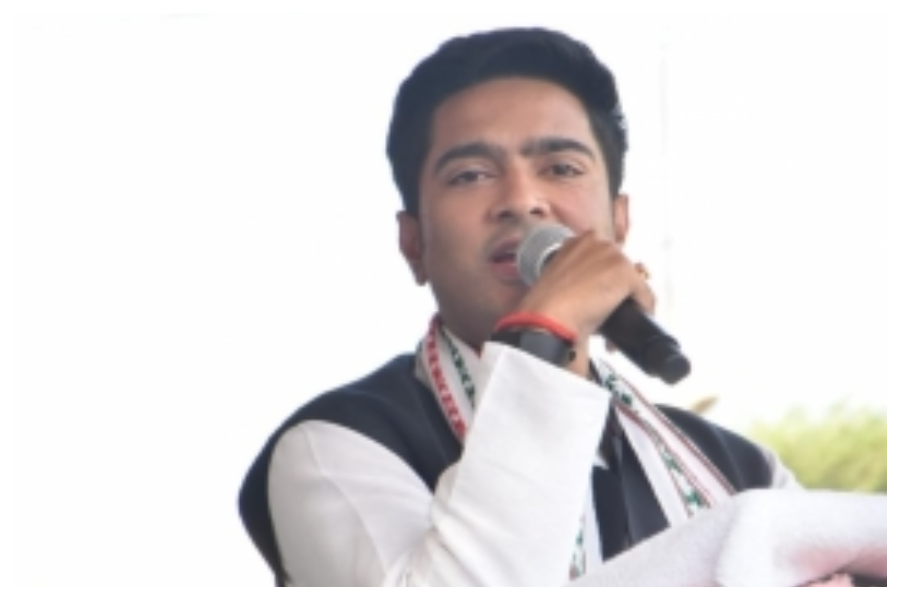
The Supreme Court on Tuesday stayed the Delhi High Court’s order, which dismissed Trinamool Congress leader Abhishek Banerjee and his wife’s challenge to the ED’s summons issued in connection with a money laundering case linked to the alleged West Bengal coal scam.
However, the top court allowed the Enforcement Directorate (ED) to summon Banerjee at its Kolkata office, and added that it will not tolerate any hooliganism or obstruction, when ED questions Banerjee in Kolkata.
A bench headed by Justice U.U. Lalit said the state government will provide assistance to the ED officials, who will have to give a 24-hour prior notice to question Banerjee and his wife. “If there is any kind of hooliganism or infraction, we will not tolerate it,” said the bench, also comprising Justices S. Ravindra Bhat and Sudhanshu Dhulia.
Additional Solicitor General S.V. Raju told the apex court that Banerjee is a potential accused in the coal scam and the ED needs to interrogate him in Delhi. Raju said it will be very difficult to interrogate him in Kolkata. Last week, Raju told the top court that Banerjee is an influential politician. “My lords know how Central agencies were treated in Kolkata…CBI officers were gheraoed…I should not be saying this,” he submitted.
The top court recorded that the West Bengal government has assured that no coercive action will be initiated against ED officials without approaching it.
Banerjee and his wife’s plea, filed through advocate Sunil Fernandes, said: “The party to which the petitioner No.1 (Abhishek) belonged, comprehensively trounced the political party at power in the Centre, thereby giving justifiable cause to ‘target’ and ‘fix’ the petitioner No.1, by misusing the Central Investigation Agencies”.


Mumbai Press Exclusive News
Employee arrested from UP for stealing from Mumbai spice shop, cash recovered

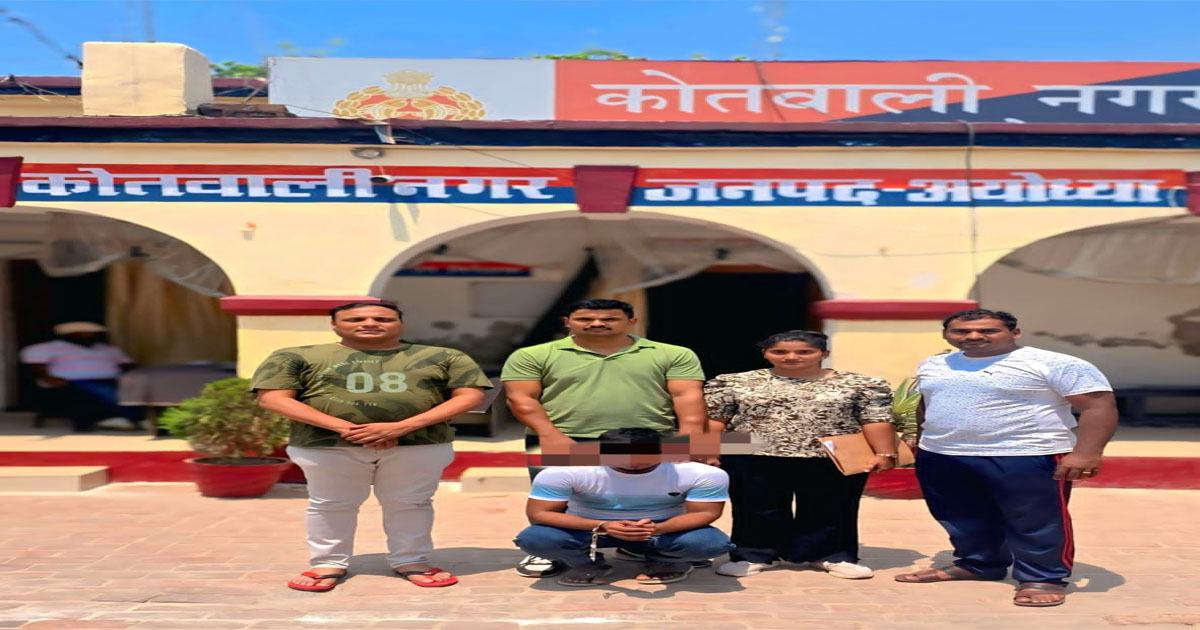
The police have claimed to have arrested an employee thief who stole Rs 13,86,200 from a spice shop in the Kala Chowki area of Mumbai from UP Ayodhya, Uttar Pradesh. The money collected for 8 days at the spice shop in the Kala Chowki area was kept in the grain and the next day the complainant shop owner searched for the money in the grain but did not find it. After that, he filed a report at the police station and the police conducted an inquiry and found that the employee working at the shop had been absent since morning, which made the police suspicious and the police arrested Ajay Kumar Shyam Sundar from Ayodhya, UP and recovered more than Rs 10 lakh in cash from his possession. This operation was solved by DCP Ragasudha on the instructions of Mumbai Police Commissioner Devin Bharti and the police have succeeded in arresting the accused from UP.
Maharashtra
Mumbai: Eviction proceedings against furniture vendors on Do Tanki Maulana Shaukat Ali Marg in ‘E’ ward
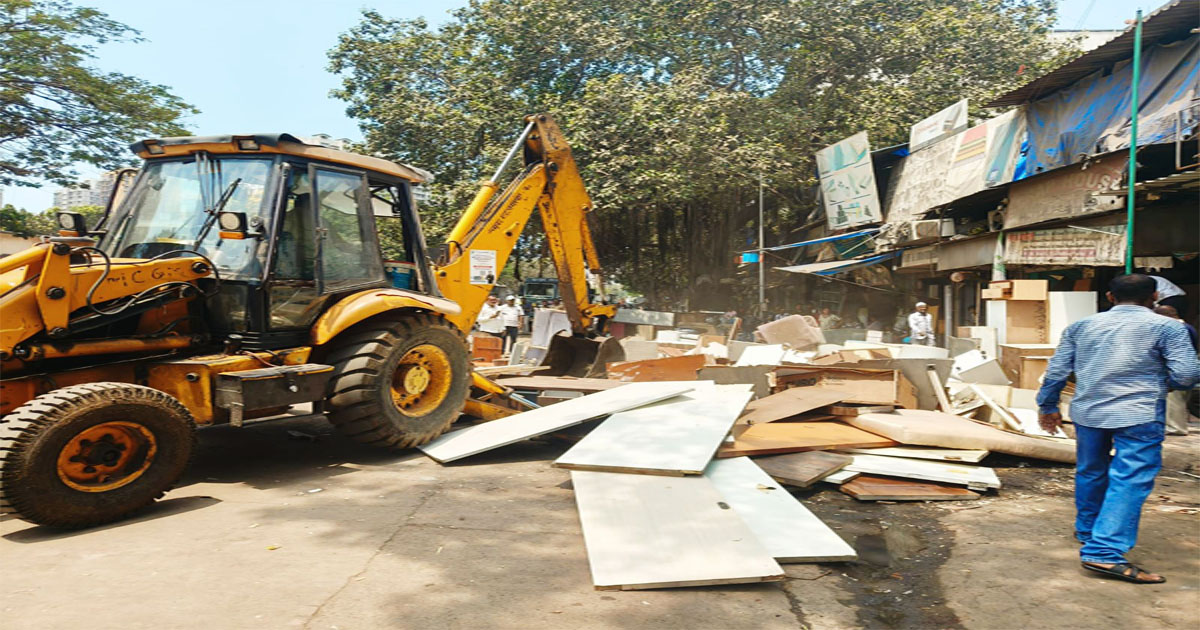
The ‘E’ Ward Department of the Mumbai Municipal Corporation recently took action against old furniture vendors and other encroachments on Maulana Shaukat Ali Marg under the ‘E’ Department. This action was taken under the guidance of Deputy Commissioner (Zone 1) Chanda Jadhav and led by Assistant Commissioner Anand Kankal. The encroachments on Maulana Shaukat Ali Marg in the ‘E’ Department, especially in the area from Muralideora Eye Hospital to JJ Hospital Signal, were causing a lot of trouble to the pedestrians. The pedestrians were forced to walk on the road instead of the footpath, which was putting their lives at risk. Keeping this situation in mind, the Conservation and Encroachment Elimination teams of the ‘E’ Division of the Municipal Corporation jointly launched a campaign along with the Mumbai Police. During this eviction operation, a crackdown and strict action was taken against the furniture vendors. The old furniture lying on the footpaths was destroyed on the spot with the help of JCB. Along with this, the waste of broken furniture was also removed immediately. All encroachments on the footpath were removed. In addition, action was also taken against unauthorized hawkers in the area. Due to which the road was completely opened for traffic.
1 JCB, 4 laborers, 3 officers and 2 engineers participated in this campaign. In addition, 9 personnel from Nagpara Police Station were deployed for security. Meanwhile, the ‘E’ Division of the Mumbai Municipal Corporation is once again making it clear on this occasion that regular action will continue against unauthorized constructions and unauthorized hawkers.
Maharashtra
Don’t target the bodyguard… Important comment of the Bombay High Court in the Sameer Wankhede case
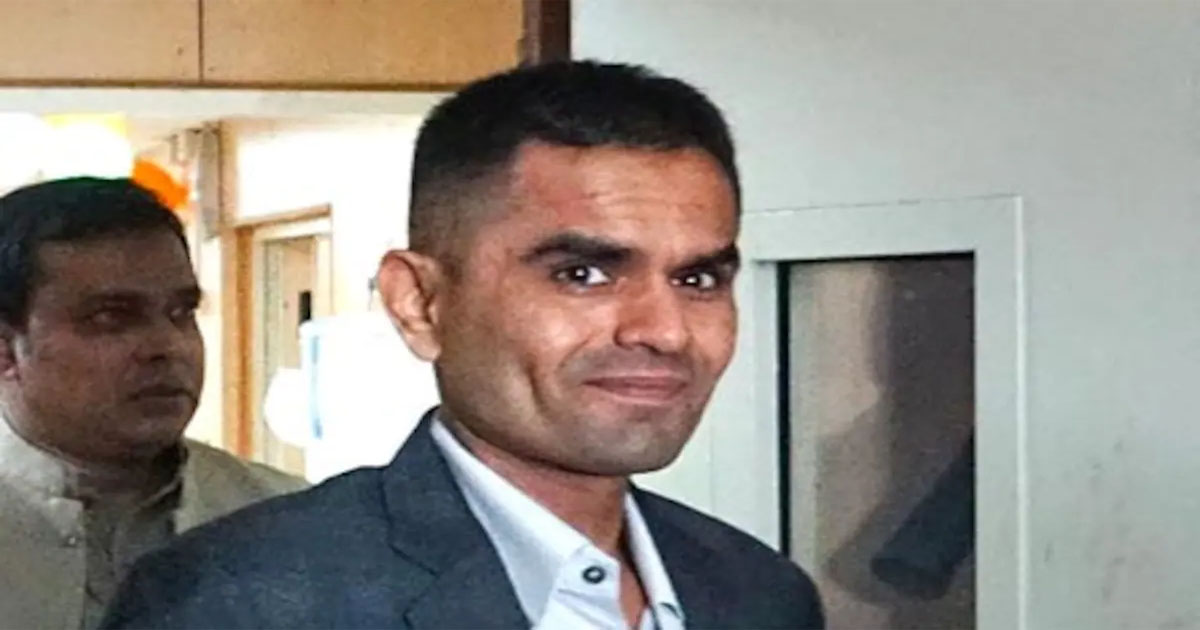
Mumbai: The Bombay High Court has made several important comments while hearing the NCB Zonal Director Sameer Wankhede bribery case and has asked the agency questions, the first of which was whether you can inquire into the statement of the accused? The NCB had earlier submitted a report in the closed session regarding the inquiry of Sameer Wankhede, saying that the inquiry into Wankhede is not the result of Nawab Malik or any political pressure, but this inquiry is being conducted on an unknown complaint and letter. Along with this, the complainant Kiran Sajnani had also demanded an inquiry into the methods of Sameer Wankhede, while Sameer Wankhede had arrested Kiran Sajnani in the drugs case and also arrested his accomplice Sameer Khan. Sameer Khan is the son-in-law of Nawab Malik. Sameer Khan died in a car accident. The court has commented on Sameer Wankhede that an officer and security guard who is doing good work in the society should be targeted. This comment was made by the court on the complaint filed by the accused against Sameer Wankhede. Along with this, the accused whose complaint is being investigated is accused of drug trafficking. It is alleged that he and his partner had planned to sell drugs like Vadapao in Mumbai. Sameer Wankhede had arrested Aryan Khan in the Cordelia Cruz case while taking action against drugs. He is also accused of demanding a bribe of Rs 25 crore from him. The CBI has registered a case in this case. In the same case, a private petitioner has demanded that both giving and receiving bribes fall under the category of crimes. If Wankhede has received bribes, then Shah Rukh Khan should also be made an accused in this case because giving bribes is also a crime. In this case, the High Court has given relief to Wankhede by making an important comment.

Employee arrested from UP for stealing from Mumbai spice shop, cash recovered

Mumbai: Eviction proceedings against furniture vendors on Do Tanki Maulana Shaukat Ali Marg in ‘E’ ward

Don’t target the bodyguard… Important comment of the Bombay High Court in the Sameer Wankhede case

Minor Scratch On Two-Wheeler Snowballs Into Violent Youth Brawl At Telephone Exchange Chowk In Nagpur

Mumbai: Impostor Ashok Kharat now under police station connection, rape case registered against municipal officer

Mumbai: 28-Year-Old Ghatkopar Woman Killed By Speeding Tanker While Crossing Road, Driver Arrested

Dhurandhar 2 Box Office Collection Day 9: Ranveer Singh Starrer Earns ₹41.55 Crore On Its Second Friday; Enters ₹700 Crore Club

Bharti Airtel Receives ₹1,74,000 Penalty Notice From DoT For Subscriber Verification Lapses

Thane Horror: Man Slashed With Chopper In Naupada For Refusing ‘Vargani’, Caught On Camera

PM Modi & US President Donald Trump Hold Crucial Talks As West Asia Crisis Deepens; Musk Joins Call
-

 Crime4 years ago
Class 10 student jumps to death in Jaipur
-

 Maharashtra2 years ago
Mumbai Local Train Update: Central Railway’s New Timetable Comes Into Effect; Check Full List Of Revised Timings & Stations
-

 Maharashtra2 years ago
Mumbai To Go Toll-Free Tonight! Maharashtra Govt Announces Complete Toll Waiver For Light Motor Vehicles At All 5 Entry Points Of City
-

 Maharashtra2 years ago
False photo of Imtiaz Jaleel’s rally, exposing the fooling conspiracy
-

 National News2 years ago
Ministry of Railways rolls out Special Drive 4.0 with focus on digitisation, cleanliness, inclusiveness and grievance redressal
-

 Maharashtra1 year ago
Maharashtra Elections 2024: Mumbai Metro & BEST Services Extended Till Midnight On Voting Day
-

 National News2 years ago
J&K: 4 Jawans Killed, 28 Injured After Bus Carrying BSF Personnel For Poll Duty Falls Into Gorge In Budgam; Terrifying Visuals Surface
-

 Crime2 years ago
Baba Siddique Murder: Mumbai Police Unable To Get Lawrence Bishnoi Custody Due To Home Ministry Order, Says Report