
Business
With debt of Rs 2.82L cr, incoming govt faces daunting task in Punjab

With a whopping public debt of Rs 2.82 lakh crore, the incoming government in one of the most fiscally stressed states, Punjab will be faced with the daunting task to usher in much-needed economic reforms as a major component of government earning and borrowing is meant for servicing debt rather than capital expenditure.
Twenty per cent of the annual budget is being spent only to pay the interest on the loans.
As per the latest findings of the Comptroller and Auditor General of India, the state’s financial crisis is set to worsen with the debt likely to reach Rs 3.73 lakh crore by 2024-25.
Government officials told IANS that the state’s debt has increased by Rs 1 lakh crore in the past five years under the current Congress government now led by Chief Minister Charanjit Singh Channi, largely owing to populism.
When this government took over the reins in 2017, it got the legacy of a Rs 2.08 lakh crore debt left by the decade-long rule of the Shiromani Akali Dal-BJP in the state.
An official familiar with the matter told IANS that political compulsions and populist announcements have been taking a huge toll on the state’s finances and this may surge the debt beyond the projected Rs 2.82 lakh crore.
Finance Minister Manpreet Badal in his last budget speech for this fiscal projected the total revenue receipts at Rs 95,257 crore. However, the state has never managed to achieve more than 80 per cent of its revenue target.
Also approximately 40 per cent of the state’s total estimated revenue receipts of Rs 95,257 crore for the current fiscal would go into debt servicing.
As per the budget estimates of an outlay of Rs 168,015 crore for 2021-22, the outstanding debt is likely to be Rs 273,703 crore in 2021-22, which is 45 per cent of the GSDP.
The total outstanding debt of the state as on March 31 is projected at Rs 252,880 crore, which is 42 per cent of the GSDP for 2020-21 and the outstanding debt is likely to be Rs 273,703 crore in 2021-22, which is 45 per cent of the GSDP.
Besides a major component of earnings and market borrowings go into debt servicing, the revenue goes into unproductive expenditure like disbursement of salaries, pensions and power subsidies for the farmers.
Also, say officials, the Covid-19 pandemic has caused a significant deterioration in public finances, adding to pre-existing strains. Also businesses in the state are reeling because of a sluggish economy and poor liquidity.
As per the recent memorandum by the state to the Centre for extending the Goods and Services Tax (GST) compensation, Punjab says being an agrarian economy it was deriving a significant portion of its revenue from the agriculture sector in the pre-GST era by imposition of tax on agricultural produce (mainly foodgrains).
This was realized in the form of the levy of Purchase Tax on agricultural produce at the rate of five per cent of the minimum support price (MSP) of produce collected from the purchaser of such produce.
In addition, an Infrastructure Development Fee at the rate of three per cent was also levied on purchase of foodgrains. The state collected Rs 3,094 crore in 2015-16 from the Purchase Tax and Infrastructure Development Fee alone, i.e. 16.55 per cent of its total tax revenue of Rs 18,692.89 crore during that year.
With the implementation of GST, both the Purchase Tax and Infrastructure Development Fee on foodgrains have been subsumed in the GST.
Since the GST is a destination-based tax and agricultural produce is largely exempted under it, Punjab has experienced a permanent loss of a significant portion of the state revenue.
However, the saving grace for the government is the first half of this fiscal with a hefty increase in revenue from the pre-Covid levels.
The GST revenue comprising state goods and services tax (SGST) and integrated goods and services tax from April to September of 2021 was Rs 7,851 crore, which is 67.55 per cent more than in the corresponding period of 2020, and 54 per cent more than in the pre-pandemic year of 2019-20.
But the area of concern for authorities now is ending GST compensation from the Centre on June 30, unless it is extended by the GST Council, leaving the state to fend for itself thereafter.
A report by the Group of Experts (GOE) led by noted economist Montek Singh Ahluwalia, set up by Chief Minister Amarinder Singh to revive Punjab’s economy, recommended measures like reducing average cost of government debt, banning recruitment in police and bringing pay scales of government employees on par, among others.
The panel in its report to aid medium and long-term revival strategy was categorically clear that unless measures are taken to correct the fiscal situation over the next few years, it will not be possible to achieve the objective of restoring Punjab to its pre-eminent position.
The experts suggested rationalisation of power subsidies given to farmers that is 1.9 per cent of its GDP and grew from Rs 5,670 crore in 2019-20 to Rs 7,180 in 2020-21.
Ahead of the polling for the Assembly elections on February 20, the opposition Aam Aadmi Party (AAP) had accused the previous Akali-BJP and current Congress government of plunging Punjab into debt.
“With the population of 3 crore, today every individual in Punjab has a debt of Rs 1 lakh. Every child who is born in Punjab already has a debt of 1 lakh rupees on them right after their birth,” AAP leader Raghav Chadha told the media.
SAD President Sukhbir Badal, the man known for micro poll management for his now own controlled century old party with the focus on farmers’ interests and justice for them, said Punjab and Punjabis are in a crisis.
“The Congress government did nothing for five years. It reneged on each and every promise made to the people be it complete farm loan waiver, Rs 2,500 per month unemployment allowance, jobs for each household and increase in social welfare benefits.
“It also stalled all development work but simultaneously presided over a sand and liquor mafia and looted the state exchequer. It was due to this that the state’s debt has increased by Rs 1 lakh crore in the last five years alone.”
All the parties were banking on freebies to woo the electorate.
The AAP has promised Rs 1,000 for all women, while the Congress has assured Rs 1,100 per month for needy women. The SAD-BSP alliance has promised Rs 2,000 per month to all women heads of BPL families.
Two-time Chief Minister and former Congress leader Amarinder Singh in his election campaignin stressed Punjab “needs the Centre’s support for its economic revival, which his party, the Punjab Lok Congress, in alliance with the BJP would help achieve.”
The state has no money for development, which will remain a far cry under the false promises of parties like the Congress, AAP and SAD, who were not willing to work in coordination with the Centre, he stressed.


New Delhi, Sep 15: Meta will directly report child safety matters to India’s Cybercrime portal managed by the Indian Cyber Crime Coordination Centre (I4C), the US-based technology giant said on Tuesday.
The decision comes amid heightened scrutiny of Meta in India over the alleged circulation and promotion of child sexual abuse material (CSAM) through advertisements on Instagram.
The government has said the online safety of children is a fundamental principle for every social media platform operating in India and remains non-negotiable, according to government sources. The commitment by Meta is being seen as a first step towards strengthening safeguards for children on social media platforms, they added.
Meta — in a statement on the ongoing issue — said protecting children on its platforms is a priority and that it is committed to working with the government to ensure perpetrators of such crimes are held responsible.
“To collectively strengthen our efforts to combat this harm, Meta will now report child safety matters directly to the Cyber crime portal managed by I4C,” a Meta spokesperson said.
Social media platforms can be used to circulate or facilitate access to CSAM and other forms of child exploitation.
Reporting such cases to law enforcement agencies would help ensure that such incidents are not dealt with solely through platforms’ internal content-moderation systems.
The government has stressed that more needs to be done and that discussions are continuing with other social media platforms to proactively identify and remove harmful content.
It has also warned that action could be taken against platforms that fail to adopt adequate proactive measures to protect children online.
The development comes amid growing global scrutiny of social media platforms over risks to children, including exposure to sexual exploitation, harmful content and online abuse.
In India, social media platforms are governed by the Information Technology Act and the Information Technology (Intermediary Guidelines and Digital Media Ethics Code) Rules, 2021, which prescribe due-diligence obligations for intermediaries.
Meta had faced scrutiny after an investigation by the Tech Transparency Project (TTP) found that Facebook and Instagram carried paid advertisements featuring child sexual abuse material this year, including AI-manipulated images of real children.
The investigation also found more than 300 advertisements featuring AI-generated child sexual abuse material on Meta’s platforms.
Mumbai, Sep 15: Indian equity benchmarks opened higher on Tuesday despite global markets remaining under pressure amid elevated US bond yields and crude oil prices.
Sensex opened at 75,369.63, up 587.87 points or 0.79 per cent, while Nifty began trading at 23,576.15, higher by 178.05 points or 0.76 per cent. The gains were led by information technology stocks as Nifty IT index jumped more than 4 per cent, while the Nifty MidSmall IT & Telecom index rose nearly 2 per cent.
Other sectors, Nifty FMCG gained 0.72 per cent, while Nifty Auto rose 0.31 per cent. Media, energy and private banking indices were also marginally higher.
In contrast, Nifty Metal fell 0.58 per cent, while Nifty Financial Services Ex-Bank and Nifty MidSmall Financial Services declined 0.52 per cent and 0.5 per cent, respectively. Nifty Pharma fell 0.37 per cent, while cement, healthcare, consumer durables and realty indices also traded lower.
Among Nifty 50 stocks, Kotak Mahindra Bank, Grasim Industries, BEL, Shriram Finance and InterGlobe Aviation were top losers which declined between nearly 1 per cent and 1.67 per cent.
“Global equity markets will be under pressure from the US 10-year yield hitting the psychological 5 per cent mark. The macro scenario will continue to be under pressure from rising crude prices,” according to market experts.
The continuing boom in the initial public offering market and the outperformance of the broader market were also cited as positives for domestic equities, according to market experts.
On the Nifty’s technical outlook, the expert said the pullback from the 23,260-23,000 region suggested the index was attempting a swing higher after approaching oversold territory, they said.
“This mean reversion move could potentially aim for 23,720,” the experts said, while cautioning that failure to clear 23,515, or a direct fall below the 23,260-23,000 region, could bring the 22,600-21,800 range into focus.
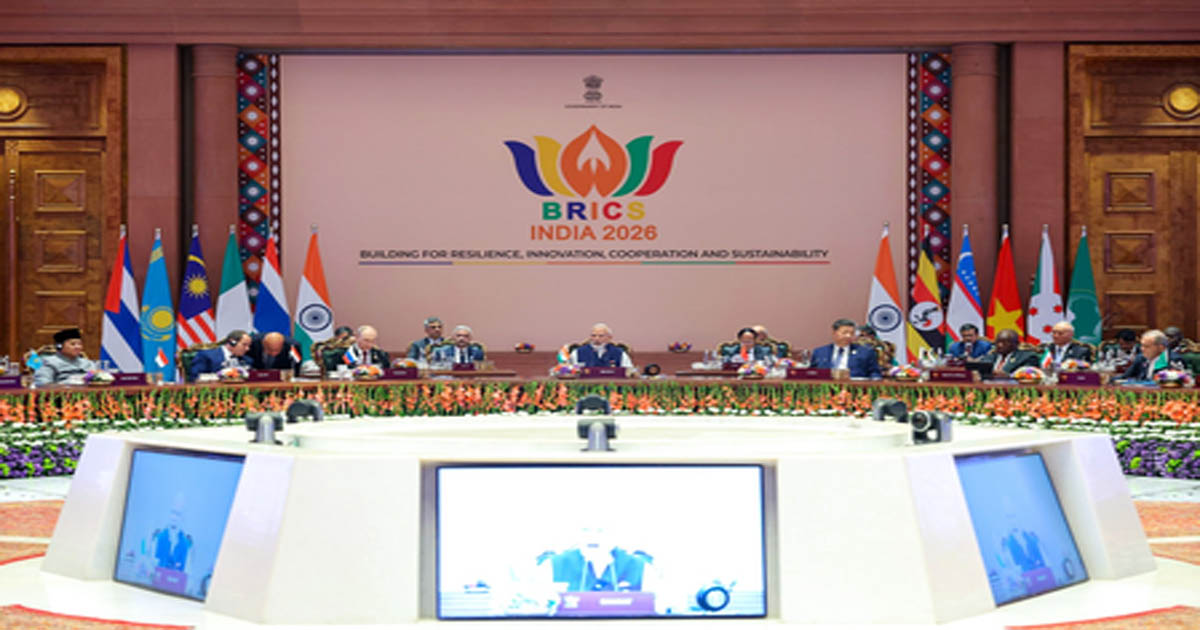
New Delhi, Sep 14: The United Arab Emirates (UAE) and India are broadening a strategic and economic partnership that serves as “an effective model of cooperation within BRICS,” a new report has said.
The partnership is built on a foundation of historic ties, shared interests and major projects that promote trade, investment and logistics connectivity between markets, the report from Gulf Today said.
“The growing UAE-India partnership, reflected in expanding trade, increasingly integrated logistics corridors and cooperation in investment and innovation, provides a practical model of the UAE’s role within BRICS,” the report said.
Further, the partnership also proves UAE’s commitment to exchanging expertise and perspectives and building more integrated and sustainable economic partnerships.
Bilateral trade reached $101.25 billion in FY26, marking the second consecutive year in which trade between the two countries exceeded $100 billion. The UAE and India have set a target to raise bilateral trade to $200 billion by 2032.
The partnership is being advanced through initiatives such as Bharat Mart, the Virtual Trade Corridor and cooperation under the India‑Middle East‑Europe Economic Corridor (IMEC).
“These initiatives are helping strengthen supply chain integration and create new routes for trade and investment flows between the two countries and global markets,” the report noted.
The UAE-India Comprehensive Economic Partnership Agreement (CEPA), operational since 2022 was hailed as the first agreement of its kind concluded by the UAE. The agreement has bolstered the flow of goods, services and investment and expanded opportunities for the private sector in both countries.
United Arab Emirates and China were the largest destinations within BRICS, together accounting for 88.50 per cent of India’s electronics exports to the grouping.
The number of Indian companies registered as active members of Dubai Chamber reached 85,841 by the end of June 2026 after 7,579 new Indian firms joined in the first half of the year, marking a year‑on‑year increase of 15 per cent, another report said.

Maratha reservation: Manoj Jarange Patil not allowed to protest at Azad Maidan.

Opposition twisted Amit Shah’s Hindi remarks, claims Maha CM

Delhi court grants three-week interim bail to influencer Swatantra Bhardwaj

Jayant Chaudhary-Akhilesh Yadav war of words intensifies; UP ministers back RLD chief

Post Ganpati darshan, Salman Khan shares a cryptic note on ‘happiness and contentment’

Four more Indian nationals rescued in Nepal, 120 cross safely from China: MEA

Nepal floods: First batch of 106 stranded Maharashtra tourists reaches India; 84 more expected today (Ld)

Gift to President Putin part of PM Modi bid to globally display India’s heritage

India, Brazil sign ICT MoU to deepen digital, telecom cooperation

Maharashtra: 17-year-old boy dies by suicide on Raksha Bandhan after emotional social media posts
-

 Crime4 years ago
Class 10 student jumps to death in Jaipur
-

 Maharashtra2 years ago
Mumbai Local Train Update: Central Railway’s New Timetable Comes Into Effect; Check Full List Of Revised Timings & Stations
-

 Maharashtra2 years ago
Mumbai To Go Toll-Free Tonight! Maharashtra Govt Announces Complete Toll Waiver For Light Motor Vehicles At All 5 Entry Points Of City
-

 Maharashtra2 years ago
False photo of Imtiaz Jaleel’s rally, exposing the fooling conspiracy
-

 National News2 years ago
Ministry of Railways rolls out Special Drive 4.0 with focus on digitisation, cleanliness, inclusiveness and grievance redressal
-

 Maharashtra2 years ago
Maharashtra Elections 2024: Mumbai Metro & BEST Services Extended Till Midnight On Voting Day
-

 National News2 years ago
J&K: 4 Jawans Killed, 28 Injured After Bus Carrying BSF Personnel For Poll Duty Falls Into Gorge In Budgam; Terrifying Visuals Surface
-

 Crime2 years ago
Baba Siddique Murder: Mumbai Police Unable To Get Lawrence Bishnoi Custody Due To Home Ministry Order, Says Report