
Crime
Uttarakhand man injured in Delhi blast was in Chandni Chowk for wedding shopping

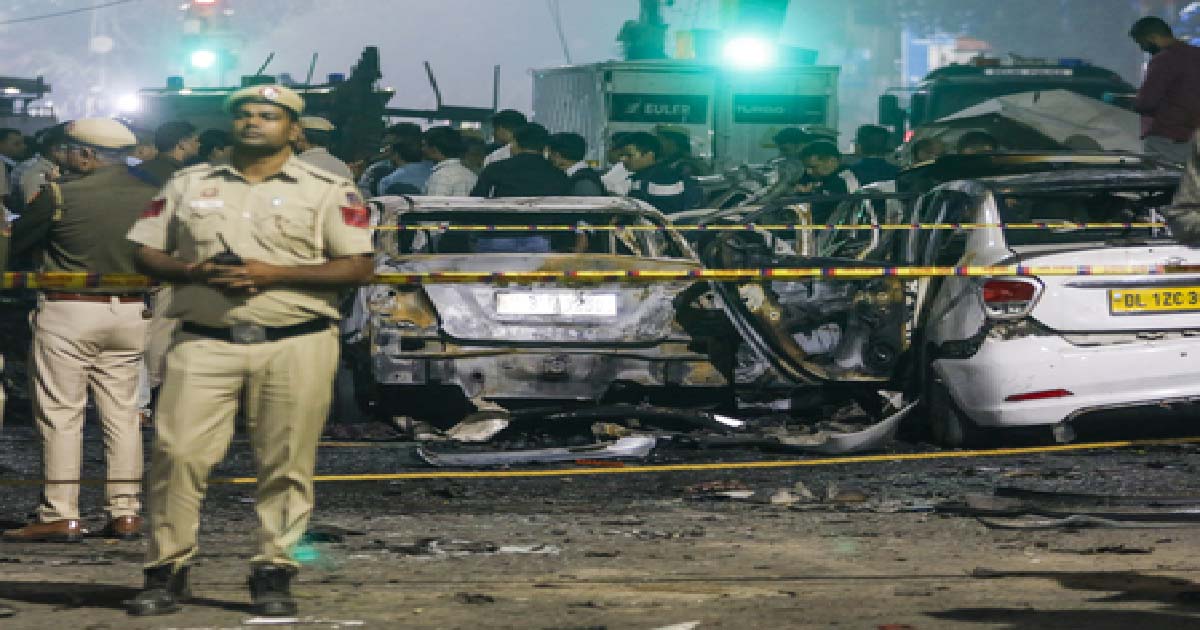
New Delhi, Nov 11: A young man from Gadarpur in Uttarakhand’s Udham Singh Nagar district was among those injured in the blast near Delhi’s Red Fort Metro Station. The injured man has been identified as 28-year-old Harshul Setia.
According to information received, Harshul, son of Sanjeev Setia, is a resident of Saraswati Vihar Colony in Gadarpur. His father said that Harshul is scheduled to get married in February. He had travelled to Delhi with his mother, brother, and fiancee for wedding shopping. They were shopping in a lane opposite the blast site when a shard of glass from the explosion struck Harshul on the head.
Sanjeev Setia said he received a phone call last evening informing him about his son’s injury. He added that Harshul is now safe and in stable condition. Following the advice of security agencies, he declined to make further comments.
He said he is leaving for Delhi to bring his son and family back home. After Harshul’s discharge from LNJP Hospital, the family will return to Gadarpur, where he will introduce his son to the media.
Meanwhile, the white Hyundai i20 car that exploded on Netaji Subhash Marg in Delhi near the Red Fort was parked outside a mosque for nearly two hours before the incident, sources said.
The police managed to piece together the route of the vehicle by obtaining CCTV footage from the area.
The blast took place at around 7 p.m., the police said. The car then took a U-turn near the Old Delhi Railway Station and then headed towards Lower Subhash Marg.
The car slowed down at the traffic signal on Chhata Rail Chowk, and then the explosion occurred, the police said.
It is, however, unclear whether the explosion was meant to take place at the signal or the occupants intended to ram the car into the Red Fort, officials said.
The trail of the car’s ownership is also under investigation. It has been found that the car was sold several times.
The vehicle bore the registration number HR26CE7674. It was first registered in 2014 to one Mohammad Salman, a resident of Gurugram. Following this, the car had been sold multiple times.
Salman sold it to a person called Devender, following which it was sold to a person in Ambala.
The current owner of the car remains unknown, and investigators are working on that aspect.
The registered owner, however, is under arrest and being questioned.
Multiple agencies are working on the case.


Crime
NEET-UG 2026 Paper Leak Case: CBI Arrests 2 More Accused, Doctor From Latur & Coaching Faculty From Pune

Mumbai: CBI has arrested two more accused in NEET-UG 2026 Examination paper leak case, bringing the total number of persons arrested in this case to 13.
An accused namely Dr Manoj Shirure, a Latur-based doctor has been arrested in the NEET UG 2026 questions leak case. He played key role in facilitating three students including the son of an accused coaching centre owner in getting the Chemistry questions from the accused P V Kulkarni.
Another arrested accused is Tejas Shah, who is a physics faculty at a Pune-based coaching centre. He got the leaked Physics questions of NEET UG 2026 Exam from arrested accused Manisha Havaldar.
Investigation to unearth the chain as well as the conspiracy in this case is ongoing. CBI has so far conducted searches at 49 locations at various places and seized several incriminating documents, Laptops, and mobile phones. Detailed analysis of the seized items is going on.
It may be recalled that CBI has registered this case on 12.05.2026 based on the written complaint given by Department of Higher Education, Ministry of Education, Government of India pertaining to alleged paper leak of NEET-UG 2026 Examination. Immediately after registration of the case, special teams were formed and searches were conducted at various locations across the country, and several suspects were picked up and interrogated.
So far 13 accused have been arrested in this case from Delhi, Jaipur, Gurugram, Nasik, Pune, Latur and Ahliyanagar. Investigation is continuing with various special teams working in tandem and the investigation has brought out the actual source of the leakage of Chemistry, Biology and Physics questions which were circulated before the exam.
CBI is committed to comprehensive, impartial and professional investigation in this case.
Crime
Delhi Police bust interstate cyber fraud network; three held for supplying bank account kits, SIM cards

New Delhi, May 27: The Cyber Police Station of Central District Police on Wednesday busted an interstate cyber fraud network involved in supplying bank account kits, SIM cards, and ATM cards that were used in online fraud cases. Three key operatives linked to the racket have been arrested from Haryana, Punjab, and Himachal Pradesh.
According to police, the accused targeted innocent citizens by impersonating Paytm employees and gaining access to victims’ mobile phones on the pretext of updating KYC details or Paytm settings.
The breakthrough came after a complaint was lodged at PS Cyber Central by a tea seller residing in South Patel Nagar, Delhi. The complainant alleged that an unidentified man visited his tea stall posing as a Paytm employee and offered to update the KYC settings on his mobile phone. During the process, the fraudster dishonestly gained access to the device and fraudulently transferred Rs 90,000 from the victim’s bank account.
Following the complaint, police conducted a preliminary enquiry and technical examination of the transaction trail. Subsequently, FIR No. 26/2026 dated May 15, under Section 318(4) of the Bharatiya Nyaya Sanhita (BNS), was registered at PS Cyber Central, and an investigation was initiated.
Considering the seriousness and interstate nature of the offence, a dedicated police team comprising SI Ravinder Kumar, HC Deepak, and HC Jai Kishan was formed under the supervision of SHO/Cyber Inspector Yograj Dalal and the overall supervision of ACP/OPS/Central Shri Padam Singh Rana.
During the investigation, the team carried out extensive technical surveillance, beneficiary account verification, bank transaction analysis, CCTV footage examination, digital profiling, and financial trail analysis. Investigators found that the cheated amount had been transferred into a Punjab National Bank account allegedly being used for routing proceeds of cyber fraud.
Further scrutiny of KYC documents, transaction records, and registered mobile numbers led to the identification of accused Vishesh Singh, a resident of Panchkula, Haryana. Police later discovered that beneficiary bank accounts, SIM cards, and ATM kits were being procured and supplied through an organised interstate network for use in cyber fraud activities.
Acting on technical inputs and local Intelligence, police teams conducted multiple raids in Panchkula, Haryana; Zirakpur in Mohali; and adjoining areas of Haryana and Punjab. Sustained surveillance and field verification ultimately resulted in the arrest of three accused persons on May 19.
The arrested accused have been identified as Vishesh Singh, 22, a resident of Panchkula, Haryana; Sachin Maurya, 22, also from Panchkula; and Ashish Sharma, 27, a resident of Kottla Kallan in Himachal Pradesh’s Una district.
According to police, Vishesh Singh acted as a beneficiary bank account holder and supplied bank account kits and SIM cards for cyber fraud activities. Sachin Maurya allegedly worked as a facilitator involved in collecting bank account kits and supplying them to other cyber fraud operatives. Ashish Sharma was allegedly responsible for handling and supplying multiple bank account kits to cyber fraud associates operating in different locations.
During interrogation, the accused disclosed that they used to receive commissions for arranging and supplying bank accounts, ATM cards, registered SIM cards, and banking credentials. These were later used by cyber fraudsters for routing and withdrawing cheated money in various fraud cases.
Police said the accused acted as intermediaries between bank account providers and organised cyber fraud syndicates operating in different states through mule bank accounts.
Technical surveillance, WhatsApp profiling, digital communication analysis, and mobile number linkage examination further revealed the active involvement of Sachin Maurya and Ashish Sharma in arranging, collecting, and circulating bank account kits and SIM cards to cyber fraudsters.
Investigators also found that the accused extensively used social media platforms such as Instagram and WhatsApp for communication, coordination, and transferring banking kits among members of the cyber fraud network.
Analysis of the seized mobile phones revealed incriminating digital evidence, including WhatsApp chats related to the supply of bank accounts and commission distribution, contact details of suspected cyber fraud associates, social media communications with co-accused persons, and details of mule bank accounts, SIM cards, and beneficiary account credentials.
Police recovered four mobile phones allegedly used for circulating bank account details and coordinating cyber fraud activities.
Further technical examination has revealed possible links with several other cyber fraud complaints and interstate cyber fraud modules. Investigation regarding the identification of additional co-accused persons, tracing of cheated money, and identification of other victims is currently underway.
Mumbai: In a four-year-old cyber fraud case wherein a city-based police officer lost ₹2.99 lakh after a call regarding PAN and Aadhaar card updates, the metropolitan magistrate court, Girgaon, has acquitted the accused from Jharkhand.
The court held that the mere receipt of funds suspected to be proceeds of cybercrime is insufficient to establish guilt without additional credible evidence.
It noted that the complainant, Priyanka Pawar transferred the money after providing an OTP, which does not constitute a criminal offence by the recipient, Manoj Kisku, 23. While the court observed that the man cannot be held criminally liable, it noted that civil liability may exist.
Pawar lodged a complaint with the South Cyber police station, claiming that on February 26, 2022, she received a call from an individual posing as a bank representative. The caller instructed her to update her PAN and Aadhaar details via a link. Upon clicking the link, ₹99,986 was transferred from her account. She later provided an OTP, leading to further debits totalling ₹2.99 lakh.
The investigation identified that the mobile number belonged to Rauf Ansari, while the funds were credited to the account of Kisku, a resident of Jamua, Jharkhand.
The court observed that the prosecution failed to establish a criminal conspiracy or a direct connection between Kisku and Ansari, noting that the mobile number used for communication was registered in Ansari’s name, yet Ansari had not been arrested. “It appears that the investigating officer had not arrested Ansari. Besides, the prosecution had not adduced direct or any circumstantial evidence on record, which could reflect that there was criminal conspiracy of the accused with Ansari,” the court stated.

Case registered against Bajrang Dal workers for bringing pigs to create ruckus in Mira Bhayander, two FIRs registered for disturbing the environment

Fugitive accused arrested in Mumbai Powai murder case, anger over dispute a week ago was the motive for the murder, police investigation after the murder concluded

Mumbai ANC Action Drug trafficker Haroon sent to Yeru Da Jail for one year

Eid marked by grief for families of disappeared Baloch civilians in Pakistan

Mumbai Commissioner Ashwini Bhide Tightens Civic Maintenance Supervision, Pushes In-House Repairs & Flood Preparedness In Suburbs

Maharashtra Shock: 22-Year-Old Arrested For Exploiting & Blackmailing Multiple Women In Kolhapur; Love Jihad Angle Suspected

Mumbai: Strict action directed against prominent Marathi placards in shops and institutions, warning of action in Shiv Sena style: Deputy Mayor Sanjay Ghadi

The Municipal Corporation and the Railway Administration should work together to make Mumbai flood-free, directs Standing Committee Chairman Prabhakar Shinde

Virar Citizens Protest Demolition Drive In Arnala; Police Block Lal Bawta March, Sit-in Held On Road

Global crude prices rise 0.73 pc as US-Iran talks stall
-

 Crime4 years ago
Class 10 student jumps to death in Jaipur
-

 Maharashtra2 years ago
Mumbai Local Train Update: Central Railway’s New Timetable Comes Into Effect; Check Full List Of Revised Timings & Stations
-

 Maharashtra2 years ago
Mumbai To Go Toll-Free Tonight! Maharashtra Govt Announces Complete Toll Waiver For Light Motor Vehicles At All 5 Entry Points Of City
-

 Maharashtra2 years ago
False photo of Imtiaz Jaleel’s rally, exposing the fooling conspiracy
-

 National News2 years ago
Ministry of Railways rolls out Special Drive 4.0 with focus on digitisation, cleanliness, inclusiveness and grievance redressal
-

 Maharashtra2 years ago
Maharashtra Elections 2024: Mumbai Metro & BEST Services Extended Till Midnight On Voting Day
-

 National News2 years ago
J&K: 4 Jawans Killed, 28 Injured After Bus Carrying BSF Personnel For Poll Duty Falls Into Gorge In Budgam; Terrifying Visuals Surface
-

 Crime2 years ago
Baba Siddique Murder: Mumbai Police Unable To Get Lawrence Bishnoi Custody Due To Home Ministry Order, Says Report