
Politics
Senior Opposition leader asked me what else was left there to achieve after becoming PM twice: Modi


Prime Minister Narendra Modi has said that a senior leader of the opposition party had asked him ‘what else was left there to achieve after becoming PM twice’.
“The leader does not know that this Modi is made of different metals, the soil of Gujarat that has shaped me,” the Prime Minister said.
The Prime Minister was virtually addressing ‘Utkarsh Samaroh’ in Bharuch, Gujarat on Thursday to mark the celebration of 100 per cent saturation of four key schemes of the state government in the district, which will help provide timely financial assistance to those in need.
“One day a very senior leader, a political opponent but I do respect him, came to meet me, to discuss and sort out some issues. He said, ‘Modiji, now what else do you want to do? The country has made you prime minister twice’. He thought that becoming prime minister twice was a huge achievement. He does not know that this Modi is made of different metals, the soil of Gujarat that has shaped me,” he said.
The Prime Minister further stated that, “It is not enough that I should rest now that everything that has happened is good. No, My dream is saturation. We should move towards 100 per cent coverage. Government machinery should get used to this and a belief should be generated among the citizens,” he said.
The Prime Minister noted that in 2014 almost half of the country’s population was deprived of facilities like toilets, vaccination, electricity connection and bank accounts.
“Over the years, with everyone’s efforts, we have been able to bring many schemes closer to 100 per cent saturation. The Prime Minister said 100 per cent coverage of beneficiaries means delivering to every creed and every section equally with Sabka Saath, Sabka Vikas. No one should be left behind from every scheme for the welfare of the poor. This also finishes the politics of appeasement. Saturation means that the benefit reaches the last person in society,” he added.


International News
Netanyahu’s Likud demands keeping security zones in Gaza, Lebanon, Syria ahead of unity govt talks

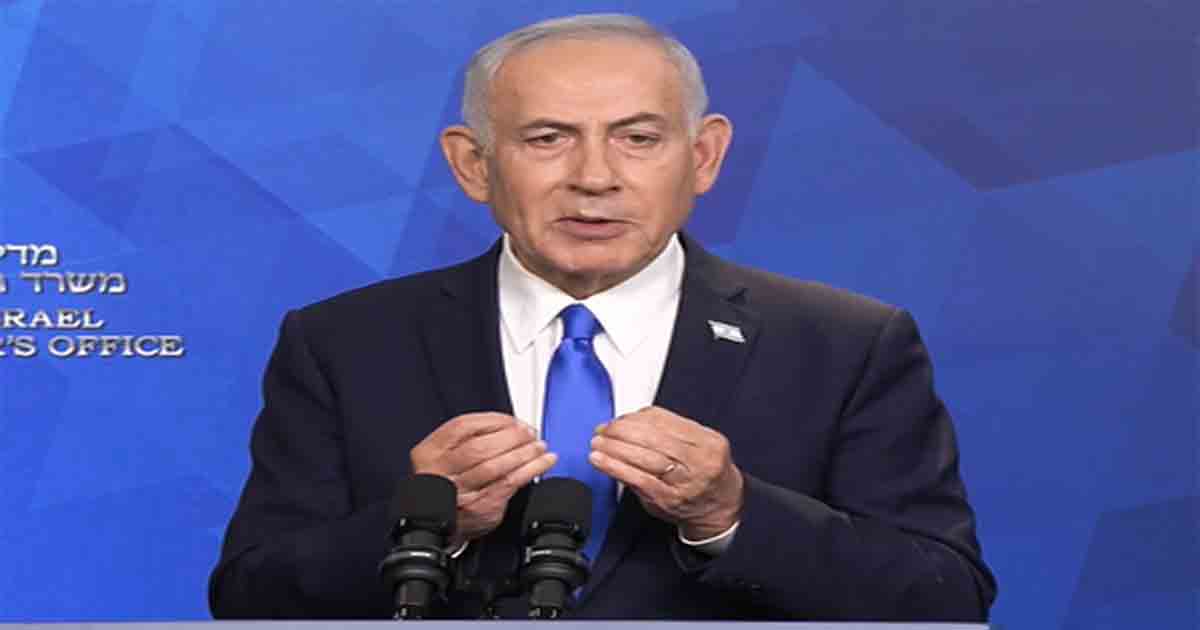
Israeli Prime Minister Benjamin Netanyahu’s Likud party issued a series of conditions for joining a potential national unity government, including a commitment to preserve Israeli security zones established during the war in the Gaza Strip, Lebanon and Syria.
The demands were outlined in an official Likud position paper as Gadi Eisenkot’s Yashar party invited Likud on Saturday to begin a “marathon” of coalition talks aimed at forming a broad national unity government. Yashar said its negotiating team would “turn over every stone,” pursue bold initiatives and seek a breakthrough that could lead to the formation of a new government.
Likud’s proposed guidelines also include recognising Israel as the nation-state of the Jewish people, rejection of the establishment of a Palestinian state, and an agreement on the status of Jewish ultra-Orthodox students regarding military service, Xinhua news agency reported.
Earlier, Likud party conditioned the formation of a national unity government with the opposition bloc led by Gadi Eisenkot on an agreement not to establish a state commission of inquiry into Hamas’s October 7, 2023, attack, local media reported.
Opposition parties have demanded such an inquiry since the attack, while Netanyahu’s coalition has rejected it, arguing that such a commission would not be objective.
According to Kan, the condition is expected to be raised at a meeting between the parties’ leaders scheduled for Sunday, reports Xinhua, quoting Israel’s state-owned Kan News.
Likud told the broadcaster that core disputes, including the inquiry, should be addressed during negotiations.
Eisenkot, a former military chief, has until December 6 to form a government, with a possible extension of up to two weeks granted by the president.
Netanyahu’s opponents won 67 of parliament’s 120 seats in the October 27 election, but that majority includes 19 seats held by Arab parties, whose support some of Eisenkot’s prospective coalition partners reject.

A joint team of the Border Security Force (BSF) and Punjab Police has recovered four pistols, six empty magazines, 57 live cartridges and 277 grams of heroin from a packet dropped by a drone in a field in Punjab’s Tarn Taran district, near the India-Pakistan international border.
The recovery was made in the Kalsian village area of the Khalra sector. Police have registered a case against unidentified persons and initiated an investigation.
According to the information, Khalra Police Station received information from Murari Lal Sharma, Commander of the Kalsian Border Outpost (BOP) of the BSF’s 115th Battalion, that a yellow packet had been dropped by a drone in the field of a farmer, Sukha Singh, in Kalsian village.
Following the information, a police team reached the spot and took the packet into custody for examination.
Upon opening the packet, the team recovered four pistols, six empty magazines, 57 live cartridges, 277 grams of heroin and 37 grams of packaging material. The recovered weapons and narcotics were seized by the police.
Sub-Inspector Arju of Khalra Police Station said the police team acted on the information provided by Murari Lal Sharma, Commander of the Kalsian BOP of the BSF’s 115th Battalion. The packet dropped by a drone in farmer Sukha Singh’s field contained weapons, ammunition and heroin, he confirmed.
Preliminary investigation suggests that the consignment may have been sent from Pakistan into Indian territory using a drone. However, police are investigating all aspects of the case to establish who sent the consignment and to whom it was supposed to be delivered.
Meanwhile, in a related development, Rajasthan Police had earlier identified 28 Pakistani handlers allegedly involved in sending weapons, narcotics and explosives across the international border using drones.
Officials had said that information about these handlers was being collected and would be shared with central security agencies.
Meanwhile, police have also started identifying properties belonging to local facilitators allegedly involved in smuggling activities. Authorities are planning to seize properties that were used for such operations.
Leading industry chamber CII on Sunday called for 15 priority reforms across banking, non-banking finance, capital markets, insurance and financial technology, ahead of the Union Budget 2027-28 and help build a $26.5 trillion economy in 2047.
These include a standing, rule-based liquidity window for well-governed NBFCs, a recalibrated priority sector lending framework, a wider investor base for lower-rated corporate bonds, parity for NBFCs in loan recovery, and a national catastrophe and climate risk pool.
CII’s analysis estimates that a $26.5 trillion economy in 2047 will need close to $106 trillion of financial assets, against about $7 trillion today.
Banking assets will need to grow 3.0 to 3.5 percentage points faster than nominal GDP, taking the bank assets-to-GDP ratio from about 1.0 times towards 1.5 times.
Insurance and pension assets together are around 10 per cent of GDP, and the corporate bond market at about 15 per cent of GDP compares with 36 per cent in China and over 80 per cent in South Korea, according to the CII document.
“The financial sector enters this phase from a position of strength, with healthy bank and NBFC balance sheets and a series of important measures by the Government and regulators over the past year. The task now is to build a system that can finance an economy several times its present size by 2047,” said Chandrajit Banerjee, Director General, CII.
That requires deeper and longer-tenor pools of capital, credit that reaches the sectors that will drive growth, and regulation that keeps pace with how finance is delivered. Our recommendations are intended to take the current reform effort to its next stage,” Banerjee noted.
The CII recommends raising the priority sector limit for renewable energy from Rs 35 crore to Rs 80-100 crore per borrower, so that medium-sized projects qualify, and bringing circular economy activities such as recycling and battery reuse within the framework.
The 2 per cent of credit cap on incremental export credit should be replaced by a dedicated export sub-target, with eligibility extended to factoring, export receivables and supply-chain finance. Within the safeguards the RBI has put in place for the foreign exchange market, pooled hedging facilities and small-ticket forward cover would help MSME exporters manage currency volatility, according to the CII paper.
Building on the Budget’s TReDS and credit guarantee measures, insurance cover against fire, flood, machinery breakdown and business interruption should be a standard feature of government-guaranteed MSME loans, reducing both NPA risk and guarantee invocation.
Guarantee fees and claim settlement timelines should also be reviewed so that cover reaches first-time and small borrowers. CII estimates the MSME credit gap at Rs 25-30 lakh crore.
CII proposes a regulatory pathway for video-based customer identification in which identity and liveness checks are carried out by certified automated systems, with audit trails and fraud safeguards retained, in place of an official’s presence in every session. This would lower onboarding costs in underserved areas.
IRDAI’s July 2026 amendments allow insurers to invest in the debt of operational infrastructure SPVs for refinancing, up to 20 per cent of the issue. CII recommends the next step: linking investment limits to the investor’s assets under management or net worth rather than to the size of the investee, harmonising norms for bonds backed by partial credit enhancement across IRDAI, EPFO and PFRDA, and developing a framework for collateralised loan obligations on infrastructure loan pools to recycle bank capital.
To complement the market-making framework and the new credit derivatives directions, CII recommends that pension funds, insurers and provident funds be allowed calibrated exposure to bonds rated below AA and to longer tenors.
On climate finance taxonomy, the draft framework released in May 2025 should be finalised with sector-specific quantitative thresholds and clear definitions of transition activities, followed by an adaptation and resilience taxonomy, said the CII.
NBFCs account for about 23 per cent of credit, and about 45 per cent of their borrowings come from banks. The RBI has opened the term money market to NBFCs. The CII proposes, in addition, a permanent, rule-based liquidity and refinance window, with access linked to compliance status, collateral standards and eligibility filters, so that rollover pressure during market stress does not lead to a contraction in credit to MSMEs and retail borrowers.
As the Government considers amendments to the SARFAESI Act, the threshold for NBFCs should be reduced from Rs 20 lakh to the Rs 1 lakh that applies to banks and HFCs. Regulated NBFCs should have access to Debt Recovery Tribunals, to the Central Repository of Information on Large Credits with appropriate safeguards, and to central fraud registries with reciprocal data-sharing obligations.
The CII also recommends a formal mechanism for informal guidance at the RBI, modelled on SEBI’s 2003 scheme, offering time-bound and binding responses on novel structures; tiered licensing with a green channel for base-layer NBFCs, building on the recent exemptions for Type I NBFCs; and a single reporting portal in place of multiple platforms.
The exemption of individual health and life insurance from GST from September 2025 has improved affordability, and the GST Council has since allowed employers credit on group cover.
The CII recommends that individual policies be zero-rated rather than exempt so that insurers can claim input tax credit, and that tax computation for insurers be aligned with IRDAI-prescribed reserves as the sector moves to Ind AS (Indian Accounting Standards).
As the government examines a national parametric insurance scheme, CII proposes a pool with mandatory cession from primary insurers, catastrophe bonds issued through GIFT IFSC, a sovereign reinsurance backstop and a parametric programme for climate events, so that disaster losses are pre-funded rather than absorbed by public finances after the event.
Exposure limits for insurers, banks and financial institutions in AIFs should be raised in a calibrated manner, with prudential treatment differentiated between single-investor and diversified pooled funds, and mutual funds, pension funds and EPFO permitted to participate.
The CII also recommends a blended finance fund-of-funds within the AIF framework, early enactment of the proposed amendments that ease the use of limited liability partnerships for AIFs, and capital-call and NAV-based financing within prudent limits.
The CII recommends aligning voting rights in private banks with economic ownership by raising the 26 per cent cap to up to 49 per cent with governance safeguards, and early approval of the proposal to raise the foreign investment limit in public sector banks from 20 per cent to 49 per cent so that they can raise capital for growth.

Netanyahu’s Likud demands keeping security zones in Gaza, Lebanon, Syria ahead of unity govt talks

Arms, ammunition, drugs recovered from drone-dropped packet near India-Pak border in Punjab

CII lists 15 priority reforms to finance $26.5 trillion economy in 2047

TN govt set to shortlist families for 3 free LPG refills a year from Pongal

Shah Rukh Khan asks 26/11 survivor Devika Rotawan how she gathered courage to testify against Kasab

Congress trying to protect 3 crore Bangladeshi infiltrators in voter list: HM Shah

Red Fort car blast probe exposes blueprint for spread of terror modules across India

Trump flags Iran targets as talks continue

‘Conspiracy, not accident’: NCP on Ajit Pawar death

BJP, Shiv Sena slam Mallikarjun Kharge for terming Diwali ‘Khushiyon ka Eid’
-

 Crime4 years ago
Class 10 student jumps to death in Jaipur
-

 Maharashtra2 years ago
Mumbai Local Train Update: Central Railway’s New Timetable Comes Into Effect; Check Full List Of Revised Timings & Stations
-

 Maharashtra2 years ago
Mumbai To Go Toll-Free Tonight! Maharashtra Govt Announces Complete Toll Waiver For Light Motor Vehicles At All 5 Entry Points Of City
-

 Maharashtra2 years ago
False photo of Imtiaz Jaleel’s rally, exposing the fooling conspiracy
-

 National News2 years ago
Ministry of Railways rolls out Special Drive 4.0 with focus on digitisation, cleanliness, inclusiveness and grievance redressal
-

 Maharashtra2 years ago
Maharashtra Elections 2024: Mumbai Metro & BEST Services Extended Till Midnight On Voting Day
-

 National News2 years ago
J&K: 4 Jawans Killed, 28 Injured After Bus Carrying BSF Personnel For Poll Duty Falls Into Gorge In Budgam; Terrifying Visuals Surface
-

 Crime2 years ago
Baba Siddique Murder: Mumbai Police Unable To Get Lawrence Bishnoi Custody Due To Home Ministry Order, Says Report