
National News
Scrap power purchase pacts, Navjot Sidhu asks Punjab CM


Time and again rapping his party’s government in Punjab on the knuckles for its failure to provide free power up to 300 units to the domestic consumers, state Congress President Navjot Sidhu on Monday demanded to extend the one-day Assembly session to terminate the power purchase agreements (PPAs) signed with private companies.
“Punjab government must immediately issue directions to PSERC (Punjab State Electricity Regulatory Commission) in public interest to revise tariff being paid to private power plants making the faulty PPAs null and void. Further calling a five-seven day Vidhan Sabha Session to bring a new legislation for termination of faulty PPAs,” Sidhu tweeted.
“This will help Punjab government give 300 units of free power to all domestic consumers, including general category, decrease domestic tariff to Rs 3 per unit and Rs 5 per unit for industry, along with redressal of all outstanding bills, waiving-off the unjustifiable and exorbitant bills,” he added.
The government has decided to call a special session of the Vidhan Sabha for one day on September 3 to commemorate the historic 400th Prakash Purb of Guru Tegh Bahadur.
In his earlier tweets, Sidhu had blamed the PPAs that the previous government had signed with three private thermal power plants and said till 2020 Punjab had paid Rs 5,400 crore due to faulty clauses in these agreements. It is expected to pay Rs 65,000 crore of people’s money just as fixed charges.
Favouring the need to set aside the PPAs, Sidhu had said the state can purchase power from the national grid at much cheaper rates. “But these Badal-signed PPAs are acting against Punjab’s public interest. Punjab may not be able to re-negotiate these PPAs due to them having legal protection from honourable courts, but there is a way forward,” he had said.


National News
‘Respected Modi ji, please save West Bengal’ poster at PM’s Asansol rally draws attention

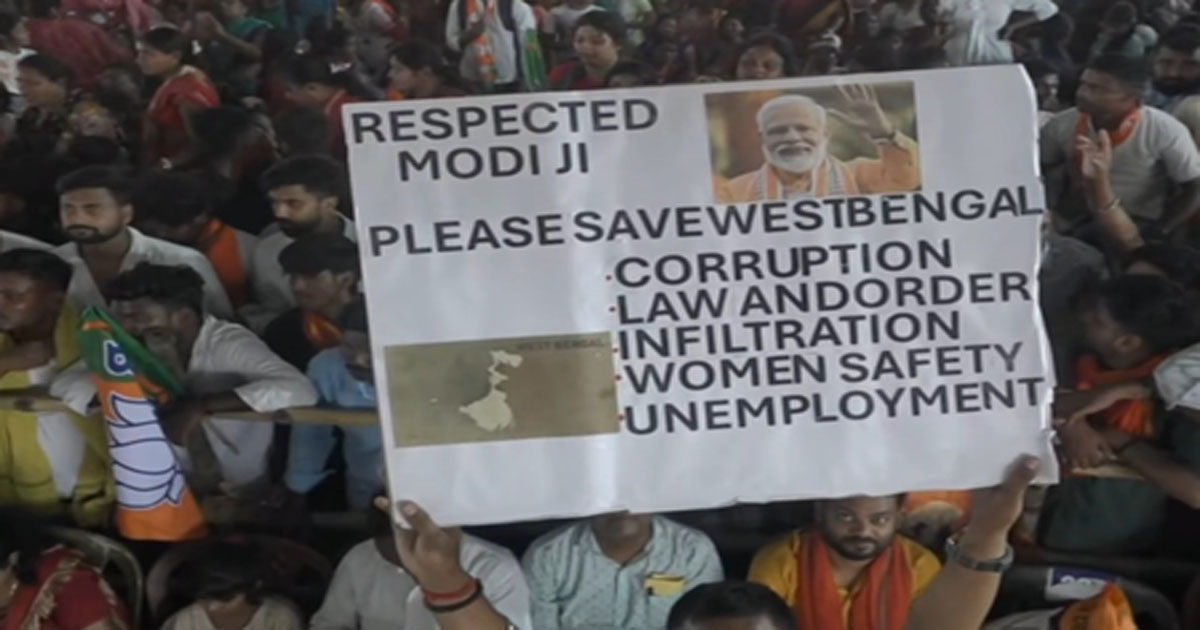
Kolkata, April 9: A striking visual emerged during Prime Minister Narendra Modi’s public rally in Asansol on Thursday, as a person in the crowd held up a poster appealing directly to the Prime Minister with the message, “Respected Modi ji, please save West Bengal.”
The moment came as the election campaign in West Bengal gathered momentum ahead of the upcoming Assembly polls.
The state is set to vote in two phases, scheduled for April 23 and April 29.
In the first phase, polling will take place across 152 Assembly constituencies, while the remaining 142 seats will go to the polls in the second phase.
The counting of votes is slated for May 4.
Amid loud cheers and slogans, the Prime Minister addressed a large and enthusiastic gathering in Asansol.
During his speech, attention briefly shifted to a person in the audience, who was seen holding up a poster featuring PM Modi’s portrait along with a map of West Bengal.
The poster prominently displayed the message, “Respected Modi ji, Please save West Bengal”, and also highlighted several issues faced by the public, including “Corruption, law and order, infiltration, women safety and unemployment”.
These concerns mirror the key themes on which the Bharatiya Janata Party (BJP) has been targeting the ruling Trinamool Congress government in the state.
The visual quickly stood out amid the rally, reflecting the charged political atmosphere as political parties intensify their campaigns in the run-up to the state elections.
Meanwhile, PM Modi launched a blistering attack on the Trinamool Congress government, claiming that the ruling-party-linked syndicate and mafia were looting the state’s resources and also warned that all those goons will be held accountable and answerable after the election results on May 4.
PM Modi, addressing his second election rally in Asansol, pinned the blame on previous dispensations from the Congress to Trinamool Congress for West Bengal’s “disgraceful decline from prosperity to deprivation” and said that the BJP’s good governance is the only solution for West Bengal’s burgeoning woes.
Accusing the Mamata Banerjee government of taking the state back to ‘dark ages’, the Prime Minister said that it is essential for West Bengal’s progress that the state is freed from Trinamool’s clutches.
“For Bengal’s progress, freedom from Trinamool is necessary, because while the entire country is moving ahead at a rapid pace, Trinamool is pushing Bengal backwards,” he added.
“Trinamool’s time is over. The next government will be a double-engine government of the BJP. After May 4, Bengal will enter a new era of development,” he said.
Making a fervent call to the electorate to choose their options wisely in the upcoming state polls, Prime Minister Modi said that the people of West Bengal won’t get fooled this time, as they want a “performing” government with a proven track record.
New Delhi, April 8: Global crude oil prices on Wednesday plunged sharply up to 20 per cent, after US President Donald Trump announced a two-week ceasefire with Iran that includes a pledge to restore navigation through the Strait of Hormuz — the narrow waterway at the heart of the world’s most acute energy crisis in decades.
The international benchmark Brent crude futures shed nearly 16 per cent or $17.39 to $91.88, hitting an intraday low, while US WTI crude declined almost 20 per cent or $21.90 to $91.05.
The Strait of Hormuz, through which roughly a fifth of global oil flows, has been at the centre of the conflict. Iran had restricted passage for several weeks, contributing to rising prices and supply concerns. Markets had been on edge ahead of Trump’s deadline for Iran to reach a deal, with traders fearing a major escalation could disrupt shipments across the Gulf and send prices sharply higher.
Oil prices had surged in recent weeks amid fears that the strait could be closed or severely restricted. The waterway handles shipments critical to global supply chains, including crude oil and liquefied natural gas.
The US-Israel-Iran conflict has been paused for two weeks after approximately 40 days of hostilities that began in February.
President Trump’s shift in stance came just ahead of his stated deadline for Iran to reopen the Strait of Hormuz or risk extensive strikes on its civilian infrastructure.
Meanwhile, Iran indicated it would halt its military operations provided attacks against it ceased simultaneously. Foreign Minister Abbas Araghchi, in a formal statement, confirmed that safe passage through the Strait of Hormuz would be ensured for two weeks in coordination with Iranian armed forces.
The conflict had triggered an unprecedented surge in oil prices in March, with gains exceeding 60 per cent during the period.
Additionally, Indian equity benchmarks also rallied sharply on the development, trading more than 3 per cent higher in early trade. The Sensex jumped nearly 4 per cent, while the Nifty surged 3.5 per cent to their respective intraday highs.
National News
Priyanka Chaturvedi Defends India’s Stand On Staying Off US–Iran Ceasefire Talks, ‘Why Should We Be Part? Wasn’t Our War’
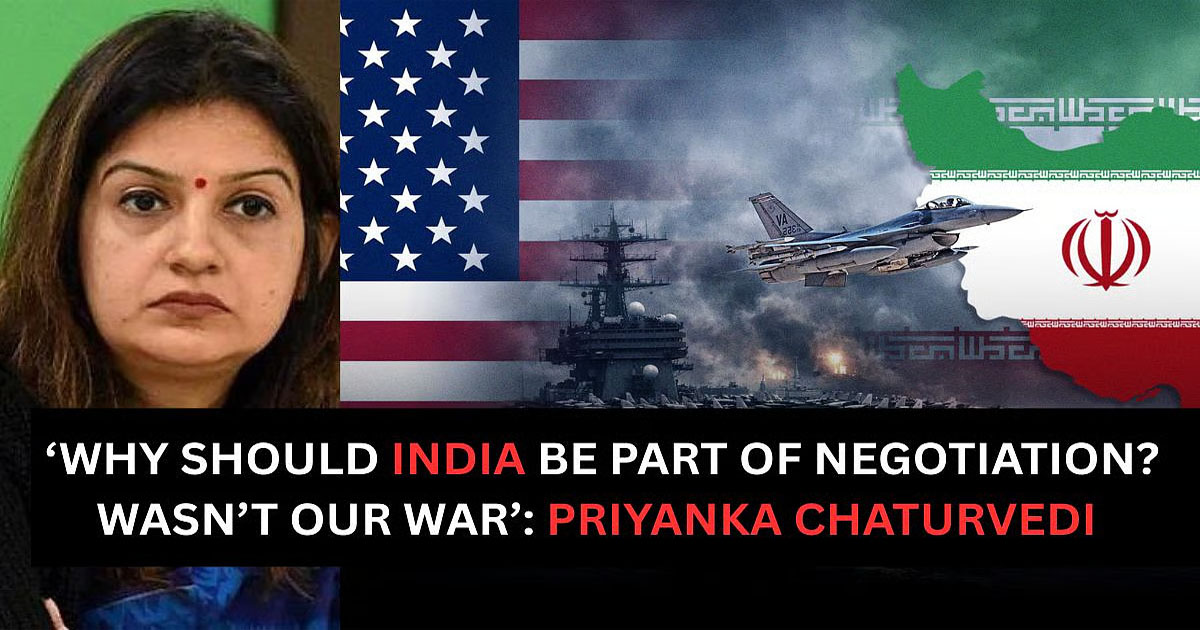
Shiv Sena-UBT leader Priyanka Chaturvedi defended India’s stand on not being part of the negotiating table between the US and Iran and questioned why it should be involved, saying the conflict ‘wasn’t our war.’ Her remarks come amid an ongoing debate over India’s stance on the escalating West Asia tensions.
Taking to her official handle on X, Chaturvedi also mocked Pakistan’s role as a mediator, and said, “And for them, it is like that tort who, for a fee will say it will resolve the crisis- best described by India’s FM in an all party meeting.”
She also spoke on the ceasefire, saying that Iran kept its position, the US saved face, Israel faced a reality check, while Pakistan got a ‘thank you note,’ and India secured its oil supply.
US President Donald Trump agreed to a 14-day ceasefire after talks with Pakistan Prime Minister Shehbaz Sharif and Pakistan Army chief Asim Munir, according to a post shared by him on his official Truth Social account. Trump also accepted the 10-point proposal from Iran. The Iranian side then accepted Trump’s peace overture and agreed to safe passage via the Strait of Hormuz for two weeks, as well as a pause in military operations.
Based on conversations with Prime Minister Shehbaz Sharif and Field Marshal Asim Munir, of Pakistan, and wherein they requested that I hold off the destructive force being sent tonight to Iran, and subject to the Islamic Republic of Iran agreeing to the COMPLETE, IMMEDIATE, and SAFE OPENING of the Strait of Hormuz, I agree to suspend the bombing and attack of Iran for a period of two weeks. This will be a double sided CEASEFIRE! The reason for doing so is that we have already met and exceeded all Military objectives, and are very far along with a definitive Agreement concerning Longterm PEACE with Iran, and PEACE in the Middle East. We received a 10 point proposal from Iran, and believe it is a workable basis on which to negotiate. Almost all of the various points of past contention have been agreed to between the United States and Iran, but a two week period will allow the Agreement to be finalized and consummated. On behalf of the United States of America, as President, and also representing the Countries of the Middle East, it is an Honor to have this Longterm problem close to resolution. Thank you for your attention to this matter! President DONALD J. TRUMP

US failed to gain Iran’s trust during talks: Iranian Parliament Speaker Ghalibaf

47-Year-Old Custody Escapee Arrested In Virar After Tea Stall Dispute Raised Suspicion

‘3-Hour Concert On 90th Birthday…’: Maha CM Fadnavis Pays Heartfelt Tribute To Ashatai, Recalls Her Passion For Music

Asha Bhosle’s son says last respects to be paid at residence in Lower Parel, followed by last rites at Shivaji Park

We have not forgotten US breaches: Iran hardens stand amid peace talks

Dhurandhar 2 Box Office Collection Day 1: Ranveer Singh Starrer Takes An Exceptional Opening; Crosses ₹100 Crore Mark

Mumbai Police Busts Fake Apple Accessories Racket In Ghatkopar, ₹16.33 Lakh Goods Seized; Six Booked

Mumbai: 28-Year-Old Ghatkopar Woman Killed By Speeding Tanker While Crossing Road, Driver Arrested

Thane Horror: Man Slashed With Chopper In Naupada For Refusing ‘Vargani’, Caught On Camera

Dhurandhar 2 Box Office Collection Day 9: Ranveer Singh Starrer Earns ₹41.55 Crore On Its Second Friday; Enters ₹700 Crore Club
-

 Crime4 years ago
Class 10 student jumps to death in Jaipur
-

 Maharashtra2 years ago
Mumbai Local Train Update: Central Railway’s New Timetable Comes Into Effect; Check Full List Of Revised Timings & Stations
-

 Maharashtra1 year ago
Mumbai To Go Toll-Free Tonight! Maharashtra Govt Announces Complete Toll Waiver For Light Motor Vehicles At All 5 Entry Points Of City
-

 Maharashtra2 years ago
False photo of Imtiaz Jaleel’s rally, exposing the fooling conspiracy
-

 National News2 years ago
Ministry of Railways rolls out Special Drive 4.0 with focus on digitisation, cleanliness, inclusiveness and grievance redressal
-

 Maharashtra1 year ago
Maharashtra Elections 2024: Mumbai Metro & BEST Services Extended Till Midnight On Voting Day
-

 National News2 years ago
J&K: 4 Jawans Killed, 28 Injured After Bus Carrying BSF Personnel For Poll Duty Falls Into Gorge In Budgam; Terrifying Visuals Surface
-

 Crime1 year ago
Baba Siddique Murder: Mumbai Police Unable To Get Lawrence Bishnoi Custody Due To Home Ministry Order, Says Report