
Crime
New twist emerges in Bengaluru BJP leader’s suicide case

The ongoing probe into the suicide case of a BJP leader in Bengaluru took a new twist on Tuesday after the police found a note where the victim had written that he was a victim of honey trapping.
Anantharaju, the BJP leader from Herohalli BBMP ward, was found hanging at his residence on May 12. Initially, it was suspected that the death was due to a health issue.
The case took a new twist as the victim’s widow, B.K. Suma, suspected the role of two women.
The police searched the house and found a death note which confirmed that the deceased was honey trapped, blackmailed and extorted.
Based on the complaint by Suma, the police have lodged a case of abatement to suicide.
Suma had complained to the police accusing the two women and a man of blackmailing the victim with private photos which led to his suicide.
As per the complaint, Anantharaju met one Rekha on social media and they had an affair. Rekha recorded a video of their private moments and colluding with her husband Vinod and friend Spandhana, blackmailed and extorted huge amounts of money from the victim.
The complaint further stated that the three accused threatened Anantharaju that they would share the photos with other party leaders and media if he did not pay them the money.
Anantharaju, unable to take the pressure, ended his life. In his suicide note, he apologised to his wife and asked her to take care of their children.
The handwriting and signature in the note has been identified as that of the victim.


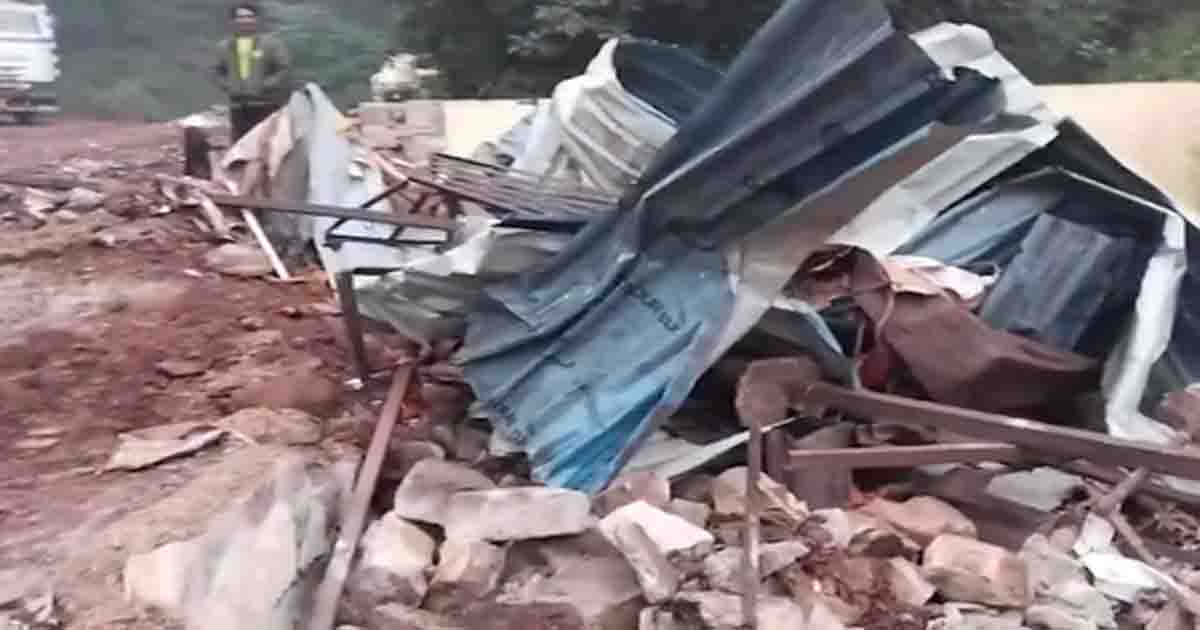
Twelve people were killed, while over 25 were injured after a truck rammed into shops near Shitla Mata Temple in Madhya Pradesh’s Gwalior early on Sunday, officials said.
The incident occurred at around 1:30 a.m. on Sunday when the truck lost control while descending a slope near the historic Shitla Mata Temple, located 18 kilometres from the district headquarters.
“Approximately 50 people were struck by the vehicle, resulting in at least 12 deaths. More than 25 others, including two police personnel and several children, have sustained injuries,” an official said.
According to eyewitnesses, the truck was loaded with sacks of paddy and lost control while descending a hill and crashed into shops near the temple.
“The truck, approaching from the direction of Chinor, went out of control while descending the slope near the main outer gate of the temple and ploughed into the shops situated around the gate. The impact caused significant damage to several shops and destroyed multiple two-wheeled vehicles,” an eyewitness told media.
Upon receiving news of the accident, police teams arrived at the scene and transported the injured to the hospital. About five individuals remain in critical condition. The bodies of the deceased have been taken to the Jaya Arogya Hospital in Gwalior.
Speaking to media, a local said, “When I looked around, there was utter chaos and distress. People were screaming and frantically searching for their loved ones. It was heartbreaking to see people trapped beneath the truck. As for negligence, this is a result of gross negligence by the Gwalior administration. It is a major lapse that led to this tragedy at the Shitla Mata Temple.”
“Our faith has been deeply shaken. People hold an unwavering belief in this temple, a place where neither a coconut is broken nor a lemon is cut, yet such a tragedy has occurred. It is heartbreaking. I demand that the government and Chief Minister Mohan Yadav, who frequently speak about Sanatan Dharma, come to Gwalior today. Compensation must be provided to the families of those who lost their lives, and the injured should receive free medical treatment,” he said.
A shopkeeper, Bablu Prajapati, said, “I had a shop here, which was being managed by my father. Two relatives were also visiting. In total, four people who were at the shop have been injured; they are all currently undergoing treatment in the hospital.”
The tragedy occurred during the auspicious festival of Navratri, when hundreds of thousands of devotees visit the historic Shitla Mata Temple. Typically, the route passing by the temple is closed to large vehicles during this period; hence, an investigation is underway to determine who allowed the truck to enter.
Officials have stated that they are probing who authorised the truck’s entry and whose negligence led to this incident.
An investigation is underway, and further details are awaited.
Four accused have been named in a supplementary chargesheet filed before a National Investigation Agency (NIA) Special Court in Haryana’s Panchkula in connection with a grenade attack carried out near a Women Police Station in Sirsa in 2025, officials said.
The NIA filed a supplementary chargesheet before the NIA Special Court on Saturday against four accused, namely Rajbir Singh alias Fouji, Ved Parkash alias Pamma, Jiwanjot Singh Grewal alias Jyoti and Chirag Thakral, in connection with the grenade attack near a Women Police Station in Sirsa on November 25, 2025 (RC-24/2025/NIA/DLI), according to the officials.
The case, originally registered as FIR No. 710/2025 dated November 26, 2025, at Police Station Civil Line in Sirsa, was re-registered by NIA on December 30, 2025, as RC-24/2025/NIA/DLI.
Earlier on May 24 this year, the investigating agency had filed a chargesheet in the case before the NIA Special Court in Panchkula, against nine accused, including Pakistani nationals Shahzad Bhatti and Sohail Ahmad alias Sohail Baloch, officials said.
“The supplementary chargesheet details the conspiracy and the individual roles of the 4 accused, along with the supporting evidence collected during further investigation. It charges them under sections 61(2) r/w 109 and 238 of the Bharatiya Nyaya Sanhita, 2023, sections 5 and 6 of the Explosive Substances Act, 1908, and sections 18, 18B and 20 of the UA (P) Act, 1967,” the NIA said in a statement.
The investigators revealed that Rajbir Singh alias Fouji acted as the India-based coordinator of the cross-border network, working in coordination with foreign-based handlers for the collection and movement of weapons/hand grenades and narcotics in India.
Additionally, Chirag Thakral, Jiwanjot Singh Grewal alias Jyoti and Ved Parkash alias Pamma used to work under the directions of Rajbir Singh and played a key role in facilitating the movement of explosives used in the grenade attack at the Women Police Station in Sirsa, officials said.
“The attack was carried out by members of the Shahzad Bhatti network, acting pursuant to an organised conspiracy, with the intention of causing harm to police personnel and of creating terror and fear among the general public. NIA’s investigation has traced the conspiracy in the case to foreign-based handlers operating a cross-border terror network,” the NIA said.
It mentioned that further investigation in the case is continuing to identify and apprehend the other persons involved in the conspiracy and to unearth the complete cross-border terror network behind the attack.
Mumbai, Oct 17: In fresh action against an online betting/gaming and cyber fraud syndicate, the Enforcement Directorate (ED) conducted search operations at 20 premises located in Mumbai, Pune, Mehsana, Surat and Hyderabad, ED officials said on Saturday.
During the search operations on October 13, the ED’s Mumbai Zone-2 seized various incriminating documents, digital devices and other material evidence relating to the layering and diversion of proceeds of crime, the official said in a statement.
In addition, multiple bank accounts of the concerned entities and persons have been ordered frozen under the provisions of the Prevention of Money Laundering Act (PMLA), 2002, the statement said.
In the case, the ED had earlier conducted searches at multiple places in Pune, Mumbai and Bengaluru and also arrested Ram U. Ramdhani, founder of Edsom Fintech Private Limited, who remains in judicial custody, it added.
The investigation stems from two predicate offences pertaining to the online gaming and betting platform “All Panel Exchange” (allpanelexch.com) and MGM91 wherein the complainants were induced to deposit funds and were subsequently cheated, the ED said.
The central agency’s investigation under PMLA established that funds collected from victims of both betting platforms were routed and ultimately received in the bank accounts of a Pune-based entity established by Ram U. Ramdhani.
“Edsom had developed and operated an in-house payment intermediary platform called “iPaisa”, through which it onboarded more than 200 shell/front entities — referred to internally as “merchants” — on behalf of online gaming, betting, and cyber fraud operators and their agents, referred to as “Channel Partners/Carry and Forward Agents”,” the ED said.
“Investigation revealed that funds collected from victims of online gaming/betting/cyber fraud platforms were routed through a vast network of mule bank accounts and the controllers of these betting platforms, along with the shell entities used for routing the proceeds of crime, have been identified,” the ED added.
It also emerged that a significant number of persons involved in operating these online betting/gaming platforms were being directed from Dubai based persons, the probe agency said.
The syndicate was further aided by certain cooperative banks, whose infrastructure was used to collect and further layer the illicit proceeds, it added.
“Investigation has also established that the proceeds of crime generated through online betting/gaming and cyber fraud activities were siphoned out through three principal routes: One, by way of remittances disguised as trade transactions through over invoicing; and other, by cash withdrawals from mule accounts opened under the guise of APMC units; and another, by conversion of funds into cryptocurrency for siphoning off the proceeds of crime outside India,” the ED said.

Ranbir Kapoor showcases singing talent, croons ‘Kabira’ at Durga Puja pandal during Navratri

TN announces Rs 2 per kg incentive for cooperative ration shop onion sales

Student killed as lighting truss collapses during Dandiya event at Hyderabad college

12 killed as truck crashes into shops near temple gate in MP Gwalior

Kolkata stampede: CM Adhikari appeals to Oppn not to play politics over tragedy

Rahul, Cong ecosystem want to force regime change: BJP after Neha Bora praises B’desh Gen-Z protest

BJP pays tribute to ex-President Abdul Kalam, recalls his enduring influence on generations of India’s youth

Attack on democratic rights: INDIA Bloc leaders on detentions of anti-ECI protestors

INDIA bloc begins protest march against ECI

Maha Congress stages agitation against Gyanesh Kumar
-

 Crime4 years ago
Class 10 student jumps to death in Jaipur
-

 Maharashtra2 years ago
Mumbai Local Train Update: Central Railway’s New Timetable Comes Into Effect; Check Full List Of Revised Timings & Stations
-

 Maharashtra2 years ago
Mumbai To Go Toll-Free Tonight! Maharashtra Govt Announces Complete Toll Waiver For Light Motor Vehicles At All 5 Entry Points Of City
-

 Maharashtra2 years ago
False photo of Imtiaz Jaleel’s rally, exposing the fooling conspiracy
-

 National News2 years ago
Ministry of Railways rolls out Special Drive 4.0 with focus on digitisation, cleanliness, inclusiveness and grievance redressal
-

 Maharashtra2 years ago
Maharashtra Elections 2024: Mumbai Metro & BEST Services Extended Till Midnight On Voting Day
-

 National News2 years ago
J&K: 4 Jawans Killed, 28 Injured After Bus Carrying BSF Personnel For Poll Duty Falls Into Gorge In Budgam; Terrifying Visuals Surface
-

 Crime2 years ago
Baba Siddique Murder: Mumbai Police Unable To Get Lawrence Bishnoi Custody Due To Home Ministry Order, Says Report