
Crime
Narco-trafficker escaped from Punjab jail arrested in J&K Reasi district

Police in Jammu and Kashmir’s (J&K) Reasi district said on Tuesday it has arrested a narco-trafficker, who had escaped from a jail in the neighbouring state of Punjab.
A statement on Tuesday said police in Reasi district has arrested a wanted narco-trafficker who had escaped from District Jail Ferozepur in Punjab.
The accused has been identified as Ramandeep Singh, son of Prem Singh resident of Basti Rawa Bali in Ferozepur district of Punjab. Officials said the accused was lodged in District Jail Ferozepur in connection with FIR No. 26/2026 under Sections 8/21/22/29/61/85 of the NDPS Act, registered at Police Station NCB, Amritsar Zonal Unit, in which 21 kg of heroin was recovered from him.
Following his escape from judicial custody, another case under FIR No. 386/2026 under Sections 261 and 262 of the Bharatiya Nyaya Sanhita (BNS) was registered against him at Police Station Ferozepur City, Punjab.
Acting on specific Intelligence inputs and sustained efforts, a police team from Police Station Katra traced and apprehended the fugitive, who was wanted by Punjab Police in connection with his escape from jail, the statement said.
Jammu and Kashmir enforces a strict zero-tolerance policy against drug trafficking through criminal prosecution, preventive detention, and financial crackdowns under the Narcotic Drugs and Psychotropic Substances Act and the Prevention of Illicit Traffic in Narcotic Drugs and Psychotropic Substances Act.
Police register FIRs under the Narcotic Drugs and Psychotropic Substances Act and detain repeat offenders or kingpins under the Prevention of Illicit Traffic in Narcotic Drugs and Psychotropic Substances Act. Recent operations across districts such as Kupwara, Baramulla, Anantnag, and Awantipora have led to arrests and contraband seizures.
Under Section 68-F of the Narcotic Drugs and Psychotropic Substances Act, authorities freeze or attach real estate, land, and other assets linked to proceeds from drug trafficking to disrupt smuggling networks.
Administration measures include cancelling driving licences and recommending passport revocations for involved individuals.


Security agencies across the country have intensified their crackdown on drug mafias and their networks, with both central and state agencies reporting significant success since the Narendra Modi government announced its resolve to make India drug-free.
Narcotics smugglers operating from Pakistan, Myanmar and India’s southern coast have been extensively targeted. The agencies have also busted consignments worth crores of rupees allegedly linked to Mexican drug cartels.
An official said that while the top cartels have come under stress, there has been a mushrooming of private players who try to flood the narcotics market.
“The private market that manufactures drugs at homes or rented places may not directly benefit the top cartels financially. However, it creates the much-needed diversion for these narcotics cartels, allowing them to re-strategise and subsequently re-enter the market,” the official said.
An Intelligence Bureau official said that the number of DIY (do-it-yourself) drug videos has been increasing considerably on the Internet.
“These videos are promoted by players operating abroad and demonstrate ways of preparing synthetic drugs at home. They also provide information on procurement tactics and methods to keep operations inexpensive, while generating substantial profits once the substances enter the market,” the official said.
Since the government stepped up its war on drugs, several safeguards have been introduced to restrict the availability of chemicals used in the manufacture of narcotics. For instance, the government notified 2-bromo-4-methylpropiophenone as a controlled substance in March this year to curb the production of mephedrone.
Another official said that immediately after this notification by the government, videos on using alternatives flooded the Internet.
“These individuals are aware that after some time, such content gets taken down due to a legal request. This prompted these persons to create DIY drug videos and circulate them on chat groups and other encrypted channels,” the official said.
Since 2-bromo-4-methylpropiophenone is now a controlled substance, it cannot be imported or transported openly. Instead, cartels have been helping private players indirectly by suggesting evasion tactics.
The chemical is now disguised as legal industrial goods, such as pharmaceutical intermediaries, fertilisers, paint thinners and dye chemicals. This is done by using the fired customs paperwork and Harmonised System Codes.
Further, single large batches are not being moved across state lines. Crew members have been told to break down the stockpiles into smaller parcels and then sent via private couriers before these make way into the hands of private players, officials say.
In a recent operation, the Narcotics Control Bureau (NCB) dismantled a clandestine mephedrone manufacturing laboratory in Ahmedabad’s Sarkhej area. The accused, Mudassar Ahmed Khan, lived in the premises with his family. He ran a café, which served as a delivery point for the contraband. He had procured material through suppliers in Mandsaur and Ahmedabad, and also through online e-commerce platforms.
This is one of the many busts that the agencies have undertaken where private players are concerned. There has been an increasing and disturbing shift in the manner in which narcotics smuggling is taking place.
Investigations into such cases do not reveal any direct link to the big cartels. However, a deeper look clearly suggests that the big players are indirectly aiding the private networks. Although it may not benefit them financially, it still keeps the agencies busy, which in turn could give them time to recover from their losses and rebuild supply chains that were broken by the Indian agencies, an official said.
A Thai YouTuber in Udaipur, Rajasthan, was allegedly harassed by an auto-rickshaw driver who made obscene remarks towards her while she was live-streaming a municipal fair. The woman captured the incident on her mobile phone and subsequently uploaded the footage to her Instagram account.
Following the video going viral on social media, the Surajpole police arrested the accused driver on Monday.
According to Station House Officer (SHO) Kamlendra Singh, the accused has been identified as Aftab, alias Gabru, a resident of Maharaj Ka Akhada, Udaipur.
The accused had been driving the woman to various locations across the city in his auto-rickshaw for two consecutive days.
The woman, who is currently travelling across India, had hired the accused’s auto-rickshaw to explore Udaipur.
On November 13, she visited a municipal fair organised at the Town Hall. While she was recording and live-streaming a cultural programme on her mobile phone, the driver approached her and repeatedly made obscene remarks, including asking her for a “lip kiss”. The woman recorded the entire incident on her phone.
She shared the footage on her Instagram account on November 14, which has around 70,000 followers.
The video subsequently attracted widespread attention on social media.
Taking cognisance of the incident, the Surajpole police initiated an investigation, traced the accused driver and arrested him on Monday. The police have registered a case in connection with the alleged obscene behaviour, and further legal proceedings are underway.
Kamlendra Singh, the Station House Officer (SHO) of Surajpol Police Station, said that the accused Aftab, alias ‘Gabru’, is the son of Abrar Khan, a resident of Sector-11, Maharaj Ka Akhada, Udaipur, and works as an auto-rickshaw driver.
The police have registered a case under provisions relating to obscenity and arrested the accused. Further legal proceedings in the matter are underway. More details are awaited.
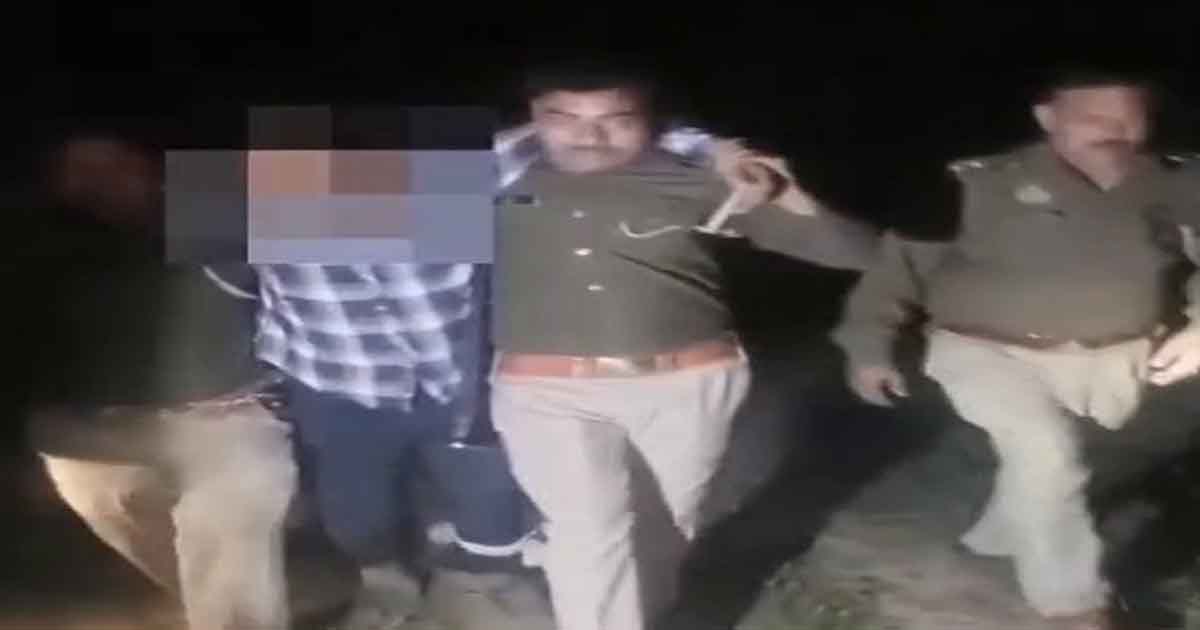
A man wanted in connection with a murder case was arrested following an altercation with police in Uttar Pradesh’s Firozabad district, officials said on Tuesday.
The accused, identified as Devendra, sustained a gunshot injury in his leg during retaliatory firing by the police in the Eka police station area. He was subsequently arrested and taken to a hospital for treatment.
Police also recovered an illegal country-made pistol and cartridges from his possession.
According to police, a man identified as Pradeep was allegedly beaten to death in a village under the Eka police station limits on the morning of November 15. The incident had triggered tension in the area.
Preliminary investigation revealed that Pradeep and Devendra were involved in a dispute over land. Police suspect that the dispute led to an altercation in which Devendra allegedly assaulted Pradeep, resulting in his death.
The accused had been absconding since the incident, and police teams had been conducting raids to trace him.
On Tuesday morning, police received information from an informer that Devendra, who was wanted in the murder case, was hiding near Nagla Dharu. Acting on the tip-off, a police team reached the location and cordoned off the area.
Police said that when the accused realised he had been surrounded, he opened fire at the police team. The personnel retaliated in self-defence, leading to an exchange of fire during which Devendra was hit in the leg.
He fell to the ground following the injury and was taken into custody by the police team.
The injured accused was shifted to a hospital under police custody for medical treatment. An illegal country-made pistol and cartridges were recovered from him, police said.
Officials said further legal proceedings were underway and other aspects of the murder case were also being investigated.

Punjab polls: BJP President Nitin Nabin to visit Jalandhar tomorrow

‘Jatayupara is pride of Keralam’, KC Venugopal recalls role in launching tourism project

Narco-trafficker escaped from Punjab jail arrested in J&K Reasi district

India airlines poised to order 1,000 more planes as air travel rises

Maha Cabinet revises textile policy, approves district and sessions court for Palghar

Congress trying to protect 3 crore Bangladeshi infiltrators in voter list: HM Shah

Red Fort car blast probe exposes blueprint for spread of terror modules across India

Tiger Shroff attack: Bihar family denies accused is their son

Trump flags Iran targets as talks continue

‘Should face same punishment as adults’: Abu Azmi demands lowering of age of juvenile offenders to 14
-

 Crime4 years ago
Class 10 student jumps to death in Jaipur
-

 Maharashtra2 years ago
Mumbai Local Train Update: Central Railway’s New Timetable Comes Into Effect; Check Full List Of Revised Timings & Stations
-

 Maharashtra2 years ago
Mumbai To Go Toll-Free Tonight! Maharashtra Govt Announces Complete Toll Waiver For Light Motor Vehicles At All 5 Entry Points Of City
-

 Maharashtra2 years ago
False photo of Imtiaz Jaleel’s rally, exposing the fooling conspiracy
-

 National News2 years ago
Ministry of Railways rolls out Special Drive 4.0 with focus on digitisation, cleanliness, inclusiveness and grievance redressal
-

 Maharashtra2 years ago
Maharashtra Elections 2024: Mumbai Metro & BEST Services Extended Till Midnight On Voting Day
-

 National News2 years ago
J&K: 4 Jawans Killed, 28 Injured After Bus Carrying BSF Personnel For Poll Duty Falls Into Gorge In Budgam; Terrifying Visuals Surface
-

 Crime2 years ago
Baba Siddique Murder: Mumbai Police Unable To Get Lawrence Bishnoi Custody Due To Home Ministry Order, Says Report