
Crime
Meth cartels and ISI: How Kerala became India’s narco transit point

New Delhi, Sep 30: There has been a marked rise in the number of drug-related incidents in Kerala in recent years. Security agencies say they had sensed a pattern setting in where the drug smuggling routes would be predominantly through the southern states.
However, the suspension of four prison officials in Kerala for trafficking narcotics to inmates clearly indicates that there is a rot within the system, which has ensured that the drug menace has become big in the state.
Nearly 95 per cent of the narcotics market is under the control of the Dawood Ibrahim syndicate. This is the same syndicate which is backed by the ISI that managed to compromise the state of Punjab. The drugs from Pakistan would enter Punjab in large numbers before it is circulated to the rest of the country. However, this route has become too obvious, and the security agencies have managed to curb this menace to some extent.
The D-syndicate realised that in order to expand, it would need to tap into the southern markets. This is when it decided to create modules in Sri Lanka.
The drugs from Pakistan would land in Sri Lanka before it is smuggled into India by sea. Officials say that one of the most preferred drugs in Kerala is methamphetamine or meth. There is also a huge demand for this drug in the rest of the country, and sensing the same, the syndicate decided to make Kerala a transit point.
Officials say that Kerala is a favoured destination owing to several factors, such as the long coastline and the proximity to international borders.
The operations are overseen by Haji Salim, who is a member of the D-Syndicate. He is in charge of all the operations in South India. Over the last couple of years, Salim has managed to build a deep-rooted network in South India through his operations in Kerala.
Central agencies have often complained that there is corruption within the system, due to which the monitoring is very low. This has made it easy for the drug smugglers to get the drugs into Kerala from Sri Lanka and then circulate them across the country.
Once the meth lands in Kerala, it is smuggled into the rest of the country through the land borders that the state has with Tamil Nadu and Karnataka.
In recent times, it has also been found that the Andhra Pradesh border is used to smuggle cannabis. Intelligence Bureau officials say that the drugs are mainly smuggled into the northeastern states from Kerala. However, in recent times, drugs that land in Kerala are also smuggled with the help of international cartels into Thailand and other foreign countries.
The drug smuggling into Thailand is at its highest as there is a very high demand for the same. The D-syndicate has roped in a large number of Nigerians to execute this trade. The Nigerians, who gained experience in this trade while operating in Goa, are now taking over the international operations for the D-Gang.
Officials dealing with the menace say that these cartels are not smuggling meth in small numbers. Their deals are audacious in nature, and the recent seizure of meth worth Rs 30,000 crore at the Andaman and Nicobar Islands is proof of the same. However, after this seizure, these cartels have changed their modus operandi. They are now bringing in drugs in smaller quantities, as this makes the possibility of detection low. Every tactic at their disposal is being used to avoid detection.
The ISI is very reliant on this trade after the Indian agencies have successfully put down the fake currency racket to a large extent. The funds that are generated through this trade are used to fund terror against India, and hence, this trade is of extreme importance to the Pakistani spy agency.

Crime
Ashok Kharat Sexual Exploitation Case: ED Searches 11 locations In Nashik, Shirdi & Pune Linked To Self-Styled Godman

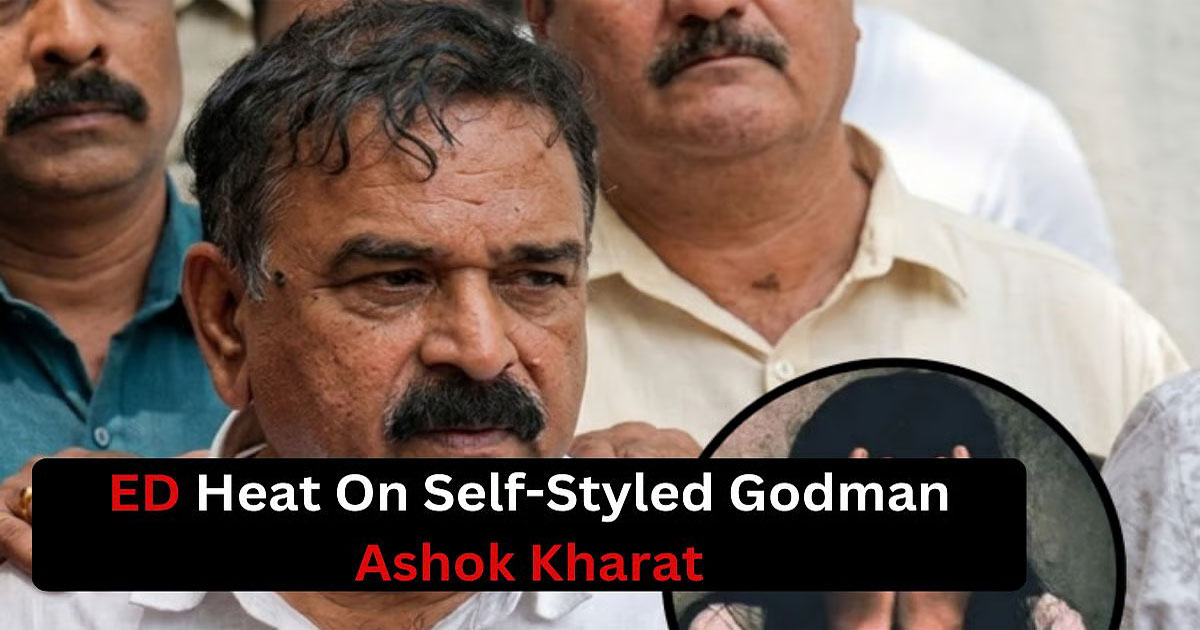
Mumbai: The Enforcement Directorate (ED) on Monday conducted searches at multiple locations in connection with the Ashok Kharat case.
Searches were carried out at five places in Nashik, three in Shirdi, and three in Pune. The searches are ongoing.
Meanwhile, a widening probe into the self-styled godman recently uncovered a massive alleged financial network involving more than 130 bank accounts and transactions exceeding RS 63 crore, with fresh findings pointing towards possible administrative complicity.
The probe gathered pace earlier this month after a Mumbai-based hotelier was alerted by Ahilyanagar Police that over Rs 2.43 crore had been routed through four bank accounts opened in his and his wife’s names, accounts he claims he never authorised. The hotelier suspects that documents submitted to Kharat for a ‘darshan booking’ were misused to open these accounts without his knowledge.
“We approached him believing he was a spiritual healer,” the hotelier said, according to an Indian Express report, adding that neither he nor his family had any connection with the credit society where the accounts were created.
Investigators believe the case is part of a larger, organised operation. According to complaints and bank records examined during the probe, personal documents collected from followers, visitors, and even alleged victims were systematically used to open multiple bank accounts. These accounts were then allegedly used to route and circulate funds between 2021 and 2024.
Authorities have identified a consistent pattern in the modus operandi. Individuals visiting Kharat for spiritual consultations or predictions were asked to submit Aadhaar cards, PAN cards, and photographs. These documents were then allegedly used to open bank accounts without consent, enabling large-scale financial transactions.
A large number of these accounts were reportedly opened under two cooperative credit societies, Jagdamba Cooperative Credit Society and Samata Nagari Sahakari Pat Sanstha, both linked to Kharat and his associates. Records show that Kharat served as chairman of the Jagdamba society until 2024, while the Samata society is associated with his co-accused Arvind Pandurang Bawke.
Investigators have traced over 100 suspect accounts to the Samata society and around 32 to Jagdamba. Further, Kharat has been listed as a nominee in at least 100 accounts, with his mobile number appearing across several of them, raising serious red flags.
The case, which initially began with allegations of sexual assault, cheating, extortion, and violations under anti-superstition laws, has now evolved into a major financial investigation. The Enforcement Directorate has also registered a money laundering case against Kharat.
Crime
Dongri Police Arrest Three For Knifepoint Robbery Of Waiter, Accused Threatened Victim And Took ₹8,000
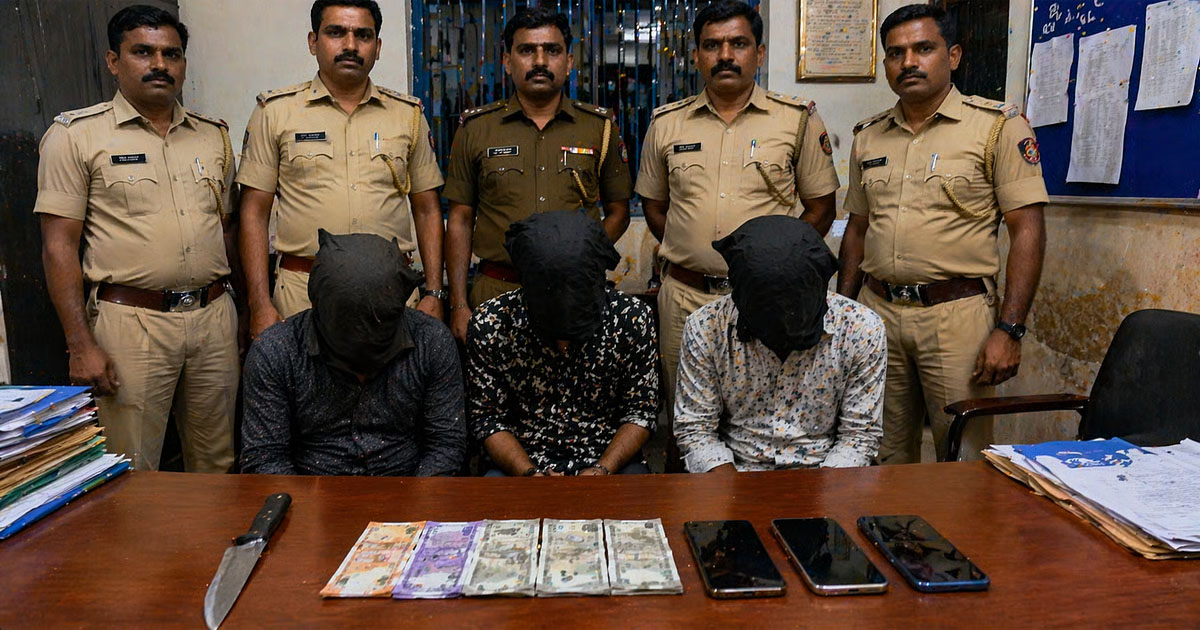
Mumbai: The Dongri Police Station has registered a robbery case after a 38-year-old waiter was allegedly threatened at knifepoint and robbed of ₹8,000 in the early hours of Friday. In this case, Dongri Police have arrested three accused, identified as as Ramzan Shakeel Shaikh (22), Ibrahim Shamshodh Ahmed Shaikh (20), Aman Rakesh Shaikh (18), and Tajuddin Yajuddin Shaikh (22).
The complainant, Saddam Siddique Shaikh, a resident of Nandlal Jani Marg near a beer godown in Wadi Bunder, Dongri, stated that the incident occurred around 3:00 am on April 10, 2026.
According to the complaint, while the victim was asleep at his residence, four accused knocked on his door and called him outside. Once he stepped out, the accused identified as Ramzan Shakeel Shaikh (22), Ibrahim Shamshodh Ahmed Shaikh (20), Aman Rakesh Shaikh (18), and Tajuddin Yajuddin Shaikh (22)—allegedly threatened him with a knife and forcibly took ₹8,000 from his pocket.
Based on the complaint,Dongri police registered an FIR under Sections 309(4) and 3(5) of the Bharatiya Nyaya Sanhita.
Police have arrested three accused Ramzan Shaikh, Aman Shaikh, and Tajuddin Shaikh while one accused, Ibrahim Shaikh, remains absconding.
The arrested accused have been remanded to police custody until April 13. The case is being investigated by PSI Gokul Shinde. Further investigation is underway.
Crime
24-Year-Old Man Attacked With Sharp Weapon At Simba Uproar 2026 In Bandra After Dance Floor Altercation, Case Registered

Mumbai: Three unidentified individuals allegedly attacked a 24-year-old youth with a sharp object during Simba Uproar 2026, a music concert held in Bandra East. The incident occurred on Saturday at around 9 pm. The attack reportedly took place following a minor altercation after someone was bumped into while dancing. The BKC police on Sunday registered a case against three unidentified individuals.
According to the police, the complainant, Aditya Mukhi, a resident of Sion West, works with a private company. On April 11, he and his friend, Divyang, attended Simba Uproar 2026, a music concert organised at the MMRDA grounds in BKC. They reached the venue at around 7.30 pm.
At around 9 pm, both were dancing along with other attendees when three to four individuals standing nearby were also dancing. During this time, one of the individuals bumped into Aditya. When Aditya objected and asked him not to push, the situation escalated.
Following this, the man began verbally abusing him. Soon after, one of his associates hit Aditya on the back of his head. Another person allegedly assaulted him with shoes, while a fourth individual attacked him with a sharp object, causing injuries to his left hand and stomach. The accused also allegedly threatened him with dire consequences.
Aditya’s friend immediately rushed him to Gurunanak Hospital in Kherwadi by ambulance. After receiving treatment, they approached the BKC police station and lodged a complaint.
The police have registered a case under Section 118 (voluntarily causing hurt or grievous hurt by dangerous weapons or means), along with other relevant provisions of the Bharatiya Nyaya Sanhita.

Maulana Khalid Ashraf and his sons attacked in Mumbai Dongri, 4 accused arrested, tension calmed down

Mumbai road accident: Death toll climbs to 11, CM Fadnavis expresses grief

Ashok Kharat Sexual Exploitation Case: ED Searches 11 locations In Nashik, Shirdi & Pune Linked To Self-Styled Godman

Nine killed as dumper truck rams into car in Mumbai’s Kalyan

Child killed, 12 students injured as school van overturns in Bihar Nawada

Dhurandhar 2 Box Office Collection Day 1: Ranveer Singh Starrer Takes An Exceptional Opening; Crosses ₹100 Crore Mark

Mumbai Police Busts Fake Apple Accessories Racket In Ghatkopar, ₹16.33 Lakh Goods Seized; Six Booked

Thane Horror: Man Slashed With Chopper In Naupada For Refusing ‘Vargani’, Caught On Camera

Mumbai: 28-Year-Old Ghatkopar Woman Killed By Speeding Tanker While Crossing Road, Driver Arrested

Dhurandhar 2 Box Office Collection Day 9: Ranveer Singh Starrer Earns ₹41.55 Crore On Its Second Friday; Enters ₹700 Crore Club
-

 Crime4 years ago
Class 10 student jumps to death in Jaipur
-

 Maharashtra2 years ago
Mumbai Local Train Update: Central Railway’s New Timetable Comes Into Effect; Check Full List Of Revised Timings & Stations
-

 Maharashtra1 year ago
Mumbai To Go Toll-Free Tonight! Maharashtra Govt Announces Complete Toll Waiver For Light Motor Vehicles At All 5 Entry Points Of City
-

 Maharashtra2 years ago
False photo of Imtiaz Jaleel’s rally, exposing the fooling conspiracy
-

 National News2 years ago
Ministry of Railways rolls out Special Drive 4.0 with focus on digitisation, cleanliness, inclusiveness and grievance redressal
-

 Maharashtra1 year ago
Maharashtra Elections 2024: Mumbai Metro & BEST Services Extended Till Midnight On Voting Day
-

 National News2 years ago
J&K: 4 Jawans Killed, 28 Injured After Bus Carrying BSF Personnel For Poll Duty Falls Into Gorge In Budgam; Terrifying Visuals Surface
-

 Crime1 year ago
Baba Siddique Murder: Mumbai Police Unable To Get Lawrence Bishnoi Custody Due To Home Ministry Order, Says Report