
Business
Level-playing field between private, public 5G networks absurd: BIF


Amid calls to ensure a level-playing field between public and private 5G networks, Broadband India Forum (BIF) on Tuesday said that such demands are ‘absurd and impractical’ as the two 5G networks are entirely different set of services for two entirely different requirements.
Nowhere in over 55 countries where private 5G networks are deployed have similar regulations been issued, said the think tank, as the two networks are on completely different footings and are not competing with each other.
“Seeking a level-playing field with enterprises for captive private networks is akin to a child in kindergarten being asked to compete with someone who has a doctoral degree. No mature regulator anywhere in the world imposes regulation on a player with no or minimal market share,a said BIF President TV Ramachandran.
Enterprises will not be in the business of selling services or earning revenues through private 5G networks, but only use it for self-consumption.
“The credibility and rationale of such claims are questionable and require introspection,” he said in a statement.
Private 5G networks are about the deployment of high speed, enhanced data capacity, and ultra-low latency applications inside a closed manufacturing unit, hospital, airport, shipping port, among others.
Private 5G networks are single end-user (the enterprise itself) in the given location, unlike a vast number of users in public networks.
In the case of private networks, the quantum of spectrum required is very small (going up to about 100 MHz) unlike the huge amounts of spectrum (almost 72000 MHz) used by public networks.
“While public networks are configured for ‘best effort’ service-level agreements (SLAs) to deliver average performance for external voice and data connectivity, private 5G Networks are meant to serve extremely high reliability and ultra-high SLAs with extremely low latency applications and ultra-high data rates,: the forum argued.
The telcos can operate their networks in full power, whereas private networks have to restrict power to a regulated level just like Wi-Fi networks, to prevent signals spilling out of their premises.
Hence, the same spectrum can be re-used many times across multiple different locations, unlike the case of public 5G networks.
“Private networks are not in the business of selling telecom services and earning revenues from it, but would be using the same purely for self-consumption,” said the forum.
The spectrum that is earmarked for private networks needs to be exclusive and distinct from those bands for Public 5G, to avoid needless possibilities of interference between the two networks.
“Seeking a level playing field with enterprises for captive private networks is akin to a child in kindergarten being asked to compete with someone who has a doctoral degree,” said Ramachandran.
The Union Cabinet last week approved the telecom department’s proposal to conduct 5G spectrum by the end of next month.
The Notice Inviting Applications (NIA) for the spectrum auction permits all the four methods of allocating spectrum for Private 5G Networks as recommended by the Telecom Authority of India (TRAI), including the option of enterprises obtaining spectrum directly from the Department of Telecommunication (DoT).
This provides enterprises the much-required right to develop their private 5G networks based on the specialised requirements for their distinctive captive use.
Leading industry bodies have hailed the TRAI recommendations of around 35-40 per cent cut in the reserve price for 5G spectrum for mobile services, terming it historic and which can finally put India on the world 5G map.
The telecom regulator has put forward a mega auction plan valued at over Rs 7.5 trillion at the base price allocated over 30 years.

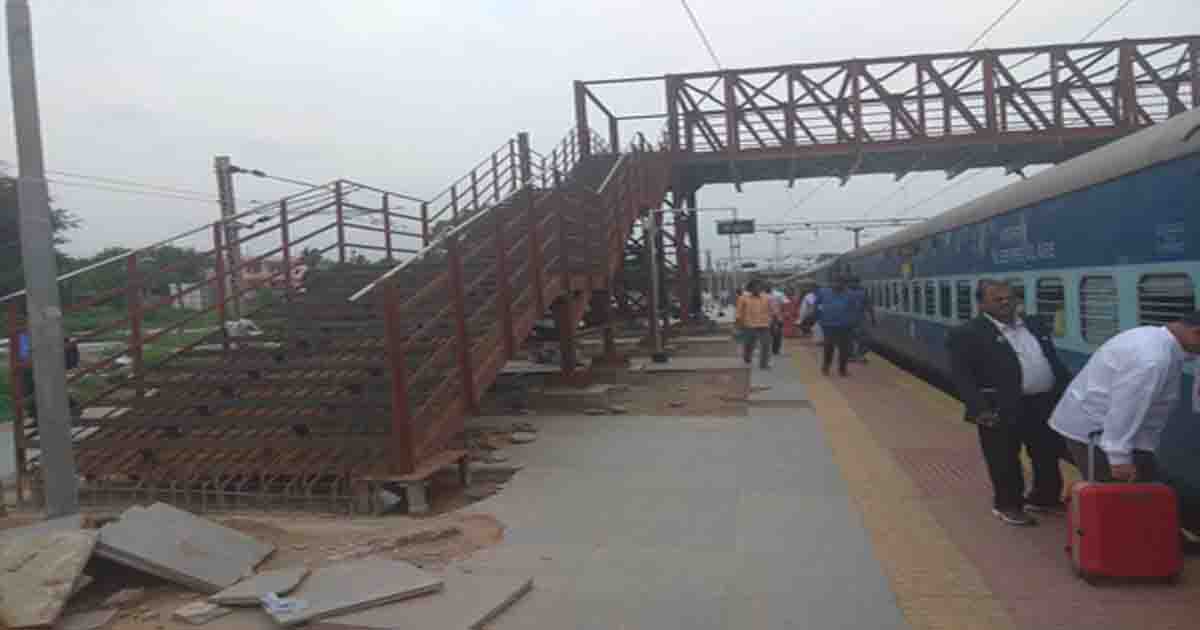
New Delhi, Oct 11: Indian Railways has announced 3,548 graduate-level vacancies for jobs under the Non-Technical Popular Categories (NTPC–Graduate), which provide opportunities for graduates to work across different functional areas of railway operations and administration, according to an official statement issued on Sunday.
The recruitment through Centralised Employment Notification issued by the Railway Recruitment Boards (RRBs) covers four categories of posts, including Chief Commercial Cum Ticket Supervisor, Goods Train Manager, Junior Accounts Assistant Cum Typist, and Senior Clerk Cum Typist. These positions offer career opportunities across commercial services, train operations, accounts and administration, supporting the efficient functioning of railway services across the country, the statement said.
Of the total 3,548 vacancies, as many as 2,750 are for Goods Train Manager, followed by 371 for Senior Clerk Cum Typist, 300 for Junior Accounts Assistant Cum Typist, and 127 for Chief Commercial Cum Ticket Supervisor.
The posts offer initial basic pay under the Seventh Central Pay Commission. Chief Commercial Cum Ticket Supervisor carries an initial basic pay of Rs 35,400 per month at Pay Level 6, while the other three categories carry an initial basic pay of Rs 29,200 per month at Pay Level 5. Applicable allowances and service conditions will be governed by the relevant rules.
The online application process commenced on October 8, and eligible candidates can submit their applications until 11:59 p.m. on November 6. The last date for payment of the examination fee is November 8, while the application modification window is scheduled from November 9 to 18 November.
Candidates must possess a degree from a recognised university or its equivalent and fulfil the prescribed post-specific eligibility conditions. The notified age limit is 18-33 years as on January 1, 2027, with applicable age relaxations for eligible categories under the prescribed rules.
The selection process comprises a first-stage Computer-Based Test (CBT), a second-stage CBT, followed by document verification and medical examination, as applicable. The recruitment framework also provides applicable reservation and age-relaxation benefits, along with scribe assistance and compensatory time for eligible candidates with disabilities, in accordance with the prescribed provisions.
Another provision under CEN No. 06/2026 is the dispensation of the Computer-Based Typing Skill Test (CBTST) for the posts of Junior Accounts Assistant Cum Typist and Senior Clerk Cum Typist. Candidates are nevertheless expected to possess basic computer and typing proficiency, which will be assessed after joining, as specified in the notification, the statement said.
Candidates can access the detailed notification, vacancy distribution, eligibility criteria and recruitment updates through the official Railway Recruitment Boards website:https://rrb.indianrailways.gov.in
Business
BMC to crack down on illegal debris disposal, impose Rs 25,000 fine for tracking violations

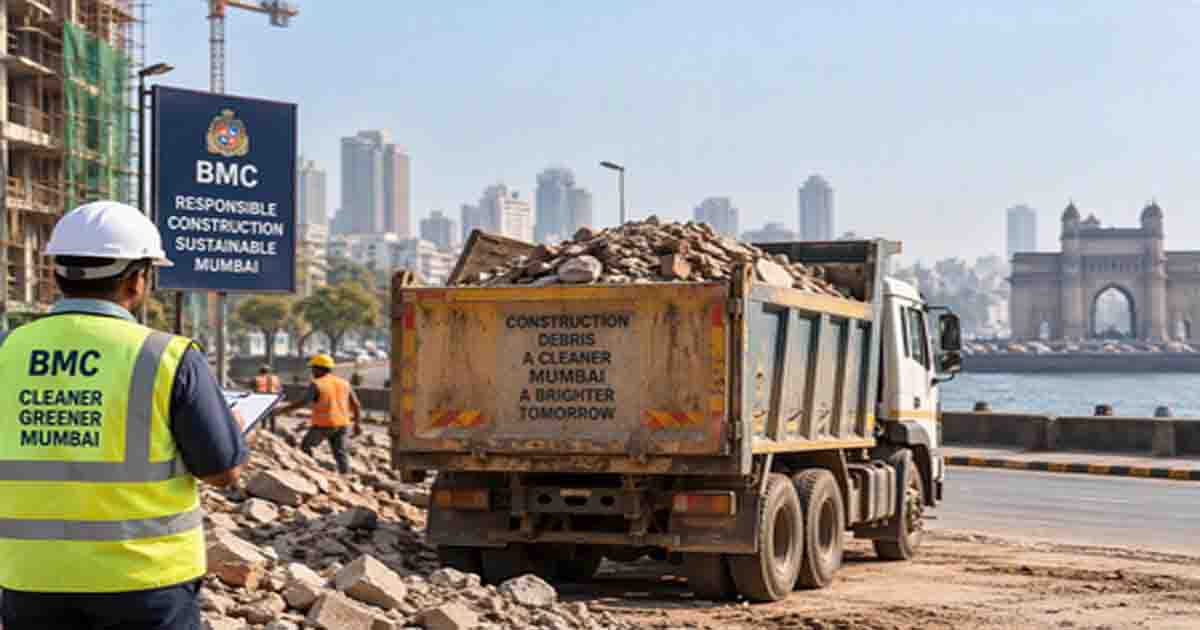
Mumbai, Oct 11: As air quality concerns begin to resurface following the withdrawal of the monsoon, the Brihanmumbai Municipal Corporation (BMC) is reportedly set to tighten enforcement of construction and demolition (C&D) waste management rules across the city.
Starting Monday, the civic body will levy a penalty of Rs 25,000 on every vehicle found transporting construction debris or excavation material without an active and authorised Vehicle Tracking and Monitoring System (VTMS).
Construction sites that fail to register on the BMC’s Mumbai Debris Control and Tracking System (MDCTS) portal will also face a fine of Rs 25,000 for each violation.
The move comes amid growing concerns over illegal dumping of construction waste and its impact on Mumbai’s environment and air quality. In a circular issued to all 26 municipal wards, the BMC has directed officials to begin inspections and enforcement drives immediately.
Mumbai generates more than 8,000 tonnes of construction and demolition waste every day, significantly exceeding the city’s treatment capacity.
The two processing facilities at Dahisar and Shilphata can collectively handle only around 1,200 tonnes of debris daily, creating a large gap that has led to rampant illegal dumping.
Civic officials said debris is frequently discarded along roadsides, vacant plots, drains, creeks, water bodies and mangrove areas, as per the report.
To improve monitoring and accountability, the BMC launched the MDCTS portal on August 24. The digital platform is designed to track C&D waste from its point of generation to authorised disposal or processing facilities.
It also allows civic authorities to monitor debris-carrying vehicles in real time, detect route deviations and identify suspected cases of illegal dumping.
The civic body has made registration on the portal mandatory for contractors, government agencies and private developers undertaking construction activities.
Registered entities are required to submit detailed waste management plans, while vehicles transporting debris must be fitted with GPS-enabled VTMS devices and follow approved transportation routes.
According to BMC data, the MDCTS portal recorded 220 registrations between August 24 and October 9. These included 109 builders and developers, 44 transporters, 19 BMC contractors, 17 external buyers of debris and soil, 15 corporate entities and four government agencies. No registrations were received from individual citizens during the period.

New Delhi, Oct 11: Crude oil prices above $100 a barrel, key inflation data in India and the US, movements in the rupee, global bond yields and a pickup in corporate earnings are likely to determine the trajectory of Indian equities in the coming week, as investors assess whether the recent rebound can sustain after eight consecutive weeks of losses.
Domestic benchmark indices staged a sharp recovery on Friday, with buying across information technology (IT), fast-moving consumer goods (FMCG), automobile and financial stocks lifting market sentiment. The Nifty rose 288.65 points, or 1.30 per cent, to close at 22,520.45, while the Sensex advanced 879.09 points, or 1.23 per cent, to settle at 72,472.33.
The gains helped both benchmark indices break their eight-week losing streak. However, persistent foreign investor outflows, elevated crude oil prices, a weakening rupee and concerns over tighter monetary policy continue to pose challenges for the market.
With important macroeconomic indicators due in India and the US, alongside a busy corporate earnings calendar, investors will closely track developments across domestic and global markets to gauge the sustainability of the recovery.
One of the biggest factors likely to influence Dalal Street will be crude oil prices. Brent crude is trading above the $100-per-barrel mark, while West Texas Intermediate (WTI) remains above $90. Uncertainty surrounding Iran, the Strait of Hormuz and regional energy infrastructure has heightened concerns over possible supply disruptions.
Inflation data and movements in US bond yields will also be closely watched. In the US, the September Consumer Price Index (CPI) report, scheduled for release on Wednesday, will provide fresh insight into price pressures and help investors assess the Federal Reserve’s next policy move. US retail sales data will also be in focus, as stronger-than-expected readings could keep Treasury yields and the dollar elevated, potentially weighing on emerging-market equities.
In India, September CPI and wholesale price index (WPI) inflation figures will offer important clues about domestic price trends and their implications for monetary policy. Any indication of persistent inflation could influence expectations around interest rates and investor sentiment, while movements in the rupee will remain an important indicator of pressure from elevated oil prices and foreign capital outflows.
Corporate earnings will be another key driver as the results season gathers pace. Investors will assess companies’ revenue growth, profit margins, management commentary and demand outlook to determine whether earnings can support market valuations amid a challenging economic environment. Results from Indian companies, alongside major corporate announcements in the US, could influence sector-specific movements and broader market direction.
Global monetary policy expectations and bond-market movements will remain important throughout the week.

UP govt to raise monthly honorarium of 60,000 village watchmen by Rs 1,000

Two killed as motorcycle collides head on with SUV in MP’s Maihar

Regime change certain in 2027: Akhilesh lashes out at BJP, Election Commission

Newlywed poisons husband, 3 family members in Maharashtra Jalgaon

Nana Patekar death: Final post-mortem report out, rules out foul play

Gift to President Putin part of PM Modi bid to globally display India’s heritage

PM Modi’s warm camaraderie with Putin, Xi on full display at BRICS Summit

INDIA bloc begins protest march against ECI

Complaint against Netflix & Mukesh Chhabra for inappropriate language on ‘India’s Got Latent 2’

Maha Congress stages agitation against Gyanesh Kumar
-

 Crime4 years ago
Class 10 student jumps to death in Jaipur
-

 Maharashtra2 years ago
Mumbai Local Train Update: Central Railway’s New Timetable Comes Into Effect; Check Full List Of Revised Timings & Stations
-

 Maharashtra2 years ago
Mumbai To Go Toll-Free Tonight! Maharashtra Govt Announces Complete Toll Waiver For Light Motor Vehicles At All 5 Entry Points Of City
-

 Maharashtra2 years ago
False photo of Imtiaz Jaleel’s rally, exposing the fooling conspiracy
-

 National News2 years ago
Ministry of Railways rolls out Special Drive 4.0 with focus on digitisation, cleanliness, inclusiveness and grievance redressal
-

 Maharashtra2 years ago
Maharashtra Elections 2024: Mumbai Metro & BEST Services Extended Till Midnight On Voting Day
-

 National News2 years ago
J&K: 4 Jawans Killed, 28 Injured After Bus Carrying BSF Personnel For Poll Duty Falls Into Gorge In Budgam; Terrifying Visuals Surface
-

 Crime2 years ago
Baba Siddique Murder: Mumbai Police Unable To Get Lawrence Bishnoi Custody Due To Home Ministry Order, Says Report