
International News
Lavrov bats for actively developing Russia-India-China trilateral mechanism

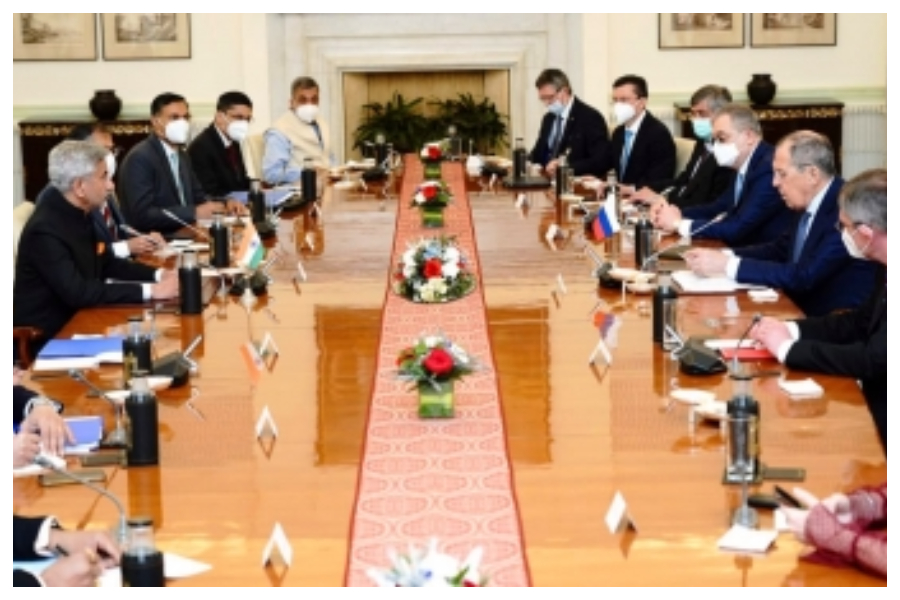
Russian Foreign Minister Sergey Lavrov said that he discussed with External Affairs Minister S. Jaishankar about actively developing the Russia-India-China trilateral mechanism in the interests of stabilising international relations and ensuring “equity in international affairs”.
“This is especially true given that all the three countries – Russia, India and China – are now members of the UN Security Council. So we have a lot of plans,” he said while responding to a query here on Friday over Moscow looking at Beijing and New Delhi to make up for a likely dip in its energy exports.
“We are close partners with both countries. The three of us participate in a number of international formats… There is our ‘troika’ – RIC (Russia, India, China),” he said while talking about Moscow proposing an RIC summit earlier this year.
Lavrov left for Moscow on Friday after his two-day visit to India.
In Delhi, he called upon Prime Minister Narendra Modi and held discussions with Jaishankar over the ongoing crisis in Ukraine, crude offer and arms deal.
Lavrov briefed the Prime Minister on the situation in Ukraine, including the ongoing peace negotiations.
Modi reiterated his call for an early cessation of violence, and conveyed India’s readiness to contribute in any way to the peace efforts.


Kathmandu, Oct 15: Nepal and the International Bank for Reconstruction and Development (IBRD), part of the World Bank Group, have signed a mandate agreement to explore the development of a catastrophe bond that could help the Himalayan nation secure rapid access to funds in the event of a major natural disaster.
The agreement marks the beginning of a collaboration to assess the feasibility and potential structure of a catastrophe bond, under which Nepal could transfer part of its disaster risk to international capital markets and strengthen its financial preparedness for natural disasters, the World Bank said in a statement.
Under the agreement, the World Bank Group Treasury will work with the Nepal government and market participants to evaluate the proposed transaction.
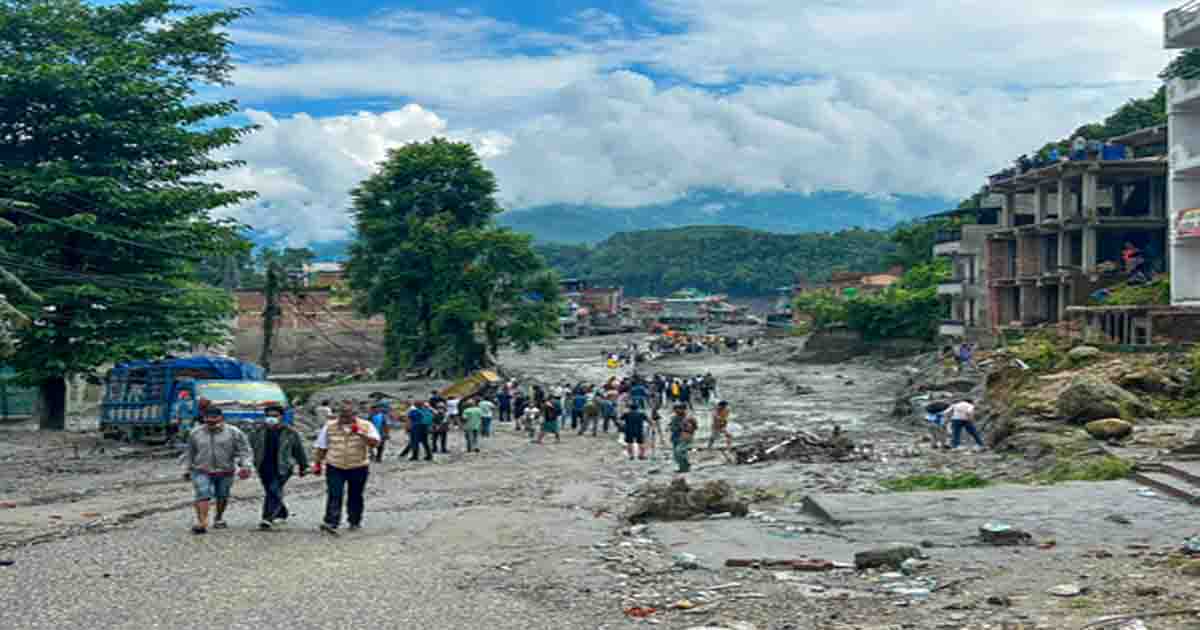
The initiative comes as Nepal seeks to strengthen its capacity to prepare for, withstand and recover from natural disasters in the wake of devastating floods in the Bhotekoshi and downstream Trishuli river basins on August 26. The floods have killed nearly 1,500 people, while more than 5,000 remain unaccounted for, according to the National Disaster Risk Reduction and Management Authority.
Triggered by an avalanche near the Nepal-China border that blocked the river’s flow, the floods swept away several human settlements, a dozen hydropower projects, a solar plant, and several roads and bridges. Physical damage is estimated at 1.66 billion US dollars, according to the World Bank’s Global Rapid Post-Disaster Damage Estimation report.
According to the World Bank, Nepal is highly vulnerable to earthquakes, floods, landslides and other climate-related hazards, which can cause extensive damage to infrastructure, disrupt economic activities and place considerable pressure on public finances.
A catastrophe bond is a financial instrument that allows governments or other entities to transfer specific disaster risks to investors. Depending on the terms of the bond, investors may lose some or all of their principal if a specified disaster occurs, allowing the funds to be used to support the affected entity.
“Such instruments can provide an alternative source of disaster financing, potentially enabling governments to access funds more quickly than relying solely on budget reallocations or post-disaster assistance,” the World Bank said.
The initiative is part of the World Bank Group’s established catastrophe bond programme, which has helped countries access international capital markets to transfer disaster risks and secure financial protection against natural hazards.
The World Bank helps countries increase their financial resilience to disasters by supporting disaster risk financing programmes and offering contingent financing and insurance solutions.
It also assists countries in designing, developing and implementing comprehensive disaster risk financing strategies.
“A risk financing strategy helps clients determine a balance between retaining risk, for example, through a contingent financing product, and transferring risk, for example, through an insurance product,” the World Bank said.
A range of financial products can be used to address the financial risks of disasters, and the optimal mix of approaches depends on the types of risks faced by a country and the frequency and severity of disaster events, it said.
Developing countries are particularly vulnerable to the economic and fiscal consequences of disasters because of factors such as gaps in insurance coverage, inadequate infrastructure resilience, and the concentration of populations and economic activities in exposed areas.
“Following a major disaster, governments often have to redirect budgetary resources towards emergency response, relief and reconstruction, potentially affecting other development priorities,” the World Bank said.

Islamabad, Oct 15: At least 31 children and two female teachers were killed and over 50 others injured after the roof of a private school collapsed in Pakistan’s Peshawar, local media reported, citing local Lady Reading Hospital (LRH).
According to LRH, 53 children were taken to the hospital, majority of them boys. Among those, 33 died while 17 were discharged from the hospital after observation. All the children were aged 14 years or below, Pakistani daily The Express Tribune reported.
LRH spokesperson Muhammad Asim said that an emergency was declared at LRH and senior hospital officials were present in the trauma ward to oversee the treatment of the injured people, including some in critical condition.
Speaking to reporters, Capital City Police Officer (CCPO) Mian Saeed said that the owner of the school has been taken into custody and a case will be lodged over the incident, The Express Tribune reported.
Saeed said the roof of the school had been poorly constructed and the building was located in narrow streets, which created difficulties for rescue operations. He said that 110 children were enrolled in the school.
Pakistan army personnel reached at the site of the incident and joined rescue and relief agencies in conducting operations to find children and staff feared trapped under the debris.
Reports suggest that roof and building collapses are a recurring problem in Pakistan, where weak safety enforcement and substandard construction materials have repeatedly contributed to such tragedies.
In August, a couple was killed, and their daughters injured after the roof of their house collapsed in Islamabad following three days of heavy rainfall, Dawn had reported.
In July, at least 11 people were killed and six others injured after a three-storey building collapsed in Harbanspura town of Pakistan’s Lahore.
According to the spokesperson, three brothers lived in the building with their families while their sister and her children were there for birthday celebrations, just before the building collapsed. Lahore DC retired Captain Muhammad Ali Ijaz had ordered an investigation to determine the cause of the incident.
In June, as many as 14 children were killed after the roof of a private tuition centre in the Kahna area of Pakistan’s Lahore, Dawn reported.
The incident took place less than two months after four children were killed and 20 people were injured after the roof of a classroom at a private school collapsed in Dera Ghazi Khan city of Pakistan’s Punjab.

Berlin, Oct 15: As many as three Indian nationals have been killed in a fire incident in Bochum in Germany North Rhine-Westphalia, the Indian Embassy in Germany said on Thursday.
The Indian Embassy said that all three Indian nationals were studying in Germany.
The Embassy said it is in contact with local authorities and the victims’ families and is providing all necessary assistance.
German authorities have launched a probe into the incident.
“Three Indian nationals (two women and one man) have tragically lost their lives in a fire incident in Bochum, North Rhine-Westphalia, Germany. All 3 were studying in Germany. Embassy of India in Berlin and Consulate General of India in Frankfurt are in contact with local authorities and the bereaved families, and are extending all necessary assistance,” the Indian Embassy in Germany posted on X.
“The incident is under investigation by German authorities. We extend our deepest condolences to the bereaved families in this hour of grief,” it added.
According to local media reports, police have identified the deceased as three Indian nationals — two women aged 25 years and 27 years and a 26-year-old man.
The fire erupted in the house in Bochum on Tuesday morning (local time). Emergency responders found the three bodies on the second floor of the building, Germany-based WDR reported.
The operation was difficult as the flames had spread upwards through the stairwell, preventing firefighters from using the stairs to reach the upper floors.
A 41-year-old resident of the house in Bochum is under initial suspicion of murder, WDR reported, citing a Bochum police spokesperson.
The man has been arrested and has already been questioned by officers from the homicide squad.
Fire investigators have examined the house and ruled out the possibility of a technical defect as the cause of the fire and are probing the possibility of arson, as per the report.
The police are investigating whether it was a deliberate act or an accidental fire.

Building collapses in Varanasi due to firecracker explosion, two rescued

Take child sexual abuse material circulation on social media seriously, SC tells Centre

Kerala: 5,991 road accident deaths occurred on national highways in three years

SC refers Rajpal Yadav cheque bounce cases to mediation for amicable settlement

NEET-PG 2026: SC issues notice on plea seeking candidate-wise disclosure of questions, options, and answers

Rahul, Cong ecosystem want to force regime change: BJP after Neha Bora praises B’desh Gen-Z protest

Mumbai Cyber Cell arrests 6 members of organized gang in major operation; Beware of cyber fraudsters; Digital arrest has no legal status; DCP Bajrang Bansode

INDIA bloc begins protest march against ECI

Maha Congress stages agitation against Gyanesh Kumar

Complaint against Netflix & Mukesh Chhabra for inappropriate language on ‘India’s Got Latent 2’
-

 Crime4 years ago
Class 10 student jumps to death in Jaipur
-

 Maharashtra2 years ago
Mumbai Local Train Update: Central Railway’s New Timetable Comes Into Effect; Check Full List Of Revised Timings & Stations
-

 Maharashtra2 years ago
Mumbai To Go Toll-Free Tonight! Maharashtra Govt Announces Complete Toll Waiver For Light Motor Vehicles At All 5 Entry Points Of City
-

 Maharashtra2 years ago
False photo of Imtiaz Jaleel’s rally, exposing the fooling conspiracy
-

 National News2 years ago
Ministry of Railways rolls out Special Drive 4.0 with focus on digitisation, cleanliness, inclusiveness and grievance redressal
-

 Maharashtra2 years ago
Maharashtra Elections 2024: Mumbai Metro & BEST Services Extended Till Midnight On Voting Day
-

 National News2 years ago
J&K: 4 Jawans Killed, 28 Injured After Bus Carrying BSF Personnel For Poll Duty Falls Into Gorge In Budgam; Terrifying Visuals Surface
-

 Crime2 years ago
Baba Siddique Murder: Mumbai Police Unable To Get Lawrence Bishnoi Custody Due To Home Ministry Order, Says Report