
National News
Karnataka HC dismisses plea seeking permission to wear hijab in classrooms

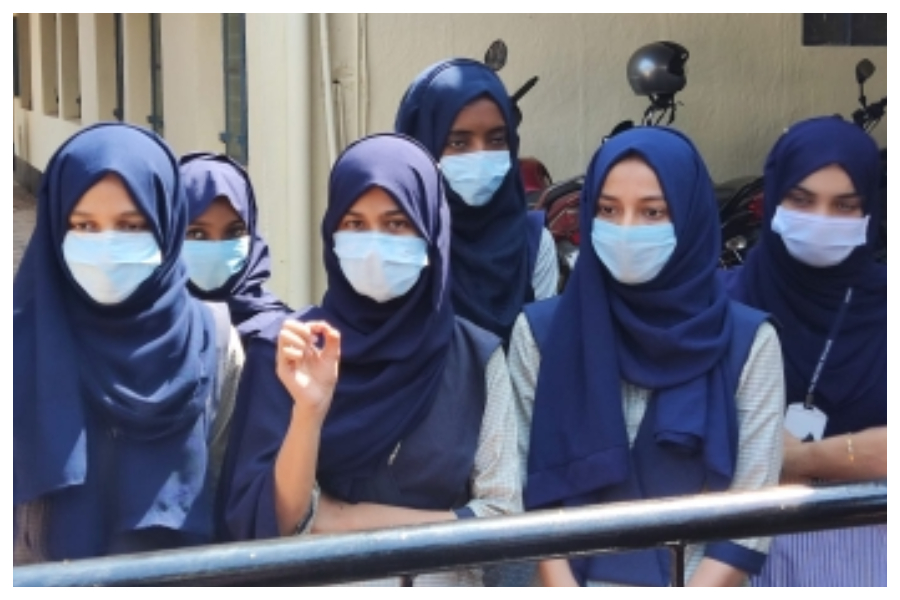
The Karnataka High Court’s special bench on Tuesday dismissed petitions filed by students seeking direction for permission to wear hijab in classrooms.
The court said, “Wearing of hijab was not an essential part of Islam.”
“The prescription of uniform is constitutional and students can’t object to it.”
The court dismissed all the petitions filed by the students. The bench stated that no case was made out by the petitioners.
Further details of the judgement were awaited.
Earlier, as a precautionary measure, security was beefed up across the state. Holiday was declared in the districts of Dakshina Kannada, Kalaburagi and Shivamogga for the schools and colleges.
Most of the districts imposed prohibitory orders in the surrounding areas of the educational institutions. Bengaluru Police Commissioner Kamal Pant issued prohibitory orders restricting protests, celebrations and gatherings in the entire city for seven days from Monday.
The hijab row, which started as a protest by six students of the Udupi Pre-University Girl’s College in January, turned into a big crisis and was also discussed at the international levels.
The bench headed by the Chief Justice Ritu Raj Awasthi, Justice Krishna S. Dixit and Justice Jaiunnesa Mohiyuddin Khaji heard the matter on a daily basis.
The counsels appearing for the petitioners contended that restrictions on hijab to classrooms is a violation of fundamental and religious rights. There is no legal standing for the School Development Committee (SDC) or College Development Committee (CDMC), they said.
They also argued that wearing of hijab is an integral part of Islam. However, the Advocate General and other counsels appearing for the government argued that wearing of hijab is not an essential part of Islam. They have also stated that the government respects the wearing of hijab and it had been left to the discretion of SDMC and SDC’s.
It was also brought to the notice of the court that many Islamic and European countries have banned hijab.


National News
‘Mobocracy got a reply from democracy’, says BJP amid party’s resounding victory in bypolls

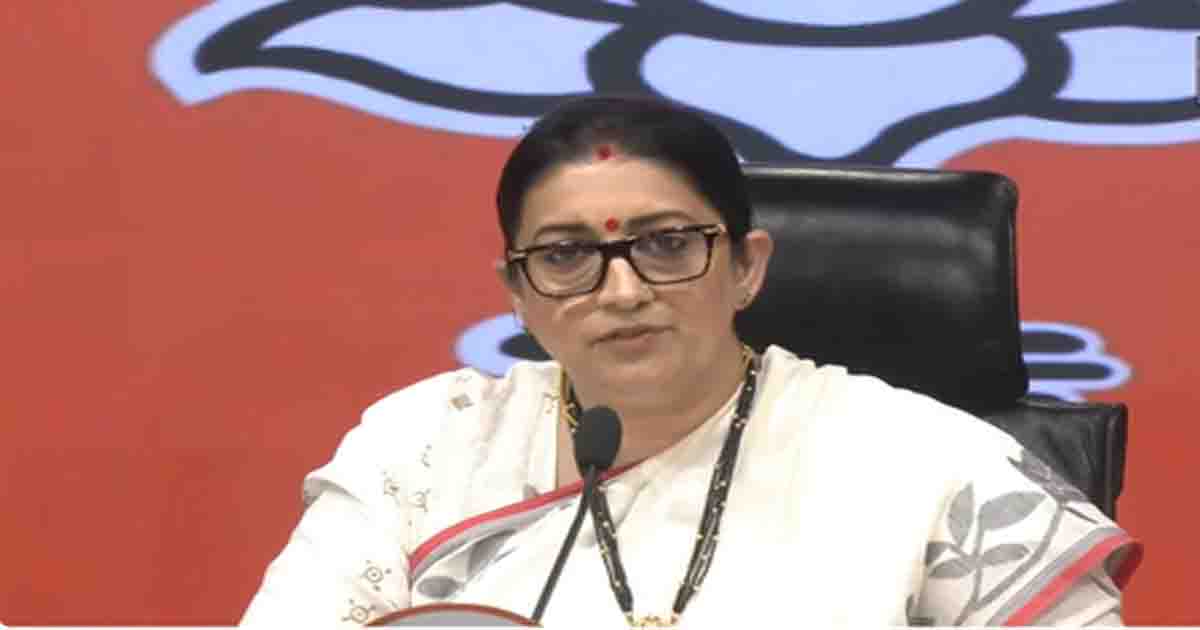
New Delhi, Oct 9: The overwhelming positive results for the Bharatiya Janata Party (BJP) in the recently held bye-elections in Assam, West Bengal and Puducherry shows that ‘mobocracy’ has got a fitting reply from India’s robust democracy, BJP National spokesperson Smriti Irani said on Friday.
Addressing the media, after party’s landslide victory in West Bengal’s Nandigram, Smriti Irani took a jibe at Congress party’s ‘street politics’ and denounced its call to ‘hurt’ the Indian state, on pretext of fighting off the ‘tyrannical’ BJP.
“On January 15, 2025, the former Congress President (Rahul Gandhi) had said with open heart that he was fighting battle not against the BJP but against the Indian State, signalling that the constitutional and democratic institutions will come under attack from them,” the BJP leader said.
She added that never in the history of India, has any elected leader chosen or dared to inflict harm upon the country’s constitutional fabric.
Welcoming the resounding mandate across multiple states, Smriti Irani said, “Today, democracy has given a reply to mobocracy. In Uttar Pradesh, the election of BJP candidates to the Rajya Sabha is a matter of great joy for us. In Puducherry, we heartily welcome the victory of NDA candidate. From West Bengal, we are receiving overwhelming joyous news in Nandigram and Rejinagar,” Smriti Irani said.
“Nandigram was the bastion of Left-wing ideology, violence against the public. Today, the mandate for BJP shows victory for good governance. In Rejinagar, where nearly 71 per cent of voters belong to the minority community, the BJP is moving towards victory,” she added.
The BJP spokesperson also called out Congress MP Rahul Gandhi’s recent appeal for “Smashing the Patriarchy”, highlighting how the “hollow claims” got exposed very soon.
Citing the example of Congress MP, also noted professor of a reputed university in the national capital, Smriti Irani said that the women students had lodged complaint against him accusing him of sexually harassing them in return for marks.
“Former Congress President who brags about smashing the patriarchy never acted against him, leave aside taking cognisance of the offence,” she added.
“The same professor has now been found guilty of harassing female students in the university’s inquiry report. I ask the Congress leadership why it didn’t initiate any political action against the indicted professor,” Smriti Irani asked.
Without taking name, she also targeted Rahul Gandhi’s alleged misbehaviour with woman policeman during the recent Jantar Mantar protest and demanded that he walks the talk on what he preaches.

Sonipat, Oct 9: Union Minister and Lok Janshakti Party-Ram Vilas (LJP-RV) Chief Chirag Paswan on Friday asserted that no amount of cancellations of trains or halting of connectivity will be able to stop the youth of the country.
He made the remarks after Indian Railways cancelled and rescheduled several trains which were to arrive at New Delhi and Hazrat Nizamuddin railway stations on October 10, in view of anticipated severe road traffic congestion around the stations amid the proposed Cockroach Janata Party (CJP) protest in the national capital.
Speaking to reporters after addressing the seventh Convocation ceremony of the National Institute of Food Technology Entrepreneurship and Management (NIFTEM) in Kundli, Chirag Paswan said: “These are the youth of India; no one can stop them.”
“Those who try to spread such misconceptions…how many trains can anyone stop? How much connectivity can anyone halt? How many roads can anyone block? These are the youth of India; they possess the capability to show the world the way forward, and generations before them have done so as well. So, in such a situation, no one can stop them,” the Union Minister added.
Train services scheduled to arrive at New Delhi and Hazrat Nizamuddin railway stations between 4 a.m. and 2 p.m. on Saturday will be affected by the cancellations.
Meanwhile, the national capital has been turned into a fortress for the planned demonstration with more than 23,000 security personnel expected to be on duty.
Earlier, the Delhi Police said that permission for the CJP’s protest has been denied due to the organisers’ failure to comply with legal directions and their own undertakings during an earlier protest and sought the closure of 57 metro stations.
Following the Delhi Police’s proposal, the Delhi Metro Rail Corporation (DMRC) announced earlier on Friday that the entry and exit of 57 metro stations will be closed from 9 p.m. on Friday till further orders, in view of the agitation.
However, the Supreme Court ordered that there should be no complete stoppage of Metro train services ahead of the proposed protest in the national capital on Saturday, and directed the Centre to ensure that Metro and other railway services are allowed to operate in a suitably regulated manner to minimise inconvenience to the public.
National News
As bypoll results largely favour ruling parties, BJP pulls a surprise in Bengal Rejinagar
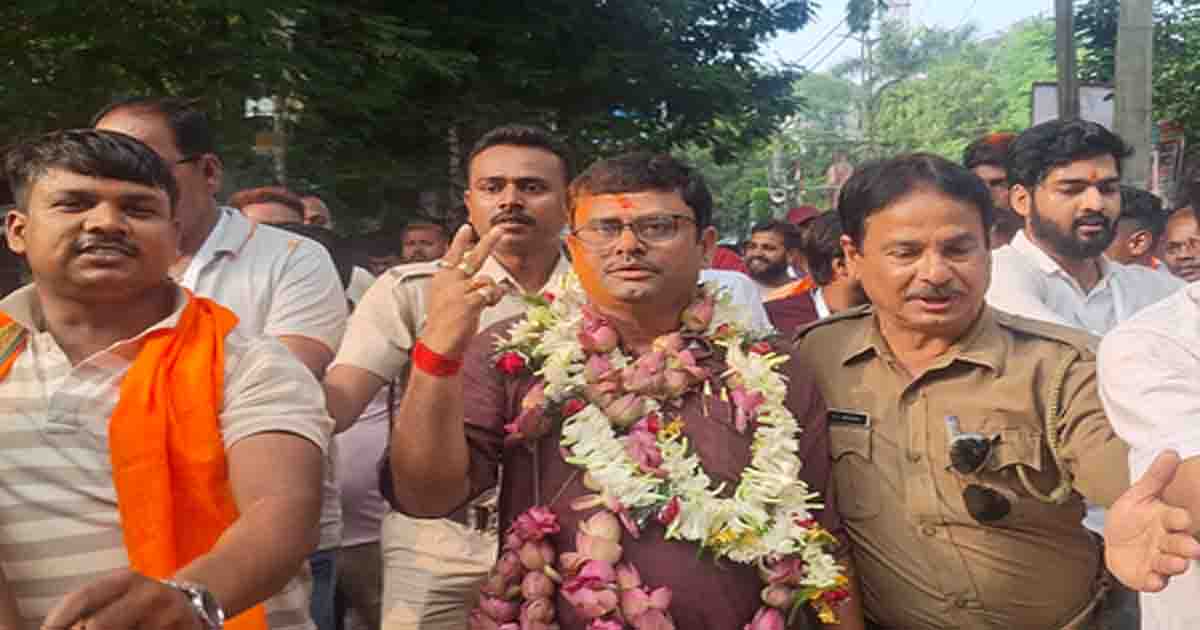
New Delhi, Oct 9: Ruling parties in three states and one Union Territory that went for by-elections are poised comfortably to win as counting comes close to an end on Friday for five Assembly and one Lok Sabha constituencies.
Elections were held on Tuesday for the lone Parliamentary constituency of Nagaon in Assam, while voting took place the same day for the Assembly seats in West Bengal’s Nandigram and Rejinagar; Madurantakam and Dharapuram of Tamil Nadu; and Thattanchavady in the Union Territory of Puducherry.
The Nagaon Lok Sabha seat was vacant after Congress leader Pradyut Bordoloi – who won in 2019 and 2024 – joined the BJP and subsequently won from Dispur in this year’s Assembly elections. The state’s ruling BJP was leading at the time of writing, with its candidate Devasish Sharma ahead with a convincing margin of 1.6 lakh votes over his closest rival.
In Puducherry, the ruling All India N. R. Congress (AINRC) retained the Thattanchavady seat, with Ashok Anand winning here with a margin of 8,482 votes over nearest rival E. Vinayagam of the Congress.
Chief Minister Natesan Rangaswamy vacated this seat to retain Mangalam, which he had won simultaneously in the Assembly elections held earlier this year. As a Congress candidate, he lost from Thattanchavady in 1990, but registered a victory in the election held the next year. In 2006, he won here with a record 90 per cent of the total votes polled.
Since winning in 1991 as a Congress candidate, Rangaswamy retained Thattanchavady till he chose to contest elsewhere beginning in 2011 after breaking out of the Congress and founding the AINRC. He returned, winning again in the 2021 and 2026 general elections.
In Tamil Nadu, while Chief Minister C. Joseph Vijay’s Tamilaga Vettri Kazhagam (TVK) was ahead by almost 67,000 votes in Dharapuram at the end of all 23 rounds of counting, it was ahead by close to 58,000 mandates in Madurantakam after 17 of 21 rounds. In the Assembly elections held earlier this year, TVK emerged as the largest single party, forming the government with allies.
In West Bengal, BJP’s Hasi Rani Rath was declared winner by a massive margin of over 1.2 lakh votes, while in Rejinagar the ruling party pulled a surprise with its candidate Shankharavh Sarkar close to victory with a lead of over 75,800 mandates. Muslims in Rejinagar comprise well over 70 per cent, where the controversial Babri Masjid-replica builder and founder of Aam Janata Unnayan Party (AJUP), Humayun Kabir, stepped down to retain Nowda.
He had won from Rejinagar earlier, bagging 51.62 per cent of the total votes polled, but his son Golam Nabi Azad failed to retain it for the AJUP in the subsequent by-election.
Since delimitation and polling held in 2011, the seat has been decided on the basis of demographic divide.
But Chief Minister Suvendu Adhikari had predicted the change before the by-election, promising to work for the development of the region.
In the 2011 election, Humayun Kabir, then a Congress candidate, defeated his nearest rival Serajul Islam Mondal of the Revolutionary Socialist Party (RSP), a Left-Front ally. The seat was retained by the Congress in the 2013 by-election after Kabir switched over to the Trinamool Congress, with Rabiul Alam Chowdhury beating the RSP again. In 2016, Chowdhury again triumphed, this time against Kabir, who contested as an independent.
In the subsequent 2021 polls, the BJP rose to the second position in a significant surge, but lost to Chowdhury, then a Trinamool candidate, by a massive margin of over 68,000 votes.
Shankharavh Sarkar’s comfortable position in Rejinagar at the time of writing suggests that the larger part of the Muslim community has accepted the BJP government as a possible benefactor in the coming days, as observers suggest.
Moreover, the trend of being rendered directionless and mass erosion in parties after losing power has also had its impact, say analysts.
Even the once formidable Trinamool Congress has fragmented after its defeat in the Assembly poll this year and has fared poorly in the by-elections too. In Rejinagar, the Mamata All India Trinamool Congress managed less than 4,000 votes, while the Democratic Trinamool Congress collected a little over 2,000.
In Nandigram, that was once among the principal reasons behind Mamata Banerjee’s 15-year tryst with power, her candidate withdrew from the race while the rival faction got a meagre 853 mandates.

‘Mobocracy got a reply from democracy’, says BJP amid party’s resounding victory in bypolls

‘No one can stop the youth’: Chirag Paswan on train cancellations for CJP protest

Nepal: School bus plunges off road, kills five in Pokhara

As bypoll results largely favour ruling parties, BJP pulls a surprise in Bengal Rejinagar

Govt disconnects over 82 lakh fraudulent mobile connections via ASTR

Gift to President Putin part of PM Modi bid to globally display India’s heritage

PM Modi’s warm camaraderie with Putin, Xi on full display at BRICS Summit

INDIA bloc begins protest march against ECI

Complaint against Netflix & Mukesh Chhabra for inappropriate language on ‘India’s Got Latent 2’

Maha Congress stages agitation against Gyanesh Kumar
-

 Crime4 years ago
Class 10 student jumps to death in Jaipur
-

 Maharashtra2 years ago
Mumbai Local Train Update: Central Railway’s New Timetable Comes Into Effect; Check Full List Of Revised Timings & Stations
-

 Maharashtra2 years ago
Mumbai To Go Toll-Free Tonight! Maharashtra Govt Announces Complete Toll Waiver For Light Motor Vehicles At All 5 Entry Points Of City
-

 Maharashtra2 years ago
False photo of Imtiaz Jaleel’s rally, exposing the fooling conspiracy
-

 National News2 years ago
Ministry of Railways rolls out Special Drive 4.0 with focus on digitisation, cleanliness, inclusiveness and grievance redressal
-

 Maharashtra2 years ago
Maharashtra Elections 2024: Mumbai Metro & BEST Services Extended Till Midnight On Voting Day
-

 National News2 years ago
J&K: 4 Jawans Killed, 28 Injured After Bus Carrying BSF Personnel For Poll Duty Falls Into Gorge In Budgam; Terrifying Visuals Surface
-

 Crime2 years ago
Baba Siddique Murder: Mumbai Police Unable To Get Lawrence Bishnoi Custody Due To Home Ministry Order, Says Report