
National News
From ‘Bua-Babua’, UP poll narrative shifts to ‘Baba-Babua’

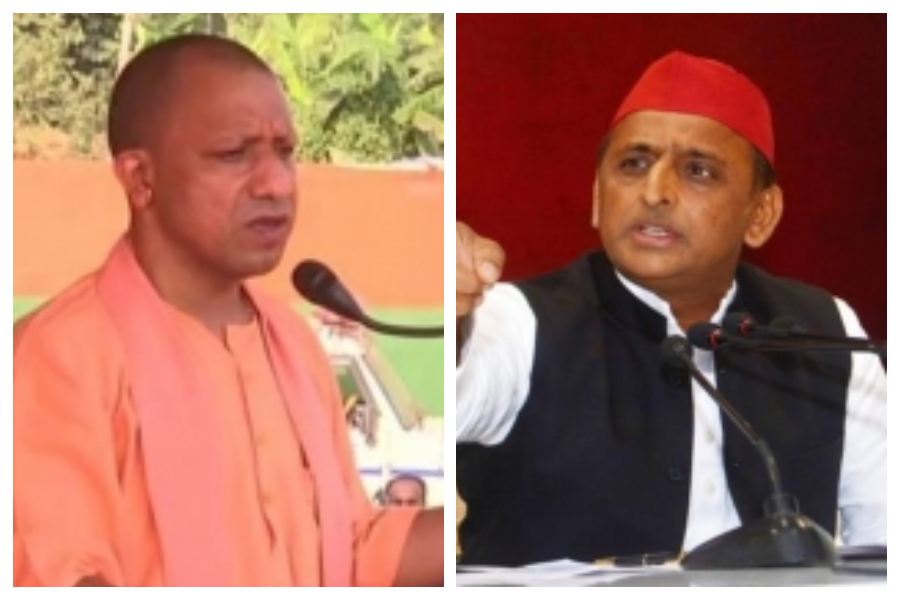
From the famous ‘Bua-Babua’ narrative that dominated the Uttar Pradesh politics in 2019 when the BSP and SP forged an alliance, the focus is now shifting to ‘Baba-Babua’ — Baba being Chief Minister Yogi Adityanath and Babua remains Samajwadi chief Akhilesh Yadav.
Akhilesh Yadav had referred to Yogi Adityanath as ‘Baba’ at an event and the Chief Minister retaliated by taking a jibe at the SP chief and saying: “Babua, ye Twitter hi vote bhi de dega (This twitter will give you votes).”
The Chief Minister was in Akhilesh Yadav’s home district Etawah on Saturday to inaugurate and lay foundations for projects worth about Rs 475 crore. The projects he inaugurated included the Central jail in Etawah.
Hours before, Akhilesh Yadav, referring to Yogi Adityanath, had said: “Baba Mukhya Mantri should not contest an Assembly seat, he is already on his way out.”
In retaliation, Yogi Adityanath said: “I had come here (Etawah) twice during corona. But people of other parties were in home isolation even when you were in a crisis. They should remain confined to their homes even during polls. They need to be given replies to by people in this manner only. Tell them, ‘Babua, ye Twitter hi vote bhi de dega’.”
He asked BJP supporters to ensure the aleaders who sat at home during Covid should be made to remain there’ in the elections.
“They were busy on Twitter. So, tell them, Babua, Twitter will vote for you,” the Chief Minister added.
Yogi Adityanath also hit out at Akhilesh Yadav for frequently accusing the BJP and him of “re-laying foundation stones and inaugurating or re-inaugurating previous SP government projects”.
“It happens only in the BJP government that we lay the foundation and then inaugurate the projects. When the intent is not clean, dishonesty and corruption rule. Even if power is attained by deceit, and foundation stones are laid, the public does not leave them in a position to inaugurate the projects.”
The Chief Minister also mentioned Ayodhya to attack the SP without directly naming it.
“The sparkle from the lamps in Ayodhya are shining across the world. This is the same Ayodhya where people used to be scared to go earlier and where Ram bhakts (devotees of Ram) were fired at (in 1990 when Akhilesh Yadav’s father Mulayam Singh Yadav was the Uttar Pradesh Chief Minister),” he said.
The war of words between BJP and SP leaders is already touching a new low with both the parties lashing out at each other, using derogatory languages.
The Uttar Pradesh Assembly elections are due early next year along with Uttarakhand, Punjab, Goa and Manipur.
Political parties have already started campaigning for the polls in right earnest.

International News
Targeting Afghan civilians appears central to Pakistan’s strategy as airstrikes kill 400


New Delhi, March 17: The situation in Afghanistan is going from bad to worse and in the latest attack by Pakistan, 400 people were killed in an airstrike. Officials said this escalation is a dramatic one and signals that Pakistan has no plans of stopping the war that it got into with Afghanistan.
This is the deadliest strike in Afghanistan following the one that took place in 2021 when the US troops were withdrawing from the country. In that attack, which was a suicide bombing, 169 Afghan civilians and 13 US service members were killed.
Since the start of the war in February, there have been repeated clashes between the two sides in the border areas. Pakistan has also used its air power extensively to subdue the Afghan Taliban.
Officials said that Pakistan knows that it cannot sustain boots on the ground with the Taliban. It has tried reaching out to the Taliban, but Kabul has remained firm that it wants no interference from Islamabad.
Another official said that Pakistan is attempting a regime change in Afghanistan. The targeting of a hospital is an attempt by Islamabad to send across a message to the Taliban that they would have to come to the negotiating table, the official added.
Afghanistan’s deputy government spokesperson, Mandullah Fitrat, said the airstrike had hit the hospital at around 9 p.m. local time. A large section of the 2,000-bed facility had been destroyed. He also said that the death toll so far stood at 400, while the number of those injured was at 250. Around 2,000 people were being treated at the drug treatment hospital when the strikes took place.
Fitrat said that rescue operations are on and teams are working to control the fire and recover the bodies. The casualties are likely to be higher, the spokesperson also said.
The ramifications of this strike could be huge, Afghanistan watchers said.
It is clearly a miscalculation by Pakistan, and in this act of madness, it has only managed to unite the Afghan people further. The Afghan people, who were initially not siding with the Taliban, started backing the regime after Pakistan threw out Afghan refugees. This was seen as an act of barbarism by the people of Afghanistan, and they started justifying the Taliban’s actions against Islamabad.
Pakistan was, however, quick to deny any role in the attack. Pakistani Prime Minister Shehbaz Sharif’s spokesman, Mosharraf Zaidi, said that the allegations made by Kabul are baseless and no hospital was targeted.
Pakistan further said that the strikes precisely targeted military installations and terrorist support infrastructure that included technical equipment storage and ammunition storage of the Afghan Taliban. Pakistan continued to claim without proof that the Afghan Taliban is backing terror groups to target innocent Pakistani civilians.
Islamabad has been attacking Afghanistan since February 26. While Pakistan claims that it has hit military targets, the fact remains that there have been many misses as a result of which there have been a large number of civilian casualties.
With the latest strikes, there have been at least 475 civilian deaths, while 1,15,000 people have been displaced.
Officials said that Pakistan is out to destroy Afghanistan, and the targeting of civilians clearly shows that. Pakistan is also looking to take advantage of the fact that the world is focused on the war in Iran.
With no intervention from the rest of the world, Pakistan hopes to inflict maximum damage on the people of Afghanistan, officials also added.
Since the start of the war, Pakistan has been attempting to change the regime in Afghanistan. Islamabad realises that the regime has the backing of the people. This explains why so many civilians are being targeted.
Media accounts clearly suggest that the Afghan people are ready to go with their children to the border and fight against the Pakistan Army.
The Pakistan Army wants to dissuade the people from backing the Taliban and hence is resorting to killing civilians, officials also said.
National News
204 retired bureaucrats, army officers, lawyers raise concerns about Rahul Gandhi’s conduct in Parliament
New Delhi, March 17: Over 200 prominent senior citizens, including former ambassadors, retired army officers, bureaucrats and senior advocates, on Tuesday raised their voice against the alleged conduct and demeanour of Rahul Gandhi, the senior Congress leader and Lok Sabha Leader of Opposition (LOP), alleging that it weakens the dignity and effectiveness of the country’s Parliament.
The letter is signed by 204 prominent citizens, including 116 retired army officers, 84 former bureaucrats, four ambassadors and four advocates.
The letter addressed to citizens of the country, released by former Jammu and Kashmir DGP, S.P. Vaid, says, “The events witnessed on 12th March are deeply concerning. Parliament is the supreme forum of democratic deliberation where the collective will of the people is articulated. Parliament is rightly regarded as the temple of democracy where elected representatives come together to deliberate on matters of national importance. Unfortunately, Shri Rahul Gandhi has repeatedly contributed to lowering the level of public discourse and decorum through theatrics both inside and outside Parliament.”
The signatories said such actions suggest a pattern of conduct driven less by respect for democratic institutions and more by a sense of personal privilege that treats Parliament as a stage for provocation rather than a forum for serious deliberation.
“In the process, valuable public time and resources are lost. Parliamentary proceedings must not be disrupted or trivialised in ways that undermine the functioning of this vital democratic institution. In his efforts to question the government of the day, the actions of Shri Rahul Gandhi are damaging the reputation of our country and our democracy. The fact that such behaviour is being carried out by a person who occupies a position as responsible and important as the Leader of Opposition makes it even more disturbing,” the latter said.
“As custodians of a constitutional institution that embodies the democratic aspirations of over a billion people, Members of Parliament must remain conscious that their actions carry symbolic and institutional significance. The credibility of Parliament is reinforced when its Members uphold the traditions of propriety and restraint that have always defined parliamentary life,” the signatories said.
They said that as citizens who have served this nation for decades in public life, they are deeply pained to witness repeated attempts by Rahul Gandhi and his associates that risk weakening the effectiveness of this temple of democracy.
“As citizens committed to the preservation and strengthening of India’s democratic institutions, it is incumbent upon all of us to call out conduct that diminishes the dignity of Parliament, an institution that embodies the sovereign will of the people of India. The events witnessed reflect a troubling sense of hubris and privilege that has no place in a constitutional democracy, least of all in the conduct of the Leader of the Opposition. Shri Rahul Gandhi must apologise to the nation for this behaviour and introspect. The Parliament of India occupies a unique and elevated position within the constitutional architecture of the country.
“The dignity of Parliament, therefore, is not a matter of mere convention but an essential element of the constitutional ethos that governs our democracy. The conduct of Members within the precincts of the Parliament House must, consequently, conform to the highest standards of propriety and institutional respect,” the letter mentioned.
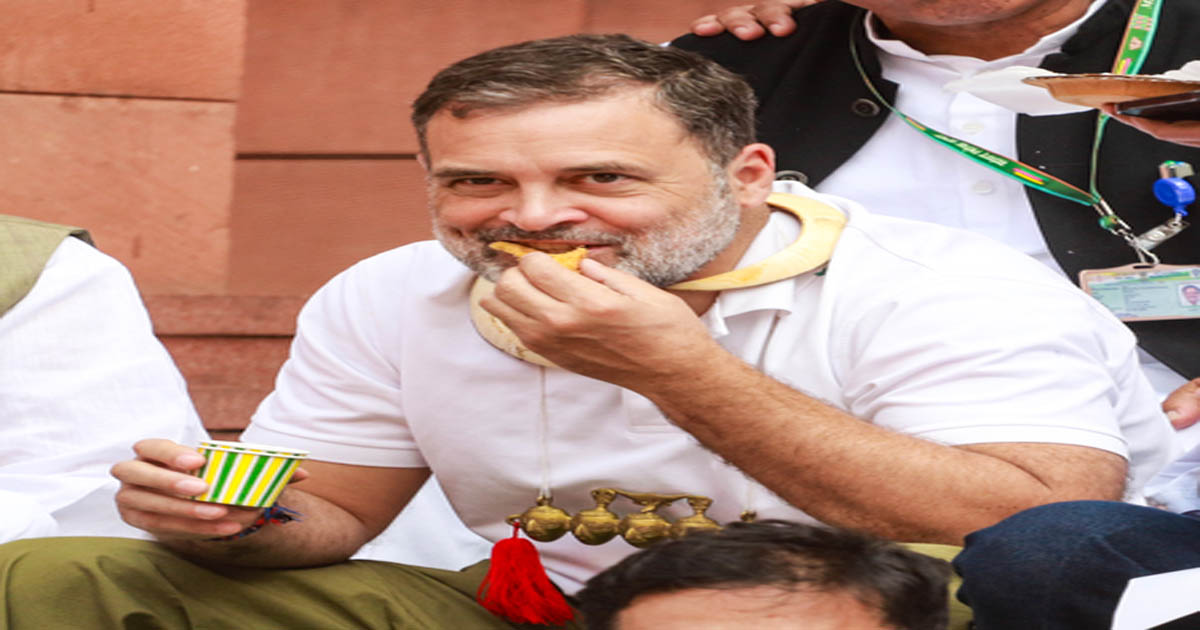
“Shri Rahul Gandhi, along with several Members of Parliament, was seen sitting on the steps of Parliament having tea and biscuits in a manner that was wholly unbecoming of members of the nation’s highest legislative body. The steps of Parliament are not a venue for spectacle or political theatre. Such conduct within the precincts of Parliament represents a clear disregard for established norms of behaviour and decorum. It reflects an attitude of arrogance and entitlement, and a troubling lack of respect for an institution that embodies the democratic will of the people,” the letter pointed out.
“Parliamentary practice and long-standing conventions recognise that the sanctity attached to the Chambers of the Lok Sabha and the Rajya Sabha extends equally to all areas within the parliamentary precincts, including its stairs, corridors and lobbies. These are not incidental spaces but integral parts of Parliament itself, and the conduct expected therein must reflect the dignity of the institution, so that the solemnity, authority and institutional sanctity of the Parliament remain fully preserved,” the letter added.

Bhuj, March 17: The Indian‑flagged liquefied petroleum gas (LPG) tanker ‘Nanda Devi’ arrived at Vadinar Port in Gujarat at about 11.25 a.m. on Tuesday, becoming the second LPG carrier to reach the west coast this week after ‘Shivalik’ docked at Mundra Port a day earlier, officials confirmed.
Both vessels were transporting critical LPG supplies to India following an unusually hazardous passage through the Strait of Hormuz, where maritime traffic has been disrupted by the ongoing conflict involving Iran, the US and Israel.
The strait, a strategic chokepoint for global energy shipments, has seen a sharp reduction in commercial vessel movements since late February amid heightened military actions and warnings from Iran.
Authorities at Kandla Port issued directives on Monday that all ships carrying LPG should be given priority berthing to expedite unloading of cargo and reduce delays amid concerns over domestic supply.
In a circular to vessel agents, the Deendayal Port Authority said the Ministry of Ports, Shipping and Waterways instructed ports to accord priority berthing for LPG-laden ships to help maintain uninterrupted distribution of cooking gas across the country.
The Shivalik, laden with around 46,000 tonnes of LPG from Qatar, completed its nine‑day voyage and berthed at Mundra on Monday evening after port authorities made advance arrangements, including documentation and priority docking, to begin discharge operations without delay.
Officials said both vessels are part of efforts to shore up LPG supplies for household and industrial use as India continues to rely on imports for a significant share of its energy needs.
Before the transit of the two tankers, dozens of Indian‑flagged ships and hundreds of seafarers remained anchored in the Persian Gulf as maritime insurers and shipping firms reassessed routes through the volatile region.
The Nanda Devi’s arrival at Kandla comes amid broader diplomatic and logistical efforts, including negotiations with regional authorities and coordination with naval assets, to safeguard merchant shipping.
Indian maritime authorities have maintained that all Indian seafarers operating in the Gulf area remain safe and that no untoward incidents involving Indian-flagged vessels have been reported in recent days.
While Nanda Devi has arrived, another ship, ‘Jag Laadki’, carrying nearly 81,000 tonnes of crude oil from the UAE, is en route to India.
As per government data, there were 22 Indian-flagged vessels located to the west of the Strait of Hormuz in the Persian Gulf region, carrying a total of 611 seafarers.

Targeting Afghan civilians appears central to Pakistan’s strategy as airstrikes kill 400

Mumbai embraces everyone, keeping Mumbai clean and beautiful is everyone’s responsibility: Actor Akshay Kumar

Mumbai: Action will be taken against illegal hawkers and hotels in Kurla, BMC warns of registering FIRs against hawkers, police ready for effective action

FIFA World Cup 2026 uncertainty grows as Iran eyes venue change

204 retired bureaucrats, army officers, lawyers raise concerns about Rahul Gandhi’s conduct in Parliament

Salim Khan hospitalised following complaints of swelling

Mumbai: JBCN International School In Borivali Gets Bomb Threat, Search Reveals Hoax, Students Safe

Former Arsenal Star Mesut Ozil’s Convoy Gets Involved In Road Accident During Bangladesh Visit

Married Mumbai Woman Mocked In Andheri Society Over ‘Lift Kissing’ CCTV Video, Files Police Complaint

Gold and silver surge on safe haven demand, margin cut
-

 Crime4 years ago
Class 10 student jumps to death in Jaipur
-

 Maharashtra1 year ago
Mumbai Local Train Update: Central Railway’s New Timetable Comes Into Effect; Check Full List Of Revised Timings & Stations
-

 Maharashtra1 year ago
Mumbai To Go Toll-Free Tonight! Maharashtra Govt Announces Complete Toll Waiver For Light Motor Vehicles At All 5 Entry Points Of City
-

 Maharashtra1 year ago
False photo of Imtiaz Jaleel’s rally, exposing the fooling conspiracy
-

 National News1 year ago
Ministry of Railways rolls out Special Drive 4.0 with focus on digitisation, cleanliness, inclusiveness and grievance redressal
-

 Maharashtra1 year ago
Maharashtra Elections 2024: Mumbai Metro & BEST Services Extended Till Midnight On Voting Day
-

 National News1 year ago
J&K: 4 Jawans Killed, 28 Injured After Bus Carrying BSF Personnel For Poll Duty Falls Into Gorge In Budgam; Terrifying Visuals Surface
-

 Crime1 year ago
Baba Siddique Murder: Mumbai Police Unable To Get Lawrence Bishnoi Custody Due To Home Ministry Order, Says Report