
National News
Election Results 2022: AAP becomes national party

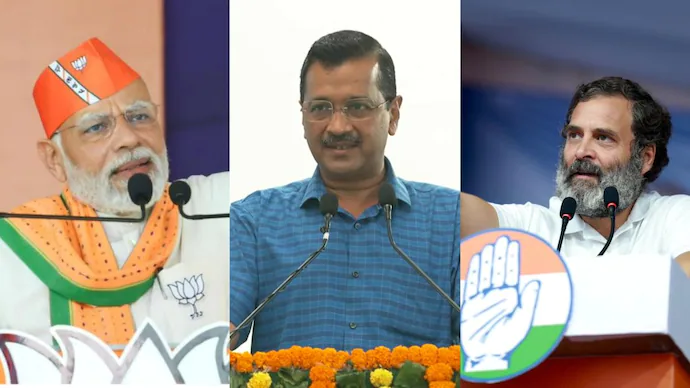
BJP is set for a record performance and a landmark victory in Gujarat and Congress was poised to form government in Himachal Pradesh according to the results and trends of the counting of votes on Thursday.
The byelection to six seats in five states also gave a mixed result with Congress and BJP leading on two seats each and BJD and RLD on one each. Samajwadi Party candidate Dimple Yadav has a massive lead in the bypoll for the Mainpuri Lok Sabha seat.
The BJP is poised to break all records of electoral performance in Gujarat, the home state of Prime Minister Narendra Modi and Home Minister Amit Shah, and is set to get the highest number of seats won by a political party in the state’s history.
According to the latest information from the Election Commission, BJP is poised to win 158 seats in the 182-member Gujarat assembly having already won 79 seats and leading on 79 seats. Aam Aadmi Party has made its entry in the state assembly having won two seats and leading on two more. The party has increased its vote percentage to 12.87 per cent in an indication of its growing presence in the state.
The Congress is set to suffer its worst electoral defeat in Gujarat, having won seven seats and leading on nine.
The BJP, which has won its seventh straight election in Gujarat, is set to not only improve its own best record of 127 seats in 2002 – the first election with Narendra Modi as chief minister – but the Congress tally of 149 seats in 1985.
The Aam Aadmi Party headquarters in Delhi was decked up with colourful balloons, and music was blazing to exhibit the mood for celebrations that prevailed in the party as it will get the national status after the Gujarat Assembly election results on Thursday.
With the AAP’s government in Delhi and Punjab, the party has achieved the status of a state party and the fate of becoming the national party depends on its performance in the Gujarat Assembly polls.
A political party needs to be recognised in at least four states to become the national party. To be recognised as a party in the state, it needs to win at least two seats and 6 per cent of votes.
In Himachal Pradesh, Congress is slated to win 39 of 68 seats, having won 26 and leading on 13. The BJP has won 14 seats and is leading on 12. Independents have won three seats and AAP failed to open its account in the state.
In terms of vote share in Himachal, Congress is only marginally ahead of the BJP having got 43.88 per cent of votes compared to 42.99 per cent of its rival. Others have garnered 10.4 per cent vote share in the hill state.
The Congress, which had not projected a Chief Ministerial candidate in the hill state, is planning a meeting its MLAs in Chandigarh with some of its leaders apprehending “poaching” attempts by BJP.
Celebrations began at the BJP office in Ahmedabad soon after it was clear that the party was on course to an overwhelming victory in the state. Congress workers also celebrated the party’s performance in Himachal Pradesh.
Incumbent Gujarat chief minister Bhupendra Patel is set to take oath as chief minister of the state for the second time on December 12.
“The results of Gujarat elections are quite clear. People have made up their minds to further continue with the journey of development in Gujarat. We humbly accept the mandate of the people. Every worker of BJP is committed to public service,” he said.
BJP president JP Nadda congratulated Bhupendra Patel, party’s Gujarat chief CR Paatil and all the workers of state BJP for the party’s landslide victory in the state.
Alpesh Thakor, BJP’s candidate from Gandhinagar South seat said BJP has developed Gujarat.
“We will serve the people of Gujarat. It’s a bumper win. We said earlier also that we will win over 150 seats,” says Alpesh Thakor,” he said.
Himachal Pradesh Chief Minister Jai Ram Thakur has tendered his resignation to the Governor.
“I respect people’s mandate. I want to thank Prime Minister and central leadership (for their support) during last 5 yrs. We’ll stand for the development of the state irrespective of politics. We’ll analyse our shortcomings and improve during the next term,” Thakur told media persons in Shimla.
Congress in charge of Himachal Pradesh Rajiv Shukla said the party will implement 10 guarantees in the state.
Congress leader Sukhwinder Singh Sukhu said that the party will form government in the state.
“BJP considered itself strong in Himachal Pradesh, PM Modi and Amit Shah visited the State several times. Congress is going to form the government with a full majority,” he said.


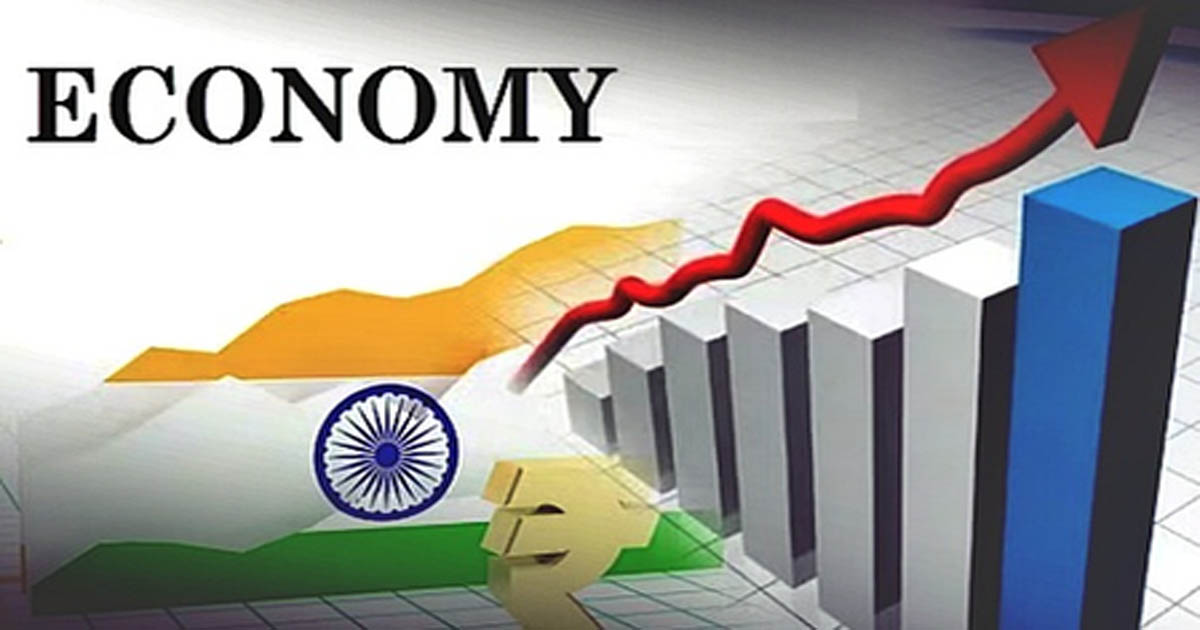
New Delhi, March 15: The Bharat Progress Report 2025-26, released by the NXT Foundation, highlights India’s rapid economic and technological growth over the year with the achievement of as many as 101 major milestones across digital public infrastructure, highways, railways, space, and renewable energy, taking the country towards the goal of becoming a developed nation.
The report underscores that India became the world’s fourth-largest economy in 2025, overtaking Japan with a nominal GDP of about $4.18 trillion. Driven by a robust 8.2 per cent growth rate, India continues to be the world’s fastest-growing major economy. The country is now on course to soon become the third-largest economy in the world.
The report points to several high-frequency indicators that reflect the economic growth momentum. GST collections reached a record Rs 2.17 lakh crore in April 2025, while the country’s mutual fund industry surpassed Rs 80 lakh crore in assets under management. Besides, cumulative foreign direct investment crossed $1.15 trillion with the surge in investor confidence.
The development of India’s digital public infrastructure, which is being adopted by other countries as well, is reflected in the monthly UPI transactions surpassing Rs 21 lakh crore, while Aadhaar authentication crossed one billion. This enabled the expansion of financial inclusion in the country with a marked improvement in the delivery of government services to the poor in a transparent manner, directly into the accounts of beneficiaries.
On the infrastructure and connectivity front, the major achievements included the completion of the Chenab Rail Bridge, the world’s highest railway arch bridge, and the continued expansion of the Vande Bharat train network, which has enhanced high-speed rail connectivity. At the same time, the country expanded its national highways and logistics networks, helping improve supply chains and reduce transportation costs.
The report further highlights the country’s progress in science and advanced technology. The Space Docking Experiment (SpaDeX) conducted by the Indian Space Research Organisation successfully demonstrated in-orbit docking capability, saw India storming into the exclusive club of countries with this sophisticated technology. A major step was also undertaken during the year to develop domestic capacity in semiconductors, artificial intelligence and quantum computing as the country emerges as an alternative to China for becoming a world manufacturing hub for hi-tech electronic products.
India also made major advancements in achieving its renewable energy goals in the fight against climate change. The country’s share of non-fossil fuel power capacity reached the 50 per cent mark five years ahead of the 2030 target, on the back of strong growth in solar, hydel and wind energy. The report points out that the achievement of these milestones showcases the country’s evolution into a major driver of global growth in the new world order.
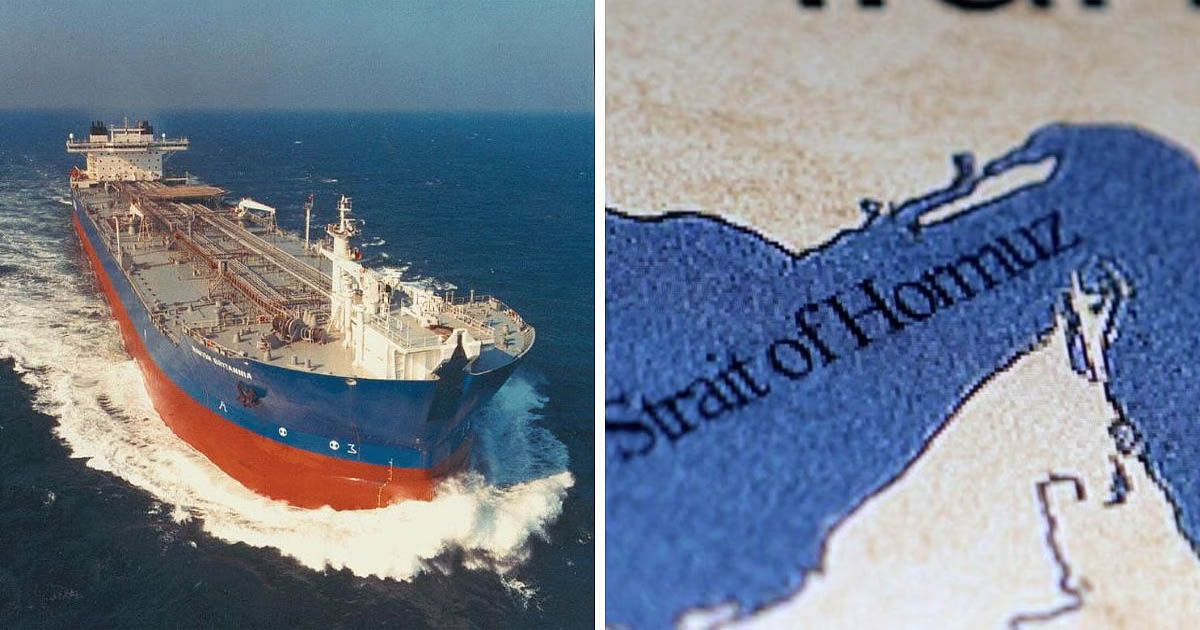
New Delhi: Iranian Ambassador Mohammad Fathali’s words of reassurance that India will receive safe passage through the Strait of Hormuz will certainly gladden Indian hearts. The Iranian envoy to India told reporters that “changes would be seen in two-three hours,” suggesting that ships carrying Indian oil and Indian nationals may be safe while going through the Strait.
The reality isn’t that simple. India is dependent on 40% of its oil from the Strait of Hormuz, but there’s a catch. Energy experts say that Indian ships do not pick up oil from the Strait but have so far outsourced it to foreign tankers.
The main reason for this is insurance. Due to the Strait being so geopolitically sensitive, insurance costs are very high, and therefore Indian Oil Corporation (IOC) or BPCL prefer to outsource it.
There is another advantage to outsourcing the oil to foreign tankers – Indian oil companies do not have to own the fleet.
India could attach its flag to the foreign tankers, but naval regulations state that there must be a minimum number of Indian crew members on the ship, along with other regulations that have to be met before the Indian flag can be put on the tanker.
If there is no flag, there is no way that an Iranian ship can detect if a ship is carrying Indian oil or not.
Coming to Indian crew members, India is one of the top three nations in the world that supplies sailors.
Government data shows the number of Indian sailors has grown from around 1.25 lakh a decade ago to more than three lakh now. Indians now comprise around 10–12% of the total number of sailors in the world.
The problem for India is that most of the Indian crew members work on oil tankers, containers, LPG vessels and bulk carriers on foreign tankers and are at great risk when naval warfare takes place.
The Ministry of Ports, Shipping and Waterways has confirmed three Indian seafarers died, with four others injured in maritime attacks around the strait amid escalating hostilities. Naval experts believe the figure is likely to be much higher.
Despite these problems, some level of coordination seems to be taking place between India and Iran.
Agency reports said that on Thursday, the Suezmax tanker Shenlong, carrying Saudi crude, arrived at a port in Mumbai after transiting the strait. The Liberia-flagged vessel was the first crude carrier to reach India from the Middle East since the war between Iran and the United States and Israel broke out in late February, according to LSEG data.
The customer is state-run Bharat Petroleum Corp.
But the lack of a formal agreement between the Iranian Navy and tankers carrying Indian oil suggests the Iranian envoy’s assurance does not guarantee a safe maritime corridor.
An MEA official says talks are on to make this happen, but so far Iran has not provided such assurance. In turn, Iran wants assurance from New Delhi that it will provide a joint statement from BRICS nations condemning the US-Israeli aggression.
India currently holds the chairmanship of BRICS, and so far there has been no joint statement. This has not been viewed well by Iran, which is a full member of BRICS.
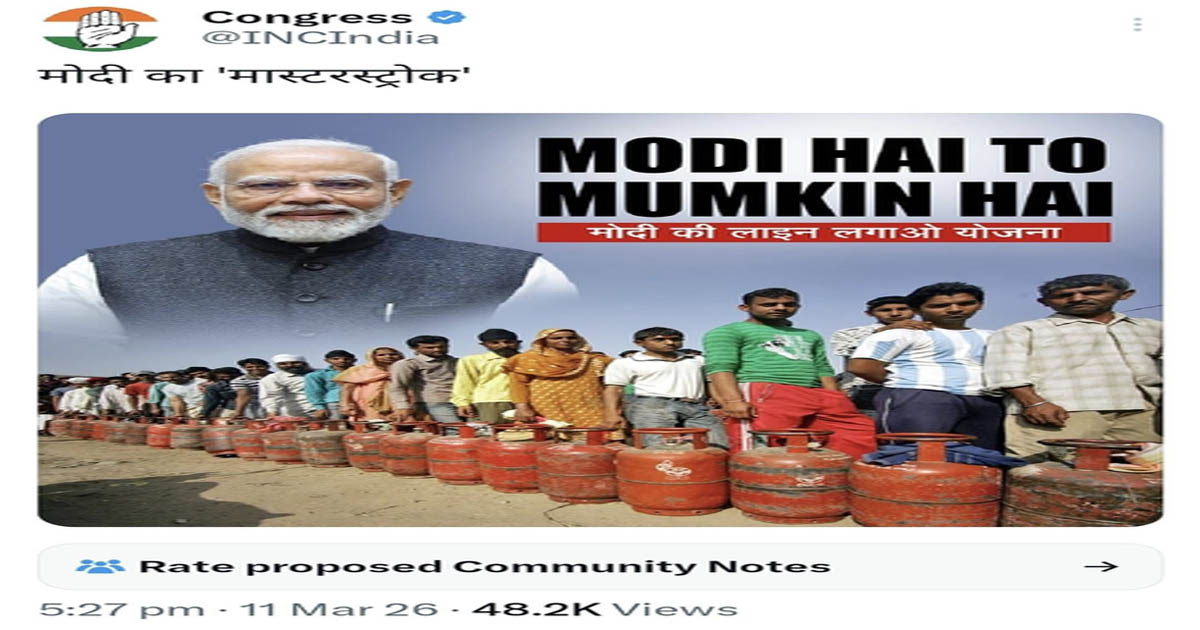
New Delhi, March 12: Amid the ongoing controversy over LPG shortages and rising fuel prices, the Congress party sparked debate on social media after sharing a post on platform X that criticised the government. However, the party later deleted the post following widespread criticism for using an old photo.
The post featured an image carrying the slogan “Modi Hai To Mumkin Hai,” with a caption below that read “Modi ki line lagao yojana,” suggesting people were being forced to stand in long queues for LPG cylinders. Soon after it was posted, several users pointed out that the photograph used in the post was reportedly from 2011, leading to criticism of the Congress for sharing an outdated image to highlight the current issue.
Following the backlash, the party quietly removed the post from its social media account.
Meanwhile, protests against the recent hike in LPG prices have continued in several parts of the country. In Karnataka’s Mandya district, members of the District Congress Committee along with its women’s wing staged a protest against the Union government, condemning the increase in domestic and commercial LPG cylinder prices.
On March 7, oil marketing companies raised the price of a 14.2-kg domestic LPG cylinder by Rs 60, while the price of a 19-kg commercial cylinder was increased by Rs 114.50 to Rs 115. The hike has largely been attributed to rising global energy costs amid escalating geopolitical tensions in West Asia.
The Maharashtra Pradesh Congress Committee (MPCC) has also announced a statewide protest across all districts on Thursday, demanding that the Centre immediately roll back the recent LPG price hike. The party accused the government of failing to adequately plan fuel and gas supplies at a time when global markets are facing uncertainty due to the West Asia crisis.
Even as protests continue, the Congress is also preparing for internal organisational activities. The party is set to hold a two-day residential training workshop in Trimbakeshwar starting Thursday for candidates from the North Maharashtra division who recently contested local body elections.
Meanwhile, government officials have cautioned against panic buying and hoarding of LPG cylinders. Authorities said that misinformation circulating on social media has led to unnecessary panic bookings.
Officials urged citizens to remain calm and avoid spreading unverified claims regarding LPG shortages.
At a joint briefing by the Ministry of Shipping, Ministry of External Affairs, and the Ministry of Petroleum, officials said India’s domestic LPG production has been increased by nearly 25 per cent following government directives aimed at boosting output.
Sujata Sharma, speaking during the briefing, said that additional LPG cargo shipments are currently on their way to India and are expected to arrive within the next one or two days.
She also noted that India imports nearly 60 per cent of its LPG requirements, with about 90 per cent of these imports passing through the Strait of Hormuz.
“Currently, LPG is being directed primarily towards the domestic sector. For non-domestic LPG, priority is being given to essential services such as hospitals and educational institutions,” Sharma said.
She added that a committee is working with state authorities and industry representatives to ensure that the available LPG supply is distributed in a fair and transparent manner across the country.

Mumbai: Not only Muslims but also Hindus are worried about SIR, SP national president Akhilesh Yadav criticizes UP government and Election Commission

BMC Removes Flashing Lights From Mumbai Mayor Ritu Tawde’s Car Following Social Media & RTI Protest

Trump rejects deal with Iran, seeks global help on Hormuz

China’s air defence system fails miserably, becomes ‘laughing stock’: Report

Mumbai: Shiv Sena (UBT) leader Sanjay Raut Alleges Election Commission Acting As ‘Extended Branch Of BJP’, Says Opposition Does Not Trust Poll Body

Salim Khan hospitalised following complaints of swelling

Mulund Horror: Maharashtra CM Devendra Fadnavis Expresses Grief After 1 Killed In Mumbai Metro 4 Slab Collapse; ₹5 Lakh Aid Announced For Deceased

Mumbai: JBCN International School In Borivali Gets Bomb Threat, Search Reveals Hoax, Students Safe

Former Arsenal Star Mesut Ozil’s Convoy Gets Involved In Road Accident During Bangladesh Visit

Gold and silver surge on safe haven demand, margin cut
-

 Crime4 years ago
Class 10 student jumps to death in Jaipur
-

 Maharashtra1 year ago
Mumbai Local Train Update: Central Railway’s New Timetable Comes Into Effect; Check Full List Of Revised Timings & Stations
-

 Maharashtra1 year ago
Mumbai To Go Toll-Free Tonight! Maharashtra Govt Announces Complete Toll Waiver For Light Motor Vehicles At All 5 Entry Points Of City
-

 Maharashtra1 year ago
False photo of Imtiaz Jaleel’s rally, exposing the fooling conspiracy
-

 National News1 year ago
Ministry of Railways rolls out Special Drive 4.0 with focus on digitisation, cleanliness, inclusiveness and grievance redressal
-

 Maharashtra1 year ago
Maharashtra Elections 2024: Mumbai Metro & BEST Services Extended Till Midnight On Voting Day
-

 National News1 year ago
J&K: 4 Jawans Killed, 28 Injured After Bus Carrying BSF Personnel For Poll Duty Falls Into Gorge In Budgam; Terrifying Visuals Surface
-

 Crime1 year ago
Baba Siddique Murder: Mumbai Police Unable To Get Lawrence Bishnoi Custody Due To Home Ministry Order, Says Report