
National News
Eight year old Muslim boy slapped by classmates at teacher’s egging in Uttar Pradesh

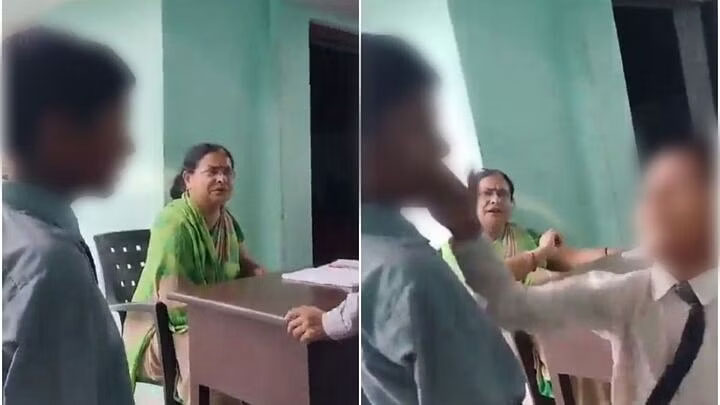
Muzaffarnagar: The teacher who is accused of asking students to hit their classmate as a punishment to the kid has today issued a clarification. The teacher who is identified as Tripta Tyagi defended her actions after the video of the incident went viral on social media. The teacher said that she was physically handicapped so she could not stand up to personally punish the kid. Hence, she asked the other students of the class to hit the kid. The incident occurred at Neha Public School in Muzaffarnagar.
Teacher Tripta Tyagi issues clarification
Tripta Tyagi in her statement claimed that the video is fake and also it has been hampered to defame her. She said “I made a mistake by getting the child beaten up by the students. I am handicapped and could not get up, so I asked the students to beat the child. The video has been tampered with.” The video of the incident is going viral on social media and the teacher is facing ire for her inhumane actions against the child. Bharatiya Janata Party (BJP) is also facing criticism after the video of the teacher has gone viral on social media.
The teacher while speaking to News Agency said that “The video that was made viral was edited and cut, I had no such intentions. In our place, Hindus and Muslims stay with unity and we have more Muslim students in our school. There was pressure from the parents of the child to be strict with him. I am handicapped I can’t get up. He was not doing homework for last 2 months. So I made 2-3 students beat him up so that he would start doing his work. What I said was ‘Muhamdan mothers must not take their kids to their uncles’ homes as the exam is approaching. But they cut this video and took the ‘Muhamdan’ word. I had no such intentions. I have made a mistake and I seek apology with folded hands.”
Father reacts, seeks justice
The father of the kid who was beaten in the school appealed that law should take its course and that juistice must prevail. He said that the video was shot by his nephew who went to the school for some work. The student’s father said that “My son is seven years old. This incident happened on 24th August. The teacher made the students beat my child again & again. My nephew made the video and had gone to school for some work. My seven-year-old child was tortured for an hour or two. He is scared. This is not a Hindu-Muslim matter. We want the law should take its own course.”
Incident that occurred in the school
The teacher can be heard in the viral video saying that the mothers of these minority students do not pay attention to the education of their kids and this hampers the studies of other students. She then ordered other students in the class to hit the kid. Other kids in the video can be seen hitting and slapping the student on his face and back. The teacher also filmed the incident on camera. Probe has been ordered in connection with the incident. The teacher also accepted in her statement that she did wrong by asking other students to beat the kid.
Opposition attacks BJP
Opposition is attacking BJP for the teacher’s action. They are blaming BJP for spreading hate against the minority community in the country. Earlier, Samajwadi Party chief Akhilesh Yadav shared the video of the Uttar Pradesh Police’s statement on social media and said that BJP is to be blamed for the teacher’s actions. He also said that the BJP must show this video in the G20 Summit and also prove to the world that their hate-spreading agenda in the country is correct.
Akhilesh Yadav slams BJP over the incident
Akhilesh Yadav said that “In a viral video from Muzaffarnagar, a teacher is seen getting a minority child thrashed by other children. In this she is guilty of double crime because she is beating and making other children violent. The BJP government should show this video in the G20 meeting to prove how its hate agenda is correct. Such a teacher is a blot on the society, teachers of the whole country should raise their voice to punish that teacher.”


Preparations for the Mumbai Municipal Corporation (BMC) elections are in the final stages. On the instructions of the Election Commission, Mumbai Police has banned mobile phones at polling stations and the use of mobile phones is prohibited within a radius of 100 meters. The code of conduct will be applied at polling stations. There will be a complete ban on the use of mobile phones and wireless within 100 meters. In addition, advertising campaigns and advertising of election symbols are also prohibited. Candidates cannot attract voters at polling stations. If anyone is found involved in this process, action will be taken against them. This order has been issued by Mumbai DCP Operation Akbar Pathan on the instructions of Mumbai Police Commissioner Devin Bharti.
New Delhi, Jan 8: The Delhi High Court on Thursday stayed a single-judge direction that required the Reserve Bank of India (RBI) to institute a second level of human review for consumer complaints dismissed by its banking ombudsman.
A division bench of Chief Justice D.K. Upadhyaya and Justice Tejas Karia passed the interim order on an appeal filed by the RBI against a ruling delivered by Justice Prathiba M. Singh, which required such reviews to be conducted by legally trained professionals, including retired judicial officers or lawyers with a minimum of ten years’ experience.
While staying the impugned directions, the CJ Upadhyaya-led Bench observed that, prima facie, it found force in the submissions advanced on behalf of the RBI.
“Accordingly, we provide that the directions contained in paragraph 47(5) and 48 of the impugned judgment by the learned single judge dated November 27, 2025, shall remain stayed,” it ordered.
The bench also stayed the single-judge’s direction requiring the RBI Deputy Governor to submit a compliance affidavit by January 15, 2026. The matter has now been scheduled for further hearing on March 17.
Appearing for the RBI, Solicitor General of India Tushar Mehta submitted that the single judge had travelled beyond the permissible scope of judicial review under Article 226 of the Constitution.
The Centre’s second-highest law officer submitted that the Reserve Bank-Integrated Ombudsman Scheme, 2021, is a statutory scheme framed under Section 35A of the Banking Regulation Act and Section 18 of the Payment and Settlement Systems Act, and can be altered or modified only by authorities empowered under those enactments.
In her November 27, 2025, ruling, Justice Prathiba M. Singh had expressed concern over complaints being rejected through “system-generated responses” and held that the Ombudsman Scheme must be “an effective Scheme and not a mere toothless division of the RBI”.
The judgment was delivered in a writ petition filed by advocate Sarwar Raza, who had approached the Delhi High Court alleging harassment and wrongful rejection of his complaints by the RBI Ombudsman following a disputed credit card transaction of Rs 76,777.
The single-judge Bench had directed the RBI to ensure that customer complaints are not rejected merely through a mechanised process and that complainants should be given an opportunity to correct minor errors.
It had further ordered that whenever complaints are finally rejected, they must undergo a second level of human supervision by legally trained personnel, observing: “If the complaint redressal mechanism adopted by the Ombudsman is made more effective and efficient, litigation in courts and consumer forum/s can be reduced considerably.”
National News
Mumbai: Train Delays, Sudden Cancellation Throw Trans-Harbour Line Schedule Out Of Gear

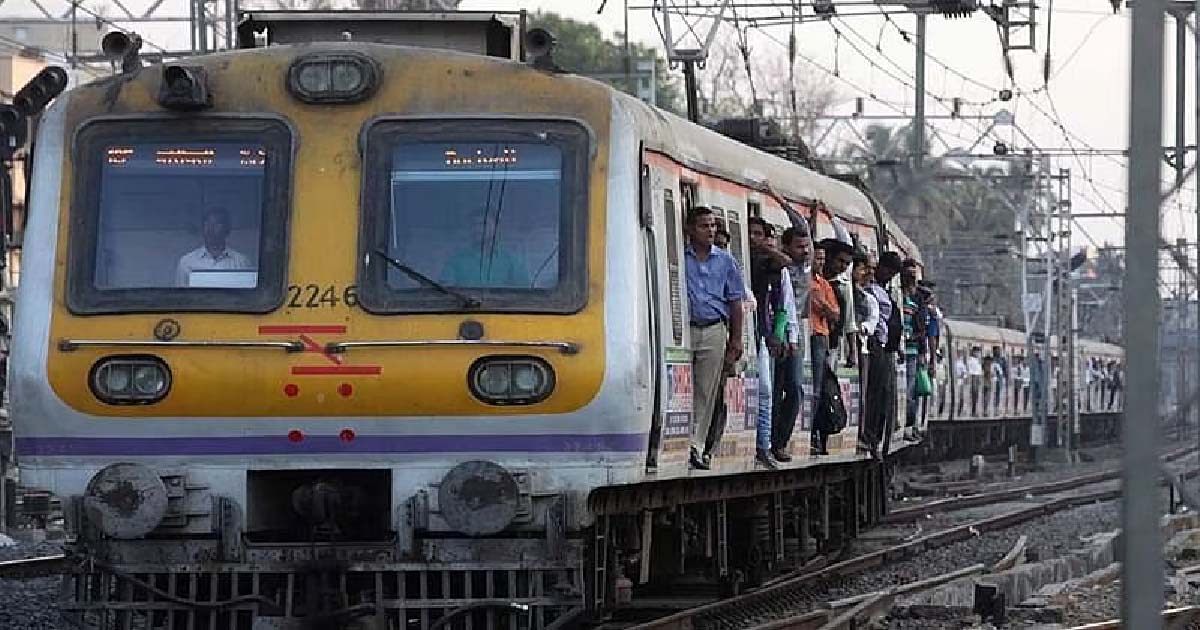
Thane: The local trains on the Trans-Harbour line are running 15 to 20 minutes late. Due to this, there was a rush of passengers at important railway stations including Thane, Digha, and Airoli during the peak morning hours. Also, passengers suffered a lot when the train leaving Thane railway station for Vashi at 8.56 am was suddenly cancelled. Many could not reach their workplaces on time.
National and international companies have offices and factories in Navi Mumbai. Therefore, lakhs of employees from Thane to Karjat, Kasara, Mulund, Bhandup areas travel to Navi Mumbai via the Trans-Harbour route from Thane railway station. Also, the number of passengers coming to Thane city from Navi Mumbai is high. Due to this, there is a huge rush of passengers at Thane railway station in the morning.
Since Thursday morning, trains on this route have been running 15 to 20 minutes late. Due to this, the entire railway timetable has collapsed and there is a rush of passengers at the main stations. In the morning, a large number of employees travel to Navi Mumbai from Thane station. However, the train leaving Thane station for Vashi at 8.56 am every day was suddenly canceled. This created confusion among the passengers. Even after that, all the trains are running 15 to 20 minutes late.
Due to this, there was a huge rush of passengers at many important railway stations including Thane, Digha, Airoli. Due to the disruption of railway services during the morning rush hour, passengers suffered a lot. Many could not reach their workplaces on time, while some had to wait for hours to travel. Many passengers expressed displeasure over the sloppy functioning of the railway administration. One angry passenger reacted that due to such a breakdown in the morning, our planning collapsed. The railway administration should take this seriously.
Passenger reaction: The timetable of railway trains on this route has collapsed since last night. The train which leaves Vashi for Thane daily at 8:50 PM had not arrived even after 9 PM last night, said a passenger who travels from Thane to Vashi for work.

Mobile phones banned at Mumbai BMC election polling centre

Delhi HC stays order requiring second review of RBI Ombudsman complaints

Mumbai: Train Delays, Sudden Cancellation Throw Trans-Harbour Line Schedule Out Of Gear

Local body elections deal a blow to Ajit Pawar, alliance leader withdraws from election process

Sensex, Nifty end lower as India-US trade tension spook investors

Mamata Banerjee announces judicial committee to probe chaos at Salt Lake Stadium over Lionel Messi’s visit

One more accused arrested for vandalism during Lionel Messi’s Kolkata event

Andhra Pradesh CM congratulates Koneru Humpy

Jannat Zubair and Elvish Yadav meet Messi, call it an ‘amazing day’

Sensex, Nifty open lower amid tariff-related concerns
-

 Crime3 years ago
Class 10 student jumps to death in Jaipur
-

 Maharashtra1 year ago
Mumbai Local Train Update: Central Railway’s New Timetable Comes Into Effect; Check Full List Of Revised Timings & Stations
-

 Maharashtra1 year ago
Mumbai To Go Toll-Free Tonight! Maharashtra Govt Announces Complete Toll Waiver For Light Motor Vehicles At All 5 Entry Points Of City
-

 Maharashtra1 year ago
False photo of Imtiaz Jaleel’s rally, exposing the fooling conspiracy
-

 National News1 year ago
Ministry of Railways rolls out Special Drive 4.0 with focus on digitisation, cleanliness, inclusiveness and grievance redressal
-

 Maharashtra1 year ago
Maharashtra Elections 2024: Mumbai Metro & BEST Services Extended Till Midnight On Voting Day
-

 National News1 year ago
J&K: 4 Jawans Killed, 28 Injured After Bus Carrying BSF Personnel For Poll Duty Falls Into Gorge In Budgam; Terrifying Visuals Surface
-

 Crime1 year ago
Baba Siddique Murder: Mumbai Police Unable To Get Lawrence Bishnoi Custody Due To Home Ministry Order, Says Report