
National
Dr Farooq Abdullah appeals to PM Modi to get private Hajj quota restored

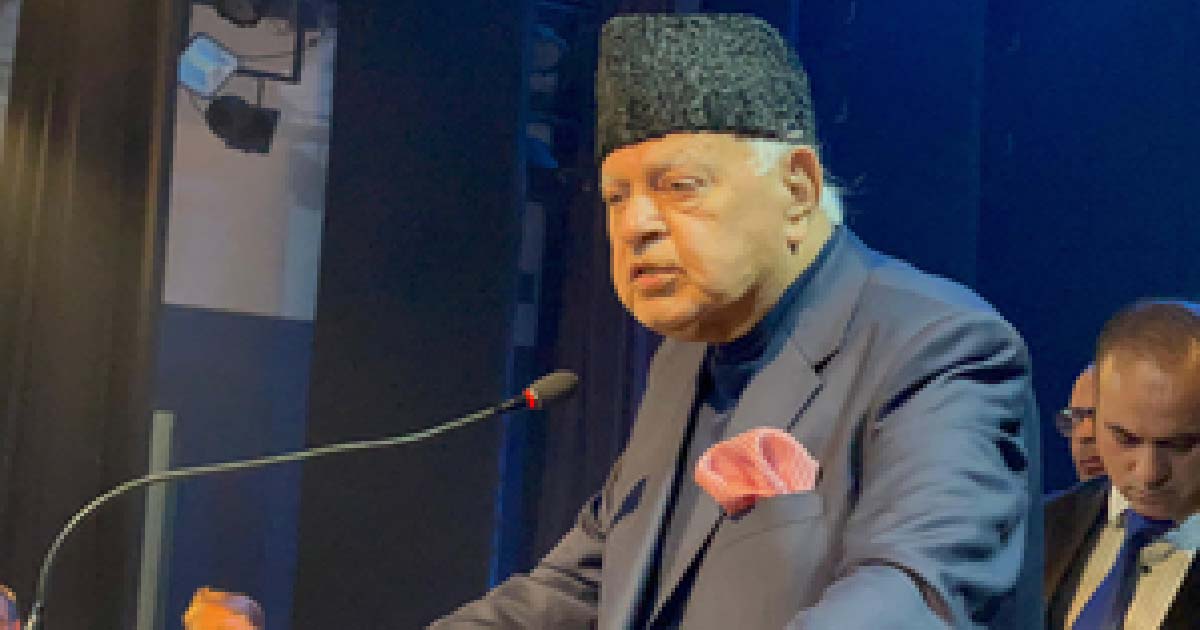
Srinagar, April 14: Former Jammu and Kashmir (J&K) Chief Minister and President of the ruling National Conference (NC), Dr Farooq Abdullah on Monday appealed to Prime Minister Narendra Modi to use his friendship with the rulers of Saudi Arabia to get the private Hajj quota restored.
The government of Saudi Arabia has slashed India’s private Hajj quota by 80 per cent.
Each year, many Muslims belonging to well-to-do families undertake the Hajj pilgrimage using the services of private tour and travel operators.
These tour and travel operators get a quota of pilgrims every year that they can send to Saudi Arabia over and above the Hajj quota allotted to India officially by the Saudi government.
Each year, hundreds of pilgrims use the services of private tour and travel operators to perform the annual Hajj pilgrimage, which is the holiest journey a Muslim can ever undertake in life.
Dr Farooq Abdullah said on Monday, “I appeal to the Prime Minister to use his personal influence on the Saudi rulers to restore the private Hajj quota. We (India) have very good relations with Saudi Arabia.
“The Prime Minister is a friend of the Saudi rulers. If they cannot increase the private Hajj quota, let them restore what we already had. It has implications on jobs of many people.
“And over and above everything else, Hajj is the lifelong desire of a Muslim. A Muslim saves all his life to afford the Hajj pilgrimage. It is one of the basic duties of a devout Muslim to perform the Hajj pilgrimage.
“I will also tell Omar (Chief Minister) to write a letter to the Prime Minister to use his influence to get the private Hajj quota restored.”
On Sunday, former Chief Minister and President of Peoples Democratic Party (PDP), Mehbooba Mufti also expressed concern at the development.
“Disturbing news emerging from Saudi Arabia. Reports indicate that 80 per cent of India’s private Haj quota has been cut abruptly. This sudden decision is causing immense distress for pilgrims and tour operators across the country.
“Urge the Ministry of External Affairs to immediately intervene by taking up this matter with the Saudi government to seek a resolution”, she said on social media platform X.


New Delhi, Jan 24 : Investors are likely to remain on edge over the proposed US framework on Greenland, and near-term volatility related to this issue can continue, a report has said.
The report from Bank of Baroda said that market participants are awaiting more details that could determine whether negotiations succeed or unravel.
“Going ahead, investors are likely to await more details of the deal, as there are a few sticking points which can derail the negotiations. Hence, some volatility can be expected,” the report said.
Several analysts expect the arrangement to resemble an update of the existing security agreement between the US and Denmark, which was signed in 1951, the report noted.
Further negotiations will follow in due course which will cover areas such as US military presence in Greenland, as well as use of its mineral resources and sovereignty, said Aditi Gupta, Economist, Bank of Baroda.
US President Donald Trump has framed Washington’s interest in Greenland as driven by national security concerns, but the island’s largely unexplored mineral wealth including oil, gas and rare earth elements is of interest to US, the report said.
“The announcement of a framework deal between the US and NATO has helped to soothe investors’ nerves, however the details of the deal are still fuzzy,” it added.
Geo-political tensions escalated and markets went into turmoil after the US President intensified rhetoric to annex Greenland and threatened economic measures against European countries that oppose US plans. In response, several European nations, including France, Germany, Sweden amongst others increased military deployment in Greenland, further escalating tensions.
Trump had announced a 10 per cent additional tariff on goods from the UK, Denmark, Norway, Sweden, France, Germany, Netherlands and Finland from February 1, 2026. The rate was expected to increase to 25 per cent by June 1, 2026.
Later, he backed off from his threat of imposing tariffs on European countries along the sidelines of the World Economic Forum meeting in Davos.
Crime
Two Held With ₹68 Lakh Cash Near India-Myanmar Border In Mizoram; Heroin Worth ₹78 Lakh Seized


Aizawl: Two persons were arrested with Rs 68 lakh in cash near the India-Myanmar border in east Mizoram’s Champhai district, officials said on Thursday.
Acting on a tip-off, the Assam Rifles intercepted a vehicle at Zote village on August 11, they said.
Upon thorough checking, Rs 60 lakh in cash was recovered from two persons in the vehicle.
The duo, identified as Joseph Lalthansanga and Vanlalruati, could not state any proper reason why they were carrying such a huge amount of cash. They were subsequently handed over to the police for legal action, officials said.
In another operation, the Assam Rifles recovered 94.6 gram of heroin, worth Rs 78 lakh, from the village on Wednesday.
The drugs were handed over to the Excise and Narcotics Department, officials said.

India’s AI technology spending is projected to grow at an annualised rate of 38 per cent from 2023 to reach $10.4 billion (approximately Rs. 92 thousand crore) in 2028, a report said on Thursday.
Around 40 per cent of organisations in India have already implemented agentic AI, and close to 50 per cent are planning to use the technology within the next 12 months, IDC InfoBrief and UiPath said in a joint report.
In 2025, AI investments are focused on building the foundational infrastructure required to power transformative, high-value use cases.
According to the report, the adoption is surging, fueled by a tech-savvy workforce, expanding digital infrastructure, and government-backed initiatives.
Organisations’ spending on enterprise automation, multilingual AI models, and agentic deployments is driving this momentum further.
The benefits are already visible, as 80 per cent of Indian companies say agentic AI boosts productivity, while 73 per cent say it improves decision-making, the report said.
According to the report, agentic AI is gaining strong traction across the manufacturing, retail and wholesale, healthcare, and life sciences industries, which heavily rely on data and repetitive decision-making cycles.
“Agentic automation is rapidly redefining business operations across India. While enterprises in this region are embracing the full potential of AI agents to streamline workflows and autonomously execute complex business processes, trust and security remain barriers to widespread implementation,” said DebDeep Sengupta, Area Vice President, South Asia, UiPath.
Our agentic automation platform directly addresses these challenges, breaking down barriers to enterprise AI adoption by enhancing security and compliance, improving accuracy and reliability for agentic outcomes, Sengupta added.
About 69 per cent of Indian organisations are using agentic AI to enhance productivity, 59 per cent to drive personalised customer engagement, while 57 per cent apply it to risk and fraud detection, highlighting how agentic AI is being applied across front and back-office functions, the report highlighted.
“Becoming an AI-fueled business is no longer an option in today’s unpredictable climate. For many organisations, it’s fast becoming a strategic necessity,” said Deepika Giri, Associate Vice President, IDC Asia/Pacific.
Across the region, organisations are embracing agentic AI and agentic automation at scale, Giri added.

Mumbai Crime Branch records IIT-Bombay Prof’s statement in student suicide case; Doolla denies all charges

Salman Khan ‘salutes’ Captain Smit Machchhar for heroic act, says ‘Kamaal kar diya pilot ji, will be a pleasure to fly with you’

IIT-Bombay suicide case: Maha Congress leaders meet Sahil Wakode’s family

Sanjay Raut predicts Cabinet reshuffle by early 2027, calls for CEC’s resignation

BB 20: Rhiti Tiwari pens sweet note for Qazi post elimination, says ‘I’ve got your back’

Gift to President Putin part of PM Modi bid to globally display India’s heritage

PM Modi’s warm camaraderie with Putin, Xi on full display at BRICS Summit

BMC takes action against Mumbai Central Orchid City Mall; mall shut down.

Corporators of all parties in trouble! Corporators of all major parties including Shiv Sena (UBT), BJP and Congress are facing legal challenges.

Complaint against Netflix & Mukesh Chhabra for inappropriate language on ‘India’s Got Latent 2’
-

 Crime4 years ago
Class 10 student jumps to death in Jaipur
-

 Maharashtra2 years ago
Mumbai Local Train Update: Central Railway’s New Timetable Comes Into Effect; Check Full List Of Revised Timings & Stations
-

 Maharashtra2 years ago
Mumbai To Go Toll-Free Tonight! Maharashtra Govt Announces Complete Toll Waiver For Light Motor Vehicles At All 5 Entry Points Of City
-

 Maharashtra2 years ago
False photo of Imtiaz Jaleel’s rally, exposing the fooling conspiracy
-

 National News2 years ago
Ministry of Railways rolls out Special Drive 4.0 with focus on digitisation, cleanliness, inclusiveness and grievance redressal
-

 Maharashtra2 years ago
Maharashtra Elections 2024: Mumbai Metro & BEST Services Extended Till Midnight On Voting Day
-

 National News2 years ago
J&K: 4 Jawans Killed, 28 Injured After Bus Carrying BSF Personnel For Poll Duty Falls Into Gorge In Budgam; Terrifying Visuals Surface
-

 Crime2 years ago
Baba Siddique Murder: Mumbai Police Unable To Get Lawrence Bishnoi Custody Due To Home Ministry Order, Says Report