
Crime
Delhi Police arrests juvenile tasked to kill Salman Khan


The Special Cell of the Delhi Police has apprehended two key members of an international terror module, including a juvenile, who were wanted in a number of terror cases — the RPG attack incident at the Intelligence Headquarters in Punjab’s Mohali, plotting to kill Bollywood actor Salman Khan & others.
Special Commissioner Police, Special Cell, H.G.S. Dhaliwal, said the apprehended accused were important nodes of the joint terror network of Pakistan-based Khalistani terrorist Harvinder Singh alias Rinda and Canada-based gangster turned terrorist, Lakhbir Singh Landa.
The arrested accused, Arshdeep, was wanted in the IED recovery case of Shahabad, Kurukshetra and IED recovery case of police station Sirhali in Punjab’s Tarn Taran.
The official said the juvenile was also wanted in the murder of a builder, Sanjay Biyani, which took place on April 5 in Nanded city of Maharashtra, and in the murder of gangster Rana Kandowalia, outside a private hospital in Amritsar on August 4.
“The apprehended JCL has also disclosed the task given to him along with absconding Deepak Surakhpur and Monu Dagar (in jail) by Lawrence Bishnoi regarding the elimination of film actor Salman Khan. While the JCL was being handled by Rinda, Arshdeep was being handled by Landa Harike,” the official said.
How they were caught
Dhaliwal said that they had been working to nab the culprits for a long time. They identified people who were providing logistics support to the accused. Finally, both the accused, Arshdeep and the juvenile, were arrested from Jamnagar in Gujarat.
Rocket Launcher attack
On May 9, a rocket-propelled grenade was fired at Punjab Police’s Intelligence Headquarters in Mohali. During the course of the investigation, it was established that the attack was a conspiracy of Babbar Khalsa International (BKI), backed by Pakistan’s Inter-Services Intelligence (ISI) and local gangsters.
The juvenile held by the Special Cell was also involved in the conspiracy. The police has learnt that the attack was conspired by gangster turned ISI stooge Harvinder Singh alias Rinda.
Another fugitive gangster, Lakhbir Singh Landa had joined hands with Harvinder Singh alias Rinda. They were sharing manpower, logistics and resources. Rinda’s name had already cropped up in the grenade attack at the Crime Investigation Agency (CIA) office in Nawanshahr and in the arrest of four suspected Pakistan-linked terrorists in Haryana’s Karnal earlier this year.
Salman Khan murder plot
The official said that the juvenile was involved in the conspiracy along with other accused to carry out an attack on Salman Khan. They couldn’t conduct a recce due to some reasons. Later, the juvenile was asked to kill Rana Kandowalia, a businessman.
Dhaliwal said that they will move a plea before the court with a request to try the juvenile as an adult. The official said that when the juvenile is over 16, the court can decide whether to try him as an adult or not.

Crime
Husband Slits Wife’s Throat At Petrol Pump In Broad Daylight, Arrested In Chhatrapati Sambhajinagar


Chhatrapati Sambhajinagar, April 10: A 26-year-old woman was allegedly murdered by her husband at a petrol pump in the Karmad area of Chhatrapati Sambhajinagar on Thursday afternoon, police said. The incident unfolded in front of staff members and several customers, leaving those present in shock.
In a fit of rage, the husband allegedly took out a knife and slit the victim’s throat. The accused, identified as Satyam Gavande, was arrested shortly after the crime.
The deceased, Pooja Gavande, worked at a fuel station near the Ganapati temple in Karmad. According to police, Satyam arrived at the petrol pump on a two wheeler and confronted her while she was attending to her duties.
What began as an argument quickly escalated into violence.
Police officials said the couple had been facing ongoing marital discord and were living separately. Pooja had married Satyam around six months ago after the death of her first husband.
Superintendent of Police Vinaykumar Rathod said the accused had been pressuring her for a divorce as he wanted to remarry. However, she had refused, reportedly keeping in mind the future of her two young children from her first marriage.
During the confrontation, the accused allegedly pulled out a knife, pushed Pooja to the ground and attacked her repeatedly before anyone could intervene. She died on the spot.
The entire incident was captured on CCTV cameras installed at the petrol pump and is now a key part of the investigation.
Sources said the petrol pump owner attempted to stop the attack but was threatened with the weapon. The accused then tried to flee, causing panic among those present.
Police teams reached the spot soon after being alerted, sent the body for postmortem and registered a case of murder. The accused was traced to Kachner village and arrested within a short span.
Crime
Mumbai: Special POCSO Court Denies Bail To Cricket Coach In Minor Sexual Assault Case, Cites Risk Of Reoffending

Mumbai: The special POCSO court has refused to grant bail to a Ghatkopar resident, a 38-year-old cricket coach arrested on the complaint of his 13-year-old student for repeated penetrative sexual assault and harassment, observing that he may repeat the crime with other girls and may also abscond.
The case was lodged with Deonar police station, wherein a 13-year-old girl alleged that when she was attending cricket coaching, the accused was working as a cricket coach.
She claimed that the accused touched her inappropriately and repeatedly sexually assaulted her, because of which she often had severe stomach pain.
The coach, on the other hand, pleaded that he is innocent and has not committed any alleged crime. He claimed that the case filed against him is false. He stated that he had lodged a case against two persons and, as a counter to that, the present case was lodged.
The plea, however, was opposed by the prosecution, wherein it was pointed out that the coach was also booked in another case registered by a 16-year-old girl for molestation.
It was claimed that there was a CCTV camera at the spot, which was destroyed by the accused with the intention to tamper with the prosecution evidence.
The victim girl too had objected to the bail plea, claiming that she was doing the practice of cricket and also attending tuition; if the accused is released on bail, again there are chances of repetition of crime.
The court, after hearing arguments, noted that, “age of the victim girl is only 13 years. There is an allegation of penetrative assault. Medical evidence is also on record. Nature of the offence is serious, further it is also alleged that there was a CCTV camera at the incident spot, which was destroyed by the accused to disappear the prosecution evidence.”
“If, in this situation, the accused is released on bail, there are chances of repetition of crime with minor girls and also there are chances of absconding of accused,” the court said, rejecting the bail plea.
Crime
Anti-Terrorism Branch Busts Hawala Racket In Malad East, Detains Man With Fake Passports, Foreign Currency; Terror Funding Angle Probed
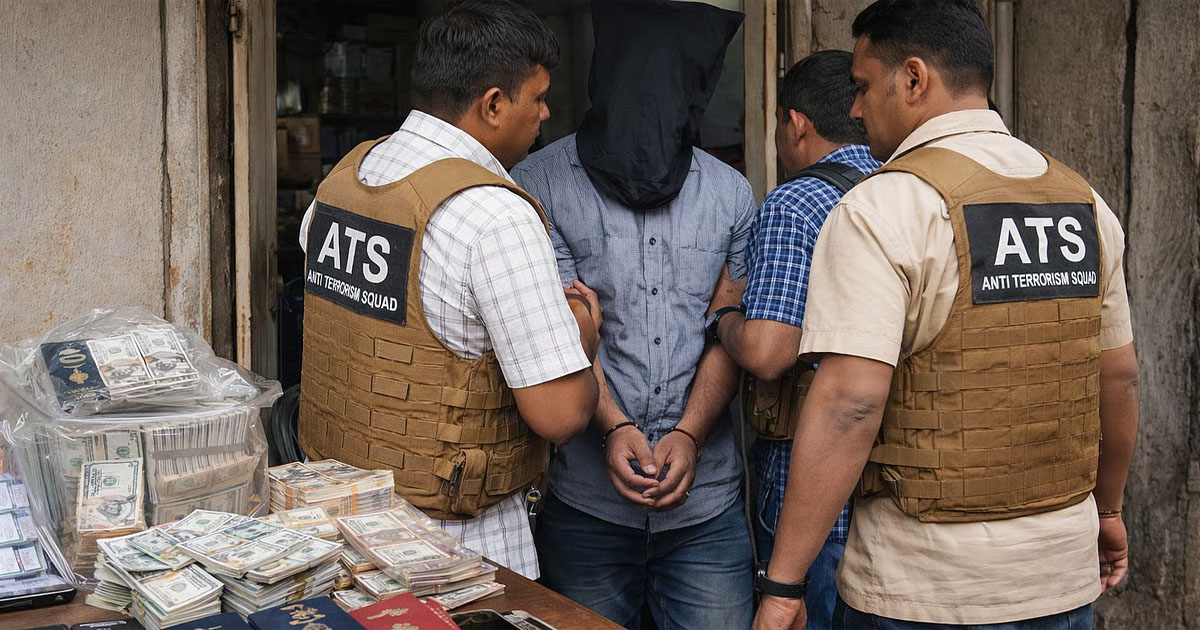
Mumbai: The Anti-Terrorism Branch (ATB) of the Special Branch busted a hawala racket after coordinated raids at three locations in Kurar, Malad East, on Wednesday. One accused, Mohammed Islam Ismail Khan alias Salim Rahmatullah Shaikh, 49, has been detained for questioning. An FIR has been registered at Kurar Police Station against accused Mohammed Islam Ismail Khan under Sections 318(4), 319(2), 336(3), 337, 340(2), and 180 of the Bharatiya Nyaya Sanhita (BNS), along with Section 12(1)(b) of the Passports Act, 1967, and Sections 3 and 13 of the Foreign Exchange Management Act (FEMA), 1999.
The raids were conducted at Flat No 1302, Fatema Tower, Pathanwadi; Flat No 904, D-Wing, Sugra Park, RS Road; and a ground-floor office in Parekh Overseas building, all in Malad East.
During the operation, officials seized cash worth ₹12.5 lakh, foreign currency worth around ₹2 lakh in Kuwaiti dinars, multiple fake passports, nine mobile phones, a laptop, an iPad and larg number of documents, including bank wire transfer records.
Preliminary investigation revealed that the accused had been residing in Kuwait for the past 22 years and frequently visited Mumbai for short durations of two to three months. He allegedly owns three laundry businesses in Kuwait and operates two offices in Mumbai.
Police sources said multiple passports were fraudulently obtained under different identities, two in the name of Mohammed Islam Ismail Khan and three in the name of Salim Rahmatullah Shaikh.
Authorities are probing a possible terror funding angle linked to the hawala operations. The detained accused is being questioned, and the process of registering a case at Kurar police station is underway. Senior Police Inspector Umesh Patil confirmed the development.

Marathi requirement for permits and licenses for rickshaw and taxi drivers is absolutely wrong, Marathi language should be taught first: Abu Asim

Mumbai: Ashok Kharat case creates stir across the state, Pratibha Chakankar also under investigation, new revelations

Mumbai: Purohit’s career growth had been effectively frozen since 2008 following his arrest in connection with the Malegaon blast case.

‘Scary & Traumatic’: Commuter Alleges Mobbing By Auto Drivers Over Uber Bike Booking In Navi Mumbai

Afghanistan: 148 killed, 216 injured in weather disasters over last two weeks

Married Mumbai Woman Mocked In Andheri Society Over ‘Lift Kissing’ CCTV Video, Files Police Complaint

LPG Crisis In Maharashtra: Cyber Crime On Rise Amid Shortage, 2 Women Lose ₹4 Lakh In ‘Gas Update’ Online Scam In Kalyan-Dombivli

Dhurandhar 2 Box Office Collection Day 1: Ranveer Singh Starrer Takes An Exceptional Opening; Crosses ₹100 Crore Mark

Mumbai Police Busts Fake Apple Accessories Racket In Ghatkopar, ₹16.33 Lakh Goods Seized; Six Booked

Mumbai: 28-Year-Old Ghatkopar Woman Killed By Speeding Tanker While Crossing Road, Driver Arrested
-

 Crime4 years ago
Class 10 student jumps to death in Jaipur
-

 Maharashtra2 years ago
Mumbai Local Train Update: Central Railway’s New Timetable Comes Into Effect; Check Full List Of Revised Timings & Stations
-

 Maharashtra1 year ago
Mumbai To Go Toll-Free Tonight! Maharashtra Govt Announces Complete Toll Waiver For Light Motor Vehicles At All 5 Entry Points Of City
-

 Maharashtra2 years ago
False photo of Imtiaz Jaleel’s rally, exposing the fooling conspiracy
-

 National News1 year ago
Ministry of Railways rolls out Special Drive 4.0 with focus on digitisation, cleanliness, inclusiveness and grievance redressal
-

 Maharashtra1 year ago
Maharashtra Elections 2024: Mumbai Metro & BEST Services Extended Till Midnight On Voting Day
-

 National News2 years ago
J&K: 4 Jawans Killed, 28 Injured After Bus Carrying BSF Personnel For Poll Duty Falls Into Gorge In Budgam; Terrifying Visuals Surface
-

 Crime1 year ago
Baba Siddique Murder: Mumbai Police Unable To Get Lawrence Bishnoi Custody Due To Home Ministry Order, Says Report