
National News
CJI to Shinde: Ignoring political parties after being elected, isn’t a danger to democracy?

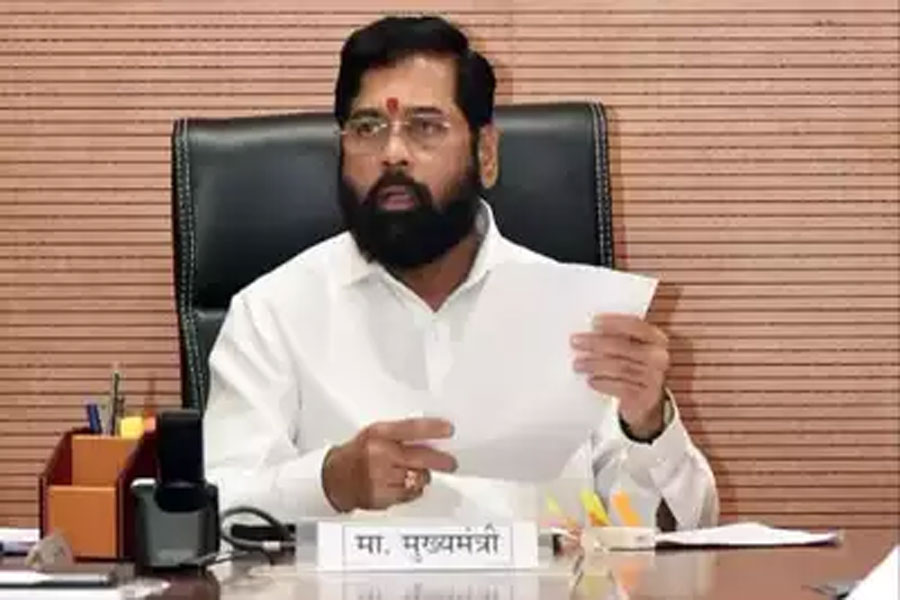
The Supreme Court on Thursday queried Maharashtra Chief Minister Eknath Shinde’s counsel, that ‘if completely ignoring political parties after being elected, is it not a danger to democracy?’
Shinde’s counsel submitted that his client is not disqualified, and he has also not left the party, and emphasized on the aspect of dissent within a political party.
Senior advocate Harish Salve, representing Shinde, submitted that disqualification under the Tenth Schedule of the Constitution takes place, only if the Speaker reaches a conclusion that a member has voted against the stand of a party. Salve added that if the Speaker of an Assembly takes one or two months to decide on disqualification pleas against MLAs, then what does this mean? That they should stop attending the proceedings of the House? He further added, “There is no per se illegality principle, until and unless there is a finding of disqualification…”
A bench headed by Chief Justice N.V. Ramana and comprising Justices Krishna Murari and Hima Kohli said, “What is the use of whip then? Does anti-defection apply to only those things?”
Salve replied that the anti-defection law cannot be an anti-dissent law.
The Chief Justice queried, if completely ignoring political parties after being elected, is it not a danger to democracy? Justice Ramana further queried “You say this court and high court should not hear this and this is after you had approached us first.”
Salve said that in facts of this case, there is nothing to show that these people left the party. The Chief Justice told Salve, “Today you say the court can’t go into the issue…because the Speaker has the power”. Salve said, “I am not disqualified, I have not left the party…”
Senior advocate Kapil Sibal, representing the Uddhav Thackeray faction, submitted that there was no need to refer the issue to a constitution bench.
The Chief Justice posed a query, suppose there are two groups saying we are the real political party, and general members of the political party cannot claim to recognise who is the original political party. Sibal contended that a group may say that they have the support of 40 out of 50 MLAs, so they are the real political party. He added, if the 40 are disqualified? If the Election Commission decides one way or the other, what happens to this defection?
Senior advocate Abhishek Manu Singhvi, also representing the Thackeray group, said that till this court decides, how can Election Commission decide this issue, and later they would say that these proceedings are infructuous?
Senior advocate Arvind Datar, representing the Election Commission, submitted that disqualification of rebel MLA means their disqualification from the House, not from the political party. Datar added that this is not a political issue and the Tenth Schedule cannot interdict this. “I can only decide who can have the symbol after the evidence is adduced,” said Datar.
After hearing arguments, the top court orally asked the Election Commission of India to not take any precipitative action on the claim raised by the Shinde group for recognising them as the real Shiv Sena party in the meanwhile, and allow Thackeray faction to submit their response. The top court said it will decide by Monday whether to refer to a larger bench regarding the constitutional questions involved in the disqualification of MLAs arising from the Maharashtra political scenario.


National News
Change certain in Bengal, will perform brilliantly in other states: NDA leaders on exit polls

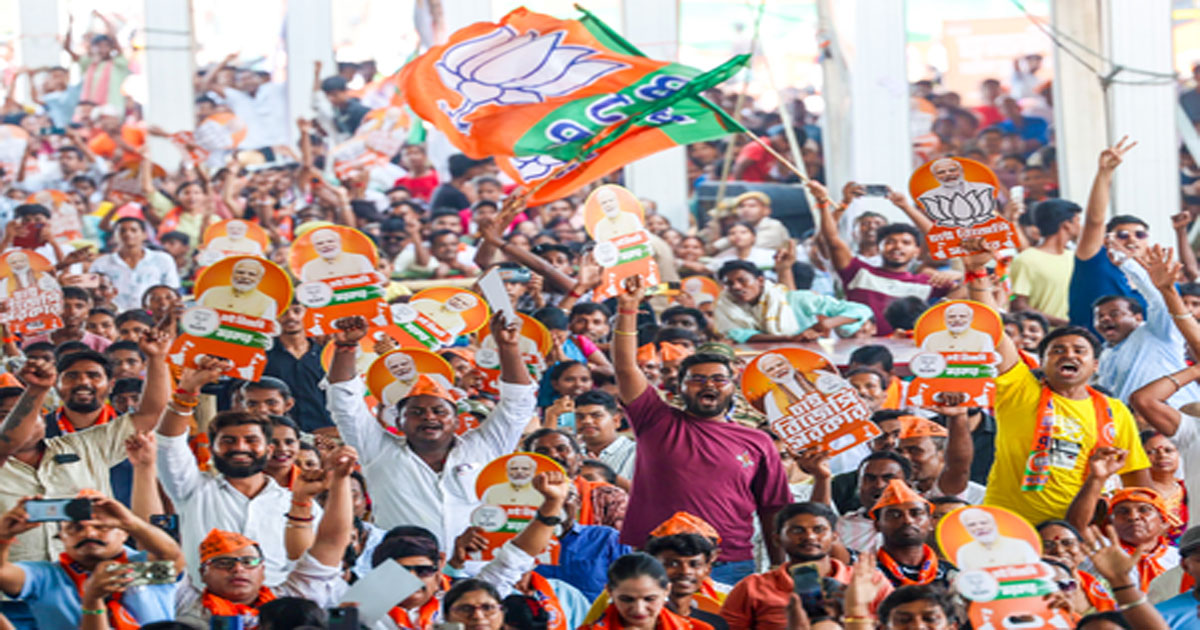
New Delhi, April 30: As multiple exit polls projected notable gains for the BJP in West Bengal and Assam, leaders of the National Democratic Alliance (NDA) on Thursday voiced confidence that “double-engine governments” would be formed in both states, while also expressing optimism about the party’s performance in Tamil Nadu and Kerala.
According to Matrize exit poll findings, the BJP is likely to register a strong showing in the West Bengal Assembly elections, with projections placing the party in the range of 146–161 seats and a vote share of around 42.5 per cent.
The same survey indicates that in Tamil Nadu, which has a 234-seat Assembly, the DMK-led alliance is expected to retain power. In Kerala’s 140-seat Assembly, a close contest is anticipated between the two main fronts. Matrize projects the Congress-led UDF to secure 70–75 seats, slightly ahead of the Left Democratic Front (LDF), which is estimated to win 60–65 seats.
The reuslts will be announced on May 4.
Reacting to the projections, Union Minister Gajendra Singh Shekhawat said, “This time in Bengal, the people of Bengal have made up their mind for change. Change is definitely going to happen.”
Bihar BJP President Sanjay Saraogi struck a cautious note while referring to the exit polls, and told media, “According to exit polls, the Bharatiya Janata Party appears to be leading. However, the final results will only be known on counting day… For the first time, many people who were previously deprived of voting rights were able to cast their votes.”
He further added that based on exit poll results, “it appears that the Bharatiya Janata Party will come to power in West Bengal.”
“For the first time, voters in Bengal have been able to cast their votes in a peaceful and fear-free environment. In past elections, there have been allegations of violence and booth capturing, but this time, voters were able to exercise their right freely and in large numbers,” he said.
JD(U) Rajya Sabha MP, Sanjay Kumar Jha, also stated that the BJP will win in Bengal. Speaking to the reporters, Jha said, “Many exit polls from Bengal indicate that the NDA is ahead. The results will come on the 4th, but based on the feedback from journalists and political people who went, and since it is a neighbouring state, an NDA government is coming to Bengal.”
Delhi Chief Minister Rekha Gupta said the trend was expected, remarking, “This was bound to happen. The people have given their full blessings… The change in Bengal is certain, which will be visible to us on the 4th in the form of results.”
Delhi Minister Kapil Mishra added a lighter tone to the political anticipation, saying, “May 4 is about to come, and saffron is visible everywhere. The mood of the public is now understandable. I think we should wait for the evening of the 4th, everyone will eat jhalmuri, everyone will eat jalebi.”
Speaking to the reporters, Uttar Pradesh Deputy Chief Minister Brajesh Pathak said, “In West Bengal, the BJP is seen coming with a strong majority in the exit polls. After voting, we should wait for the counting of votes.”
JD(U) national spokesperson Rajeev Ranjan Prasad said, “Undoubtedly, the exit poll trends and almost all surveys indicate that a massive mandate is going to be received by the Bharatiya Janata Party in Assam.”
BJP National Spokesperson Shahnawaz Hussain, speaking to media, also expressed strong confidence in the party’s prospects, stating, “The exit poll results indicate that in Assam and West Bengal, our government is going to be formed with a huge majority. We will also perform well in Tamil Nadu, and in Keralam, we are expected to deliver a surprise result. In West Bengal, just as the sunrise is certain, the formation of the Bharatiya Janata Party government is also certain.”

New Delhi, April 24: As India and New Zealand prepare to sign a Free Trade Agreement (FTA) on Monday, both sides are expected to benefit from expanded trade ties and improved market access, New Zealand Prime Minister Christopher Luxon has said.
Taking to the social media platform X, Luxon said, “We will sign a Free Trade Agreement with India on Monday.”
In a video message, Luxon said the agreement would improve market access for New Zealand exporters, particularly manufacturers of marine jet systems used in boats and exported to over 70 countries.
He added that the deal would help reduce trade barriers and strengthen commercial engagement between the two countries.
He also noted that certain exporters currently face tariffs while accessing the Indian market, and said the agreement would gradually ease such duties, improving competitiveness and supporting higher trade flows.
Luxon said the FTA would support increased business activity, employment opportunities and economic growth in New Zealand, while also strengthening bilateral trade linkages with India.
He added that the agreement would bring ‘more jobs, higher wages and more opportunities,’ highlighting the broader economic impact of the deal.
Once signed, the FTA is expected to expand trade and investment ties between the two countries and enhance export opportunities on both sides in a large and growing global market environment.
Earlier this month, legal verification of the New Zealand-India FTA was completed, with both countries agreeing to sign the pact on April 27 in the presence of a large contingent of business representatives, New Zealand Trade and Investment Minister Todd McClay said.
In a statement, McClay described the agreement as a “once-in-a-generation opportunity,” saying it would strengthen bilateral trade relations and provide improved access to each other’s markets.
He said that amid global economic and geopolitical uncertainty, strengthening trade partnerships remains important for long-term economic stability.
McClay added that signing the FTA would allow New Zealand to formally initiate parliamentary treaty examination, enabling public scrutiny of the agreement.
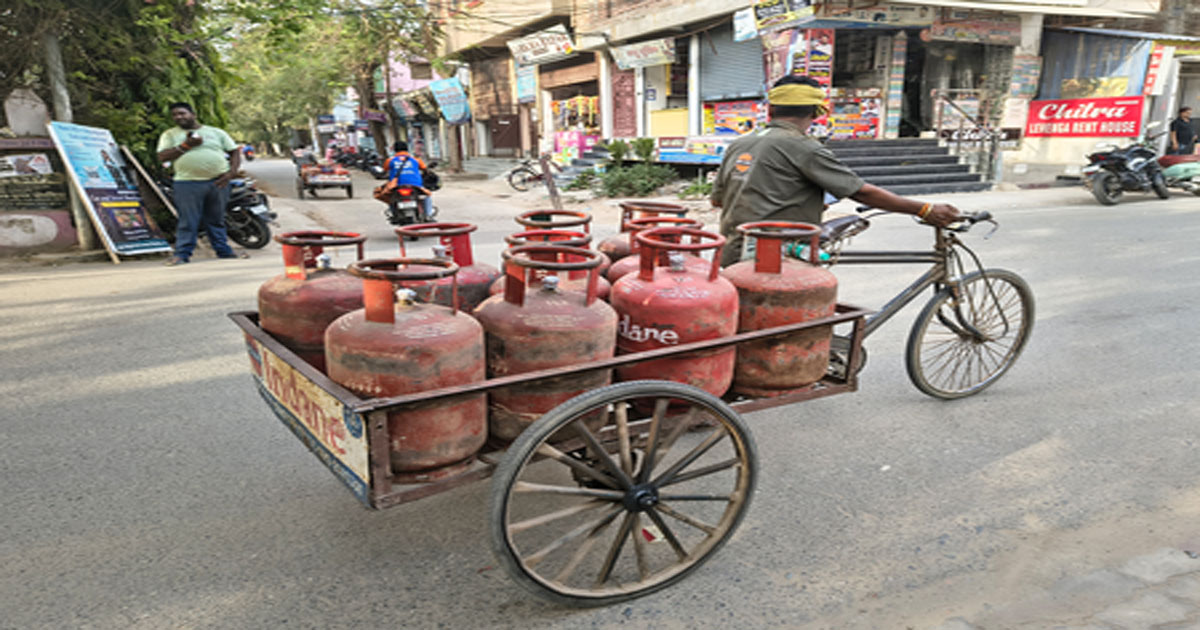
New Delhi, April 23: In a major breakthrough, the AGS/Crime Branch of Delhi Police, acting on specific and credible intelligence, carried out coordinated raids at multiple locations in the Palam and Dwarka areas, uncovering a large-scale illegal operation involving the unauthorised storage and refilling of LPG cylinders, officials said on Thursday.
The crackdown resulted in the recovery of 137 LPG cylinders along with refilling equipment, exposing serious violations of safety norms and regulatory guidelines. Officials said the operation points to a deliberate misuse of the LPG distribution system.
Keeping in view the prevailing circumstances, and as a preventive step against hoarding and black marketing of LPG cylinders, a dedicated team was constituted to identify and apprehend those involved in such activities.
The team comprised Inspector Krishan Kumar, along with Sub-Inspectors Narender Kumar and Agam Prasad; Assistant Sub-Inspectors Surender, Mintu, and Deepak; Head Constable Shyam Sunder; and Constable Dheeraj. The operation was carried out under the close supervision of ACP Bhagwati Prasad, ACP/AGS, and overall supervision of IPS officer Harsh Indora, DCP/Crime Branch.
Following sustained groundwork, specific and credible secret information was received regarding hoarding and illegal refilling of LPG cylinders in the Dwarka and Palam areas of Delhi.
Acting on the input, a raiding team was formed, and a search operation was conducted at JJ Colony, Sector-7, Dwarka. During the raid, 77 LPG cylinders were found stored at the premises. Some cylinders were also discovered loaded in vehicles present at the spot.
The following persons, all residents of Delhi, were found present along with their vehicles — Arjun (45), a resident of Bagdola; Surajpal Pandey (42), resident of Raj Nagar-II, Palam Colony; Amarjeet Kumar (28), resident of Raj Nagar-II, Palam Colony; Prempal Singh (52), resident of Raj Nagar-II, Palam Colony; Sukh Ram (48), resident of Goyla Dairy, Kutub Vihar Phase-1; and Vikram (42), resident of Dada Dev Road, Dev Kunj, Palam.
When questioned about the possession of such a large number of LPG cylinders, they failed to produce any valid documents or a satisfactory explanation. Subsequent interrogation led to further raids at two additional locations.
In a second recovery, 25 LPG cylinders were seized from a tempo parked near the premises. The owner of the vehicle, Malkhan (59), a resident of Sector-7, Dwarka, was found present at the spot.
A third recovery led to the seizure of 35 LPG cylinders from premises in Gali No. 6, near Bachpan Play School, Dev Kunj, Raj Nagar-II, Palam Colony, where the cylinders were stocked in an open area adjoining a house.
At this location, the following persons were found present: Raju Rai, a resident of Manglapuri Phase-II; Chander Pal, a resident of Palam Dada Dev Road; Bablu, a resident of Goyla Dairy; and Sujeet Kumar, a resident of Shyam Vihar Phase-1.
Considering the scale of the recovery, the Food and Supply Officer (FSO), Palam-Dwarka, was informed and called to the spot. The official stated that such accumulation of LPG cylinders is not authorised without proper permission. In his presence, all the recovered cylinders were seized.
The FSO subsequently informed the Senior Manager (LPGS), New Delhi and South-West District, and the case property was handed over to Shivam Jain, Senior Manager (LPGS).
All the accused persons have been apprehended. Investigations revealed that they were illegally storing domestic LPG cylinders for black market purposes and were involved in unauthorised refilling and tampering of cylinders, officials said.
A case has been registered at the Crime Branch police station under Sections 125/3(5) of the BNS and Section 3/7 of the Essential Commodities Act, 1955.
During interrogation, it emerged that the accused had procured LPG cylinders from a gas agency, but instead of delivering them as per the assigned targets, they diverted and stored them illegally at the identified premises.
They maintained an unauthorised stock and used illegal equipment to transfer gas from filled cylinders into empty ones, which were then sold in the open market for unlawful gains.
Further investigation into the matter is currently underway.

Maharashtra Proposes 325 ‘Vihardhams’ For Jain Monks, Expands Welfare

Mumbai: Water pipeline tunnel work from Amar Mahal to Wadala, Parel along with Trombay and Tarbhai high level reservoirs, water supply stopped

Change certain in Bengal, will perform brilliantly in other states: NDA leaders on exit polls

Thane Woman, 61, Duped Of ₹15.76 Lakh By Fraudsters Posing As Officials; Police Register Case, Launch Probe To Trace Accused

‘No Fear, I Am Not Scared’: Dawood Ibrahim’s Aide Salim Dola’s 1st Reaction After Being Brought To Mumbai Following Istanbul Arrest

Iran-Israel Conflict Hits India’s Real Estate: Supply Disruptions & Rising Costs Delay Project Possessions

‘Son Falsely Implicated, We Are Well-Educated’: Father Of Accused Tausif Attar Defends Son After Skullcap, Namaz Coercion Allegations Rock TCS Nashik

Mumbai: Pan-India Hawala Trail Exposes Chilling Conspiracy Behind Rohit Shetty House Firing Case

Asha Bhosle’s son says last respects to be paid at residence in Lower Parel, followed by last rites at Shivaji Park

Crude oil prices tank up to 20 pc over Iran ceasefire announcement
-

 Crime4 years ago
Class 10 student jumps to death in Jaipur
-

 Maharashtra2 years ago
Mumbai Local Train Update: Central Railway’s New Timetable Comes Into Effect; Check Full List Of Revised Timings & Stations
-

 Maharashtra2 years ago
Mumbai To Go Toll-Free Tonight! Maharashtra Govt Announces Complete Toll Waiver For Light Motor Vehicles At All 5 Entry Points Of City
-

 Maharashtra2 years ago
False photo of Imtiaz Jaleel’s rally, exposing the fooling conspiracy
-

 National News2 years ago
Ministry of Railways rolls out Special Drive 4.0 with focus on digitisation, cleanliness, inclusiveness and grievance redressal
-

 Maharashtra1 year ago
Maharashtra Elections 2024: Mumbai Metro & BEST Services Extended Till Midnight On Voting Day
-

 National News2 years ago
J&K: 4 Jawans Killed, 28 Injured After Bus Carrying BSF Personnel For Poll Duty Falls Into Gorge In Budgam; Terrifying Visuals Surface
-

 Crime2 years ago
Baba Siddique Murder: Mumbai Police Unable To Get Lawrence Bishnoi Custody Due To Home Ministry Order, Says Report