
National News
SC agrees to extend tenure of ED chief Sanjay Mishra till September 15 (Lead)

The Supreme Court on Thursday agreed to extend, till September 15, the tenure of the present ED Director Sanjay Mishra, who was due to demit office on July 31 in accordance with its recent judgement.
“In ordinary circumstances we would not have accepted such an application…taking into consideration larger public interest, we permit the ED Director to continue till September 15, 2023,” a special bench of Justices B.R. Gavai, Vikram Nath, and Sanjay Karol ordered.
However, the bench clarified that it will not entertain any further application by the Centre seeking extension of tenure of the present ED Director. It said that Mishra will cease to hold the post from the midnight of September 15/16, 2023.
At the outset of the hearing, the bench asked whether the ED does not have any other competent officer to deal with the FATF review.
“Are you not giving a picture that your entire department is full of incompetent officers? You have only one officer? Is it not demoralising the entire force?” queried the special bench.
Solicitor General Tushar Mehta, representing the Centre, repeatedly urged before the court that any change in leadership at the ED would adversely impact India’s national interests in view of the ongoing FATF Review which is at a critical stage.
“Circumstances are unusual. From November 3, FATF will visit India. This is a peer review of the past 5 years. This isn’t an annual exercise. Continuity will help the country,” he said.
“It is not that one person is indispensable. It’s just that continuity will help give a better presentation to the international body. We need continuity to put forth that before the international body,” he added.
The FATF is an inter-governmental body which has developed its recommendations to prevent and combat money laundering and terror financing. Around 200 countries, including India, have committed to implement these standards. The FATF conducts peer reviews of all its member countries on a regular basis to assess levels of implementation of the FATF recommendations and provide an in-depth description and analysis of each country’s system for preventing criminal abuse of the financial system.
On the other hand, senior advocate Abhishek Manu Singhvi opposed the application for extension, saying that Centre is making an attempt to get a review of the judgment rendered by the apex court.
Senior advocate Anoop G. Chaudhari, representing original writ petitioners, argued that in relation to FAFT, the main authority is Union Revenue Secretary and application filed by the Centre is “misconceived” and “deserves to be rejected”.
Advocate Prashant Bhushan went on to say that the Centre’s application is a “gross abuse of process of court” and a review application has been filed in guise of an application seeking extension.
In its order delivered in open court, the bench allowed the Union government’s request “in view of the larger public interest”, but granted an extension only till September 15, while the application moved by the Centre has requested extension up to October 15.
On Wednesday, the Supreme Court agreed to constitute a special bench to hear the Centre’s application on July 27 after Mehta sought an urgent listing of the matter.
In a judgement on July 11, the Supreme Court dubbed the extension of Mishra as “illegal” for violating the mandate of the top court’s judgment in 2021. However, the top court had allowed him to continue in the post till July 31 taking into consideration the concerns expressed by the Union government with regard to the FATF review and taking into consideration that the process of fresh appointment would take some time.
The court had held that the extension granted to Mishra was contrary to an earlier 2021 judgment rendered by a division bench of the Supreme Court in this regard.
Mishra was first appointed as ED Director for a two-year term in November 2018. His term expired in November 2020. In May 2020, he had reached the retirement age of 60.
However, on November 13, 2020, the Central government issued an office order stating that the President had modified the 2018 order to the effect that a time of ‘two years’ was changed to a period of ‘three years.’ This was challenged before the Supreme Court by the NGO Common Cause.
The Supreme Court in a September 2021 verdict approved the modification, but ruled against granting more extensions to Mishra. After the court’s decision in 2021, the Central government brought in an ordinance amending the Central Vigilance Commission (CVC) Act, giving itself the power to extend the tenure of the ED Director by up to five years, and the law in this regard was subsequently passed by the Parliament.
“Challenge to CVC Act and Delhi Special Police Establishment Act is dismissed to that extent. Extension granted to Sanjay Kumar Mishra after Supreme Court verdict is illegal. However, he is permitted to hold office till July 31, 2023,” the court had ordered on July 11.

National News
Delhi HC agrees to urgent hearing on plea seeking release of CJP leaders Saurav Das, Ashutosh Ranka

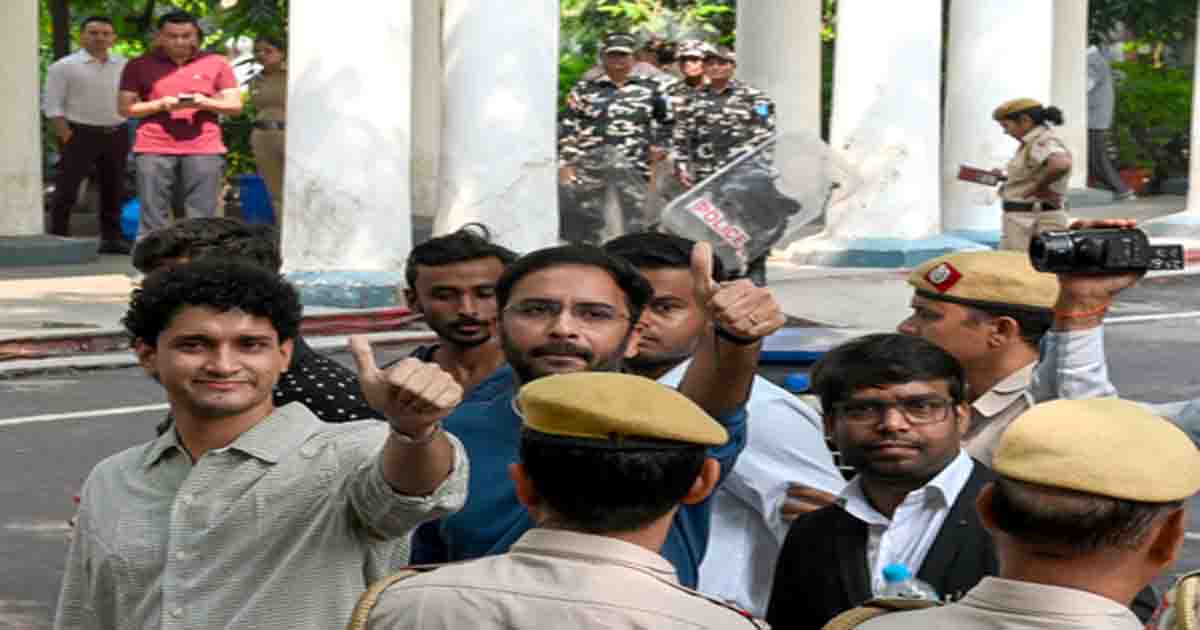
The Delhi High Court on Wednesday agreed to hear urgently a plea filed by Cockroach Janta Party (CJP) activists Saurav Das and Ashutosh Ranka seeking their release from custody in connection with the Jantar Mantar trespassing case.
The development comes on the day their judicial custody is due to end, with the two activists also scheduled to be produced before the Special Executive Magistrate (SEM) court.
CJP’s legal affairs head, Ratna Singh, said on Tuesday that the duo had moved the High Court and requested an urgent hearing at night.
“We have moved the Delhi High Court and requested an urgent night hearing. Saurav and Ashutosh should not spend a single minute behind bars. Their liberty must not be curtailed because of political games. Justice must not wait,” she said in a post on X.
On Monday, SEM Ritu Raj had extended their custody, observing that their conduct “shows no respect for law” and reflects their “habitualness in calling protest at de-notified areas”.
In its order, the SEM court said the Investigating Officer had placed substantial material on record, raising concerns over the likelihood of a breach of peace and disturbance of public tranquillity.
It also recorded that the two leaders had allegedly breached the bonds furnished by them before the SEM, South-West District, on October 11 and subsequently committed a breach of peace in the present case.
The SEM further observed that their assurance that they would not repeat the alleged offence did not inspire confidence in view of their past conduct and the material placed on record by the Investigating Officer.
Das and Ranka, along with party member Ajinkya Shinde, were among 14 people detained on October 13 after they allegedly entered Jantar Mantar through private premises and obstructed police personnel from discharging their official duties.
The CJP members were protesting against alleged irregularities in the Special Intensive Revision (SIR) of electoral rolls and had raised slogans against Chief Election Commissioner Gyanesh Kumar.
Delhi Police had justified their continued custody, citing repeated violations of law and apprehensions that their release could lead to further violations and instigation of others.
The SEM court had also found the sureties furnished on behalf of the two leaders unfit following an enquiry, citing discrepancies in identity documents and their inability to provide basic details about the persons for whom they stood surety. It had directed them to furnish fresh sureties.

A 52-year-old truck driver lost his life after being hit by a vehicle near Machlilok under the Mufassil police station area in West Champaran district on Wednesday. The vehicle reportedly bore a sign identifying it as belonging to the Senior DSP (Administration) at the DIG’s office, according to the deceased’s brother.
The deceased was identified as Sheikh Arman, son of Sheikh Serajul Haque and a resident of Beldari Ward No. 35.
According to his brother, Mohammad Nezam, the incident occurred around 6 a.m. when Arman had parked his truck along the Bettiah-Motihari main road near Machlilok and stopped to have tea.
A vehicle allegedly struck him, leaving him seriously injured.
Police personnel travelling in the vehicle took Arman to the Government Medical College and Hospital (GMCH) in Bettiah for treatment.
However, he succumbed to his injuries at around 8.45 a.m., despite medical intervention.
Following his death, family members rushed to the hospital. Police sent the body for a post-mortem examination.
Nezam claimed that the vehicle involved in the accident carried a sign identifying it as belonging to the Senior DSP (Administration) at the DIG’s office.
However, there was no official confirmation regarding the identity of the driver or the other occupants of the vehicle at the time of the incident.
Arman was the eldest of five brothers and is survived by his wife, Salma Khatoon, and four sons, according to his family.
His death has plunged the family into grief, while residents of the Beldari locality were mourning the loss.
The incident has also triggered anger among local residents, particularly over the reported involvement of a vehicle bearing the police official’s designation.
No detailed official statement regarding the circumstances of the accident had been issued at the time of reporting.
Further details about the incident and the responsibility for the collision are awaited.
National News
‘Free and fair polls part of basic structure’: SC directs Andhra SEC to decide on nomination extension, ensure security for candidates

The Supreme Court on Wednesday directed the Andhra Pradesh State Election Commission (SEC) to examine allegations that candidates of the Y.S. Jagan Mohan Reddy-led YSRCP were prevented from filing nominations for Urban Local Body elections and decide by Thursday whether the deadline should be extended in affected municipalities.
A Bench of Justices Joymalya Bagchi and V. Mohana ordered the state poll panel to keep the final list of contesting candidates on hold until October 25, pending its decision on the representations and evidence submitted by the YSRCP and other candidates.
The Justice Bagchi-led Bench said that wherever an extension is granted, candidates must be given at least 48 hours from the publication of the SEC’s decision to submit their nomination papers.
The election notification will have to be amended accordingly, the apex court ordered. It also directed the Director General of Police (DGP) to ensure adequate security at nomination centres, including police deployment and CCTV coverage, and file a compliance report.
The Supreme Court further asked the respective Superintendents of Police to provide protection to YSRCP candidates and directed that nomination papers be received by Collectors at district headquarters wherever necessary.
Observing that free and fair elections are part of the basic structure of the Constitution, the Justice Bagchi-led Bench said the right to participate in elections by filing nominations is an integral facet of the electoral process.
It said that constitutional courts could not remain entirely silent when allegations of obstruction in filing nomination papers were brought before them by a principal Opposition party, particularly when the party had submitted representations and supporting material even before the election process commenced.
“Instilling confidence in the election process is vital for the maintenance of constitutional democracy,” the Supreme Court said, stressing the need for the state authorities to ensure a level playing field.
The SEC has been asked to assess the representations on their merits, along with documentary and electronic evidence, and take appropriate measures to ensure that eligible candidates are not denied an opportunity to contest.
The matter will be heard again on October 27, when the state poll panel and the state government are required to submit compliance affidavits.
The directions came on a Special Leave Petition (SLP) filed by the YSRCP challenging an order of the Andhra Pradesh High Court, which refused to extend the deadline for filing nominations amid allegations of violence and obstruction during the local body election process.
The party had alleged that its candidates were prevented from filing nomination papers in several areas, including Punganur, Rayachoti, Kadapa and Tirupati, after the nomination process opened on October 16.
According to the petition, nomination papers of a candidate in Kadapa were allegedly seized and torn, while several candidates in Tirupati were prevented from entering the rooms of the Returning Officers concerned.
It also alleged that party workers and MP P.V. Midhun Reddy were attacked while travelling to file nomination papers.
The YSRCP had initially approached the High Court seeking alternative nomination centres with adequate security.
A single judge, on October 15, declined to grant the blanket relief sought but allowed individual candidates facing threats to approach the Election Officers concerned, for permission to file nominations at alternative locations.
The party subsequently sought a one-day extension of the nomination deadline, contending that the alleged disruptions had deprived its candidates of an opportunity to contest the elections.
Dismissing the application on October 18, a Division Bench of the High Court held that the nomination period had expired and that extending it at that stage would amount to interference with the election process.
The High Court also observed that the relief sought went beyond the scope of the original writ petition.
In its SLP before the Supreme Court, the YSRCP contended that restrictions on judicial intervention in election matters should not prevent constitutional courts from issuing directions to safeguard the conduct of free and fair polls.

Manipur burns while Delhi barricades: Shiv Sena(UBT) in ‘Samaana’

Delhi HC agrees to urgent hearing on plea seeking release of CJP leaders Saurav Das, Ashutosh Ranka

Truck driver dies after being hit by vehicle with DSP sticker in Bihar West Champaran

‘Free and fair polls part of basic structure’: SC directs Andhra SEC to decide on nomination extension, ensure security for candidates

Sensex, Nifty surge up to 1 pc in early deals; IT shares lead gains

Rahul, Cong ecosystem want to force regime change: BJP after Neha Bora praises B’desh Gen-Z protest

BJP pays tribute to ex-President Abdul Kalam, recalls his enduring influence on generations of India’s youth

Attack on democratic rights: INDIA Bloc leaders on detentions of anti-ECI protestors

INDIA bloc begins protest march against ECI

Maha Congress stages agitation against Gyanesh Kumar
-

 Crime4 years ago
Class 10 student jumps to death in Jaipur
-

 Maharashtra2 years ago
Mumbai Local Train Update: Central Railway’s New Timetable Comes Into Effect; Check Full List Of Revised Timings & Stations
-

 Maharashtra2 years ago
Mumbai To Go Toll-Free Tonight! Maharashtra Govt Announces Complete Toll Waiver For Light Motor Vehicles At All 5 Entry Points Of City
-

 Maharashtra2 years ago
False photo of Imtiaz Jaleel’s rally, exposing the fooling conspiracy
-

 National News2 years ago
Ministry of Railways rolls out Special Drive 4.0 with focus on digitisation, cleanliness, inclusiveness and grievance redressal
-

 Maharashtra2 years ago
Maharashtra Elections 2024: Mumbai Metro & BEST Services Extended Till Midnight On Voting Day
-

 National News2 years ago
J&K: 4 Jawans Killed, 28 Injured After Bus Carrying BSF Personnel For Poll Duty Falls Into Gorge In Budgam; Terrifying Visuals Surface
-

 Crime2 years ago
Baba Siddique Murder: Mumbai Police Unable To Get Lawrence Bishnoi Custody Due To Home Ministry Order, Says Report