
National News
Raj Kumar appointed new Chief Secy of Gujarat

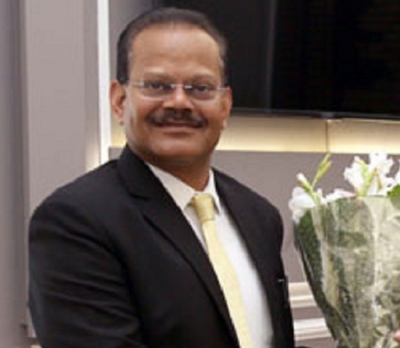
The Gujarat Government on Wednesday promoted Additional Chief Secretary Raj Kumar as Chief Secretary of the state with effect from January 31.
He will take charge on January 31, when Chief Secretary Pankaj Kumar retires from his office.
According to the government order, till January 31, Raj Kumar would officiate as officer on Special Duty in Chief Secretary’s office.
Raj Kumar was appointed as Additional Chief Secretary (Home) on December 6, 2021, after he was repatriated from Central deputation.
The present Chief Secretary Pankaj Kumar, had retired from his post in mid 2022, on reaching superannuation, but his term was extended for six months keeping in view the state assembly elections.
Second senior-most IAS officer and Additional Chief Secretary Vipul Mitra is likely to be appointed as Chairman of Gujarat State Fertiliser Company and any other public sector company of Gujarat, said sources.

National News
Rajnath Singh accuses Cong of seeking ‘regime change’, says ‘they want power by creating anarchy’

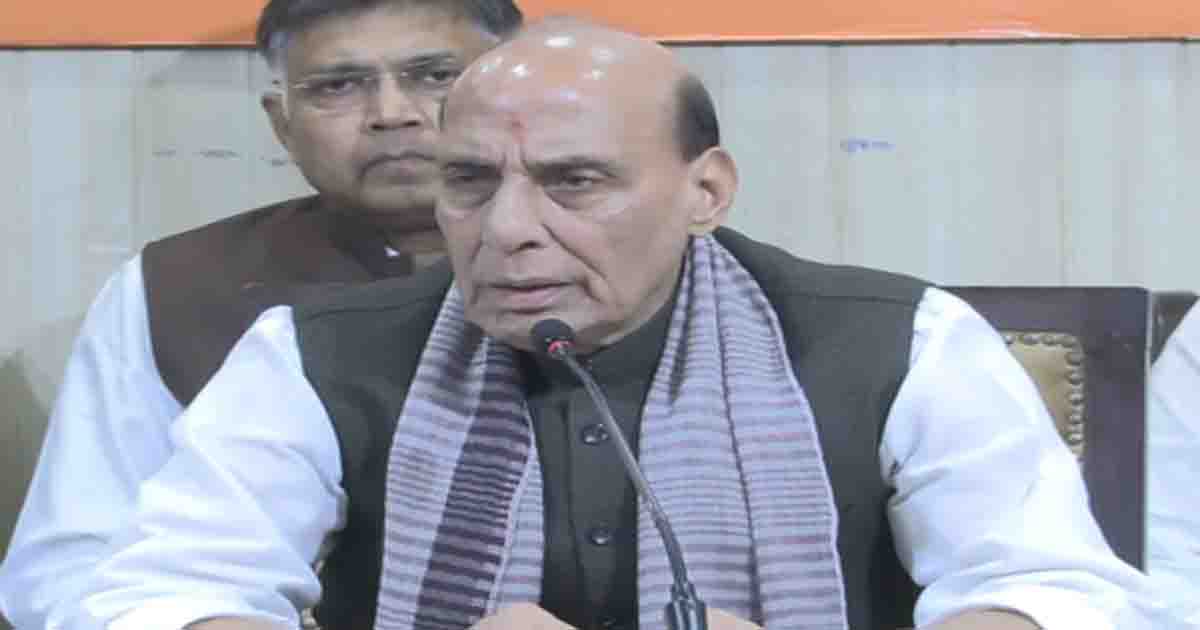
Lucknow, Oct 16: Defence Minister Rajnath Singh on Friday launched a scathing attack on Congress, saying that its fight was neither for the Election Commission nor for the Special Intensive Revision (SIR), but solely to capture power by creating anarchy in the country. Referring to Bangladesh, he accused the party of advocating “regime change”.
Addressing a press conference in Lucknow, Singh said the incidents that occurred in Delhi in recent days raised serious questions about the Congress’s intentions, alleging that the party was trying to divert the energy of the country’s youth from national progress and use it to create disorder.
“They want to change the regime like in Bangladesh and openly mention in their press conference that they are motivated by Bangladesh and talk about bringing down the government. It clearly shows that their sole agenda is to destroy democratic institutions.
“They are using words such as ‘regime change’, which clearly shows that their fight is neither for the Election Commission nor for the Special Intensive Revision (SIR), nor against Gyanesh Kumar, nor for the bright future of the youth. They simply want power by creating anarchy in the nation. When political selfishness is placed above truth or the nation’s interests, democratic discourse, instead of being guided by facts, becomes a victim of obstinacy and malicious propaganda,” Singh said.
Targeting Rahul Gandhi and his supporters, the Defence Minister said democracy could not be used as a licence to create anarchy, damage constitutional institutions, or obstruct India’s progress.
“Rahul Gandhi and his supporters must understand that democracy is not a licence to create anarchy, harm constitutional institutions or hinder India’s progress,” he said.
“To maintain law and order, laws must be respected. India’s constitutional institutions cannot be destroyed for political interests,” he added.
Singh also advised Rahul Gandhi to respect the people’s mandate and introspect on his political role, instead of engaging in political disruptions in the name of protecting democracy.
“Rahul Gandhi, instead of causing political disruptions in the name of saving democracy, should respect the people’s choice and undertake a self-evaluation of his political role. This is my suggestion to him. India’s future is the responsibility of everyone,” he said.
National News
Gujarat: 12-year-old swallows metal pin; AIIMS Rajkot doctors remove it without surgery
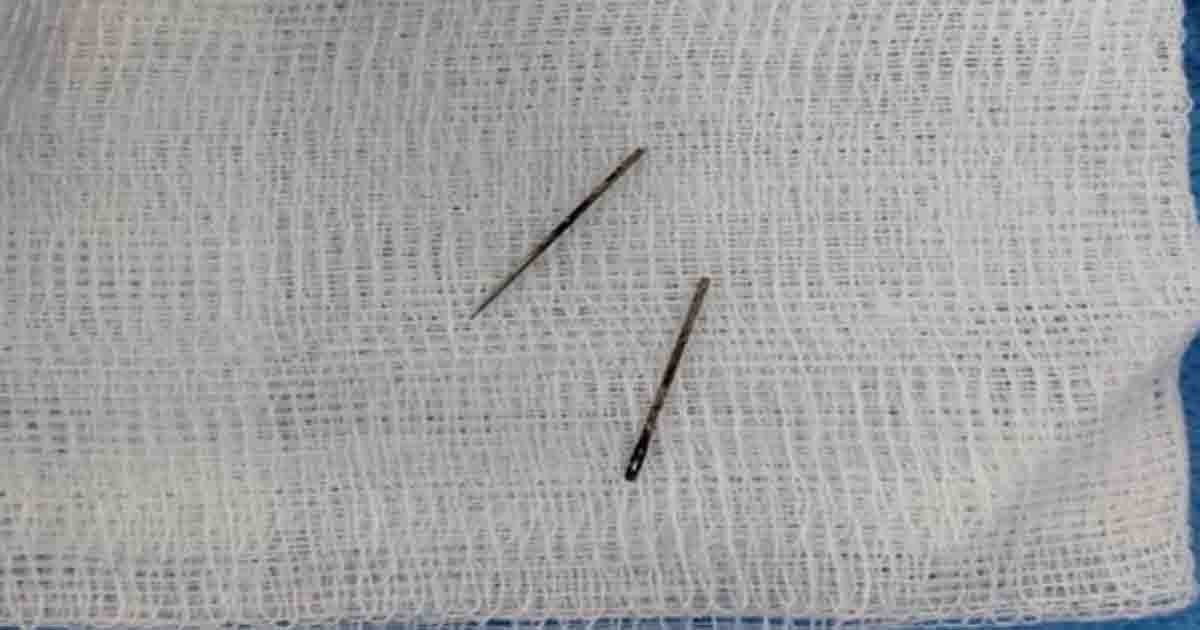
Rajkot, Oct 16: Doctors at the All India Institute of Medical Sciences (AIIMS), Rajkot, have removed a sharp metal pin lodged in the small intestine of a 12-year-old girl through endoscopy, avoiding the need for major surgery.
The girl, who had been experiencing persistent abdominal pain after accidentally swallowing the object, was discharged the day after the procedure.
A resident of Junagadh district, the girl had swallowed the pin accidentally a few days before being brought to AIIMS Rajkot.
Her family initially took her to Junagadh Civil Hospital and a private hospital, where an X-ray revealed a metallic object in the upper abdomen. They subsequently approached AIIMS Rajkot for further treatment.
The girl was examined at the General Surgery outpatient department, where doctors conducted further investigations in view of her continuing abdominal pain.
An X-ray showed that the sharp metal pin was lodged in the duodenum, with the first part of the small intestine beyond the stomach, at the junction of its second and third portions.
Doctors decided to remove the object through endoscopy to prevent prolonged retention from causing injury or other complications.
The procedure was performed by a senior team of doctors, and the anaesthesia team supported the procedure and administered anaesthesia.
During endoscopy, the medical team located and safely removed the sharp metal pin from the duodenum. The procedure was completed without an abdominal incision or major surgery, and the girl’s condition remained stable.
Following the procedure, doctors monitored her condition and reported no complications. She was started on a liquid diet six hours later, after which her diet was gradually returned to normal.
As her recovery progressed satisfactorily, she was discharged the following day. The doctors also advised parents to remain alert to the possibility of children accidentally swallowing small objects, including pins, coins and toy parts, while playing.
They cautioned against treating such incidents as harmless, even when a child does not immediately show symptoms.
Parents should not attempt to induce vomiting or remove a swallowed object themselves, but should seek medical attention promptly so that doctors can determine its location and provide appropriate treatment.
AIIMS Rajkot has endoscopy facilities to manage such cases, with treatment determined by the patient’s condition and the assessment of specialist doctors.

Varanasi, Oct 15: A massive explosion triggered the collapse of a two-storey building in Uttar Pradesh’s Varanasi on Thursday, leaving two people injured and a woman trapped under the debris, officials said.
The incident took place in the Paigambarpur area under the Sarnath police station area of Varanasi.
According to preliminary information, an illegal firecracker manufacturing unit was operating inside the house. The explosion is suspected to have occurred due to highly inflammable materials on the premises.
Two people were injured in the incident and have been taken to hospital for treatment, while efforts are underway to rescue a woman trapped under the rubble.
Speaking to media, DCP Rajesh Pandey said: “Information was received at 5 p.m. that a two-storey building had collapsed. Upon reaching the spot, we found firecrackers scattered around the place, so it is being considered that the incident took place due to the explosion of firecrackers.”
He said that according to locals, a woman is trapped under the debris and a rescue operation is currently underway to pull her out.
Uttar Pradesh Chief Minister Yogi Adityanath has directed officials to reach the site immediately and expedite relief operations, NDTV reported.
Further, CM Adityanath has instructed officials to ensure proper medical treatment for those injured. The officials have also been directed to contact the families of the injured and provide them with all possible assistance.
In August, eleven people were killed, and five others suffered serious injuries after an explosion ripped through an illegal firecracker manufacturing and storage facility in Chilla Shahbazi village, under the Pipri police station area in UP’s Kaushambi.
The UP government had then announced a reward of Rs 25,000 each for three absconding suspects wanted in connection with the blast.
Superintendent of Police Satyanarayan Prajapat announced a reward of Rs 25,000 each for information leading to the arrest of three absconding accused – Shakeel, Kahaksha Bano, and Adil, said an official statement.
Earlier, as part of action against the accused in the firecracker factory explosion, the police arrested the main accused, Naushad, following an encounter on the Terah Mile-Syed Sarawan road in the Charwa police station area, an official said.

Two arrested in copper coil theft case in Rajasthan Bhiwadi

Kareena Kapoor Khan celebrates wedding anniversary with Saif Ali Khan: Forever to go

Rajnath Singh accuses Cong of seeking ‘regime change’, says ‘they want power by creating anarchy’

Maha woman dies by suicide; note alleges film job promise, blackmail, Rs 1 Cr extortion demand

Gujarat: 12-year-old swallows metal pin; AIIMS Rajkot doctors remove it without surgery

Rahul, Cong ecosystem want to force regime change: BJP after Neha Bora praises B’desh Gen-Z protest

BJP pays tribute to ex-President Abdul Kalam, recalls his enduring influence on generations of India’s youth

Mumbai Cyber Cell arrests 6 members of organized gang in major operation; Beware of cyber fraudsters; Digital arrest has no legal status; DCP Bajrang Bansode

INDIA bloc begins protest march against ECI

Maha Congress stages agitation against Gyanesh Kumar
-

 Crime4 years ago
Class 10 student jumps to death in Jaipur
-

 Maharashtra2 years ago
Mumbai Local Train Update: Central Railway’s New Timetable Comes Into Effect; Check Full List Of Revised Timings & Stations
-

 Maharashtra2 years ago
Mumbai To Go Toll-Free Tonight! Maharashtra Govt Announces Complete Toll Waiver For Light Motor Vehicles At All 5 Entry Points Of City
-

 Maharashtra2 years ago
False photo of Imtiaz Jaleel’s rally, exposing the fooling conspiracy
-

 National News2 years ago
Ministry of Railways rolls out Special Drive 4.0 with focus on digitisation, cleanliness, inclusiveness and grievance redressal
-

 Maharashtra2 years ago
Maharashtra Elections 2024: Mumbai Metro & BEST Services Extended Till Midnight On Voting Day
-

 National News2 years ago
J&K: 4 Jawans Killed, 28 Injured After Bus Carrying BSF Personnel For Poll Duty Falls Into Gorge In Budgam; Terrifying Visuals Surface
-

 Crime2 years ago
Baba Siddique Murder: Mumbai Police Unable To Get Lawrence Bishnoi Custody Due To Home Ministry Order, Says Report