
Crime
PIL in SC challenges National Commission for Minorities Act

A Public Interest Litigation (PIL) has moved the Supreme Court challenging the validity of Section 2 (C) of the National Commission for Minorities (NCM) Act, 1992 terming it ‘arbitrary’ and ‘contrary’ to the Constitution.
Petitioner Devkinandan Thakur Ji, filed through Advocate Ashutosh Dubey, also sought directions from the Centre to define ‘minority’ and lay down a guidelines for identification of minorities at district level in order to ensure that only those religious and linguistic groups, which are socially economically politically non-dominant and numerically very inferior, get the benefits and protections guaranteed under Articles 29-30.
“Hindus are merely 1 per cent in Ladakh, 2.75 per cent in Mizoram, 2.77 per cent in Lakshdweep, 4 per cent in Kashmir, 8.74 per cent in Nagaland, 11.52 per cent in Meghalaya, 29 per cent in Arunachal Pradesh, 38.49 per cent in Punjab and 41.29 per cent in Manipur but the Central government has not declared them ‘minority’ under Section 2(c) of the NCM Act and Section 2 (f) of the NCMEI Act, thus Hindus are not protected under Articles 29-30 and cannot establish-administer educational institution of their choice,” the PIL contended.
It further stated that the Act using unbridled power under S. 2(c), the Centre arbitrarily notified five communities –Muslims, Christians, Sikhs, Buddhists and Parsi– as minority at national level.
Cause of action continues till date because followers of Judaism, Bahaism and Hinduism, who are real minorities in Ladakh, Mizoram, Lakshdweep, Kashmir, Nagaland, Meghalaya, Arunachal Pradesh, Punjab, Manipur, cannot establish and administer educational institutions of their choice because of non-identification of ‘minority’ at state level, thus jeopardising their basic rights guaranteed under Article 29-30, the PIL claimed.
Their right under Articles 29-30 is being siphoned off illegally to the majority community in the state because the Centre has not notified them as ‘minority’ under NCM Act.
Followers of Judaism, Bahaism and Hinduism are being deprived of their basic rights to establish and administer educational institutions of their choice.
“On the other hand, Muslims are in majority in Lakshdweep (96.58 per cent) and Kashmir (96 per cent) and there is significant population in Ladhakh (44 per cent), Assam (34.20 per cent), Bengal (27.5 per cent), Kerala (26.60 per cent), Uttar Pradesh (19.30 per cent) and Bihar (18 per cent); can establish & administer educational institutions of their choice. Christians are a majority in Nagaland (88.10 per cent), Mizoram (87.16 per cent) and Meghalaya (74.59 per cent), and there is significant population in Arunachal, Goa, Kerala, Manipur, Tamil Nadu & West Bengal, can also establish and administer,” it read.
Likewise, Sikhs are a majority in Punjab and there is large population in Delhi, Chandigarh, Haryana, but they can establish and administer.
Similarly, Buddists are majority in Ladakh but they can establish and administer educational institutions of their choice, the PIL added.


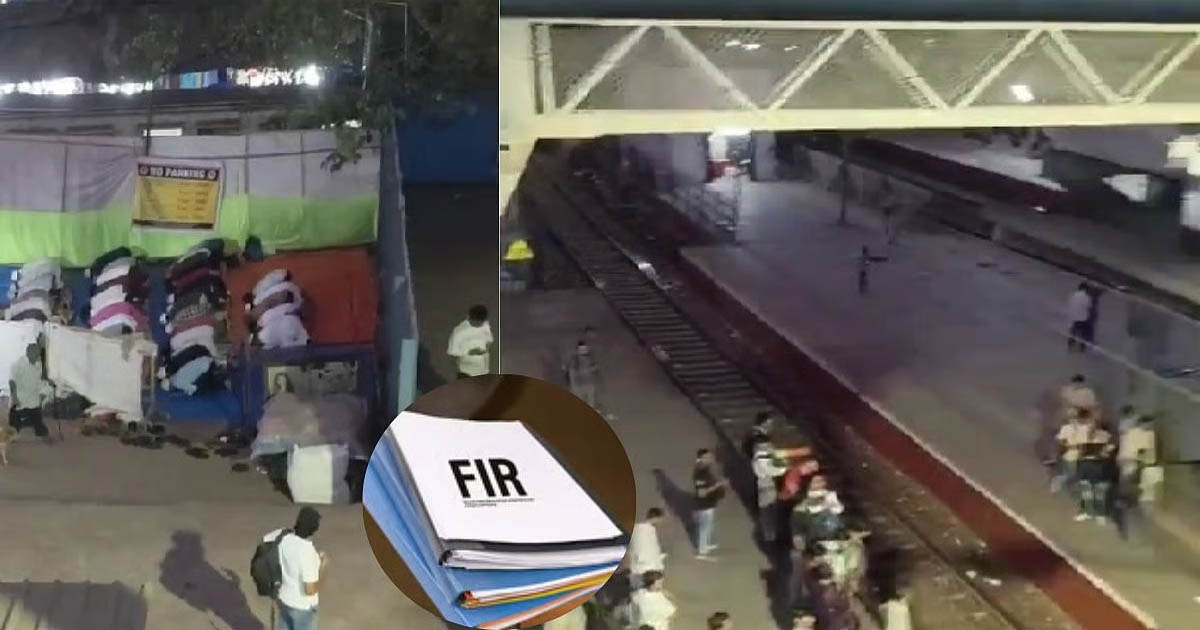
Mumbai: An FIR was filed against three hawkers after a video of them offering namaz at Malad railway station went viral online, the railway police said.
The RPF registered a case under Section 147 of the Railway Act for trespass, while the GRP filed another under BNS Section 168 following the station master’s complaint. After the video went viral, BJP leader Kirit Somaiya had also demanded action.
Slamming the viral video, BJP leader Kirit Somaiya had said that an FIR will be filed regarding all this. While speaking to news agency Media, “Openly, at Malad railway station in Mumbai, on top of the station platform, a small mandap-like structure has been made and namaz has started being offered there… An FIR will be filed regarding all this.”

Mumbai: Nearly four decades after a knife attack case was registered in Sakinaka, a sessions court has acquitted a 58-year-old Mumbai resident who had been accused of being part of the group involved in the assault. The court cited the absence of convincing evidence while clearing the accused.
Additional Sessions Judge Amit A. Laulkar acquitted Nasir Ibrahim Dadan of charges of attempt to murder and causing grievous hurt. The case had remained pending for nearly 37 years, during which several key witnesses either passed away or could not be traced.
The incident occurred on September 30, 1987, when a group of accused persons allegedly attacked Manor Naidu with a knife in Sakinaka. The group was also accused of assaulting two others, identified as Sayyed Amir and Shankar Tayde, leaving them seriously injured. Police registered a First Information Report (FIR) the following day and subsequently filed a chargesheet in 1988.
Despite this, the trial began only decades later. During the long pendency of the case, two of the accused died, while another remained absconding for several years before eventually being arrested. Charges in the matter were framed only in August 2025, and the trial commenced in February 2026.
In its judgment delivered on Friday, the court observed that the prosecution’s case had weakened significantly because it failed to produce crucial witnesses. During the trial, only one witness, police constable Amit Chowdhary, was examined, and his testimony did not support the prosecution’s version.
The court noted that Chowdhary’s evidence was largely based on hearsay. It emphasised that in a case involving allegations of attempted murder, the testimony of the injured victims and the complainant was essential, but the prosecution failed to secure their presence before the court.
The judge further pointed out that other important evidence had not been proved during the trial. Medical reports and forensic material were not formally exhibited, and the investigating officer was also not examined.
In view of these shortcomings, the court held that the prosecution had failed to establish the charges beyond reasonable doubt.
“Material ingredients of offence posed against the accused are not proved beyond all probable doubts… no offence can be legally sustained without any credible evidence against the accused.”
The court subsequently acquitted Dadan and cancelled his bail bonds. It also disposed of the case against the absconding accused, noting that there was “not much evidence” to justify continuing the proceedings.

Thane: Three persons have been arrested for allegedly breaking into a house and decamping with gold and silver jewellery worth Rs 36 lakh in Navi Mumbai, police said on Saturday.
The crime branch made the arrests on March 10 within 24 hours of the burglary that occurred at a residential building in the Kalamboli area, an official said.
According to the police, the accused broke into the flat on the evening of March 9 and stole gold and silver ornaments and cash worth about Rs 36 lakh.
A case of theft and break-in was registered, and following investigation, the crime branch zeroed in on the trio and apprehended them from Daighar village in Thane district, the official said.
The accused, Pawan Rohidas Jadhav (25), Sumit Rohidas Jadhav (22), and Shivaji Jagan Rathod (23), were caught with the stolen valuables, he said.

Mumbai: Not only Muslims but also Hindus are worried about SIR, SP national president Akhilesh Yadav criticizes UP government and Election Commission

BMC Removes Flashing Lights From Mumbai Mayor Ritu Tawde’s Car Following Social Media & RTI Protest

Trump rejects deal with Iran, seeks global help on Hormuz

China’s air defence system fails miserably, becomes ‘laughing stock’: Report

Mumbai: Shiv Sena (UBT) leader Sanjay Raut Alleges Election Commission Acting As ‘Extended Branch Of BJP’, Says Opposition Does Not Trust Poll Body

Salim Khan hospitalised following complaints of swelling

Mulund Horror: Maharashtra CM Devendra Fadnavis Expresses Grief After 1 Killed In Mumbai Metro 4 Slab Collapse; ₹5 Lakh Aid Announced For Deceased

Mumbai: JBCN International School In Borivali Gets Bomb Threat, Search Reveals Hoax, Students Safe

Former Arsenal Star Mesut Ozil’s Convoy Gets Involved In Road Accident During Bangladesh Visit

Mumbai Crime Branch Issues LOC Against Lawrence Bishnoi Aide Harry Boxer For Threatening Actor Ranveer Singh
-

 Crime4 years ago
Class 10 student jumps to death in Jaipur
-

 Maharashtra1 year ago
Mumbai Local Train Update: Central Railway’s New Timetable Comes Into Effect; Check Full List Of Revised Timings & Stations
-

 Maharashtra1 year ago
Mumbai To Go Toll-Free Tonight! Maharashtra Govt Announces Complete Toll Waiver For Light Motor Vehicles At All 5 Entry Points Of City
-

 Maharashtra1 year ago
False photo of Imtiaz Jaleel’s rally, exposing the fooling conspiracy
-

 National News1 year ago
Ministry of Railways rolls out Special Drive 4.0 with focus on digitisation, cleanliness, inclusiveness and grievance redressal
-

 Maharashtra1 year ago
Maharashtra Elections 2024: Mumbai Metro & BEST Services Extended Till Midnight On Voting Day
-

 National News1 year ago
J&K: 4 Jawans Killed, 28 Injured After Bus Carrying BSF Personnel For Poll Duty Falls Into Gorge In Budgam; Terrifying Visuals Surface
-

 Crime1 year ago
Baba Siddique Murder: Mumbai Police Unable To Get Lawrence Bishnoi Custody Due To Home Ministry Order, Says Report