
disaster
Op Jal Rahat-2: Army rescues over 2,500 flood-hit people in Manipur

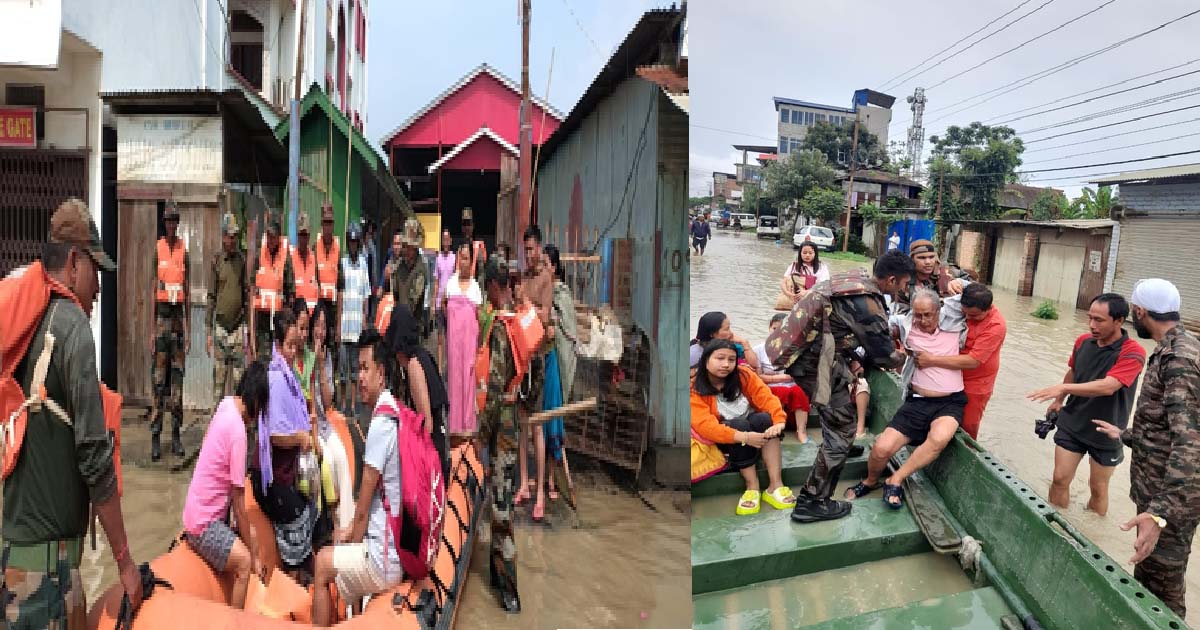
Imphal, June 5: As torrential rains and flooding continue to disrupt normal life in Imphal and surrounding areas, the Indian Army and Assam Rifles have been at the forefront of relief and rescue efforts under the ongoing ‘Operation Jal Rahat-II’ relief operation.
A Defence spokesman said on Thursday that since May 31, the Indian Army and Assam Rifles troops have been working tirelessly across multiple flood-affected localities in Imphal East and Imphal West districts, providing critical assistance to the flood-affected population within certain cases, without waiting for formal requisition.
Operating under extremely challenging conditions, the Indian Army and Assam Rifles have evacuated nearly 2,500 civilians to safety during the rescue operation so far.
Major evacuations took place in Imphal’s Wangkhei areas, where 778 individuals were rescued and at government-run Jawaharlal Nehru Institute of Medical Sciences (JNIMS) medical college and hospital, where 750 people, including 15 patients requiring urgent care, were safely evacuated.
Continuing the efforts in Imphal’s Khitai Chingangbam Leikai areas, 110 civilians were brought to safety, while 115 were rescued from Laishram Leikai, the spokesman said.
Rescue teams also evacuated 65 individuals from Lamlong and 75 from Heinjang areas, where operations included navigating through challenging terrain and fast flood stream due to breach in the Imphal River embankment.
He said that at other locations in Imphal East and West districts, an additional 408 people including 179 women and 92 children were extricated.
In a testament to their inclusive and compassionate approach, Indian Army and Assam Rifles personnel also carried out special missions to rescue three specially-abled adults from different locations.
The troops not only rescued stranded civilians but also established a medical camp providing aid to over 400 civilians, simultaneously carrying out defogging operations to mitigate health hazards caused by stagnant water.
Their rapid response helped prevent further deterioration of living conditions and safeguarded the health of the community.
According to the Defence spokesman, the unprecedented floods had left the local population struggling for survival, with clean drinking water becoming an urgent necessity in the flood-ravaged village of Soibam Leikai in Imphal East.
Responding swiftly to the crisis, a team led by an Indian Army Officer reached the village with essential supplies and an unwavering resolve to help.
Recognising the immediate need for safe drinking water, the Army established emergency drinking water distribution points, ensuring that the residents had access to clean and potable water.
Also, 5,750 litres of fresh water was supplied to fulfill the immediate requirement.
The official said that equipped with rescue boats, medical teams and essential relief materials, the Indian Army soldiers have been operating in close coordination with Assam Rifles and the civil administration.
The efforts of Indian Army and Assam Rifles reflect the ethos of ‘Service Before Self’ and unwavering commitment to safeguard the lives of citizens, the spokesman said.
He said that as flood relief operations continue, the Indian Army and Assam Rifles remain fully committed to supporting the people of Manipur during this crisis and would persist in extending every possible assistance to mitigate the impact of the ongoing natural disaster.

disaster
Bihar tragedy: 13 children die as boat capsizes in Ganga River in Vaishali; search on for missing passengers


Patna, Oct 14: In a major tragedy, at least 13 children drowned after a boat carrying passengers capsized in the Ganga River near Rampur Shyamchand village under the Raghopur police station area of Bihar’s Vaishali district on Tuesday evening. The search is on for missing passengers.
Even more heartbreaking is the fact that seven of the deceased children belonged to the same family, turning the incident into a huge tragedy for the family and the village.
According to preliminary reports, around 20 to 30 people were travelling by boat to attend a feast in a neighbouring village.
The boat reportedly lost equilibrium after reaching the main current of the Ganga and overturned, throwing passengers into the water.
The accident triggered panic in the area, as cries for help were heard from the river.
Local residents rushed to the spot and began rescue efforts before the district administration, police and State Disaster Response Force (SDRF) teams joined the operation. Local divers also assisted in the search.
Seven of the deceased children were reportedly from the family of Rampravesh Rai, alias Raja, a resident of Rampur Shyamchand village.
The deaths have left the affected families and the wider village in deep mourning.
The group was travelling to a neighbouring village, crossing the river and a nearby low-lying waterlogged area locally known as a dhab.
Several children were aboard the boat, while the total number of passengers was estimated at between 20 and 30.
Authorities have been working to establish the exact number of people on board and determine whether anyone remains missing.
Angry residents protested against the district administration following the tragedy.
Villagers alleged that the boat was old and in poor condition and claimed that requests for its replacement had been submitted earlier, but no action was taken by the authorities.
There are also suspicions that the boat may have been carrying more passengers than its holding capacity.
However, the exact cause of the accident and the boat’s condition remain subject to investigation.
Union Minister Chirag Paswan expressed grief over the deaths, describing the incident in Raghopur Diyara, which falls within his parliamentary constituency, as deeply distressing.
Paswan said he had spoken to the District Magistrate to seek details about the rescue operation and discuss assistance for the affected families through the Bihar and central governments.
Paswan also announced that he would visit the accident site to meet the bereaved families and enquire about the condition of the injured.
He added that injured passengers had been sent to NMCH for further treatment.
The Bihar Congress also expressed deep sorrow over the deaths of the children and conveyed condolences to the bereaved families.
The party prayed for peace for the souls of the departed children and strength for their families to cope with the loss.
Further details regarding the final casualty count, the number of missing passengers and the circumstances leading to the capsizing are awaited.
disaster
Landslide triggering Budhi Gandaki River floods in Nepal unleashed energy equivalent to 3.5-magnitude quake: Report
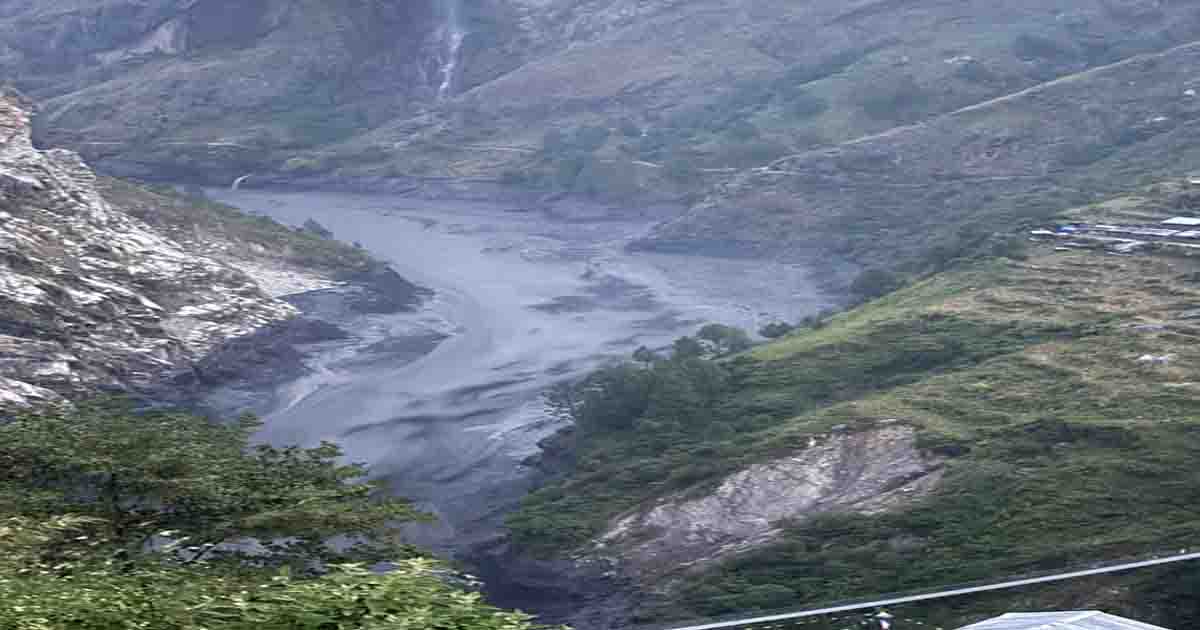
Kathamandu, Oct 14: A massive landslide in the high Himalayas of Nepal Gorkha district on October 11, which triggered devastating floods in the Budhi Gandaki River, generated energy equivalent to that of a 3.5-magnitude earthquake, according to a preliminary assessment by the Department of Mines and Geology.
The landslide occurred in the upper reaches of the Ungdilung Khola, a tributary of the Budhi Gandaki River, triggering destructive flood surges after a large volume of debris blocked and subsequently released river flows, the technical report said.
The report provides an initial explanation of how the high-altitude landslide and the repeated blockage and release of river flows contributed to the flooding downstream.
The National Disaster Risk Reduction and Management Authority (NDRRMA) said in a social media post, citing the department’s report, that the Budhi Gandaki River experienced repeated flood surges in a single day following the massive landslide involving snow, water and glacial debris in the high Himalayas.
The latest disaster left at least five people missing and destroyed several hydropower projects, roads and bridges, according to the NDRRMA.
The October 11 flooding was the second major flooding disaster, which occurred around one and a half months after devastating floods struck the Bhote Koshi and Trishuli rivers on August 26, which killed nearly 1,500 people and left more than 5,000 missing while devastating communities, houses, hydropower plants, roads and bridges along the affected rivers, the authority said.
Citing the department’s technical report, the NDRRMA said the largest of the repeated flood surges reached an estimated height of 20 to 25 metres.
The incident occurred at around 4:20 a.m. in the upper reaches of the Ungdilung Khola, between Chamar Himal and Syerangi Himal, in Chumnubri Rural Municipality, which borders China.
According to the report, an avalanche originated at an altitude of approximately 6,000 metres in the Tibetan Tethys Himalaya, an area characterised by relatively weak rock formations, and a landslide occurred at around 5,500 metres.
“The massive landslide, comprising a mixture of snow, water and debris, flowed southward along the Ungdilung Khola, depositing a large volume of debris at the narrow confluence of the Ungdilung Khola and Syar Khola, another tributary of the Budhi Gandaki River, at an altitude of around 2,000 metres,” the authority said in its social media post.
The debris repeatedly blocked and released the flow of the Syar Khola, potentially generating successive flood surges. A similar process may also have occurred at the confluence of the Syar Khola and the Budhi Gandaki River, contributing to repeated flooding downstream, it said.
However, the report suggests that the enormous volume of debris carried by the Ungdilung Khola played a more significant role in generating the largest flood surge than the water accumulated behind the blockage of the Syar Khola.
The first mud-laden flood reached the Salleri area at around 4:30 a.m., where a camp for the 341-MW Budhi Gandaki Hydroelectric Project was located.
“The largest surge arrived at the hydropower camp in Salleri at around 6:30 a.m., reaching an estimated height of 20 to 25 metres before sweeping away the camp,” the report said.
The powerful surge caused major damage downstream, particularly in the Jagat area along the Budhi Gandaki River, where several buildings were affected. Permanent bridges over the Soti Khola and the Budhi Gandaki River were also among the damaged structures, the report said.
Field observations further indicated that the flow of the Syar Khola had stopped following the landslide approximately one hour before the largest flood surge arrived.
“Water had accumulated over a stretch of around 1.5 kilometres in the upper reaches of the river. Smaller flood surges continued even after the largest surge had passed,” the report said.
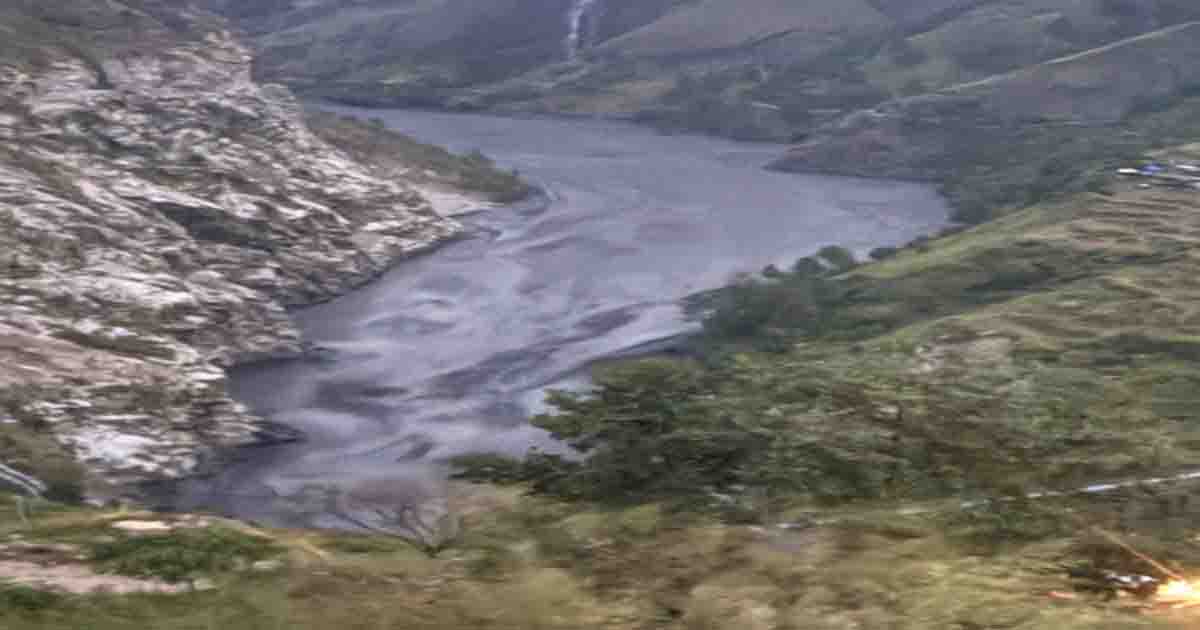
Kathmandu, Oct 11: At least four hydropower projects in the Budhi Gandaki River basin in western Gorkha district have been affected by massive floods that struck early Sunday morning, the Independent Power Producers’ Association, Nepal (IPPAN) said.
The latest floods, reminiscent of the devastating floods in the Bhote Koshi and Trishuli rivers on August 26, swept away parts of several settlements and damaged bridges, roads and infrastructure at hydropower project sites in the Budhi Gandaki River basin and its tributaries.
In a statement, IPPAN, an association of private-sector power developers in Nepal, said four hydropower projects along the Budhi Gandaki River and its tributary streams, with a combined installed capacity of 412.09 MW, had been affected.
According to IPPAN, the main camp area of the 341-MW Budhi Gandaki Hydropower Project was swept away by the floodwaters. Some construction equipment at the project, which is under construction, was also washed away.
Some houses in the camp area of the 24.5-MW Dobhan Khola Hydropower Project were damaged, while a Bailey bridge near the project site was swept away, IPPAN said.
The floods also damaged a Bailey bridge supporting construction work at the 30.59-MW Yaru Khola Hydropower Project, while construction materials and equipment were washed away.
An access road and the bridge connecting the project site of the 16-MW Machha Khola Hydropower Project were also damaged, according to IPPAN.
At a time when Nepal aspires to become a major hydropower exporter in South Asia, the latest disaster highlights the vulnerability of the country’s clean energy infrastructure to sudden floods, landslides and other climate-related hazards.
The devastating floods in the Bhote Koshi and Trishuli rivers on August 26 caused extensive damage to hydropower projects, solar energy facilities, electricity transmission infrastructure and transport networks. The energy sector, particularly hydropower projects, was among the hardest hit.
The August 2026 floods affected 12 hydropower projects and one solar power project, including 281.1 MW of operational capacity and 395.02 MW under construction, according to the World Bank’s Global Rapid Post-Disaster Damage Estimation (GRADE).
Damage to transmission lines and substations also disrupted the transmission of 149.6 MW of electricity to the national grid, bringing the total affected capacity to approximately 430.7 MW, or 10.6 per cent of Nepal’s total installed hydropower and solar capacity at the end of fiscal year 2025-26, which ended in mid-July, according to the report.
The August disaster claimed 1,455 lives, while 5,285 people remained missing, according to the National Disaster Risk Reduction and Management Authority.

Hyderabad Police cautions citizens against digital arrest fraud

Delhi court summons Dhruv Rathee in 2018 defamation case

Fake RTO app used to hack phone, siphon Rs 24.40 lakh; Gujarat Police nab account provider in Bengal

Drugs worth Rs 1 crore seized in Greater Noida, three arrested

Israeli military says killed Hamas Commander in Gaza City

INDIA bloc begins protest march against ECI

Maha Congress stages agitation against Gyanesh Kumar

Complaint against Netflix & Mukesh Chhabra for inappropriate language on ‘India’s Got Latent 2’

Delhi court grants three-week interim bail to influencer Swatantra Bhardwaj

Bombay HC warns Vijay Mallya against posting court documents on social media
-

 Crime4 years ago
Class 10 student jumps to death in Jaipur
-

 Maharashtra2 years ago
Mumbai Local Train Update: Central Railway’s New Timetable Comes Into Effect; Check Full List Of Revised Timings & Stations
-

 Maharashtra2 years ago
Mumbai To Go Toll-Free Tonight! Maharashtra Govt Announces Complete Toll Waiver For Light Motor Vehicles At All 5 Entry Points Of City
-

 Maharashtra2 years ago
False photo of Imtiaz Jaleel’s rally, exposing the fooling conspiracy
-

 National News2 years ago
Ministry of Railways rolls out Special Drive 4.0 with focus on digitisation, cleanliness, inclusiveness and grievance redressal
-

 Maharashtra2 years ago
Maharashtra Elections 2024: Mumbai Metro & BEST Services Extended Till Midnight On Voting Day
-

 National News2 years ago
J&K: 4 Jawans Killed, 28 Injured After Bus Carrying BSF Personnel For Poll Duty Falls Into Gorge In Budgam; Terrifying Visuals Surface
-

 Crime2 years ago
Baba Siddique Murder: Mumbai Police Unable To Get Lawrence Bishnoi Custody Due To Home Ministry Order, Says Report