
Business
Nil tax till Rs 12 lakh: How taxpayers will benefit from tax slab changes in Budget 2025-26

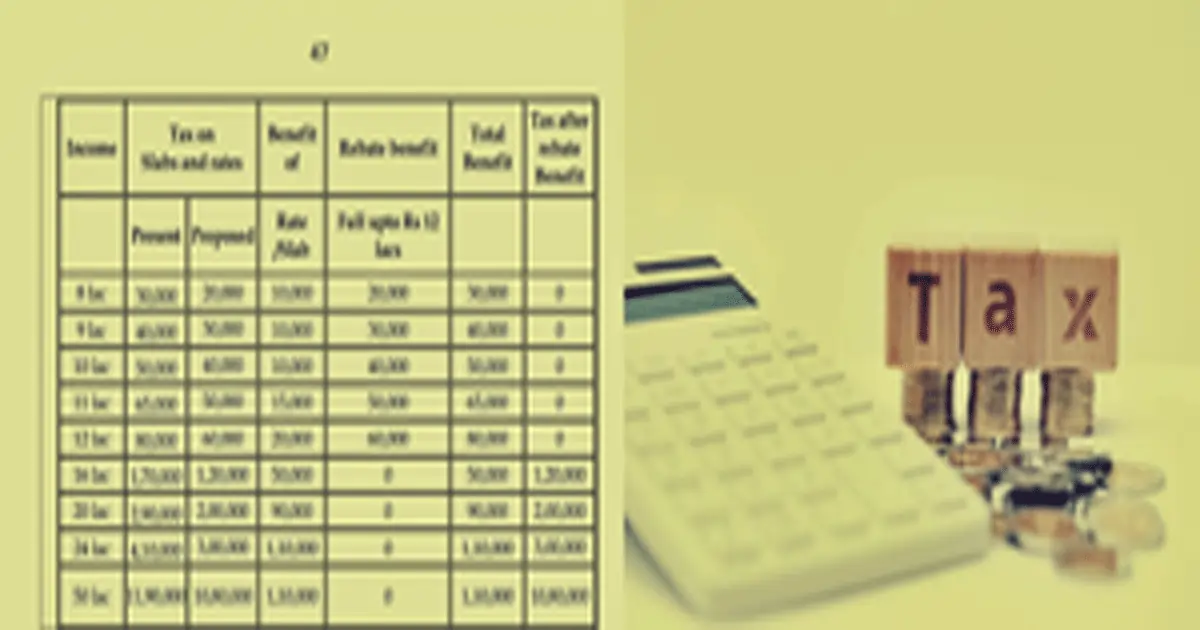
New Delhi, Feb 1: The big-ticket announcement by Finance Minister Nirmala Sitharaman regarding the income tax slab for an income up to Rs 12 lakh has brought wide cheers to the faces of the middle-class and taxpayers.
By bringing down their tax liability to nil, FM Sitharaman unveiled the bonanza at a time when they least expected it. However, these changes are applicable only to the New Tax Regime.
Under the proposed budgetary changes in Union Budget 2025-26, those with an income of up to Rs 12 lakh will no longer have to pay any income tax, a significant shift from the previous practice where they had to pay anywhere between Rs 60,000 – Rs 80,000.
“The New tax regime is the default regime. To avail benefits of the rebate allowable under proposed provisions of the new tax regime, only a return is to be filed otherwise no other step is required to be taken,” said an official release.
Also, there exists a standard deduction of Rs 75,000 available to taxpayers in the new regime. Therefore, a salaried taxpayer will not be required to pay any tax where his income before the standard deduction is less than or equal to Rs 12,75,000.
Below are some Q&As regarding new income tax slabs:
What was the earlier income limit for nil tax?
Earlier, the limit of income for nil tax payment was Rs 7 lakh. By increasing this limit to Rs 12 lakh, around one crore assesses who were earlier required to pay tax varying from Rs 20,000 to Rs 80,000 will now pay nil tax.
Who will benefit from changes in tax slabs?
The new tax regime applies to a person, or Hindu undivided family or association of persons [other than a co-operative society], or body of individuals, whether incorporated or not, or an artificial juridical person referred to in sub-clause (vii) of clause (31) of section 2.
Accordingly, changes in tax slabs will benefit all these persons.
What benefits a taxpayer can avail?
Any individual, who earlier was required to pay a tax of Rs 80,000 (in the new regime) for an income of Rs 12 lakh, will be required to pay nil tax on such income.

Mumbai, June 19: IT stocks came under selling pressure on Friday, with the Nifty IT index plunging more than 6 per cent after global technology services firm Accenture cut its revenue growth guidance and flagged a weaker demand environment, reigniting concerns over the pace of recovery in global technology spending.
The technology index declined as much as 6.43 per cent or 1,831 points to hit an intraday low of 26,634.50 at around 10:25 am, making it the worst-performing sectoral index in early trade.
At the last count, the IT index was trading about 5 per cent or 1,500 points lower at 26,956.90.
The sell-off was led by Infosys, which plunged 7.4 per cent. Tata Consultancy Services (TCS) declined 5.6 per cent, while Mphasis fell 5.3 per cent.
Meanwhile, Persistent Systems dropped nearly 5 per cent, while LTIMindtree slipped more than 4 per cent. Tech Mahindra and HCLTech lost around 4.5 per cent each. Coforge declined nearly 4 per cent, while Wipro shed over 3 per cent.
Selling pressure was also visible across the broader market. On the BSE Midcap index, technology stocks such as KPIT Technologies, Tata Elxsi, Hexaware Technologies and LT Technology Services were among the top losers and traded sharply lower.
The sell-off followed a steep overnight decline in Accenture shares and weakness in the American Depositary Receipts (ADRs) of Indian IT companies after the global consulting and technology services major lowered its FY26 revenue growth guidance.
According to market experts, guidance cuts by the IT firm has triggered sell-off in Indian IT majors’ ADRs.
“Buying can emerge at lower levels in IT since valuations are becoming attractive,” the experts said.
They noted that pressure on IT stocks is likely to persist if earnings downgrades continue relative to market expectations in the near term.
Experts further pointed out that despite the sharp correction, valuations of major Indian IT companies remain higher than Accenture’s. While Accenture is currently trading at around nine times one-year forward consensus earnings.
Given the prevailing uncertainty, analysts said they remain cautious on the sector.
Accenture shares plunged nearly 18 per cent overnight, while Infosys ADRs tumbled around 10 per cent and Wipro ADRs lost more than 3 per cent.
The company reported third-quarter revenue of $18.7 billion but reduced its annual growth outlook amid continued uncertainty in client spending and revenue headwinds linked to developments in West Asia.
It reported lower new bookings compared to the year-ago period.
The fall in IT stocks comes after the sector had already faced pressure earlier this week following indications from the US Federal Reserve that interest rates could remain elevated for longer, dampening sentiment towards global technology shares.
The Nifty IT index has declined nearly 30 per cent from 38,600 in the last one-year horizon.
However, domestic equity benchmarks declined nearly 1 per cent in morning trade, with Sensex falling over 700 points and Nifty slipping about 200 points below the 24,000 level.
Business
G7 Summit: PM Modi, Prez Trump discussed West Asia, India-US trade deal & bilateral cooperation across sectors: MEA

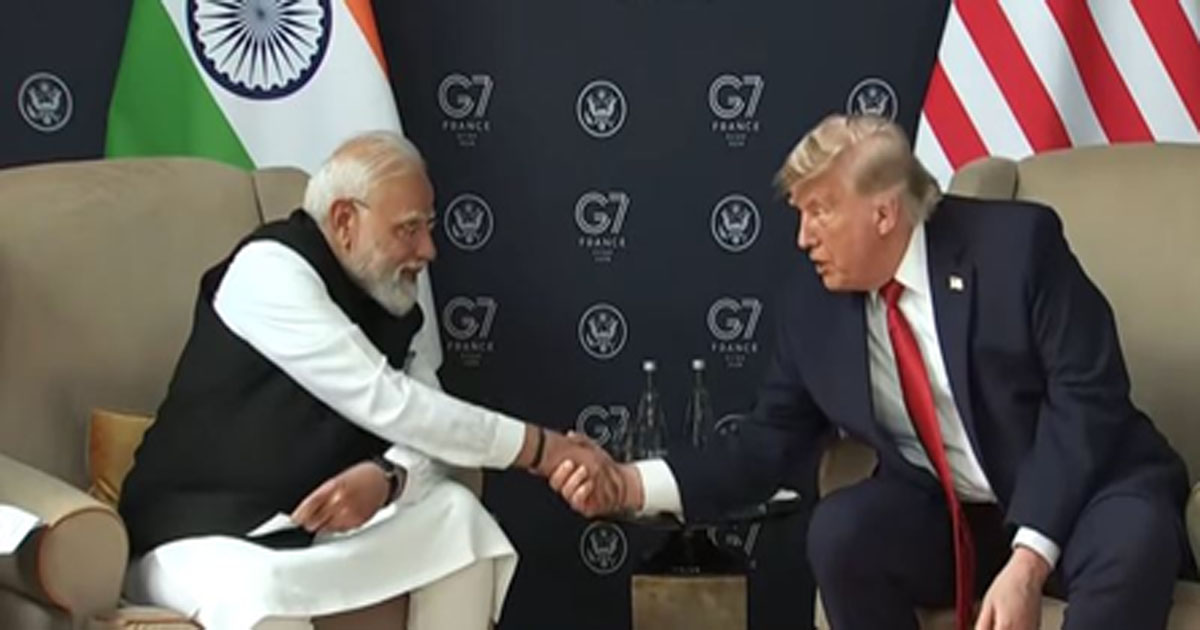
Evian (France), June 18: The Ministry of External Affairs (MEA) said on Thursday in an official statement that Prime Minister Modi met the US President Donald Trump on the sidelines of the G7 Summit in France’s Evian and discussed end of West Asia conflict, significant progress in the India-US interim trade deal and bilateral cooperation in terms of defence, strategic technologies, energy, and trade sectors between the two countries.
Prime Minister Modi commended President Trump for his efforts that had resulted in an understanding to end the ongoing conflict in West Asia and restore peace and stability across the broader region, the MEA statement said.
The Prime Minister also underlined the importance of maintaining freedom of navigation and unimpeded commerce in the Strait of Hormuz and the need to ensure the safety of seafarer, the MEA statement added.
Taking to his official social media plaform X, PM Modi said: “Pleased to meet President Trump in Evian. We reviewed the sustained progress in our bilateral cooperation in trade, energy, defence, technology and people-to-people ties. Conveyed India’s appreciation on the progress in the efforts for restoring peace and stability in West Asia. Keeping the Strait of Hormuz open is vital for the global economy. Reiterated the importance of ensuring the safety and security of civilians, including seafarers.”
“Both PM Modi and President Trump reviewed the substantial progress achieved under the India–US COMPACT (Catalysing Opportunities for Military Partnership, Accelerated Commerce and Technology) since their meeting in Washington D.C. in February 2025,” the MEA said in the statement.
The two leaders welcomed key developments across the defence, strategic technologies, energy, and bilateral trade sectors, the MEA statement added.
“The leaders noted with particular satisfaction the significant progress made in negotiations towards an interim Bilateral Trade Agreement and instructed their officials to work towards a “balanced, mutually beneficial, and commercially meaningful agreement at the earliest”. The US Trade Representative Jamieson Greer, will be visiting India next week in this connection.”
“Prime Minister Modi and President Trump reaffirmed their commitment to further strengthening the India-US Comprehensive Global Strategic Partnership and advancing cooperation across all domains for the mutual benefit of the two countries and their people,” the MEA added.
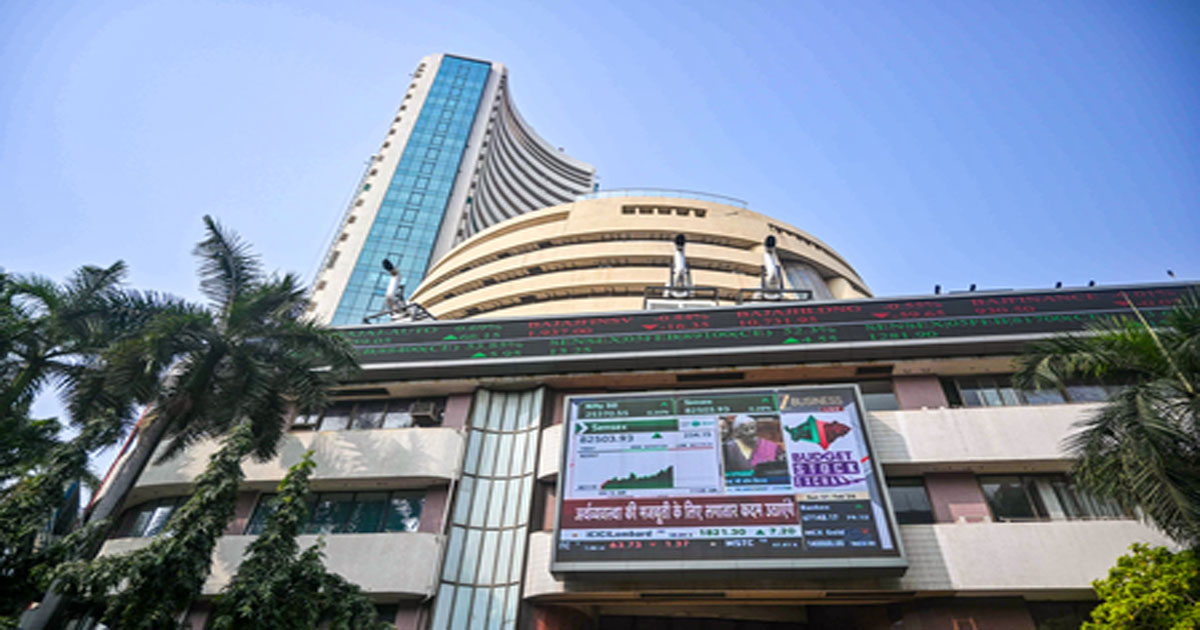
Mumbai, June 18: Indian equity markets traded flat on Thursday in morning trade amid mixed global cues as investors and traders assessed indications that the US Federal Reserve may still raise borrowing costs later this year, despite the benefits of lower oil prices and the Fed’s decision to keep rates unchanged.
Sensex was trading at 77,095.99, down 59 points or 0.08 per cent in early trade, while Nifty was at 24,076.95, down 8.75 points or 0.04 per cent.
Sector-wise, IT stocks remained under pressure, with Nifty IT declining 1.70 per cent. In contrast, Nifty Consumer Durables and Nifty FMCG rose 0.31 per cent each, while Nifty Metal advanced 0.25 per cent and Nifty Chemicals gained 0.21 per cent.
From the Nifty pack, Infosys, HCLTech, Tata Consultancy Services (TCS), Tech Mahindra, Wipro, Bajaj Finance and Bajaj Finserv were the top losers.
Moreover, the US Federal Reserve left interest rates unchanged, while indicating that further rate hikes remain possible this year as inflation continues to stay above its 2 per cent target.
According to market experts, Indian markets will not be unduly influenced by developments on the Fed rate front.
“In the near term, the market will remain resilient, supported by the crash in Brent crude to around $78 levels. The rupee is stable at around the 94.52 level,” they said.
Analysts stated that FII selling has tapered off, as expected, and that FIIs turned buyers yesterday, though in limited quantities. Brent crude prices at around $78 levels and stability in the rupee are big positives from the market perspective. Bank Nifty will remain strong with an upward bias.
Meanwhile, international oil benchmark Brent crude declined 1.64 per cent to $78.24 per barrel, while US West Texas Intermediate (WTI) crude slumped 2 per cent to $75 per barrel.
In Asian markets, indices showed a mixed trend. Japan’s Nikkei traded over 1 per cent higher, while Hong Kong’s Hang Seng was trading around 2 per cent lower. South Korea’s KOSPI was up more than 1 per cent, while Indonesia’s Jakarta Composite and China’s Shanghai Composite declined by up to 1 per cent.
Overnight in the US, Wall Street ended lower, with the S&P 500 decreasing 1.21 per cent and the Nasdaq closing 1.34 per cent down.

Mayawati alleges smear campaign to defame BSP ahead of 2027 UP polls

Illegal constructions razed down in Rajasthan’s Barmer within 15 km of Pakistan border

Nifty IT tumbles over 6 pc as Accenture guidance cut rattles sector

Public representatives have high confidence in Shinde’s work, Uddhav Thackeray MPs did not have confidence in his leadership: Milind Deora

Mumbai Municipal Corporation and Customs Department sign MoU for conservation and restoration of Mahim Fort

G7 Summit: PM Modi, Prez Trump discussed West Asia, India-US trade deal & bilateral cooperation across sectors: MEA

Trump, Netanyahu hold phone talks after Iranian missile fire: Israeli state media

Virar Citizens Protest Demolition Drive In Arnala; Police Block Lal Bawta March, Sit-in Held On Road

Indian equity markets trade higher as Iran-Israel tensions ease

Rubio says Hamas disarmament key to Gaza rebuild
-

 Crime4 years ago
Class 10 student jumps to death in Jaipur
-

 Maharashtra2 years ago
Mumbai Local Train Update: Central Railway’s New Timetable Comes Into Effect; Check Full List Of Revised Timings & Stations
-

 Maharashtra2 years ago
Mumbai To Go Toll-Free Tonight! Maharashtra Govt Announces Complete Toll Waiver For Light Motor Vehicles At All 5 Entry Points Of City
-

 Maharashtra2 years ago
False photo of Imtiaz Jaleel’s rally, exposing the fooling conspiracy
-

 National News2 years ago
Ministry of Railways rolls out Special Drive 4.0 with focus on digitisation, cleanliness, inclusiveness and grievance redressal
-

 Maharashtra2 years ago
Maharashtra Elections 2024: Mumbai Metro & BEST Services Extended Till Midnight On Voting Day
-

 National News2 years ago
J&K: 4 Jawans Killed, 28 Injured After Bus Carrying BSF Personnel For Poll Duty Falls Into Gorge In Budgam; Terrifying Visuals Surface
-

 Crime2 years ago
Baba Siddique Murder: Mumbai Police Unable To Get Lawrence Bishnoi Custody Due To Home Ministry Order, Says Report