
Business
Mercedes-Benz India’s YoY Q1 2022 sales up 26%


Luxury carmaker Mercedes-Benz India on Friday reported sales growth of 26 per cent in Q1 2022 on a year-on-year basis.
The company’s sales rose to 4,022 units from 3,193 units sold in the corresponding period of last year.
The luxury carmaker said the Q1 sales growth has been achieved against the backdrop of continuing semi-conductor shortage, global supply chain challenges, and increasing operating cost for the company.
Mercedes-Benz also ended Q1 2022 with a highest-ever order bank of more than 4,000 units.
“We are excited with our sales performance achieved in Q1 2022, laying a strong foundation for a long-term sales recovery. This achievement becomes important in context of continued intense headwinds like semi-conductor shortage, global supply chain disruptions and rising input costs,” said Martin Schwenk, Managing Director & CEO, Mercedes-Benz India.
“With the highest order bank in our history, we are confident of continuing this growth momentum in the coming months.”


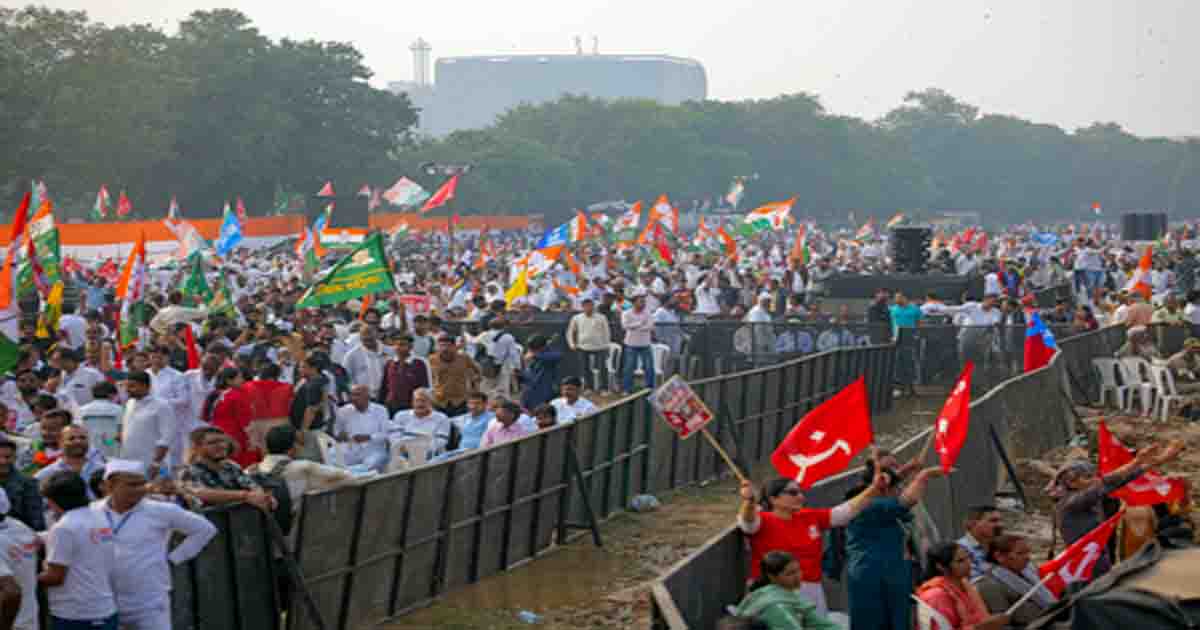
The Delhi Vyapar Mahasangh has expressed concern over the impact of the INDIA Bloc’s rally held at Ramlila Maidan on November 1, saying the political event affected business activities, customers’ movement and the livelihoods of traders and workers in the national Capital, particularly ahead of the festive season.
In a statement titled, ‘What Did We Lose, What Did We Gain?’, the traders’ body said that while the rally may have provided political parties with an opportunity to express their views and demonstrate their strength, it left Delhi’s business community with several economic questions and concerns.
“November 1 may have been an opportunity for political parties to put forward their views and demonstrate their strength, but for Delhi’s business community, the day left behind several economic questions and concerns,” the Mahasangh said.
It pointed out that Delhi’s wholesale markets are not merely centres of local trade but also serve as an important foundation for the purchases, supply chains and livelihoods of millions of small traders across the country.
The organisation said that disruption to market activities, customer movement and the supply of goods just ahead of a major festive occasion like Diwali was a matter of concern.
Listing the losses suffered by the trading community, it said business activities and customer footfall were affected on Sunday.
Small traders arriving from other states also lost valuable time and purchasing opportunities.
It added that the daily earnings of shopkeepers, employees, labourers, transporters and families dependent on them were adversely affected.
The traders’ body further claimed that the normal commercial activities and business image of Delhi’s major markets had suffered a setback, while concerns had increased over the possibility of customers shifting towards online shopping and other commercial centres.
However, the Mahasangh also acknowledged certain positive aspects of the rally, saying it brought the problems and concerns of Delhi’s trading community onto a wider public platform.
It said the event once again highlighted the important role played by Delhi’s wholesale markets in the country’s economy and supply chain. It also underlined the need for better coordination between business interests, public convenience and traffic management while planning major events in the future.
“Delhi Vyapar Mahasangh (Regd.) respects democratic rights and peaceful protests. Every political party has the right to express its views, but equal responsibility towards trade, employment, ordinary citizens and the country’s economic activities is equally necessary,” the statement said.
“Political events last for a limited period, but the economic losses suffered by businesses and the impact on customers’ trust can be felt for a long time,” it added.
The organisation urged authorities and political parties to give priority to Delhi’s business calendar, festive season, market accessibility, supply of goods and public convenience while deciding the dates and venues of large-scale events.
“Politics has its place, and trade and employment have theirs. A balance between the two is the hallmark of a strong, responsible and healthy democratic system,” it said.

Indian equity benchmarks opened strong on Monday, surging about 1 per cent each despite mixed global cues amid buying in energy, auto and information technology (IT) sector stocks.
At open, Sensex was up 718.71 points or 0.97 per cent at 75,178.24, while Nifty was up 169.20 points or 0.73 per cent at 23,222.30.
Sectorally, energy sector shares led gain as Nifty Oil & Gas surged more than 2 per cent.
Meanwhile, Nifty Auto rose 0.77 per cent and Nifty IT gained 0.51 per cent.
On the losing side, Nifty Realty declined 0.74 per cent and Nifty Media was down 0.06 per cent.
There are clear indications of a turnaround in the Indian market assisted by positive external and domestic cues, market experts said.
“Externally, the slight cooling of Brent crude prices from last week’s high of $118 to $110 now is a relief. Equally important is the decline in the US 10-year bond yield to 4.93 per cent,” they said.
“Perhaps more important than these external tailwinds is the sharp weakening of the AI trade, which pulled down the Nasdaq by 2.8 per cent last Friday. The weakening trend in AI trade is beneficial for India which is widely regarded as a counter-AI play,” the experts added.
Fundamental domestic cues are also supportive, according to them. The 17.94 per cent credit growth and robust GST collections in October reflect a resilient economy gathering momentum.
“Another strong positive which can drive the market up is the rising expectations surrounding a thorough rejig of the LTCG tax in the coming Budget, most likely its abolition. The market, it appears, has started discounting this. In brief, for now, it is an advantage for bulls,” according to analysts.
For Nifty, RSI improved to 53.50, above its average of 45.97, while PCR at 1.24 indicated a positive derivatives setup. Immediate support is placed at 22,900-23,000, while resistance is seen at 23,200-23,250. A sustained move above the 50-day EMA would further strengthen the recovery.
Asian shares traded lower while crude oil witnessed weakness. International benchmark Brent crude declined 3 per cent to $109.97 per barrel, while US West Texas Intermediate (WTI) slipped about 3 per cent to $100.81.
In the US, Wall Street ended in negative territory on Friday, with Nasdaq posting its steepest one-day fall since June 5 as disappointing Intel and Amazon results intensified concerns over heavy AI spending.
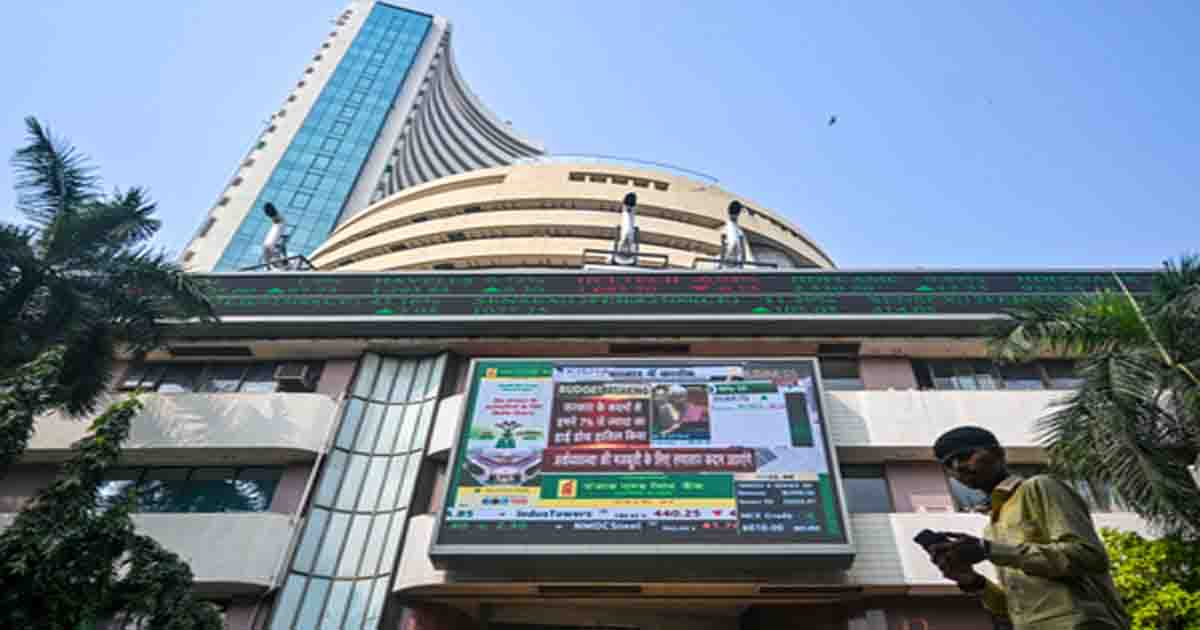
There are early indications of foreign institutional investors (FIIs) turning towards India markets amid the AI stock upheavals globally, analysts said on Sunday.
They said it is too early to say that this is a trend reversal, but early signs are positive. During the last four trading days ending on October 30, FIIs were buyers in three days in the cash market.
There are many factors that might have triggered this change in stance.
“One, the US Fed holding rates are a positive for equity markets globally. Second, the valuations in Indian markets, particularly in large caps, have become very attractive. Three, perhaps this is more important, there are clear indications of sustained momentum in economic growth in India,” said Dr. VK Vijayakumar, Chief Investment Strategist, Geojit Investments Ltd.
The surge in credit growth is impressive and indicative of robust growth ahead. Credit grew by 19.1 per cent in September (year-on-year). Credit growth to industry is at 19.5 per cent, and services are at 28.3 per cent.
There are signs of improvement in industrial capex, too. Another factor is the weakening of the AI trade globally. This change in stance of FPIs helped Nifty reclaim the 23,000 level, said the analyst.
Even while selling in large-cap financials, FIIs have been systematically accumulating stocks in pharmaceuticals and healthcare and select digital platform companies.
FIIs have net-sold $59 billion worth Indian equities in the 24 months leading up to September (about $64 billion with October 2026 month-to-date), and rolling 12-month outflows hit a record $40 billion in June 2026.
“FIIs return when oil breaks, and flows then confirm. The US midterms (November 3) and the Iran path decide when,” according to a note by JM Financial Institutional Securities.
FIIs sold a net $14.9 billion in FY25, $21.9 billion in FY26 and $17.7 billion with October 2026 month-to-date. Before this, FIIs had never sold for more than two straight years.

Ajay Devgn & Anil Kapoor birthday wish for SRK: Picture purani hai aur dosti bhi…

274 minor boys subjected to sexual abuse in Bangladesh; madrasas account for majority cases

BJP says LoP Rahul Gandhi remark shows he accepts PM Modi will remain in power

Iran defines vast arena to inflict damage on enemy: IRGC spokesman

Newlyweds among 31 hospitalised after suspected food poisoning at Mumbai wedding

Rahul, Cong ecosystem want to force regime change: BJP after Neha Bora praises B’desh Gen-Z protest

Attack on democratic rights: INDIA Bloc leaders on detentions of anti-ECI protestors

BJP pays tribute to ex-President Abdul Kalam, recalls his enduring influence on generations of India’s youth

INDIA bloc begins protest march against ECI

Online betting: ED conducts searches at 20 premises in Mumbai, Pune, Hyderabad
-

 Crime4 years ago
Class 10 student jumps to death in Jaipur
-

 Maharashtra2 years ago
Mumbai Local Train Update: Central Railway’s New Timetable Comes Into Effect; Check Full List Of Revised Timings & Stations
-

 Maharashtra2 years ago
Mumbai To Go Toll-Free Tonight! Maharashtra Govt Announces Complete Toll Waiver For Light Motor Vehicles At All 5 Entry Points Of City
-

 Maharashtra2 years ago
False photo of Imtiaz Jaleel’s rally, exposing the fooling conspiracy
-

 National News2 years ago
Ministry of Railways rolls out Special Drive 4.0 with focus on digitisation, cleanliness, inclusiveness and grievance redressal
-

 Maharashtra2 years ago
Maharashtra Elections 2024: Mumbai Metro & BEST Services Extended Till Midnight On Voting Day
-

 National News2 years ago
J&K: 4 Jawans Killed, 28 Injured After Bus Carrying BSF Personnel For Poll Duty Falls Into Gorge In Budgam; Terrifying Visuals Surface
-

 Crime2 years ago
Baba Siddique Murder: Mumbai Police Unable To Get Lawrence Bishnoi Custody Due To Home Ministry Order, Says Report