
Crime
JNUSU demands reconstruction of Babri Masjid, stages protest

A protest march was carried out by the Jawaharlal Nehru University Students’ Union (JNUSU) inside the campus demanding reconstruction of the demolished Babri Masjid in Ayodhya.
The protest march was staged on Monday night to mark the demolition anniversary. The students gathered at a site holding placards, shouting slogans, and later they took out the march inside the campus. The student leaders also made speeches demanding reconstruction of the mosque.
The JNU administration had recently warned against holding the protest, but the student union still held the protest. On Sunday, the student wing also organised a show at the campus in which a movie based on the Babri Masjid demolition was shown. The admin had asked the students not to telecast any such film otherwise strict action would be taken.
The protest march, which was carried out on Monday evening, ended at the Chandrabhaga Hostel where the student leaders made speeches.
Saket Moon, vice president of the JNUSU said that with the reconstruction of the Babri Masjid justice will be delivered.
Aishe Ghosh, the JNUSU president said that after Babri Masjid, the next target of the BJP is Kashi and they (BJP) have started working on it.
“We are remembering Baba Saheb on this day. We are also condemning the killing of civilians in Nagaland. BJP and RSS haven’t done anything in the name of development, but they are dividing us in the name of religion, law and order is crippling,” she said.


Mumbai, Oct 17: In fresh action against an online betting/gaming and cyber fraud syndicate, the Enforcement Directorate (ED) conducted search operations at 20 premises located in Mumbai, Pune, Mehsana, Surat and Hyderabad, ED officials said on Saturday.
During the search operations on October 13, the ED’s Mumbai Zone-2 seized various incriminating documents, digital devices and other material evidence relating to the layering and diversion of proceeds of crime, the official said in a statement.
In addition, multiple bank accounts of the concerned entities and persons have been ordered frozen under the provisions of the Prevention of Money Laundering Act (PMLA), 2002, the statement said.
In the case, the ED had earlier conducted searches at multiple places in Pune, Mumbai and Bengaluru and also arrested Ram U. Ramdhani, founder of Edsom Fintech Private Limited, who remains in judicial custody, it added.
The investigation stems from two predicate offences pertaining to the online gaming and betting platform “All Panel Exchange” (allpanelexch.com) and MGM91 wherein the complainants were induced to deposit funds and were subsequently cheated, the ED said.
The central agency’s investigation under PMLA established that funds collected from victims of both betting platforms were routed and ultimately received in the bank accounts of a Pune-based entity established by Ram U. Ramdhani.
“Edsom had developed and operated an in-house payment intermediary platform called “iPaisa”, through which it onboarded more than 200 shell/front entities — referred to internally as “merchants” — on behalf of online gaming, betting, and cyber fraud operators and their agents, referred to as “Channel Partners/Carry and Forward Agents”,” the ED said.
“Investigation revealed that funds collected from victims of online gaming/betting/cyber fraud platforms were routed through a vast network of mule bank accounts and the controllers of these betting platforms, along with the shell entities used for routing the proceeds of crime, have been identified,” the ED added.
It also emerged that a significant number of persons involved in operating these online betting/gaming platforms were being directed from Dubai based persons, the probe agency said.
The syndicate was further aided by certain cooperative banks, whose infrastructure was used to collect and further layer the illicit proceeds, it added.
“Investigation has also established that the proceeds of crime generated through online betting/gaming and cyber fraud activities were siphoned out through three principal routes: One, by way of remittances disguised as trade transactions through over invoicing; and other, by cash withdrawals from mule accounts opened under the guise of APMC units; and another, by conversion of funds into cryptocurrency for siphoning off the proceeds of crime outside India,” the ED said.
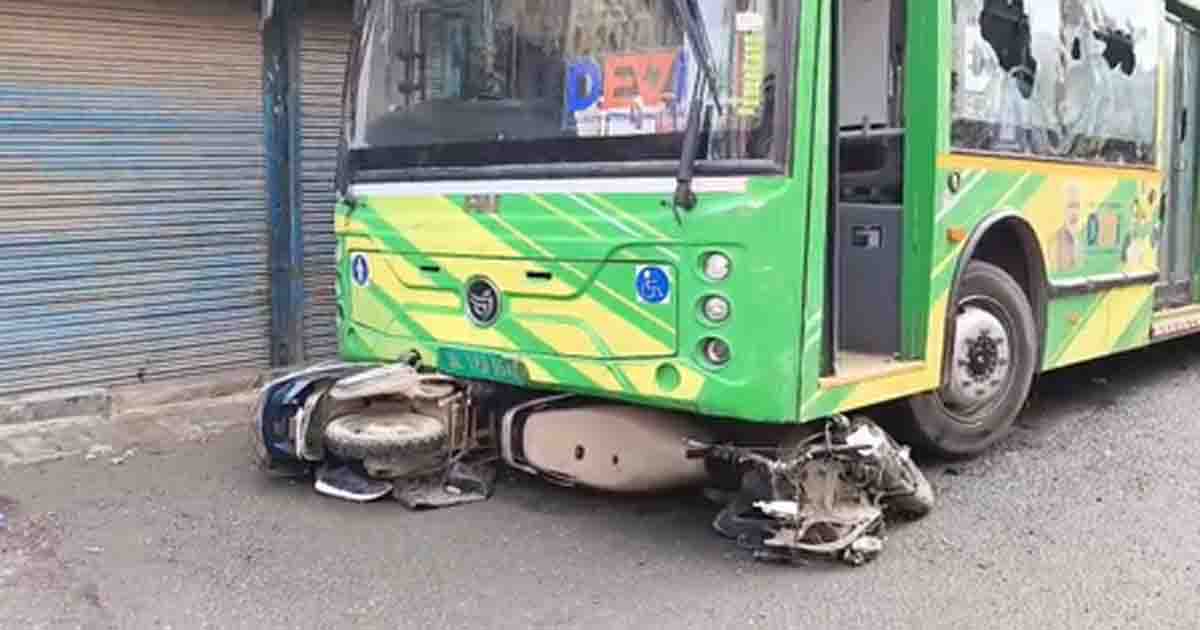
One person was killed, and two others were injured after a Delhi Transport Corporation (DTC) bus hit vehicles and pedestrians in Delhi Anand Parbat area on Saturday, officials said.
According to the officials, an e-rickshaw, two bikes, and a scooter rider were hit by the bus, which was heading towards Tikri Border.
One person died on the spot, while two others were seriously injured and were shifted to the hospital.
The officials added that the bus driver fled the scene following the accident.
According to the eyewitnesses, the bus was speeding when it hit the pedestrians.
“The bus was being driven by a female driver. The bus was at a very high speed. Pedestrians tried to save themselves; however, some were hit by the bus. Around 4-5 people were injured,” an eyewitness told media.
“There is always a traffic jam in this area. There is no place to walk on this road. Rikshaws and shops have encroached upon the road. Everyone fears to walk on this road. Today, a person has died because of all this,” another said.
“Several accidents keep happening here. The situation is miserable. The police also don’t arrive on time,” a local told media.
Police and forensic teams have reached the spot and are investigating the incident. Further details are awaited.
In a separate incident, one person was killed, and three others were injured after a truck hit two motorcycles near Crescent Apartment Red Light in Dwarka Sector 18 in the early hours of Saturday.
According to Delhi Police, the fatal accident occurred at around 12.45 a.m. The two motorcycles were carrying four people, with two persons on each vehicle, when the truck struck them.
Police apprehended the truck driver, Hotam Singh, 41, a resident of Agra, Uttar Pradesh. The truck, both motorcycles, and other exhibits were seized.
A case has been registered at Dwarka North police station under relevant sections, and further investigation is underway.
The Central District Police conducted simultaneous raids at two spa establishments in the Nabi Karim and Paharganj areas of Delhi, rescuing 19 women and arresting 10 people for their alleged involvement in illegal activities, police said on Saturday.
The raids were conducted as part of a crackdown on alleged illegal activities operating under the guise of spa services. Two FIRs have been registered under Sections 3, 4, and 5 of the Immoral Traffic (Prevention) Act, and further investigation is underway.
In the first operation, Nabi Karim police acted on specific information about an alleged sex racket operating at Hollywood Spa, located on the second and third floors of property number 8709-10 on Desh Bandhu Gupta Road.
According to police, on October 16, a secret informer approached Sub-Inspector Neeraj Rathi and provided information about the alleged racket. The information was shared with the station house officer (SHO), who constituted a team to verify the input and take legal action.
A police personnel was deployed as a decoy customer to verify the information. After the alleged illegal activity was confirmed, the team raided the premises, rescued 14 women and arrested nine accused.
The arrested persons were identified as Preeti Iman Ali, 39, the spa owner; Rizwan Ali, 38, the manager; Asif, 35; Shajeb, 31; Mohd. Umar, 39; Sameer, 25; Shahrukh, 35; Gulrej alias Danish, 28; and Shiva, 25. They are residents of Delhi, Uttar Pradesh, Uttarakhand and Karnataka.
An FIR (No. 473/26), dated October 16, was registered at Nabi Karim police station under Sections 3, 4 and 5 of the Immoral Traffic (Prevention) Act.
In a separate operation, Paharganj police raided New Latest Unisex Salon and Spa at property number 3738 on Desh Bandhu Gupta Road. During the raid, five women were rescued, and one accused was arrested.
The accused was identified as Shakeel Ahmed, 46, a native of Rampur, Uttar Pradesh, who was residing at the spa premises in Delhi.
An FIR (No. 452/2026), dated October 17, was registered at Paharganj police station under Sections 3, 4 and 5 of the Immoral Traffic (Prevention) Act.
Police teams from both stations carried out the operations under the supervision of their respective SHOs, with the Nabi Karim operation also supervised by the ACP, Paharganj.

Samajwadi Party, education two banks of river who can’t meet: UP CM Yogi Adityanath

Tanker attacked northeast of Saudi Arabia: UKMTO

MP: Mild earthquake tremors felt in Singrauli

Maha CM calls emerging technologies key to India’s youth

Iran IRGC says supertanker exploded after hitting mine in Hormuz Strait

Rahul, Cong ecosystem want to force regime change: BJP after Neha Bora praises B’desh Gen-Z protest

BJP pays tribute to ex-President Abdul Kalam, recalls his enduring influence on generations of India’s youth

INDIA bloc begins protest march against ECI

Maha Congress stages agitation against Gyanesh Kumar

Complaint against Netflix & Mukesh Chhabra for inappropriate language on ‘India’s Got Latent 2’
-

 Crime4 years ago
Class 10 student jumps to death in Jaipur
-

 Maharashtra2 years ago
Mumbai Local Train Update: Central Railway’s New Timetable Comes Into Effect; Check Full List Of Revised Timings & Stations
-

 Maharashtra2 years ago
Mumbai To Go Toll-Free Tonight! Maharashtra Govt Announces Complete Toll Waiver For Light Motor Vehicles At All 5 Entry Points Of City
-

 Maharashtra2 years ago
False photo of Imtiaz Jaleel’s rally, exposing the fooling conspiracy
-

 National News2 years ago
Ministry of Railways rolls out Special Drive 4.0 with focus on digitisation, cleanliness, inclusiveness and grievance redressal
-

 Maharashtra2 years ago
Maharashtra Elections 2024: Mumbai Metro & BEST Services Extended Till Midnight On Voting Day
-

 National News2 years ago
J&K: 4 Jawans Killed, 28 Injured After Bus Carrying BSF Personnel For Poll Duty Falls Into Gorge In Budgam; Terrifying Visuals Surface
-

 Crime2 years ago
Baba Siddique Murder: Mumbai Police Unable To Get Lawrence Bishnoi Custody Due To Home Ministry Order, Says Report