
Crime
Inspector suspended for allowing BJP leaders in police station during CT Ravi’s arrest

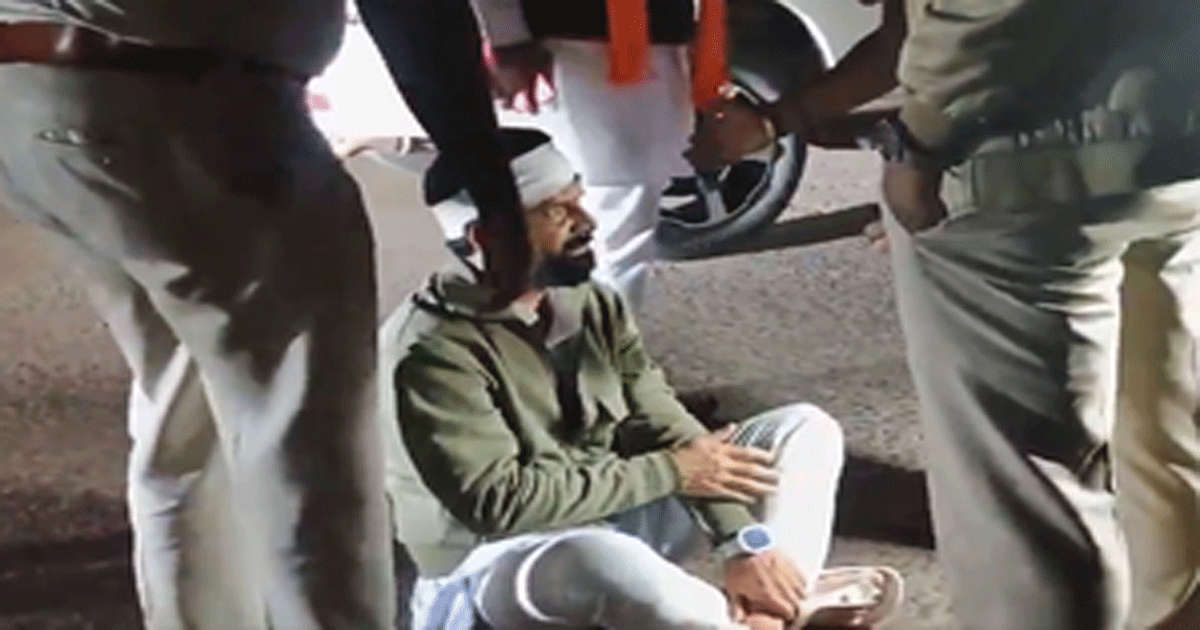
Belagavi, Dec 25: The Karnataka Police on Wednesday suspended the Inspector of Khanapur Police Station in Belagavi on the charges of violating the superior officers’ orders by letting BJP leaders inside the police station during MLC C. T. Ravi’s arrest.
IGP (Northern Range) Vikash Kumar Vikash has issued the order of suspension in this regard.
“On December 19, BJP MLC C. T. Ravi was shifted to Khanapur Police Station from the Hirebagewadi Police Station. Strict instructions were given not to allow anyone inside the station. It was also instructed to arrange security with available staff of the police station,” the IGP stated.
“Police Inspector Manjunath Nayak had not made proper security arrangements. The political leaders barged inside the police station. This had created confusion on the premises of the police station. He had failed to prevent the entry of political leaders,” the IGP said.
The IGP said that a suspension order is issued for violating the orders from superior officers, dereliction of duty, negligence and irresponsible behaviour by the officer.
Meanwhile, the development has taken a political turn with the BJP, Dalit and pro-Kannada organisations calling for a Khanapur bandh to protest the Police Inspector’s suspension.
Deputy CM D. K. Shivakumar and Home Minister G. Parameshwara held a meeting of police officers in Belagavi.
Talking to reporters, Parameshwara said, “The matter of C. T. Ravi was not discussed in the meeting. The case is currently being investigated by the Criminal Investigation Department (CID). When the matter is being investigated, I won’t make any comments.”
“The decision to suspend Manjunath Nayak was taken by the senior officers of the department. The government will not interfere in the matter in any eventuality,” he maintained.
Deputy CM Shivakumar had slammed the BJP leaders for holding a meeting in the Khanapur police station.
A BJP delegation comprising senior BJP leaders from Belagavi, including Anil Benake and Subhash Patil, met IGP Vikas Kumar and Belagavi Police Commissioner Iada Martin Marbaniang on Wednesday and demanded the arrest of the accused who allegedly attacked Ravi at the Suvarna Vidhana Soudha.
The Karnataka BJP delegation had demanded Governor Thaawarchand Gehlot to intervene in the investigation of the derogatory remark case involving Ravi and Women and Child Development Minister Laxmi Hebbalkar and to ensure a judicial inquiry.
BJP leader R. Ashoka had alleged that police stations have effectively turned into Congress offices in Karnataka and said that he is sceptical about the impartiality of police investigations.
The row erupted on December 19 during a heated debate in the Karnataka Legislative Council.
Ravi allegedly referred to Congress MP and Leader of Opposition in the Lok Sabha, Rahul Gandhi, as a “drug addict”. This provoked strong reactions, with Minister Laxmi Hebbalkar calling Ravi a “murderer”. Ravi reportedly responded with an obscene remark directed at Hebbalkar.
The alleged comment led to Ravi’s arrest on charges of using derogatory language against Hebbalkar.
However, following a High Court directive, Ravi was released, creating further political drama.
The Congress government has handed over the case to the special wing Criminal Investigation Department (CID) even as the Council Chairman Basavaraj Horatti had said that the case is a closed chapter and the police interference is unacceptable.
Meanwhile, Minister Hebbalkar challenged Ravi to swear before Lord Manjunatheshwara at the famous Hindu pilgrimage centre in Dharmasthala in Karnataka, regarding his alleged use of derogatory words against her in the Legislative Council.

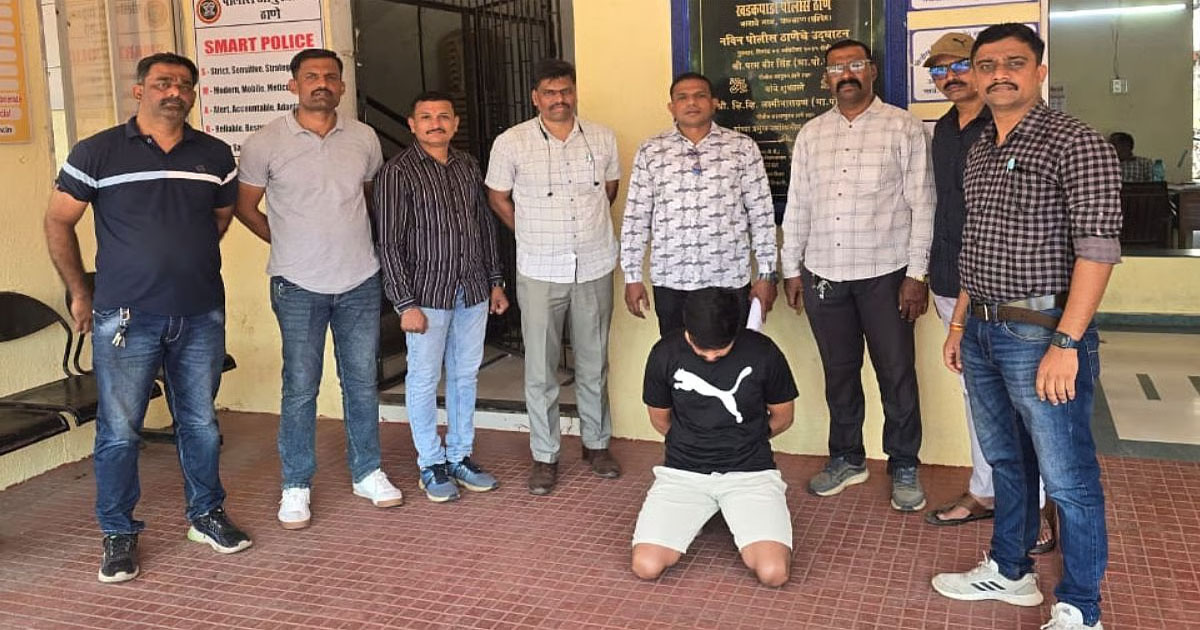
Kalyan, April 14: In a major breakthrough in the high-profile NESCO Centre drugs party case, Mumbai Police have arrested alleged drug supplier Anand Patel, a Kalyan-based businessman, following a late-night raid that turned into a tense hour-long standoff.
According to officials, the operation was carried out with the assistance of Khadakpada Police after Mumbai Police received specific intelligence that Patel was hiding at his residence in Kalyan West. A police team immediately rushed to the location and coordinated with local authorities to execute the arrest.
Senior officers, including Deputy Commissioner of Police (DCP) Atul Zende, were informed about the operation. Subsequently, a joint team led by Senior Police Inspector Amarnath Waghmode, along with officers Bhushan Devre, Kiran Shirke, Sanjay Chavan, Kundan Bhamre, and Suraj Khandale, reached the upscale Mohan Heights residential complex where Patel resides.
At the premises, police first encountered Patel’s father, Lakhan Patel, a businessman, who allegedly tried to mislead the officers by claiming that his son was not in Kalyan and had gone out of town. He also reportedly attempted to evade questioning, which further raised suspicion among the police team.
Acting on strong intelligence inputs, police escorted Lakhan Patel to the eighth-floor apartment. However, despite repeated knocking and instructions, the occupants refused to open the door. The situation soon escalated into a tense standoff, with police waiting outside for nearly an hour.
Officials made it clear that they would not leave without taking Patel into custody. Eventually, after continuous persuasion and intervention by his father, Anand Patel opened the door and was immediately detained by the police. Sources revealed that Patel had celebrated his birthday just two days earlier, and several relatives were present inside the house during the raid.
Following his detention, Khadakpada Police formally handed him over to Mumbai Police for further investigation in the NESCO drugs party case.
Preliminary investigation suggests that Patel, who claims to be a builder, played a key role in supplying drugs at the party. He is believed to have acted as a crucial link between the party organiser and drug suppliers. Police are now probing his wider network and suspect that he may have been involved in drug distribution activities in Kalyan and nearby areas as well.
Officials also stated that Patel’s father, Lakhan Patel, has multiple criminal cases registered against him, and his role, if any, will also be examined as part of the ongoing investigation. Further investigation is underway, and more arrests are likely as the probe deepens.
New Delhi, April 14: Indian agencies have reported a sharp rise in counterfeit currency seizures, pointing to a renewed push by organised networks to expand operations.
Investigators say the syndicate linked to Dawood Ibrahim, operating from Pakistan, is increasingly directing operatives in India to print fake notes locally instead of relying on cross-border smuggling routes through Pakistan and Bangladesh.
The trend points to a deliberate attempt to scale up production, with signs of a coordinated effort to undermine the Indian economy. Recent months have seen multiple seizures in border regions due to tighter security. At the same time, attempts to drop counterfeit currency using drones are being detected and intercepted with increasing frequency.
An Intelligence Bureau official said that the syndicate is now directing its operatives in India to print fake notes locally and circulate them within the market. They have been advised to keep operations small but frequent to maintain overall volume while avoiding attention.
“To reduce the risk of detection, members are also shifting bases regularly, making it difficult for agencies to track and pin down a single location,” the official added.
The route through the Bangladesh border has also become increasingly difficult for smugglers to use. Enhanced security measures have tightened surveillance, making it harder for operatives to push counterfeit currency into India.
Another official said the strategy now is to expand printing across multiple states, including Gujarat, Uttar Pradesh, Rajasthan, and Punjab. In the past, the syndicate had set up a localised unit in Malda, West Bengal, where high-quality counterfeit notes were produced and were difficult to detect.
“However, after the unit was uncovered, intensified action by agencies led to a sharp decline in operations,” the official said.
Another official said printing capacity in Malda has dropped by more than half after agencies, including the National Investigation Agency (NIA), intensified investigations and enforcement.
Officials added that efforts are underway to push in raw materials needed to set up fresh units to expand local production. If these consignments reach operatives in India, output could increase again. Even as the focus shifts to domestic printing, attempts to move counterfeit currency across the border using drones are expected to continue.
Last month, the Border Security Force (BSF) and Amritsar Police seized counterfeit currency worth Rs 2.5 lakh, which officials believe may have been a trial run. While drones have been intercepted carrying drugs, arms, and ammunition on several occasions, their use for moving fake currency has emerged as a growing concern.
Agencies said the syndicate is now relying on smaller consignments that are harder to detect on radar and surveillance systems. An official noted that operatives are adopting varied methods to increase the circulation of counterfeit notes.
Even as local production gathers pace, the use of drones is expected to continue. The broader objective, officials said, is to generate funds for terror activities and to inflict economic damage through the sustained circulation of fake currency.
Crime
Muslim Leaders Meet Mumbai Police Commissioner Deven Bharti, Seek Crackdown On Attackers Of Anti-Drug Campaigner; Demand Probe

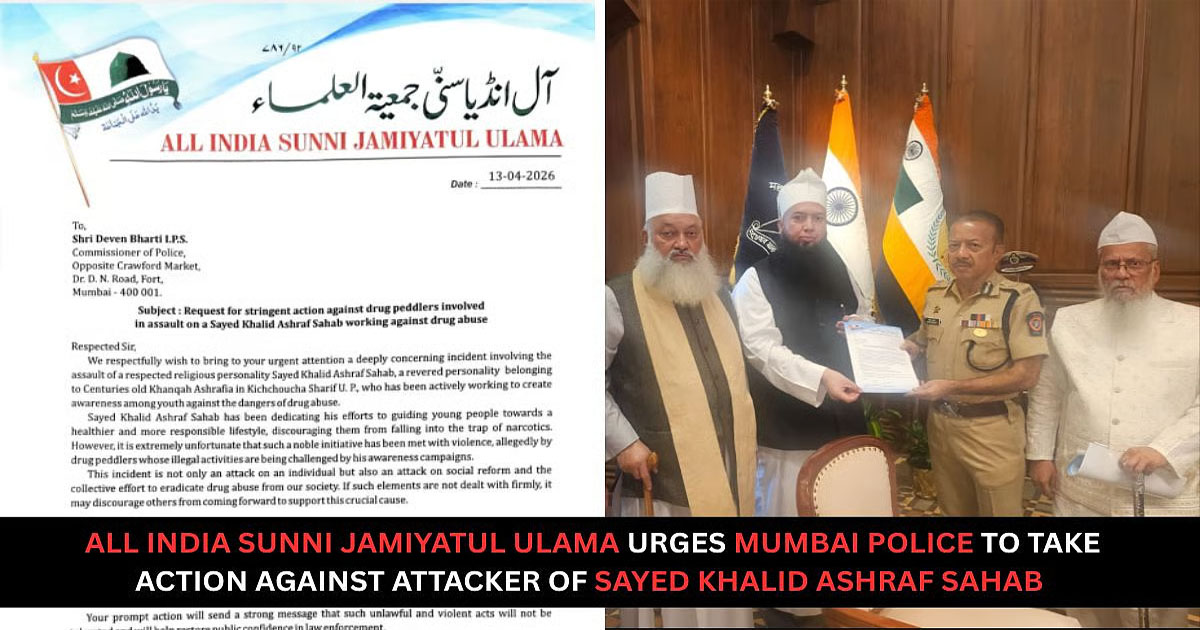
Mumbai: In a strong show of concern over rising drug-related threats, senior members of the All India Sunni Jamiyatul Ulama on Monday met Commissioner of Mumbai Police Deven Bharti, urging immediate and stringent action against drug peddlers allegedly involved in the assault on Sayed Khalid Ashraf Sahab, a religious figure known for his anti-drug awareness work.
The delegation, led by President Sayed Moinuddin Ashraf (Moin Miyan) and Vice President Mohammed Saeed Noori, submitted a formal letter highlighting the seriousness of the incident. They stressed that the attack was not merely targeted at an individual but posed a direct threat to ongoing efforts aimed at curbing drug abuse among youth.
According to the letter dated April 13, Sayed Khalid Ashraf Sahab, associated with the historic Khanqah Ashrafia in Kichchoucha Sharif, Uttar Pradesh, has been actively campaigning to steer young individuals away from narcotics and promote healthier lifestyles. His work, the delegation noted, has allegedly drawn hostility from those involved in illegal drug trade.
Calling the assault “deeply concerning,” the leaders warned that failure to act decisively could discourage social reformers and activists from continuing their efforts against substance abuse. They emphasised that such incidents undermine broader societal attempts to tackle the growing menace of drugs.
In their appeal, the delegation urged the Mumbai Police to initiate a swift and thorough investigation, identify and apprehend those responsible, and take exemplary action against drug peddlers operating in the area. They also sought adequate protection for individuals working on anti-drug initiatives, citing potential risks posed by criminal elements.
The representation further underlined that prompt police action would not only ensure justice in the present case but also reinforce public confidence in law enforcement agencies. It added that strong measures are essential to send a clear message that violence against those working for societal welfare will not be tolerated.
The incident has also raised serious concerns about the growing nexus between drug networks and intimidation tactics, particularly targeting those working at the grassroots to combat substance abuse. It underscores the urgent need for stronger enforcement, community protection measures, and sustained awareness efforts to ensure that individuals advocating for social reform are not silenced through fear or violence.

The Constitution of India has protected the oppressed and the Muslims. Abu Asim Azmi

Dr. Babasaheb Ambedkar, the creator of modern India, Governor Jashnudevarma’s address at Chetiya Bhoomi in Mumbai, tributes

NESCO Drugs Party Crackdown: Kalyan-Based Builder Arrested After Hour-Long Police Standoff

Dawood-linked fake currency syndicate goes local as border routes tighten

Muslim Leaders Meet Mumbai Police Commissioner Deven Bharti, Seek Crackdown On Attackers Of Anti-Drug Campaigner; Demand Probe

Dhurandhar 2 Box Office Collection Day 1: Ranveer Singh Starrer Takes An Exceptional Opening; Crosses ₹100 Crore Mark

Mumbai Police Busts Fake Apple Accessories Racket In Ghatkopar, ₹16.33 Lakh Goods Seized; Six Booked

Dhurandhar 2 Box Office Collection Day 9: Ranveer Singh Starrer Earns ₹41.55 Crore On Its Second Friday; Enters ₹700 Crore Club

Mumbai: 28-Year-Old Ghatkopar Woman Killed By Speeding Tanker While Crossing Road, Driver Arrested

Bharti Airtel Receives ₹1,74,000 Penalty Notice From DoT For Subscriber Verification Lapses
-

 Crime4 years ago
Class 10 student jumps to death in Jaipur
-

 Maharashtra2 years ago
Mumbai Local Train Update: Central Railway’s New Timetable Comes Into Effect; Check Full List Of Revised Timings & Stations
-

 Maharashtra2 years ago
Mumbai To Go Toll-Free Tonight! Maharashtra Govt Announces Complete Toll Waiver For Light Motor Vehicles At All 5 Entry Points Of City
-

 Maharashtra2 years ago
False photo of Imtiaz Jaleel’s rally, exposing the fooling conspiracy
-

 National News2 years ago
Ministry of Railways rolls out Special Drive 4.0 with focus on digitisation, cleanliness, inclusiveness and grievance redressal
-

 Maharashtra1 year ago
Maharashtra Elections 2024: Mumbai Metro & BEST Services Extended Till Midnight On Voting Day
-

 National News2 years ago
J&K: 4 Jawans Killed, 28 Injured After Bus Carrying BSF Personnel For Poll Duty Falls Into Gorge In Budgam; Terrifying Visuals Surface
-

 Crime2 years ago
Baba Siddique Murder: Mumbai Police Unable To Get Lawrence Bishnoi Custody Due To Home Ministry Order, Says Report